
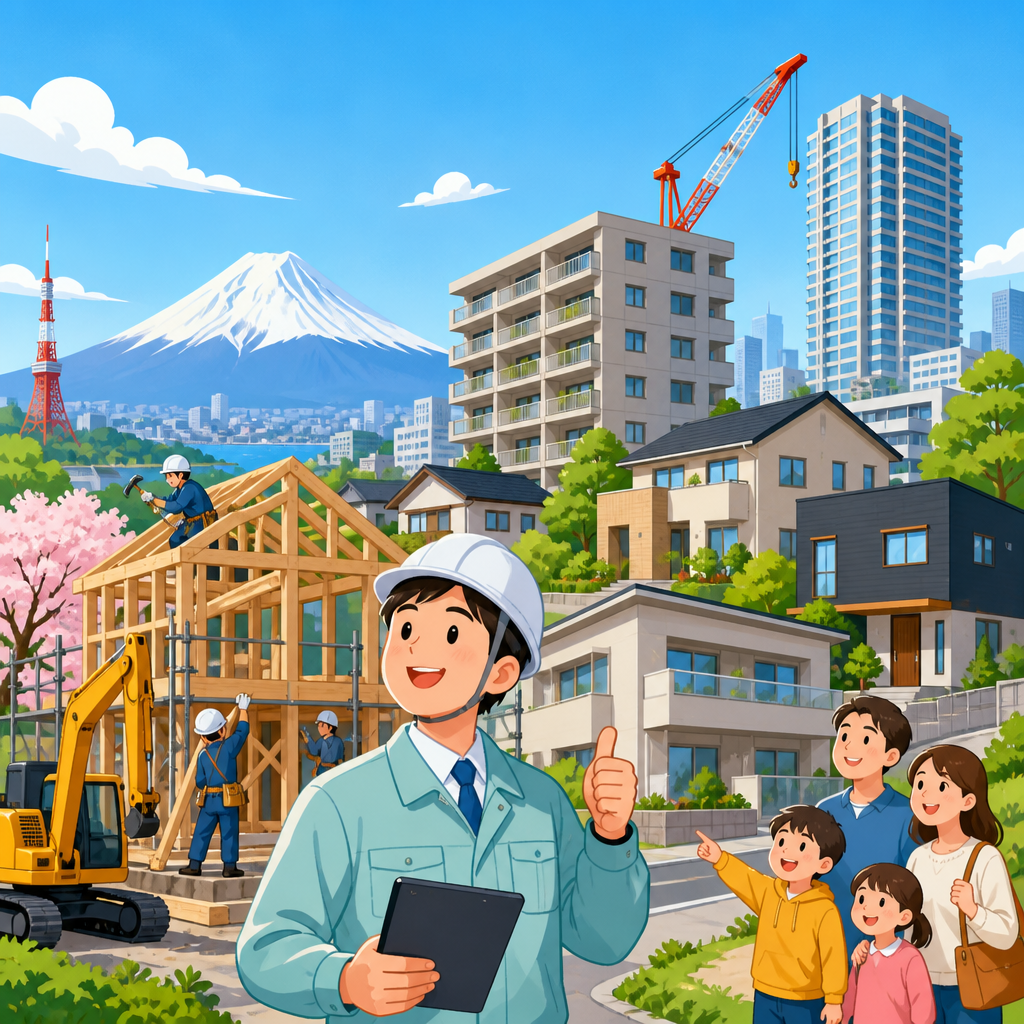
Japan builds more housing than many peer countries because its planning system, taxation, infrastructure delivery, and political economy make new construction easier, faster, and more routine. In practical terms, “housing supply” means the number of homes a market can add through new building, redevelopment, and conversion. “Peer countries” usually refers to other high-income democracies with mature urban economies, including the United States, the United Kingdom, Germany, France, Canada, Australia, and South Korea. The comparison matters because housing costs shape fertility, labor mobility, household wealth, inequality, and national productivity. When homes are scarce, workers cannot move to productive regions, young households delay family formation, and rent absorbs income that could otherwise support consumption or saving.
I have worked through zoning maps, redevelopment cases, and housing completions data across multiple countries, and Japan stands out for one reason above all: it treats housing as ordinary urban infrastructure rather than a scarce luxury asset to be protected from change. That does not mean Japanese housing is unregulated or universally cheap. Land in central Tokyo is expensive, construction costs can rise, and some shrinking regions face vacancy. Yet the national system consistently allows apartments, mixed-use buildings, and incremental redevelopment near jobs and transit. The result is high annual housing output by advanced-economy standards, especially in Greater Tokyo, the world’s largest metropolitan area.
Understanding why Japan builds more housing requires looking past stereotypes. It is not simply because the population is aging, because homes are smaller, or because standards are weaker. The real explanation lies in how national land-use law limits local obstruction, how broad zoning categories permit many building types, how transport investment opens land for development, and how tax and finance rules shape incentives. The lessons are useful far beyond Japan. Countries struggling with shortages can study the institutional design choices that make homebuilding more predictable, less politicized, and better aligned with demand.
National rules limit local veto power
The clearest reason Japan builds more housing than many peer countries is that land-use regulation is set far more at the national level. In countries such as the United States and the United Kingdom, local governments often exercise strong discretionary control over what can be built, where, and at what scale. That creates multiple veto points: neighborhood opposition, planning committees, design review boards, environmental appeals, and ad hoc negotiations over parking, setbacks, and affordable units. Each veto point adds time, uncertainty, and legal risk. Developers respond by building less, concentrating on luxury projects that can absorb delay, or abandoning projects entirely.
Japan’s framework is different. The City Planning Act and Building Standards Act establish nationwide categories and technical rules. Municipalities still implement plans, but they operate within a more standardized system. In practice, if a site is zoned for a use and a proposal meets floor-area ratio, height, setback, sunlight, fire safety, and road-access requirements, approval is much more predictable. That predictability matters as much as nominal density. A modest apartment building that can actually be approved is more valuable to supply than a theoretically dense plan trapped in years of discretionary review.
This structure also reduces the power of incumbent homeowners to block change lot by lot. Residents can object, but they generally cannot convert ordinary compliant projects into endless political battles. I have seen this difference repeatedly in comparative planning work: where permitting is rule-based, small and midsize builders stay active because they can estimate timelines and financing costs. Where permitting is discretionary, only large firms with legal budgets survive, and they build fewer units at higher price points.
Japan’s zoning is flexible, not exclusionary
Japan uses twelve main use zones, and even its lower-intensity residential zones allow more housing and more daily-life commerce than single-family zoning common in North America. This is a central but often misunderstood point. Japanese zoning is not a free-for-all. It is a hierarchy of permitted uses. If a use is allowed in a more restrictive zone, it is generally allowed in less restrictive zones as well. That simple structure broadens the geography where housing can be added.
For example, neighborhood shops, clinics, childcare centers, and apartments are commonly integrated into residential districts. Mid-rise multifamily housing is normal near stations and along commercial streets. Because many urban neighborhoods are mixed-use by default, adding homes does not require a complete remapping of land rights. Compare that with cities where large areas are reserved almost exclusively for detached houses on relatively large lots. In those systems, housing growth depends on politically difficult rezoning battles or fringe expansion.
Japan’s zoning also relies less on minimum parking mandates than many North American systems historically did. Near rail stations, developers can build for people who will walk, cycle, and ride transit instead of paying to excavate costly parking garages. Eliminating excessive parking lowers per-unit costs and frees space for more homes. In dense neighborhoods, one basement level devoted to parking can make the difference between a feasible project and one that never starts.
Transit and land development work together
Another reason Japan builds more housing is that rail and urban development are deeply integrated. Private railway companies have long combined transportation, retail, and real estate. Firms such as Tokyu, Seibu, Hankyu, and Odakyu did not simply run trains; they developed station areas, department stores, housing subdivisions, and commercial districts along their lines. This produced a durable pattern: transit creates access, access supports housing demand, and housing strengthens ridership.
Greater Tokyo demonstrates the effect at scale. Instead of concentrating growth in a tiny urban core while freezing surrounding neighborhoods, the metropolitan area channels housing into multiple subcenters connected by frequent rail. Shinjuku, Shibuya, Ikebukuro, Yokohama, Kawasaki, Omiya, Kichijoji, and many other hubs absorb jobs and residents. Because rail service is extensive and reliable, households can live in apartments and smaller homes without depending on multiple cars. That lowers both living costs and land consumption per household.
Integrated transport and housing policy also shorten political fights over “traffic impacts.” In many peer countries, neighbors oppose apartments because they assume every unit means more cars on constrained roads. In Japan, rail-rich locations make a different urban bargain possible. More housing near stations often means more fare revenue, stronger local retail, and manageable transport demand. The station area becomes the natural site for redevelopment rather than a battleground over parking spillover.
Redevelopment is continuous and incremental
Japan does not rely only on giant master-planned projects. A major share of housing supply comes from continuous replacement of older structures with newer, somewhat larger ones. Small detached houses are rebuilt. Low-rise buildings near stations become apartment blocks. Underused commercial sites become mixed-use projects. Because the process happens lot by lot and district by district, cities can add substantial supply without waiting for a few spectacular megaprojects.
This pattern is reinforced by the fact that buildings in Japan are often treated as depreciating assets rather than permanent stores of value. The market typically values the land more than the structure, especially for ordinary housing. As a result, demolishing and rebuilding can be financially rational. In countries where existing homes are expected to appreciate for decades and where renovation is favored over replacement, owners have stronger incentives to resist nearby supply that could moderate price growth.
Incremental redevelopment is not frictionless. Narrow streets, irregular parcels, and inherited plots can complicate assembly. Earthquake standards raise replacement costs. Still, the system regularly produces net additions. Over time, thousands of ordinary projects matter more than a handful of trophy towers.
| Factor | Japan | Common pattern in peer countries | Effect on housing output |
|---|---|---|---|
| Planning approvals | More rule-based | More discretionary | Lower delay and uncertainty |
| Zoning | Broader residential permissions | More exclusionary single-family areas | More sites can add homes |
| Transit | Rail-centered development | Car-oriented growth in many metros | Higher density near stations |
| Redevelopment | Frequent replacement of older buildings | Slower turnover of built stock | Steady incremental supply |
| Local opposition | Constrained by national rules | Often powerful in approvals | Fewer veto points |
Taxes and infrastructure support construction
Tax design influences whether land is held idle, underused, or redeveloped. Japan has often taxed land and buildings in ways that encourage active use, though the details create mixed incentives. Fixed asset taxes and city planning taxes apply to property, while inheritance tax pressures some families to sell or intensify land use rather than preserve large low-yield sites indefinitely. In metropolitan markets, that can bring parcels to market and support apartment construction.
Infrastructure provision also matters. Japanese cities generally have stronger utility and transit foundations in already urbanized areas, so adding homes does not always require massive greenfield expansion or bespoke public works. When roads, sewers, schools, and stations already exist, the marginal cost of more housing is lower. This is one reason infill and station-area redevelopment can proceed at significant scale.
By contrast, some peer countries socialize the politics of infrastructure while privatizing the risk of delay. Developers may be asked to negotiate impact fees, school contributions, road improvements, or affordable housing concessions project by project. Those obligations can be justified, but when combined with uncertain approvals they become another source of friction. Japan’s comparatively standardized environment makes feasibility easier to model, especially for repeat builders operating across many neighborhoods.
Construction norms keep supply responsive
Japanese housing output is also shaped by a construction sector accustomed to rebuilding and adapting. Standardized components, compact unit design, and repeated building typologies allow firms to deliver projects efficiently. This does not mean quality is poor. It means the market is organized around frequent production. National building codes, including strict seismic standards updated after major earthquakes, create technical clarity. Builders know the rules, engineers know the calculations, lenders know the product, and buyers know what they are getting.
Housing preferences play a role as well. Apartments are socially normal for families in large metropolitan areas. Smaller dwellings, narrow urban lots, and attached or closely spaced buildings are widely accepted. In countries where political culture strongly idealizes detached houses with parking on quiet streets, demand for urban apartments can still be high, but regulation often lags behind reality. Japan’s norms are better aligned with land scarcity in major cities.
Importantly, responsiveness does not mean oversupply everywhere. Some regional markets have shrinking populations and high vacancy, known as akiya. That is the flip side of a system willing to let housing stock turn over. The lesson is not that every place should build indiscriminately. It is that strong supply in high-demand metros can coexist with decline elsewhere, and policy must distinguish between those contexts rather than imposing blanket scarcity.
What other countries can realistically learn
Japan is not a template that can be copied wholesale. Its legal traditions, rail networks, parcel patterns, and postwar development path are distinctive. Still, several lessons travel well. First, standardize approvals and reduce discretionary review for code-compliant housing. Second, allow apartments and mixed-use buildings in far more urban neighborhoods, especially near transit and job centers. Third, remove excessive parking requirements that inflate costs and suppress density. Fourth, coordinate transport and land use so that more homes mean better access rather than more congestion.
Policymakers should also focus on the “missing middle”: duplexes, courtyard apartments, small multifamily buildings, and mid-rise blocks that fit ordinary streets. Japan produces these forms routinely. In many peer countries, rules either permit only detached houses or push toward expensive high-rise projects that trigger intense opposition. The middle is where resilient supply often lives.
There are tradeoffs. Faster building can generate demolition waste, strain schools if planning is poor, and create localized disruption. National rules can overlook local design concerns. Tenant protections and social housing still matter, because supply alone does not solve every affordability problem. But the core fact remains: when cities make it normal to add homes, they get more homes. Japan proves that this is an institutional choice, not an economic miracle.
Japan builds more housing than many peer countries because it has assembled a system that consistently favors production over scarcity. Nationally standardized land-use rules reduce uncertainty. Flexible zoning allows apartments and mixed-use neighborhoods across a wide urban geography. Rail networks and real estate development reinforce each other. Incremental redevelopment adds units year after year. Tax, infrastructure, and construction norms support feasibility instead of layering on endless local veto points.
The broader benefit is not abstract. More abundant housing helps workers live near opportunity, helps families find homes that match changing needs, and helps metropolitan economies grow without turning every move into a bidding war. Japan still faces affordability pressures in its hottest districts and vacancy in weaker markets, so it is not a utopia. Yet compared with countries that chronically underbuild, it shows what happens when housing is treated as a standard urban good that cities must continuously supply.
For anyone working in urban planning and policy, the practical takeaway is simple: study the rules that shape routine projects, not just flagship developments. If your city wants lower housing costs and greater resilience, start by asking where approvals are uncertain, where zoning is exclusionary, and where transit-rich land is being underused. Then reform those bottlenecks deliberately. The places that build enough homes are usually the places that make homebuilding ordinary.
Frequently Asked Questions
Why does Japan build more housing than many other wealthy countries?
Japan tends to produce more housing because the rules and incentives around development are generally more permissive, more predictable, and more routine than in many peer countries. In broad terms, housing supply refers to how many homes a market can add through new construction, redevelopment of older sites, and conversion of existing buildings. Japan’s system supports all three. Its zoning framework is relatively flexible, approval processes are often clearer and less discretionary, and local opposition has less ability to stop projects outright once they fit the rules. That lowers uncertainty for builders, landowners, lenders, and homebuyers.
Another major reason is that housing in Japan is often treated as ordinary urban infrastructure rather than as a rare exception requiring prolonged political conflict. Cities can add apartments near stations, replace low-intensity buildings with taller ones, and rebuild aging structures on a regular basis. Infrastructure provision, such as rail access and utility connections, has historically worked in tandem with urban growth instead of lagging far behind it. On top of that, tax and land-use institutions tend to encourage redevelopment instead of strongly rewarding underuse. The result is not that Japan has no housing problems, but that it is structurally better positioned to keep adding homes at a meaningful pace.
How is Japan’s planning and zoning system different from those in countries like the United States or the United Kingdom?
One important difference is that Japan’s land-use system is typically more rules-based and less vulnerable to highly discretionary, project-by-project political bargaining. In many peer countries, especially in parts of the United States and the United Kingdom, developers may face a long sequence of local hearings, negotiations, appeals, and lawsuits before a project can move ahead. Even when housing is technically allowed, uncertainty about height, design, parking, neighborhood objections, environmental review, or political approval can make new construction slow, risky, and expensive. That uncertainty reduces the number of projects that ever reach completion.
Japan’s approach, while still regulated, is often more standardized. Zoning categories usually permit a wider mix of uses than rigid single-use systems common elsewhere, and there is often more room for housing to be built in established urban areas. If a proposed building conforms to the applicable rules, it is less likely to be blocked by open-ended local discretion. This matters enormously for supply because builders respond not only to whether homes are legal in theory, but also to whether they can realistically secure permission in practice. A system that makes redevelopment more normal and more predictable will generally generate more housing over time than one that turns each project into a political battle.
What role do taxes and land economics play in Japan’s housing supply?
Taxes and land economics shape how attractive it is to hold land idle versus improve it, and Japan has historically maintained conditions that make active use and redevelopment more feasible. In many constrained housing markets, landowners can benefit from scarcity: if zoning is tight and approvals are hard to obtain, simply holding developable land can become highly profitable. That can discourage timely construction and amplify price increases. When added housing is difficult to deliver, the value of permission itself rises, pushing up costs and rewarding delay, speculation, or low-intensity use in high-demand areas.
Japan’s system has generally made it easier to convert land value into actual homes. Because development is more achievable, the market can respond more readily to demand. Older buildings are also frequently replaced rather than preserved indefinitely as fixed assets. In Japan, structures are often understood to depreciate faster than land, which supports a redevelopment cycle where rebuilding is normal. That does not mean taxes alone explain everything, but they interact with planning rules, financing, and market expectations in ways that make supply more elastic. In simpler terms, when institutions do not excessively protect scarcity, land can be used more intensively and housing can be added more consistently.
Does Japan’s transportation and infrastructure system make it easier to build housing?
Yes. Japan’s transportation network, especially its extensive rail systems, plays a central role in supporting housing growth. In many metropolitan areas, development is closely linked to train stations and transit corridors, which creates clear, practical locations where additional housing can be absorbed. When households can rely on rail for commuting and daily mobility, cities do not need to organize as much growth around large amounts of road space and parking. That makes denser residential construction more workable and reduces one of the major constraints that often limits housing production in car-dependent urban systems.
Infrastructure delivery also matters because housing is easier to build when public and private systems are aligned. In some peer countries, growth is slowed by fragmented governance, delayed utility upgrades, weak transit coordination, or political resistance to expanding services alongside new homes. Japan has often been better at integrating urban expansion, station-area development, and service provision. This does not mean every project is simple or every region grows smoothly, but it does mean that the basic urban framework is more supportive of continual additions to the housing stock. When transit, utilities, and land-use rules complement one another, new housing becomes less exceptional and more routine.
Does building more housing in Japan mean it has solved affordability and housing shortages completely?
No. Building more housing does not eliminate every housing problem, and Japan still faces major regional differences, demographic shifts, and market pressures. Tokyo and other large metropolitan areas can still be expensive, and not every household experiences the market in the same way. Construction volumes alone do not determine affordability; incomes, location, household size, construction quality, land prices, and interest rates all matter too. In addition, some parts of Japan face the opposite challenge: population decline, vacant homes, and weak demand rather than scarcity.
What distinguishes Japan is not perfection but relative responsiveness. Compared with many peer countries, it has often been better able to add homes when and where demand exists, especially in major urban regions. That greater responsiveness can reduce the intensity of price spikes and relieve pressure that would otherwise accumulate if supply stayed fixed. The broader lesson is that housing outcomes depend heavily on institutions. When planning systems, taxation, infrastructure delivery, and political incentives make building easier, cities can adapt more readily to economic change. Japan shows that in a high-income democracy, large-scale housing production is not impossible; it is the product of rules that make growth normal rather than exceptional.


