
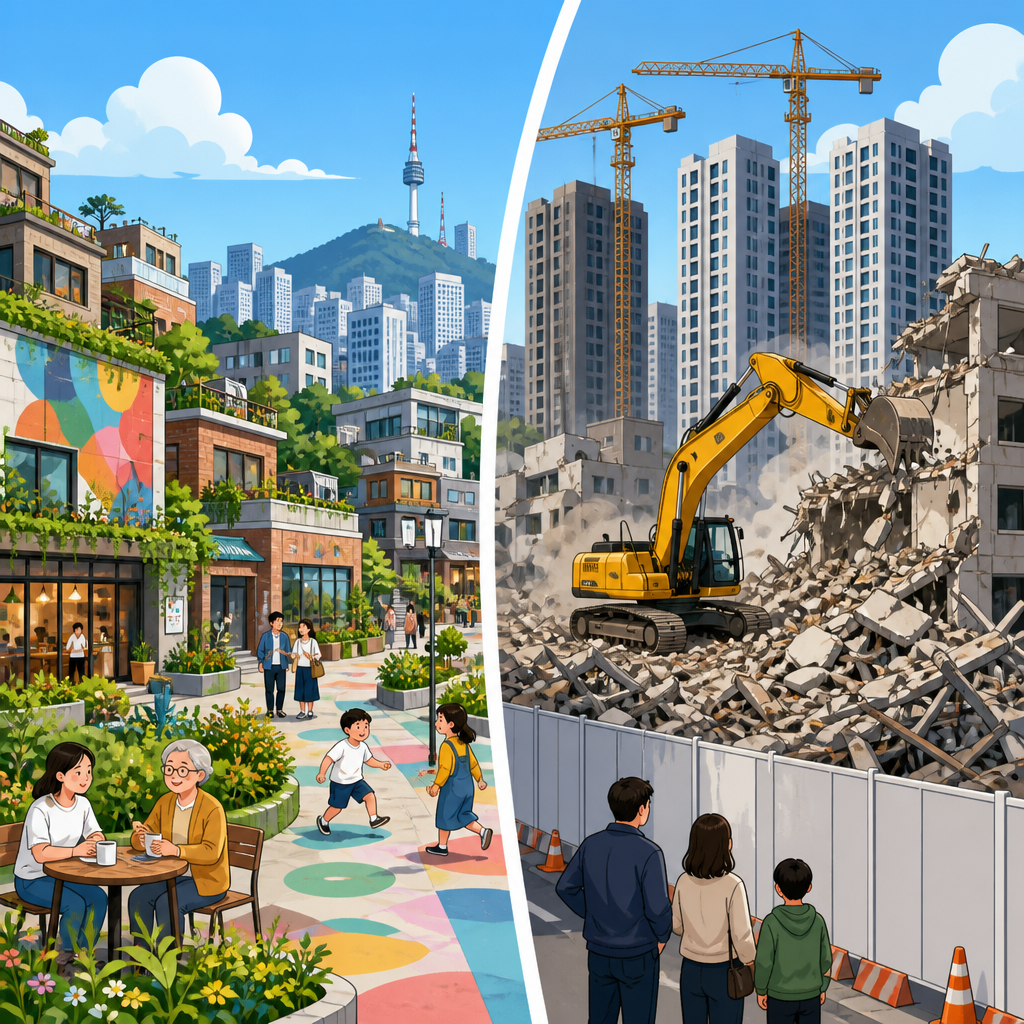
Seoul’s urban regeneration strategy compared with demolition-led redevelopment reveals two distinct ways of reshaping a dense global city: one focuses on repairing neighborhoods while people remain, and the other replaces aging districts through clearance, reconstruction, and large-scale capital investment. In planning practice, urban regeneration usually means improving a place’s physical environment, local economy, public space, housing quality, and social fabric without treating demolition as the default solution. Demolition-led redevelopment, by contrast, typically assembles land, clears existing structures, relocates residents and businesses, and delivers new apartment towers, road layouts, and commercial floor area at higher densities. In Seoul, this distinction matters because the city has lived through both models across different political periods, market cycles, and housing pressures.
I have worked with regeneration case studies and redevelopment reviews in East Asian cities, and Seoul stands out because its policy evolution is unusually visible on the ground. A single subway ride can pass restored historic fabric, upgraded low-rise neighborhoods, megablock apartment complexes, and riverfront spaces that reflect different planning doctrines. The central question is not whether one model is always right. It is which model solves which urban problem with the least social cost and the greatest long-term public value. For policymakers, residents, researchers, and investors, the comparison matters because land is scarce, housing demand remains intense, and neighborhood change can either preserve community capacity or erase it.
Any serious comparison must define the terms precisely. Urban regeneration in Seoul has included small-scale housing repair, public realm upgrades, adaptive reuse, community facilities, local business support, conservation of cultural assets, and targeted infrastructure renewal. It is usually associated with place-based intervention, resident participation, and incremental improvement. Demolition-led redevelopment has usually involved statutory redevelopment districts, developer consortia, construction firms, compensation frameworks, and replacement housing in high-rise form. It can produce major increases in floor area ratio, modern building safety, and infrastructure efficiency, but it also raises familiar concerns: displacement, loss of affordable small business space, embodied carbon from demolition, and the homogenization of urban character.
Seoul’s experience is important beyond Korea because many mature cities face the same decision. What should happen to aging housing stock built quickly during industrialization? How should governments upgrade vulnerable neighborhoods without freezing them in decline? When does preservation become neglect, and when does redevelopment become social extraction? Seoul offers a practical policy laboratory because it has tried both strategies at scale. The city’s shift from aggressive clearance toward broader regeneration was not ideological branding alone. It responded to public criticism, uneven redevelopment benefits, the limits of speculative real estate growth, and the recognition that urban vitality depends on more than new towers.
How Seoul Moved From Clearance to Regeneration
Postwar Seoul urbanized at extreme speed. Large parts of the city developed through informal settlement, rapid subdivision, and later apartment-led reconstruction. For decades, demolition-led redevelopment aligned with national growth priorities: increase housing supply, modernize infrastructure, and convert low-rise districts into higher-value urban land. This approach produced visible results. Many residents moved from substandard or structurally obsolete housing into modern apartments with elevators, district heating, parking, and stronger seismic and fire performance. Major redevelopment also enabled wider roads, utility replacement, and coordinated site planning that piecemeal improvement often cannot deliver.
Yet the social costs accumulated. Tenants and small merchants had weaker bargaining power than property owners. Compensation systems often favored asset holders while renters absorbed relocation costs. Traditional street networks and fine-grained commercial ecosystems disappeared. As I have seen in comparable projects, once a district is cleared, the city does not just lose old buildings; it loses supplier relationships, footfall patterns, informal care networks, and entry-level business space. In Seoul, criticism sharpened around neighborhoods where redevelopment stalled, leaving uncertainty for years, and around completed projects that improved land values but weakened community continuity. By the 2010s, a stronger policy vocabulary around regeneration emerged, supported by metropolitan initiatives and national urban regeneration programs.
Seoul’s regeneration turn did not mean ending redevelopment altogether. It meant broadening the toolkit. Instead of treating low-rise aging neighborhoods as blank slates, the city increasingly considered block-level rehabilitation, public investment in alleys and utilities, cultural programming, social economy support, and reuse of existing structures. Programs linked physical upgrades with local governance, including resident councils and partnership models. The key planning insight was that urban decline is usually multidimensional. A deteriorating neighborhood may suffer from old buildings, yes, but also from aging demographics, weak retail demand, inaccessible public space, and fragmented ownership. Total demolition only solves some of those problems.
What Urban Regeneration Looks Like in Seoul
In Seoul, urban regeneration is best understood as a layered intervention rather than a single project type. It can include façade and roof repair grants, retrofitting for insulation and safety, alley improvements, wayfinding, public stair upgrades on steep hillsides, pocket parks, maker spaces, youth entrepreneurship support, and cultural heritage programming. Well-known examples such as the Sewoon area’s incremental reactivation and parts of Seochon and Euljiro show the logic clearly: preserve working urban fabric where possible, improve basic conditions, and support existing economic ecosystems instead of clearing them preemptively. The objective is not nostalgia. It is to retain productive complexity while addressing decline.
This strategy works especially well where buildings are structurally serviceable, parcel patterns support small enterprises, and historic identity contributes to local value. In districts with workshops, printing businesses, specialized supply chains, or tourism-linked heritage streets, regeneration can protect an economic base that tower redevelopment would destroy. It also allows public agencies to phase spending, test uses, and adapt plans based on resident feedback. In my experience, that flexibility is one of regeneration’s strongest advantages. A city can repair drains, widen a stair, convert a vacant building into a community hub, and improve storefront conditions without forcing every owner into a single all-or-nothing timetable.
Regeneration still requires discipline. Without code enforcement, financing support, and anti-displacement measures, it can become cosmetic urbanism: nicer paving over deeper inequality. Successful regeneration in Seoul has depended on coordinated governance, including the Seoul Metropolitan Government, district offices, housing agencies, designers, and local groups. It also requires measurable objectives. A serious regeneration program should track vacancy, rent pressure, pedestrian safety, resident age profile, business survival, and maintenance quality, not just visitor numbers or social media visibility.
How Demolition-Led Redevelopment Operates
Demolition-led redevelopment in Seoul follows a more capital-intensive and legally structured pathway. Aging districts are designated, ownership interests are consolidated through associations or public mechanisms, compensation is negotiated, residents relocate, existing buildings are cleared, and the site is rebuilt at larger scale. The result is often high-rise apartment clusters with standardized unit plans, underground parking, landscaped open space, and modern utility systems. For families seeking reliable building performance and for governments under pressure to expand housing stock in a constrained city, this model remains attractive.
The strongest argument for demolition-led redevelopment is straightforward: some urban problems are too severe for patchwork repair. Buildings may be structurally unsound, lots may be too small for code-compliant modernization, road access may be inadequate for emergency vehicles, and fragmented underground infrastructure may be beyond economical retrofit. In such conditions, comprehensive redevelopment can produce safer housing and substantial net new supply. Seoul’s large reconstruction and redevelopment projects have also helped create school capacity, transit-linked density, and higher tax bases that fund municipal services.
The weaknesses are equally clear. Redevelopment takes time, often many years, and uncertainty can freeze neighborhood maintenance before construction even begins. Tenants are commonly the least protected group. Small industrial and retail users struggle to return because replacement rents are higher and unit formats are less flexible. Urban form can become repetitive, with superblocks and tower compounds replacing fine-grained streets. From a climate perspective, demolition wastes embodied carbon in existing structures unless materials are carefully salvaged, which is still less common than it should be.
Direct Comparison: Outcomes, Tradeoffs, and Policy Fit
The practical question is not abstract preference but policy fit. Urban regeneration is usually better for socially embedded neighborhoods where physical decline is real but not terminal, where local businesses depend on affordable small premises, and where cultural identity is itself an economic asset. Demolition-led redevelopment is stronger where life-safety risk is high, infrastructure failure is severe, and substantial housing intensification is needed near major transit. The best planners in Seoul understand that these conditions can exist only a few blocks apart.
| Criterion | Urban regeneration | Demolition-led redevelopment |
|---|---|---|
| Primary goal | Upgrade in place and preserve community fabric | Replace obsolete fabric and maximize comprehensive rebuilding |
| Resident disruption | Lower, often phased | High, usually requires relocation |
| Housing supply gain | Limited to moderate | Moderate to high |
| Speed of visible change | Faster in small interventions | Slower upfront, dramatic at completion |
| Impact on local businesses | Can preserve existing ecosystems | Often displaces lower-rent firms and merchants |
| Heritage retention | High potential | Usually low unless specifically mandated |
| Carbon implications | Generally lower embodied carbon loss | Higher demolition-related carbon costs |
Measured against equity, regeneration usually performs better because it reduces forced displacement and can spread benefits across owners, tenants, and local firms if designed well. Measured against raw housing output, redevelopment usually wins. Measured against urban character, regeneration has the edge. Measured against total system replacement, redevelopment is more efficient. That is why Seoul’s policy debate should never be framed as old versus new. It is a governance question about sequencing, compensation, design standards, and neighborhood typology.
What Seoul Should Take Forward
Seoul’s most durable lesson is that cities need a calibrated portfolio, not a single doctrine. Regeneration should be the first test in neighborhoods with recoverable building stock, viable street commerce, and strong social networks. Redevelopment should be reserved for places where safety, infrastructure, and density objectives cannot be met otherwise. The city also needs firmer tenant protections, relocation support for merchants, and value-capture mechanisms that return part of redevelopment windfalls to the public realm. Without those safeguards, redevelopment can deepen inequality even when it improves physical conditions.
Better evaluation is equally important. Every project should be judged on more than completion. Did original residents return? Did small businesses survive within a reasonable radius? Did energy performance improve? Did public space become more usable year-round? Did the intervention strengthen local identity or simply replace it with generic real estate product? Seoul has the institutional capacity to ask and answer these questions through longitudinal monitoring, cadastral analysis, business registry data, and resident surveys. It should use that capacity systematically.
For urban planning and policy, Seoul offers a clear conclusion. Urban regeneration is not a softer substitute for redevelopment; it is a distinct strategy for protecting social and economic complexity while modernizing the city. Demolition-led redevelopment is not inherently harmful; it is a powerful but blunt instrument that should be applied selectively, transparently, and with stronger public safeguards. The real advantage comes from matching tool to context. If you are studying urban planning and policy, use Seoul as a framework for evaluating neighborhood change: start with safety, community continuity, economic function, carbon cost, and housing need, then decide whether to repair, adapt, or rebuild.
Frequently Asked Questions
What is the main difference between Seoul’s urban regeneration strategy and demolition-led redevelopment?
The main difference is the logic of change. Seoul’s urban regeneration strategy generally starts from the idea that an existing neighborhood has value even if its buildings, infrastructure, or local economy need improvement. In practice, that means upgrading streets, public spaces, housing conditions, community facilities, small-business environments, and social services while trying to keep the area’s residents, businesses, and everyday networks in place. The goal is to repair and strengthen the neighborhood rather than erase it.
Demolition-led redevelopment works in a very different way. It usually treats aging districts as sites for replacement. Older buildings are cleared, land is consolidated, and new high-density residential or mixed-use complexes are constructed through large-scale capital investment. This model can produce dramatic physical transformation, newer housing stock, and significant increases in floor area, but it often comes with displacement, rising land values, and disruption to long-standing communities and small commercial ecosystems.
In a dense city like Seoul, the distinction matters because it shapes who benefits from urban change. Regeneration tends to emphasize continuity, incremental improvement, and community-based revitalization. Demolition-led redevelopment emphasizes restructuring, efficiency, and real estate value creation through comprehensive rebuilding. Both approaches aim to address urban decline or obsolescence, but they differ sharply in their treatment of existing residents, urban heritage, local identity, and the pace and scale of transformation.
Why did Seoul begin to place more emphasis on urban regeneration instead of relying only on clearance and rebuilding?
Seoul’s greater emphasis on urban regeneration emerged from practical, social, and political realities. For decades, demolition-led redevelopment was a powerful tool for modernizing the city, replacing substandard housing, and creating new infrastructure and apartment districts. However, over time, the limits of that model became more visible. Entire communities could be uprooted, tenants and lower-income households often struggled to return after reconstruction, and older neighborhoods with strong local identity were sometimes lost in the process. This raised concerns not only about housing justice, but also about the social cost of rebuilding the city through repeated cycles of clearance.
Urban regeneration gained traction as policymakers recognized that many neighborhoods did not need complete replacement to improve living conditions. Some areas needed safer streets, better transit access, repaired buildings, upgraded utilities, support for local merchants, cultural programming, or social welfare investments more than they needed wholesale demolition. Regeneration offered a more flexible planning framework for dealing with mixed urban conditions, especially in built-up districts where total reconstruction was expensive, contentious, or unnecessarily disruptive.
There was also a broader shift in how urban success was being defined. Rather than measuring progress only by new construction, planners increasingly looked at quality of life, community resilience, heritage preservation, economic inclusion, and public participation. In that context, regeneration became attractive because it allowed Seoul to pursue improvement without automatically assuming that aging neighborhoods were failures to be removed. It reflected a more mature urban policy approach: one that sees existing places as assets that can be renewed, not just obstacles to redevelopment.
How does urban regeneration affect residents and local businesses differently from demolition-led redevelopment?
Urban regeneration generally aims to reduce disruption for residents and local businesses by improving conditions while everyday life continues as much as possible. When done well, it can preserve social networks, school ties, customer relationships, and neighborhood identity. Residents may benefit from better public spaces, improved housing safety, upgraded infrastructure, community services, and new local economic opportunities without facing immediate relocation. Small businesses, which are often highly dependent on walk-in customers and neighborhood loyalty, may also have a better chance of surviving when change is gradual rather than sudden.
By contrast, demolition-led redevelopment often creates a much more disruptive transition. Residents may be forced to move out during clearance and reconstruction, and many cannot return because new units are more expensive or eligibility rules are difficult to meet. Renters are especially vulnerable, since redevelopment systems historically tend to protect owners more strongly than tenants. For local businesses, the disruption can be equally severe. If an entire district is cleared, the commercial ecosystem that supported neighborhood shops, food vendors, repair services, and informal local networks can disappear for years, if not permanently.
That said, regeneration is not automatically equitable. If upgrades make an area more attractive without strong tenant protections, rent pressures and commercial displacement can still follow. A regenerated neighborhood can become more desirable, and that success can trigger forms of gentrification if policy safeguards are weak. So the real policy question is not simply whether regeneration is gentler than demolition-led redevelopment, but whether it is designed with affordability, tenant stability, and support for existing businesses built into the process. In Seoul’s case, this is one of the most important tests of whether regeneration truly benefits current communities rather than just preparing an area for future market upgrading.
What are the biggest advantages and drawbacks of each approach in a dense global city like Seoul?
Urban regeneration’s biggest advantage is that it can improve a neighborhood without destroying its social and physical fabric. In a dense city, that is extremely valuable because neighborhoods are not just collections of buildings; they are complex systems of mobility, commerce, memory, and community life. Regeneration can preserve fine-grained streetscapes, older small-business districts, and local identity while still addressing poor housing conditions, declining public space, and economic stagnation. It is often better suited to places where the urban fabric still functions but needs reinvestment and repair.
Its drawbacks are equally important to acknowledge. Regeneration can be slower, less visually dramatic, and harder to scale than comprehensive rebuilding. Because it often works through coordination among many actors, including local government, residents, business owners, and community groups, implementation can be uneven. Physical improvements may also be limited where building conditions are severely deteriorated or ownership patterns are fragmented. In some cases, regeneration may not be enough to resolve deep structural problems such as obsolete infrastructure, seismic or fire safety concerns, or extreme housing inadequacy.
Demolition-led redevelopment offers different strengths. It can produce major physical transformation quickly, increase housing supply in high-demand areas, modernize infrastructure comprehensively, and generate substantial investment. In a city facing land scarcity and pressure for vertical growth, these are powerful advantages. New developments can also meet contemporary building standards more easily and support transit-oriented density at a large scale.
But those benefits often come with serious costs. Comprehensive clearance can erase local heritage, displace vulnerable populations, standardize urban form, and prioritize property value gains over social continuity. It may create modern housing, yet weaken the mixed-use, small-scale urban character that makes many Seoul neighborhoods vibrant and economically adaptive. In short, regeneration is often stronger at preserving place, while redevelopment is often stronger at producing large-scale reconstruction. The planning challenge is knowing which tool fits which urban condition, rather than treating one model as universally superior.
Is Seoul’s urban future likely to depend on regeneration, redevelopment, or a combination of both?
Seoul’s urban future is most likely to depend on a combination of both, but with a more selective and strategic use of demolition-led redevelopment than in the past. A city as dense, mature, and complex as Seoul cannot rely on a single method of urban change. Some neighborhoods are structurally sound and socially valuable but need targeted public investment, housing repair, mobility upgrades, and economic revitalization. Those places are strong candidates for regeneration. Other sites may face such severe physical obsolescence, infrastructure limitations, or redevelopment pressures that more comprehensive rebuilding remains necessary.
The key issue is not whether one approach completely replaces the other, but how the city decides where each approach is appropriate and how it manages the social consequences. Increasingly, the strongest planning frameworks are hybrid. They combine physical upgrading with affordability protections, public participation, local business support, heritage sensitivity, and environmental goals. Even where redevelopment occurs, there is growing pressure to reduce displacement, improve tenant protections, provide fairer relocation measures, and preserve elements of neighborhood identity.
For Seoul, this balanced approach is especially important because the city is no longer simply expanding; it is constantly negotiating how to renew itself while remaining livable, inclusive, and competitive. Urban regeneration reflects a recognition that older neighborhoods can be improved without being erased. Demolition-led redevelopment reflects the continuing reality that some urban areas require complete reconstruction. The long-term success of Seoul’s strategy will depend on its ability to match the right intervention to the right place while ensuring that urban improvement does not come at the expense of the people and communities that give the city its character.


