
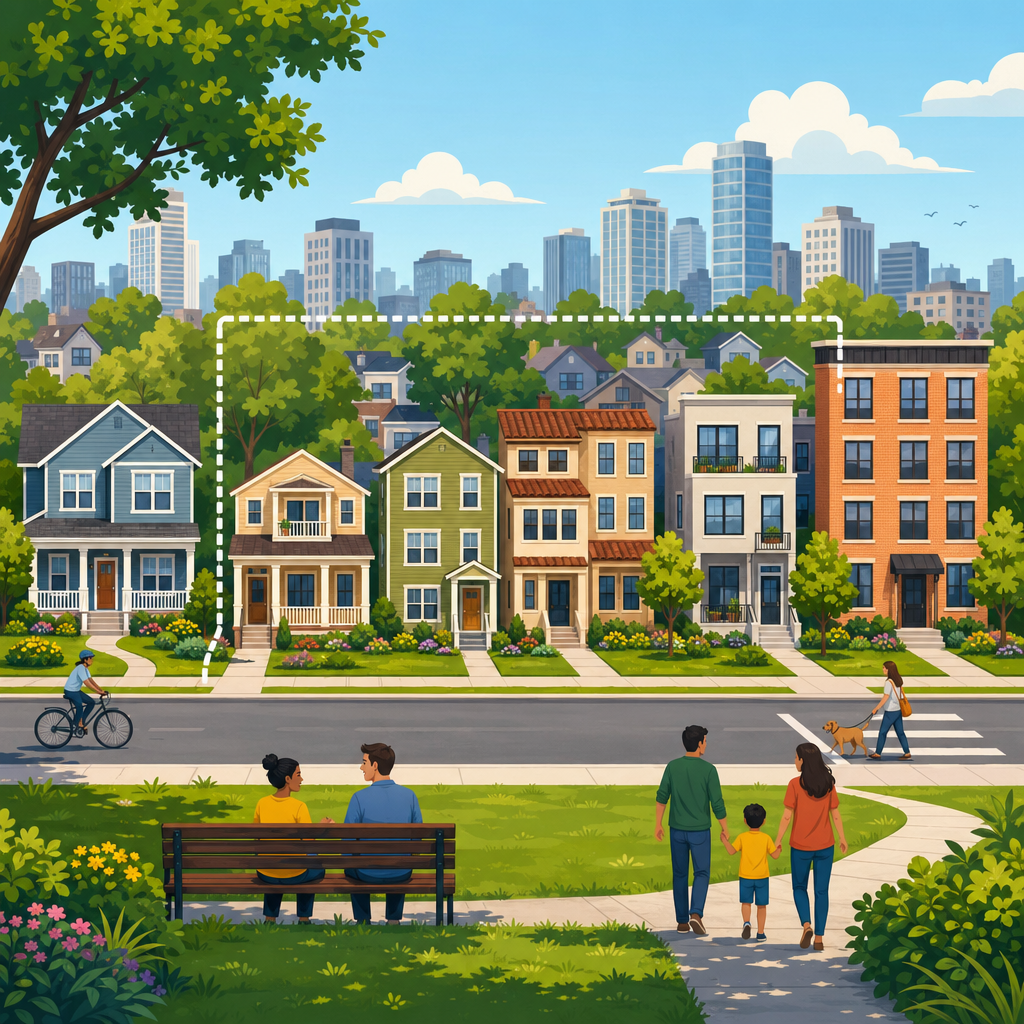
Missing middle housing describes a range of homes that sit between a detached single-family house and a large apartment block. The category usually includes duplexes, triplexes, fourplexes, townhouses, cottage courts, courtyard apartments, multiplexes, and small live-work buildings. These forms were common in many North American neighborhoods before postwar zoning codes separated land uses and sharply limited residential density. Today the term matters because it connects physical design, local land-use policy, and one of the hardest problems in the housing market: how to add homes ordinary households can actually afford.
In practice, missing middle housing is not a style. It is a scale. These buildings are generally house-sized or only slightly larger, fit on standard lots, and blend into walkable neighborhoods while accommodating more households than one-home-per-lot rules allow. I have worked with zoning maps, site plans, and pro formas for infill projects, and the pattern is consistent: where a city permits only detached homes, land costs are spread across one unit, which pushes prices up. Where the same parcel can hold several modest homes, the land cost per household falls, and the project can pencil out without requiring a high-rise.
Affordability, in this context, does not simply mean subsidized rent. It usually refers to housing costs that consume no more than 30 percent of gross household income, a benchmark used by the U.S. Department of Housing and Urban Development. Missing middle housing matters because it can expand the supply of lower-cost homes in high-opportunity neighborhoods near jobs, schools, and transit. It also diversifies tenure options, creating paths for renters, first-time buyers, older adults, and multigenerational families. For cities facing rising rents, home price escalation, and displacement pressure, understanding missing middle housing is essential because it offers a practical middle path between preserving neighborhood character and allowing enough homes to meet demand.
What Counts as Missing Middle Housing
Missing middle housing includes compact, multi-unit forms that are compatible in scale with detached-house neighborhoods. A duplex places two homes in one building. A triplex or fourplex increases that count while often retaining a residential appearance. Townhouses place several fee-simple homes side by side with separate entries. Cottage courts cluster small detached homes around shared open space. Courtyard apartments place a modest number of units around a central court, creating privacy and community at the same time. Small apartment houses with six to twelve units may also fit the category when they are low-rise and walk-up in form.
The key point is that these types deliver moderate density, often in the range of roughly 12 to 35 homes per acre, though local site conditions vary. That density is high enough to support frequent transit, neighborhood retail, and better infrastructure efficiency, yet low enough to fit within established residential areas. From a construction standpoint, many missing middle projects use wood-frame methods rather than expensive concrete or steel systems required by taller buildings. That matters for cost. Once a project crosses certain height, fire code, elevator, and structural thresholds, per-unit costs typically increase significantly. Smaller building forms can avoid some of those jumps.
These housing types are called missing because many communities effectively stopped producing them. Early twentieth-century neighborhoods in cities such as Portland, Chicago, Washington, and Montreal still contain fourplexes over corner stores, bungalow courts, and rowhouses woven among detached homes. Later zoning rewrote that pattern. Large minimum lot sizes, parking mandates, setback rules, floor-area limits, and outright bans on multifamily homes made middle-scale buildings difficult or impossible to build. The result was a polarized market: either a single detached home on expensive land or a larger apartment building requiring assembly, entitlements, and substantial capital.
Why Missing Middle Housing Affects Affordability
Missing middle housing improves affordability primarily through land efficiency and product diversity. Land is a major component of housing cost, especially in high-demand metropolitan areas. If a parcel worth $600,000 can hold one home, that full land cost must be recovered through one sale price or rent stream. If the same parcel can legally accommodate four homes, the land cost attributable to each household falls to a quarter before construction and financing are added. That does not guarantee cheap housing, but it materially improves the economics.
It also creates smaller homes, and smaller homes generally cost less in absolute dollars even when the price per square foot remains high. A 900-square-foot townhouse or a 750-square-foot apartment is often attainable to households shut out of the detached-home market, where new units may exceed 2,000 square feet. This is an overlooked point in policy debates. Many households do not need, and cannot afford, a large house with a private yard. They need a well-located home with predictable monthly costs.
Another affordability channel is neighborhood access. When zoning allows only detached homes in areas with strong schools, low crime, and short commutes, those opportunities are rationed to buyers who can afford large-lot housing. Missing middle forms open those neighborhoods to more income levels. In Minneapolis, Portland, and parts of California, reforms that legalized duplexes or small multifamily buildings were intended partly to reverse exclusionary zoning patterns that limited access by race and income. The affordability gain is often gradual rather than immediate, but over time a wider mix of housing types produces a wider range of price points.
There are limits. New missing middle housing in expensive cities may still be market-rate and may not reach very low-income households without subsidy, tax credits, vouchers, or public land support. Construction financing, impact fees, utility upgrades, and neighborhood opposition can all keep costs high. But compared with exclusive single-family zoning, allowing middle-scale homes gives the market more ways to produce units at lower cost than a new detached house in the same area.
How Zoning and Regulation Made It Scarce
The shortage of missing middle housing is not an accident of taste. It is largely a product of regulation. Conventional Euclidean zoning separated residential uses by type and density, often privileging detached houses over all other forms. Minimum lot sizes of 5,000, 7,500, or 10,000 square feet reduced the number of homes that could fit on valuable urban land. Minimum parking requirements added major cost and consumed buildable area. In many suburban codes, a duplex is illegal on a lot where two households could comfortably live, even if the resulting building would look similar to a large house.
Setbacks, open-space requirements, height limits, and floor-area ratios can be reasonable tools, but together they often make small infill projects infeasible. I have seen sites where a simple fourplex was defeated not by market demand but by a requirement for off-street parking spaces that consumed the entire rear yard. In other places, discretionary review adds months or years of uncertainty, and small builders cannot absorb that risk. Larger developers may pursue big apartment projects because the fixed cost of approvals is easier to spread across many units. That leaves the middle missing again.
Building codes and financing practices also matter. Appraisers and lenders are more comfortable with familiar products and recent comparable sales. If a city has not produced many courtyard apartments or cottage clusters, underwriting becomes harder. Insurance costs can be higher for smaller, one-off projects than for standardized subdivisions. Even when zoning reforms pass, implementation details determine whether homes actually get built. Form-based standards, preapproved plans, reduced parking near transit, and clear permit timelines are often the difference between symbolic reform and real production.
Common Housing Types and What They Offer
Each missing middle housing type serves slightly different households and sites. Duplexes work well on corner lots, deep lots, or parcels where an owner wants to add a second unit for family or rental income. Triplexes and fourplexes increase efficiency, often making urban infill viable without requiring elevators. Townhouses support ownership, individual entrances, and moderate density along corridors and near downtowns. Cottage courts appeal to older adults, singles, and small households who value community space over a large private yard. Courtyard apartments can create excellent light, ventilation, and shared open space on constrained urban sites.
| Housing type | Typical scale | Main affordability advantage | Best-fit context |
|---|---|---|---|
| Duplex | 2 homes on one lot | Spreads land cost across two households | Single-house neighborhoods, corner lots |
| Fourplex | 4 homes in one building | Strong land efficiency without high-rise costs | Transit corridors, neighborhood centers |
| Townhouse | 3 to 8 attached homes | Smaller ownership units at lower absolute prices | Infill sites, walkable mixed-use areas |
| Cottage court | 4 to 12 small detached homes | Small footprints reduce total purchase price | Residential districts needing gentle density |
| Courtyard apartment | 6 to 20 low-rise homes | Efficient unit yield with shared open space | Urban neighborhoods near services |
Design quality determines public acceptance. Good missing middle housing usually has clear front doors, usable outdoor space, windows facing the street, and massing that breaks larger volumes into smaller components. When parking is tucked behind buildings or reduced near transit, the streetscape improves. Some of the most successful examples are almost invisible to casual observers because they resemble large houses or small mansion apartments. The lesson is straightforward: affordability and neighborhood fit are not opposing goals. Careful design can deliver both.
Real-World Examples and Policy Lessons
Several jurisdictions have tested policies aimed at restoring missing middle housing. Oregon’s House Bill 2001 required many cities to allow duplexes on land zoned for detached houses and, in larger cities, to allow triplexes, fourplexes, cottage clusters, and townhouses. Portland followed with detailed implementation rules and a floor-area bonus structure that made smaller homes easier to build than one very large house. Early projects showed a practical effect: replacing one expensive detached redevelopment with several smaller ownership or rental homes on the same lot.
Minneapolis drew national attention when it allowed up to three units on residential lots citywide as part of Minneapolis 2040. The reform did not instantly transform every block, but that was never the point. The value was in legalizing options and reducing the exclusionary effect of single-family-only zoning. California has taken a different route, combining accessory dwelling unit reforms with laws that support lot splits and small multifamily development in some contexts. Accessory units are not always classified as missing middle housing, but they operate in the same space of gentle infill and expanded housing choice.
International examples reinforce the pattern. Traditional rowhouses in London, low-rise perimeter blocks in parts of Europe, and laneway or multiplex infill in Canadian cities all show that moderate density can coexist with highly livable neighborhoods. The strongest policy lesson is that legalization alone is insufficient. Cities also need predictable approvals, infrastructure capacity, sensible utility connection rules, and community engagement focused on outcomes rather than fear. Where reforms align zoning, design standards, and permitting, production follows.
Benefits Beyond Price
Affordability is the central reason missing middle housing matters, but it is not the only one. Moderate density supports transportation efficiency. More homes near jobs and services reduce vehicle miles traveled and make frequent transit more viable. That can lower household transportation costs, which are often the second-largest expense after housing. A home that is slightly more expensive but located near work, school, and groceries may be more affordable in total than a cheaper home that requires multiple cars and long commutes.
Missing middle housing also supports aging in place and family flexibility. Older homeowners may downsize within their own neighborhood rather than leave it entirely. Adult children, caregivers, or extended family can live nearby without everyone needing a separate detached house. Small rental units and entry-level ownership options help teachers, nurses, service workers, and public employees live closer to the communities they serve. In neighborhood retail districts, a modest increase in local population can mean the difference between a viable corner store and an empty storefront.
Environmental performance improves as well. Shared walls reduce heat loss and cooling demand. Smaller units require fewer materials to build and maintain. Compact development uses land more efficiently and can reduce pressure to expand into farmland or wildfire-prone exurban areas. These gains are not automatic, but they are real. When cities pair middle housing with transit, tree canopy, stormwater management, and energy-efficient building standards, the cumulative benefit is significant.
Challenges, Tradeoffs, and What Good Reform Looks Like
Missing middle housing is not a cure-all, and serious policy should say that plainly. In very high-cost markets, land prices may rise in anticipation of redevelopment, which can squeeze existing low-cost rentals or older homes. Construction defects, poor design, and investor-driven speculation can undermine public support. Some neighborhoods worry about parking spillover, infrastructure strain, tree loss, or school crowding. Those concerns should be addressed with data and management, not dismissed.
Good reform starts with clear goals. If the goal is broader affordability, legalize multiple housing types across many neighborhoods rather than confining them to a few corridors. Reduce or eliminate minimum parking requirements near transit. Allow lot sizes and setbacks that fit real infill conditions. Use objective design standards so projects can be approved ministerially when they comply. Offer preapproved plans for duplexes, fourplexes, and cottage courts to lower soft costs for small builders. Track outcomes by permits, completions, rents, sale prices, and displacement indicators. Pair market-wide zoning reform with targeted anti-displacement tools such as rental assistance, right-to-return policies, community land trusts, and preservation funding for naturally occurring affordable housing.
The strongest housing systems are not built on one product type. They are built on choice. Missing middle housing matters because it restores options that many cities once had and now urgently need again. It can lower land cost per household, create smaller and more attainable homes, widen access to high-opportunity neighborhoods, and support walkable communities without requiring towers on every block. If you are evaluating affordable housing strategies, start by asking a simple question: can your neighborhood legally add a duplex, fourplex, townhouse row, or cottage court today? If the answer is no, that is where meaningful reform begins.
Frequently Asked Questions
What is missing middle housing?
Missing middle housing refers to a range of smaller-scale, multi-unit housing types that fit between a detached single-family home and a large apartment building. It commonly includes duplexes, triplexes, fourplexes, townhouses, cottage courts, courtyard apartments, multiplexes, and small live-work buildings. The phrase focuses on both building scale and neighborhood fit. These homes are typically compact in form, designed to blend into walkable residential areas, and often resemble larger houses from the street even when they contain multiple homes.
The “missing” part of the term reflects the fact that these housing types used to be common in many North American neighborhoods but became much less common after postwar zoning rules began separating land uses and restricting residential density. As cities increasingly favored either single-family zoning or larger apartment districts, many of the in-between housing options largely disappeared from new construction. That left a gap in the market: people could often find either a detached house or a larger apartment, but not many choices in the middle.
Today, the concept matters because it helps explain how housing design, land-use policy, and affordability are connected. Missing middle housing is not one specific building type. It is a category of homes that can expand choice for first-time buyers, downsizing older adults, working families, and renters who want something more attainable than a detached house but more neighborhood-scaled than a large apartment complex.
Why is missing middle housing important for affordability?
Missing middle housing matters for affordability because it can create more homes on expensive land without requiring high-rise construction. When one lot can accommodate two, three, four, or several smaller homes instead of just one detached house, the cost of land is effectively shared across more households. That does not automatically make every home inexpensive, but it can make many homes relatively more attainable than newly built single-family houses on their own lots.
These housing types also expand the range of price points available in a neighborhood. A townhouse, duplex unit, or cottage court home is often smaller and sits on less land than a detached house, which can lower overall purchase price or rent compared with larger single-family options nearby. In practical terms, that means households with moderate incomes may have more chances to live in neighborhoods that would otherwise be financially out of reach.
Affordability is also about supply and choice. In markets where zoning allows only detached houses in large areas, the number of homes that can be built is tightly constrained. That mismatch between demand and supply tends to push prices upward. Allowing missing middle housing can help neighborhoods add homes gradually and in smaller increments, which is often more politically and physically feasible than relying only on large apartment projects. Over time, that broader mix of housing can help reduce pressure on prices and provide more options for people at different life stages and income levels.
What types of homes count as missing middle housing?
The category generally includes homes such as duplexes, triplexes, fourplexes, townhouses, cottage courts, courtyard apartments, multiplexes, and small live-work buildings. What ties these together is not just unit count, but scale and context. Missing middle housing is usually low-rise, often walk-up, and designed to fit comfortably within existing neighborhoods. A fourplex, for example, may be similar in height and footprint to a large house, while a row of townhouses can add several homes along a street without changing the basic character of the block.
Cottage courts are a good example of how missing middle housing can create gentle density. Instead of one large house on a lot, several small detached homes may be arranged around a shared courtyard. Courtyard apartments similarly place a modest number of units around a common open space, offering a balance between privacy and community. Duplexes and triplexes add homes in a more incremental way, while live-work buildings can support small businesses or home-based work at street level with housing above or behind.
There is no single architectural style required. A building can be traditional, modern, or somewhere in between and still qualify if it delivers multiple homes in a neighborhood-scaled format. The main idea is that these buildings offer more homes than a detached house, but without the size, height, or infrastructure demands often associated with large apartment blocks.
Why did missing middle housing become less common in many cities?
Missing middle housing became less common largely because of changes in zoning and development patterns after World War II. Many cities adopted land-use rules that strictly separated residential, commercial, and industrial uses. At the same time, large areas were zoned only for detached single-family homes, often with minimum lot sizes, setback requirements, parking mandates, and density limits that made duplexes, fourplexes, courtyard apartments, and similar forms difficult or impossible to build.
These rules did more than shape neighborhoods physically; they also shaped the housing market. Builders responded to what was allowed and financially practical. In many places, that meant producing either single-family houses in low-density districts or larger apartment projects in the limited areas where multifamily housing was permitted. The in-between forms gradually disappeared from new construction, even though many older neighborhoods still contained examples built before those rules took hold.
Financing standards, infrastructure choices, and consumer expectations also played a role. Auto-oriented suburban expansion encouraged larger lots and more separation of uses, while lending and appraisal systems often favored conventional single-family development. Over time, the result was a housing landscape with fewer modest, incremental, neighborhood-compatible options. That history is a major reason the term “missing middle” resonates today: it identifies a category of housing that did not vanish because people stopped needing it, but because policy and regulation often stopped allowing it.
How can allowing missing middle housing affect neighborhoods and local communities?
Allowing missing middle housing can help neighborhoods evolve in a gradual, more flexible way. Instead of changing only through large, highly visible developments, communities can add homes through smaller projects dispersed across many blocks. That can support population growth while maintaining a human-scaled built environment. Infill townhouses, duplexes, or courtyard apartments can bring more neighbors close to schools, jobs, transit, parks, and local businesses without requiring dramatic changes to neighborhood form.
There can also be economic and social benefits. More housing types mean more kinds of households can live in the same area, including young adults, families with children, seniors looking to downsize, and workers who want to live near employment centers. A wider housing mix can support neighborhood retail, improve the viability of public transit, and create communities that are less exclusive by income or household type. In that sense, missing middle housing is not only a design issue; it is also tied to who gets access to opportunity-rich neighborhoods.
Of course, outcomes depend on local policy details. Design standards, parking rules, permitting processes, infrastructure capacity, and affordability strategies all influence whether missing middle reforms work well. But at a broad level, the concept matters because it offers a practical way to align neighborhood character, housing supply, and affordability goals. Rather than treating every residential area as suitable for only one kind of household or one kind of building, missing middle housing opens the door to more adaptable, inclusive, and resilient communities.


