
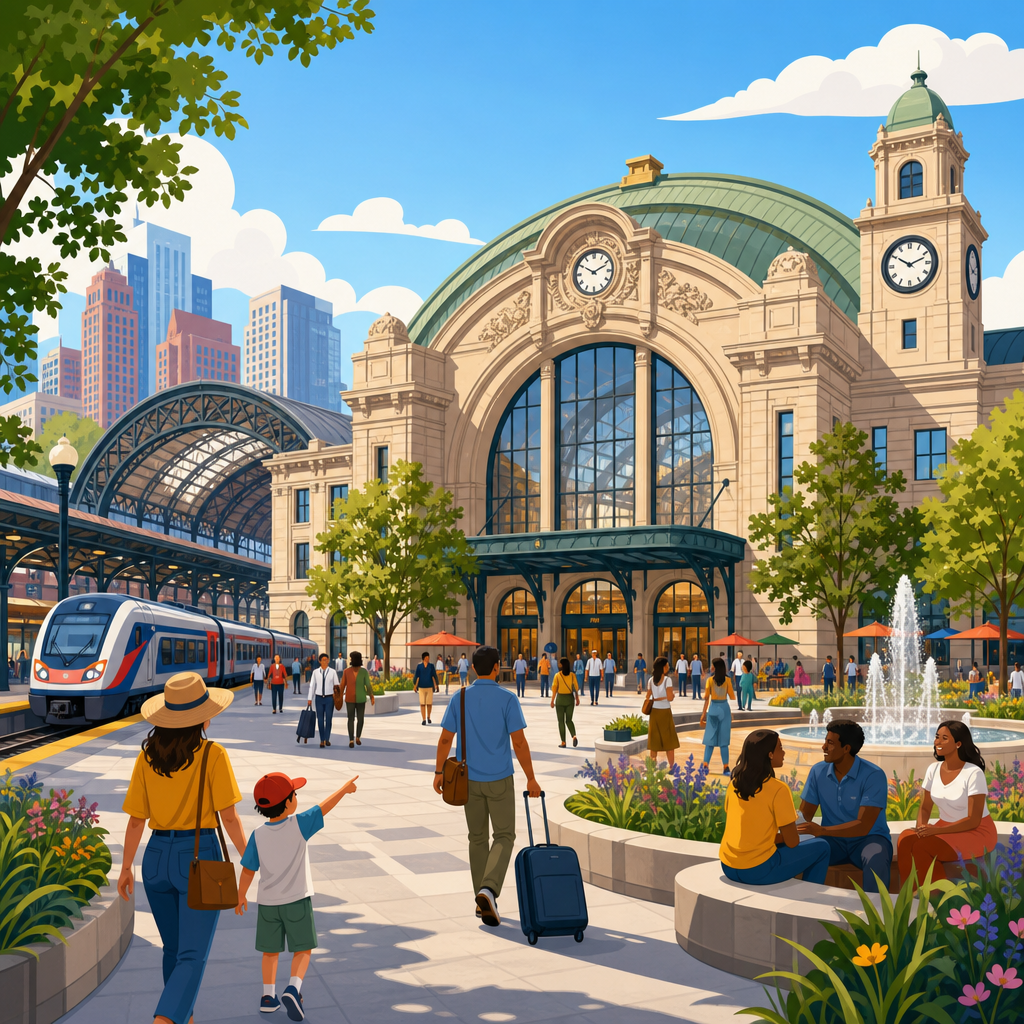
Union stations and rail terminals have long been more than transportation infrastructure; they are instruments of city building, economic coordination, and public identity. In urban planning and policy, these buildings sit at the intersection of mobility, land use, architecture, governance, and civic ritual. A union station traditionally consolidates multiple rail lines and operators in one shared terminal, while a rail terminal more broadly refers to the end point or central node of a rail network. Both forms matter because they shape how people enter a city, how districts develop around major transit assets, and how public life is staged in large, accessible, symbolic spaces.
I have worked on station-area plans where the transportation brief seemed straightforward at first: improve circulation, increase ridership, and attract investment. In practice, the real challenge was civic. A station can function as a front door, a marketplace, a waiting room, a memorial landscape, and a daily shortcut used by thousands who never board a train. That mix makes union stations unusually important in policy terms. Decisions about platform access, concourse design, zoning, retail tenancy, police presence, and public seating all determine whether a terminal behaves like a public good or a controlled passageway.
The history of rail terminals also explains why they remain central to debates about downtown revival and equitable growth. In the nineteenth and early twentieth centuries, railroads concentrated wealth and movement in dense urban cores, prompting cities to build monumental terminals such as Washington Union Station, New York Grand Central Terminal, and Toronto Union Station. Those buildings organized regional labor markets and anchored hotel, office, and cultural districts. Later, the rise of highways, aviation, suburbanization, and disinvestment weakened many terminals. Yet in the last three decades, cities have returned to rail infrastructure as a lever for climate policy, regional connectivity, and urban regeneration.
This article serves as a hub for understanding how union stations, rail terminals, and civic space fit together across planning, design, operations, preservation, and public policy. It covers the core questions readers usually have: What makes a station civic rather than merely functional? How do terminals influence surrounding neighborhoods? Which governance models work? What tradeoffs appear between security, revenue, heritage, and inclusion? By the end, you should have a clear framework for analyzing any major station, whether it is a Beaux-Arts landmark, a modern intermodal hub, or a redeveloped freight complex turned public destination.
How rail terminals became civic infrastructure
Rail terminals became civic infrastructure because they solved a metropolitan coordination problem that no single private building could solve alone. When multiple rail companies converged on a growing city, scattered depots created confusion, street congestion, and weak transfers. The union station model answered that by pooling tracks, waiting rooms, baggage systems, and passenger services. In planning terms, it reduced friction across networks and concentrated foot traffic in one legible place. That concentration then justified investments in streets, plazas, bridges, hotels, postal facilities, and government buildings nearby, turning transportation logic into urban form.
The classic examples are instructive. Chicago Union Station consolidated intercity operations in a city already defined by rail exchange. Washington Union Station, guided by the City Beautiful movement and the McMillan Plan, was conceived not only as a transport node but as a ceremonial gateway to the capital. Grand Central Terminal paired rail efficiency with air rights development, creating a model for value capture before the term became common in planning practice. These projects proved that a terminal could increase land values, improve circulation, and project civic dignity at the same time.
From a policy perspective, the station’s civic role comes from accessibility and shared use. Unlike a private office tower, a terminal hosts commuters, visitors, service workers, vendors, tourists, unhoused residents, and public employees in the same environment. That social mixing can be messy, but it is a defining urban virtue. A successful terminal gives different users intuitive wayfinding, safe movement, and places to pause without forcing every minute of occupancy to be monetized. In my experience, the loss of free seating or visible public restrooms often signals that a station is being managed primarily as a retail asset rather than civic infrastructure.
Architecture, symbolism, and the public realm
Architecture matters in rail terminals because scale, light, material, and geometry influence behavior as much as signage and schedules do. Large concourses calm movement by making paths visible. Daylighting improves orientation and perceived safety. Durable materials lower maintenance costs in high-wear environments. Monumental halls also communicate that public mobility is worthy of investment, which has symbolic power in cities where transit riders have often been treated as secondary to drivers. A terminal that looks and feels important reinforces the legitimacy of mass transportation as a public priority.
The public realm around stations is equally important. The best terminals extend into surrounding streets through forecourts, sidewalks, bike access, bus interfaces, and clear crossings. When planners neglect these edges, stations become islands severed by traffic, parking structures, or blank development parcels. Kansas City Union Station shows how restoration can revive a landmark, but station vitality still depends on the surrounding district offering walkable connections and active uses. Denver Union Station is a stronger contemporary example of integrating rail, buses, public space, and mixed-use development into a coherent civic district, though not without affordability concerns.
Symbolism should never be dismissed as cosmetic. Cities use stations to communicate arrival, order, openness, and ambition. The point is not grandeur for its own sake; it is legibility and collective meaning. In redevelopment projects, preserving historic train sheds, clock towers, ticket halls, or mosaics can maintain continuity with civic memory while accommodating modern systems such as fare gates, digital information displays, and accessible boarding. The challenge is to avoid preservation that freezes the building as a museum piece. The station must remain a living public environment, not merely a photographed backdrop.
Planning station districts and capturing value
Station districts often outperform other urban areas because regional accessibility compresses travel time and expands labor and consumer markets. Planners typically respond with transit-oriented development strategies that permit higher densities, mixed uses, reduced parking minimums, and active ground floors within walking distance of the terminal. The logic is straightforward: if a station already concentrates movement, land around it should support housing, offices, hotels, education, and culture rather than low-yield storage or surface parking. Good policy aligns zoning with actual mobility capacity.
Value capture is one of the most important tools in this context. A terminal improvement can raise adjacent property values through better access and public realm upgrades. Cities and agencies then try to reclaim some of that uplift through tax increment financing, special assessment districts, joint development leases, air rights, or land value taxes. Hong Kong’s rail plus property model is often cited because transit investment and development rights are integrated institutionally. In North America, the structure is usually more fragmented, but the principle holds: station investments should create public returns, not only private windfalls.
| Planning tool | How it works | Typical benefit | Main risk |
|---|---|---|---|
| Upzoning near stations | Allows greater height or floor area within a defined walkshed | More housing and jobs close to transit | Speculation without affordability safeguards |
| Joint development | Transit owner leases or partners on station-adjacent land | Recurring revenue for operations or capital | Public space can be subordinated to private program |
| Tax increment financing | Future property tax growth funds present improvements | Infrastructure can be built sooner | Revenue assumptions may be overly optimistic |
| Parking reform | Reduces minimum parking near high-capacity transit | Lower development costs and better land use | Political resistance from nearby residents |
Still, growth around terminals is not automatically inclusive. I have seen station-area plans praised for density while failing to preserve low-cost retail, family housing, or industrial jobs that supported existing communities. The planning answer is not to avoid investment but to pair it with anti-displacement measures: inclusionary zoning, community land trusts, tenant protections, small business support, and requirements for public amenities. A station district becomes genuine civic space only when surrounding development expands access instead of sorting people by income.
Operations, access, and everyday inclusion
Many station plans look impressive on paper but fail in daily operation. The real test is whether users can transfer quickly, find platforms easily, access toilets, rest, buy basic goods, and feel safe without being harassed or excluded. Operations determine civic credibility. Clear wayfinding follows established principles: consistent typography, sightlines to major decision points, multilingual information where appropriate, and digital systems that supplement rather than replace physical signs. Accessibility must go beyond code compliance to include reliable elevators, level boarding where feasible, tactile guidance, audible announcements, and manageable walking distances.
Security is a necessary but delicate issue. Major terminals are vulnerable sites, yet over-securitization can erode public trust and reduce usability. Best practice relies on layered security: trained staff presence, lighting, passive surveillance, emergency planning, and targeted screening where justified by risk, not permanent airport-style control imposed indiscriminately. The Transportation Research Board and CPTED principles both support designing environments that deter crime through visibility, activity, and maintenance rather than relying solely on enforcement. In my work, stations with staffed information points and active retail often feel safer than those dominated by barriers and warnings.
Inclusion also depends on mundane management choices. Seating with armrest dividers, restricted waiting, closed restrooms, or hostile treatment of non-ticketed users can convert a civic hall into a transactional corridor. Some managers justify these policies as necessary for safety or cleanliness, and there are real operational pressures. But a city should be honest about the tradeoff: when every amenity is conditioned on purchase or proof of travel, the station ceases to function as broad public space. Libraries, plazas, and terminals each carry part of the city’s burden of shared indoor life.
Preservation, adaptation, and the future terminal
Preserving historic terminals is not simply an aesthetic exercise; it is an urban policy strategy that reuses embedded carbon, sustains civic identity, and leverages existing centrality. Adaptive reuse can keep a station relevant by introducing new concourses, retail programs, offices, cultural venues, or intermodal connections while retaining defining architectural elements. St. Pancras in London demonstrates how a landmark station can combine historic restoration, high-speed rail, hospitality, and commercial activity. The lesson is not that every station needs luxury branding, but that heritage can support contemporary mobility if modernization is disciplined and technically competent.
The future terminal will also be shaped by climate adaptation and network integration. Heat resilience, flood protection, smoke management, backup power, and durable drainage systems are now baseline considerations, not optional upgrades. Electrification changes platform design, ventilation demands, and maintenance regimes. Intermodal planning matters more as cities connect commuter rail, metro, bus rapid transit, cycling, micromobility, and intercity rail in one place. A good terminal minimizes transfer penalties across these modes. Travelers should not have to decode a maze of separate agencies, fare media, or contradictory signs to complete one trip.
At the same time, not every city needs a monumental new station. Sometimes the smarter move is incremental improvement: better entrances, bus-rail coordination, platform canopies, accessible vertical circulation, or zoning reform around an existing terminal. The right intervention depends on demand, network role, governance capacity, and fiscal reality. What remains constant is the principle that union stations and rail terminals are civic space when they combine mobility efficiency with openness, memory, and shared use. If you are studying urban planning and policy, start with the station nearest your downtown and ask a practical question: who is it designed to welcome, and who is it quietly pushing away?
Frequently Asked Questions
What is the difference between a union station and a rail terminal?
A union station is a specific type of rail terminal designed to bring multiple rail companies, lines, or services together in one shared facility. Historically, the term emerged in the nineteenth and early twentieth centuries when competing private railroads often built separate depots, creating inefficiency, duplication, and confusion within growing cities. A union station solved that problem by consolidating ticketing, waiting rooms, tracks, and passenger circulation into a single coordinated hub. In practical terms, it was both a transportation innovation and an urban governance tool, because it required rival operators, municipal authorities, and landowners to cooperate around a common piece of infrastructure.
A rail terminal, by contrast, is the broader category. It can refer to any endpoint, major transfer node, or central station within a rail network, whether it serves one operator or many. Some terminals are stub-end stations where trains terminate and reverse direction, while others function as through-stations that allow continuous movement across a city or region. Not every rail terminal is a union station, because not every terminal is designed around institutional consolidation. The distinction matters in urban planning because a union station often carries additional implications for land assembly, civic symbolism, interagency coordination, and downtown development. In other words, all union stations are rail terminals, but not all rail terminals are union stations.
Why have union stations played such an important role in shaping civic space?
Union stations have historically done much more than move passengers from one place to another. They helped define how a city presented itself to residents, investors, and visitors. Because these buildings were often located at strategic downtown sites and built at monumental scale, they became front doors to the city. Their architecture, public halls, plazas, and street connections turned transportation infrastructure into a stage for civic identity. In many places, the station concourse was one of the few truly shared urban interiors, bringing together travelers, commuters, workers, business leaders, immigrants, and public officials in a common setting.
From a planning perspective, union stations also shaped civic space by organizing flows of people, goods, and capital. The concentration of rail services encouraged nearby development, including hotels, offices, warehouses, retail corridors, and government buildings. Streets were widened or reoriented to serve station access, streetcar and bus routes converged nearby, and public squares often emerged around station entrances. That made the station district a focal point for economic exchange and public life. Even ceremonial functions mattered: arrivals of dignitaries, military departures, holiday travel, and political gatherings all reinforced the station’s role as a civic theater. The result is that union stations were not just passive backdrops to urban growth; they were active instruments in making a recognizable public realm.
How do union stations connect transportation planning with land use and economic development?
Union stations sit at the crossroads of mobility and land use because they concentrate accessibility in one place. In urban planning, accessibility is a major driver of land value and development intensity. When multiple rail lines, local transit services, pedestrian routes, and sometimes intercity connections meet at a single terminal, the surrounding area becomes highly attractive for commerce, employment, housing, and institutions. That is why station districts have so often been sites of dense mixed-use development. Businesses benefit from foot traffic and regional access, while governments see opportunities for tax revenue, redevelopment, and coordinated infrastructure investment.
Economically, union stations can serve as anchors for broader development strategies. Their presence can justify zoning changes, public-private partnerships, streetscape upgrades, and investments in utilities or public space. In contemporary practice, planners often think of major stations as hubs for transit-oriented development, where compact growth is organized around high-capacity transportation. But this logic is not new. Historically, the same dynamic helped produce warehouse districts, commercial corridors, and hotel clusters around large terminals. At the same time, the economic effects are not automatically positive or evenly distributed. Station-led development can raise land prices, shift investment patterns, and create displacement pressures if not guided by equitable policy. That is why union stations matter so much in planning debates: they are places where transportation decisions directly influence urban form, market behavior, and who gets to benefit from city growth.
What makes the architecture of union stations so significant in public life?
The architecture of union stations is significant because it translates technical infrastructure into a public institution people can see, use, and identify with. These buildings had to solve highly practical problems such as circulation, ticketing, baggage handling, platform access, and coordination among rail operators. Yet they were also intentionally designed to convey permanence, order, and civic ambition. Grand waiting rooms, monumental facades, vaulted ceilings, axial entrances, and carefully composed plazas were not merely aesthetic flourishes. They communicated that rail travel was central to modern urban life and that the city itself was organized, prosperous, and outward-looking.
In public life, that architectural ambition gave stations a symbolic role beyond mobility. The station often became one of the most recognizable buildings in the city, functioning almost like a courthouse, city hall, or library in the collective imagination. People met there, lingered there, and marked important life events there. Because stations welcomed strangers as well as residents, they embodied a civic ideal of openness and connection. Their design could also express political priorities: some emphasized national grandeur, others regional identity, and still others the democratic promise of shared public space. Even today, when many historic stations are rehabilitated, the focus is often not only on transportation efficiency but on restoring a civic landmark that helps anchor memory, identity, and urban continuity.
Why do union stations remain relevant in today’s cities, even as transportation systems evolve?
Union stations remain relevant because the core issues they address—connectivity, coordination, land use integration, and public identity—are still central to city making. Modern metropolitan regions depend on linking multiple transportation modes, including commuter rail, intercity rail, subways, light rail, buses, bicycles, ride-share services, and pedestrian networks. A well-designed central terminal can reduce friction between these modes, improve regional access to jobs and services, and support more sustainable travel behavior. In that sense, the historic union station model continues to inform contemporary mobility planning, even when the institutional structure of rail service has changed.
They also remain relevant as civic and policy spaces. Today’s station districts are often where cities confront major questions about redevelopment, preservation, climate resilience, accessibility, and equitable growth. Reusing or expanding a union station can help reduce automobile dependence, strengthen downtown vitality, and make better use of existing infrastructure. At the same time, these projects force public agencies to negotiate among transportation goals, real estate pressures, heritage values, and community concerns. That complexity is exactly why union stations still matter. They are not relics of a rail age that has passed; they are living examples of how infrastructure shapes public space, governance, and urban identity across generations.


