
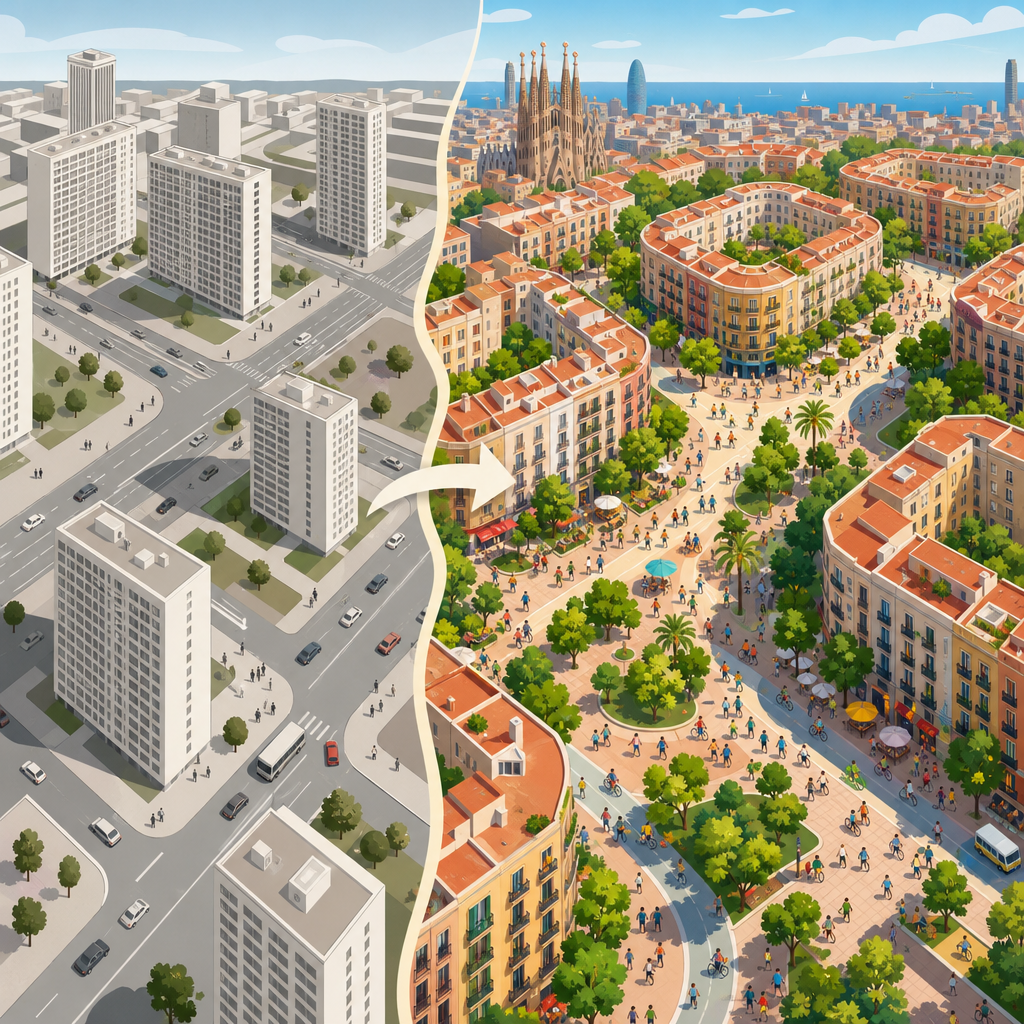
The superblock idea has moved from a modernist planning concept to a practical urban policy tool, and Barcelona has become its most closely watched laboratory. In urban planning, a superblock usually means a larger cluster of city blocks where through-traffic is redirected to perimeter streets while the interior is reorganized for walking, cycling, play, greenery, local commerce, and neighborhood life. The term sounds simple, but the idea contains several layers: street hierarchy, traffic calming, land-use coordination, public health, environmental justice, and political negotiation. I have worked on street redesign briefs and mobility studies where the hardest question was never whether cities need less traffic, but how to redistribute space without damaging access, deliveries, emergency response, or social acceptance.
The subject matters because cities everywhere face the same pressures: climate targets, heat exposure, road danger, noise, rising chronic disease, and shrinking trust in public institutions. Conventional traffic engineering treated streets primarily as conduits for vehicle flow. The superblock reframes them as public spaces with transport functions rather than transport corridors with leftover public space. That shift changes design standards, budgeting, and governance. It also changes what counts as success. A street is no longer judged only by average vehicle speed or intersection delay, but by air quality, pedestrian comfort, child independence, local business performance, shade, stormwater absorption, and time spent outdoors.
Barcelona brought the concept to global attention, but the roots are older and broader than one city. Modernist planners explored enlarged circulation units, segregation of traffic, and interior open space across the twentieth century. Some versions produced humane environments; others produced sterile separation, long walking distances, and dependence on arterial roads. Understanding the superblock idea therefore requires a historical reading as well as a policy one. The most useful lesson is not that every district should copy Barcelona. It is that the structure of the street network can be tuned to support healthier daily life when design, regulation, and community management work together.
Modernist origins and the planning logic behind the superblock
The superblock has deep roots in modernist planning, especially in efforts to solve congestion, improve sanitation, and separate conflicting urban functions. Clarence Perry’s Neighborhood Unit, published in the late 1920s, did not use Barcelona’s exact model, but it introduced a related logic: organize residential areas around schools and local services, place higher-speed traffic at the edges, and reduce dangerous cut-through movement inside neighborhoods. Later, planners and architects including Le Corbusier and figures associated with CIAM advanced larger block structures, functional separation, and open space between buildings. In postwar practice, these ideas appeared in new towns, housing estates, and campus plans across Europe, North America, and Asia.
The strengths of the modernist approach were clear. It recognized that local streets should not perform the same job as major urban arterials. It also understood that children, older adults, and non-drivers need protected environments. Yet many implementations overcorrected. Towers in the park often erased fine-grained street life. Pedestrian decks and inward-facing precincts could feel disconnected or unsafe. Large blocks reduced permeability, making walking routes indirect. In transport terms, concentrating traffic on perimeter roads sometimes created severe edge effects: noise, pollution, and collision risk moved rather than disappeared. These failures matter because they explain why superblocks can be controversial. People remember urban renewal and fear abstraction imposed from above.
Barcelona’s later interpretation differs in an essential way. It works within an existing dense street grid rather than replacing it with isolated megablocks. That distinction is decisive. Instead of demolishing urban fabric, the city selectively changes circulation rules and public-space allocation inside a cluster of streets. The aim is not suburban enclosure or total segregation, but filtered permeability: residents, deliveries, emergency vehicles, and service traffic can still enter, while routine through-traffic is discouraged. This makes the contemporary superblock less about architecture and more about mobility management, curb policy, and tactical redesign that can evolve over time.
Why Barcelona became the defining case
Barcelona’s Eixample grid, designed by Ildefons Cerdà in the nineteenth century, created unusually favorable conditions for superblocks. The district combines regular blocks, chamfered corners, mixed uses, relatively high density, and a street network with many route options. Those features allow traffic to be rerouted around a nine-block cluster without cutting off access. The city’s current model, often called the superilla, generally treats a three-by-three set of blocks as the planning unit. Perimeter streets continue to carry buses and general traffic. Interior streets are redesigned for very low speeds, restricted circulation, and public uses.
The policy context also mattered. Barcelona faced persistent air pollution, high noise exposure, limited green space in some districts, and a strong local movement for reclaiming streets from cars. European air-quality rules, climate commitments, and public-health evidence created pressure for action. At the same time, tactical urbanism methods made implementation faster and cheaper. Paint, planters, movable furniture, and interim barriers could test circulation before expensive reconstruction. I have seen this sequencing reduce risk in other cities too: pilots reveal whether loading zones, bus operations, and turning movements actually work before capital budgets are committed.
Barcelona’s superblocks became internationally visible because they generated measurable and visual change. Traffic inside intervention areas dropped. Space for play and seating increased. Trees, shade structures, and permeable surfaces were added. Some evaluations linked the approach to lower noise and improved perceived safety. Public-health researchers at institutions such as ISGlobal modeled substantial health gains if superblocks were expanded citywide, including reductions in premature mortality associated with air pollution, noise, heat, and physical inactivity. While modeling is not the same as observed long-term outcome data, it gave the policy a serious evidence base that many street redesign projects lack.
How a superblock actually works in practice
A superblock is not merely a pedestrian zone. It is a circulation system defined by access rules, street geometry, and public-space programming. The standard operating principle is simple: vehicles may access interior streets for local purposes, but they should not cross the area as the fastest route from one side to another. This is often enforced through one-way loops, modal filters, camera controls, turning restrictions, and design speeds near 10 to 20 kilometers per hour. The result is self-explaining streets where the geometry tells drivers they are guests.
Implementation usually follows a sequence. First, planners map baseline conditions: traffic counts, bus routes, freight activity, crash history, tree canopy, curb occupancy, and demographic vulnerability. Second, they define perimeter streets that can absorb through-traffic and maintain transit reliability. Third, they redesign the interior using curb extensions, raised crossings, seating, protected cycle links where appropriate, and flexible spaces for markets or school activities. Fourth, they monitor displacement effects. The most common mistake is judging the project only inside the superblock. A credible evaluation also checks neighboring streets for congestion, speeding, illegal parking, and bus delay.
| Design element | Purpose | Typical Barcelona-style application |
|---|---|---|
| Perimeter traffic routing | Keep regional and through trips outside the interior | General traffic remains on edge streets with signal priority management |
| Interior access restrictions | Allow residents and services while discouraging shortcuts | One-way loops, turn bans, bollards, and low-speed operation |
| Public-space conversion | Reallocate carriageway to social and ecological uses | Play areas, benches, trees, rain gardens, and café spillout |
| Freight and curb management | Protect deliveries and essential access | Timed loading bays on edges and short-stay interior permits |
| Monitoring and adjustment | Correct unintended effects quickly | Traffic counts, air and noise readings, and iterative redesign |
The plain-language test is this: can a child cross safely, can an older resident sit in shade, can a shop receive deliveries, can a bus move reliably nearby, and can an ambulance enter without delay? If those answers are yes, the superblock is functioning. If not, the concept has not yet been translated into workable street operations.
Benefits, criticisms, and the policy tradeoffs cities must face
The main benefits of superblocks are well established. Fewer moving cars inside residential streets reduce crash risk and noise. More walkable public space supports social contact and everyday physical activity. Additional trees and permeable surfaces help with heat and stormwater. Local businesses often gain from increased footfall, especially food, convenience retail, and services that depend on dwell time rather than drive-by visibility. In dense districts, reclaiming even a modest share of roadway can produce a large improvement in quality of life because street space is one of the few flexible public assets cities control directly.
Still, superblocks are not free of tradeoffs. Traffic may increase on perimeter roads unless wider demand-management measures are in place. Drivers who lose a shortcut perceive the change immediately, while public-health gains emerge gradually. Accessibility concerns are legitimate, especially for disabled residents, tradespeople, and caregivers who rely on vehicle access. Commercial patterns also vary. A corner café may thrive while a business dependent on quick car pickup may struggle unless loading and short-stay parking are redesigned. Equity is another real issue. If street improvements raise rents without tenant protection or affordable retail policy, a healthier neighborhood can become a less inclusive one.
The strongest superblock programs therefore combine street redesign with complementary measures: better bus service, protected cycling links, parking reform, school-street programs, freight consolidation, and housing policy. This is where many cities stumble. They treat the superblock as a branding exercise or isolated capital project. In practice it is a governance package. Transportation departments, public works, sanitation, emergency services, business associations, and neighborhood groups all have to agree on operating rules. The political skill lies in making the intervention concrete enough to trust and flexible enough to refine after launch.
What other cities can learn from Barcelona without copying it blindly
The global appeal of Barcelona’s superblocks has led some cities to imitate the graphics before understanding the operating conditions. That is a mistake. The model transfers best to places with connected street grids, mixed land uses, manageable block sizes, and viable transit alternatives. It is harder in fragmented suburban networks where a few arterials already bear most traffic and walking routes are sparse. It is also harder where emergency standards, freight dependence, or extreme weather demand different street layouts. Good adaptation starts with function, not form.
Several lessons travel well. First, use pilots to test circulation. Second, protect transit on perimeter streets so mode shift is realistic. Third, map curb uses carefully; loading, school pickup, waste collection, and accessible parking can make or break local acceptance. Fourth, measure outcomes with before-and-after data rather than anecdotes. Fifth, communicate in everyday terms. Residents care less about abstract urbanism than about whether grandchildren can play outside, whether nighttime noise falls, and whether crossing the street feels calmer. When I have seen projects win support, it has been because planners translated network logic into lived experience.
Cities such as Paris, Ghent, Vitoria-Gasteiz, and Milan have pursued related strategies through low-traffic neighborhoods, circulation plans, school streets, and public-space reclamation, each shaped by local street networks and politics. The common thread is not a fixed blueprint. It is the principle that access and movement should be differentiated by street type and neighborhood need. Barcelona remains the signature case because it showed that even a dense, busy, globally visited city can remove through-traffic from local streets and still function. That is the durable lesson for urban planning and policy.
The superblock idea endures because it solves a modern urban problem with a structural, not cosmetic, change. Instead of adding a bench to a traffic sewer, it changes who the street is for and how movement is organized. From its modernist ancestors, the concept inherited the insight that not every street should carry every kind of traffic. From decades of criticism, it learned that separation without permeability, local life, and democratic adaptation fails. Barcelona’s contribution was to reinterpret the idea inside an existing dense city, using the street network itself as the policy instrument.
For planners, elected officials, and community advocates, the practical message is straightforward. A successful superblock needs a connected grid, clear perimeter routes, disciplined curb management, reliable transit, and continuous monitoring. It also needs honesty about tradeoffs. Some traffic shifts outward. Some users need special access. Some designs need revision after rollout. None of that weakens the model; it is exactly how durable urban policy works. The goal is not to eliminate movement but to put the highest-friction, highest-risk traffic in the right places and return local streets to local life.
If you are building an urban planning and policy agenda, treat the superblock as a hub concept linking mobility, health, climate resilience, public space, and neighborhood governance. Study Barcelona closely, but diagnose your own network, institutions, and social conditions before drawing lines on a map. Start with one district, measure relentlessly, adjust fast, and communicate clearly. Done well, the superblock is not a trend. It is a repeatable framework for making cities safer, quieter, greener, and more livable.
Frequently Asked Questions
1. What is a superblock, and how does it work in practice?
A superblock is a larger grouping of city blocks that is managed as a single traffic and public-space unit rather than as a set of ordinary streets carrying through-traffic in every direction. In practice, the key move is simple but powerful: motor vehicles that are just passing through are redirected to perimeter roads, while the streets inside the superblock are reorganized for lower speeds, local access, walking, cycling, public seating, greenery, children’s play, and neighborhood activity. Deliveries, emergency access, residents, and essential services are still accommodated, but the internal street network is no longer designed primarily as a shortcut for cars.
What makes the concept important in urban planning is that it combines several policy goals into one spatial framework. It is about street hierarchy, because perimeter streets take on the role of carrying most through-movement. It is about traffic calming, because interior streets are redesigned to discourage fast driving and unnecessary circulation. It is also about reclaiming public space, since road area that was once dominated by moving or parked vehicles can be reassigned to trees, benches, social spaces, bike movement, and small-scale local commerce. In that sense, a superblock is not just a traffic scheme; it is a model for changing how a neighborhood functions day to day.
The term can sound abstract, but the lived result is concrete. Residents often experience a superblock as a quieter and safer local environment, with fewer conflicts between cars and pedestrians and more opportunities for street life. For planners, the superblock offers a way to improve public health, reduce noise and emissions, and support more sociable neighborhoods without eliminating mobility altogether. Its strength lies in reorganizing movement, not stopping it.
2. Where did the superblock idea come from, and how is it connected to modernism?
The superblock idea has roots in modernist planning, when architects and planners began rethinking how cities should handle industrial-era congestion, public health concerns, and the rapid rise of motor traffic. In many modernist visions, the traditional street grid was seen as inefficient or unsafe because it mixed too many functions at once. Planners proposed larger urban units that could separate circulation types, organize land uses more clearly, and create more open space, sunlight, and order. The superblock emerged within that broader effort to redesign the city at a larger scale.
In its early forms, the superblock was often associated with ambitious, top-down planning ideals. Modernists frequently imagined housing, movement, green space, and civic life as elements that could be rationally arranged for maximum efficiency. Sometimes that produced valuable innovations, such as more open courtyards, clearer street hierarchies, and safer pedestrian zones. At other times, it led to oversized schemes that weakened the fine-grained street life of traditional urban neighborhoods. That mixed legacy is important, because it explains why the superblock concept has generated both enthusiasm and skepticism over time.
The contemporary superblock differs from many classic modernist versions in one major respect: it is typically less about wholesale urban replacement and more about adapting existing neighborhoods. Barcelona’s superblocks, for example, are not based on wiping out the city’s street network and starting over. Instead, they work with the existing grid, shifting how streets are prioritized and used. That makes the modern superblock more flexible, more incremental, and often more compatible with established urban life. In other words, the idea comes from modernism, but its current application is often more pragmatic, more human-scaled, and more responsive to local conditions than some of its historical predecessors.
3. Why has Barcelona become the most famous example of the superblock model?
Barcelona has become the best-known superblock laboratory because it combines the right urban form, the right policy pressures, and the right international visibility. The city’s street pattern, especially in the Eixample district, provides a highly legible grid that is especially suited to experiments in traffic redirection and public-space redesign. That physical structure allows planners to test how groups of blocks can function differently when through-traffic is shifted outward and interior space is repurposed for neighborhood uses.
But urban form alone does not explain Barcelona’s prominence. The city has also faced the exact kinds of problems the superblock model is meant to address: air pollution, traffic danger, noise, limited public space, and pressure to improve quality of life in dense neighborhoods. Rather than treating these issues separately, Barcelona used the superblock as a way to connect environmental goals, mobility planning, public health, and social life. This gave the policy strong symbolic power. It was not just a transport intervention; it became part of a broader argument about what a livable city should be.
Barcelona also drew global attention because its superblocks are visible and politically legible. People can see the changes on the ground: painted surfaces, seating, play areas, planters, new pedestrian zones, and calmer streets. That visibility makes the model easy to debate and easy to document, which is one reason it appears so often in international urban policy discussions. Supporters point to cleaner air, safer streets, and better public space. Critics raise concerns about traffic displacement, accessibility, implementation quality, or uneven impacts. Because the projects are so tangible, Barcelona has become a reference point for both advocates and skeptics. It is famous not just because it has used superblocks, but because it has turned them into a public conversation about the future of the city.
4. What are the main benefits and criticisms of superblocks?
The strongest case for superblocks is that they can improve everyday urban life on multiple fronts at once. By reducing through-traffic inside a neighborhood, they often lower noise levels, improve pedestrian safety, and create a calmer local environment. Streets that once functioned mainly as conduits for vehicles can become shared public spaces with room for trees, seating, children’s play, and informal social interaction. This can strengthen neighborhood identity and make local commercial areas more attractive, especially for foot traffic and short visits.
There are also broader environmental and public-health arguments in favor of the model. Fewer cars moving through interior streets can mean lower exposure to emissions at the neighborhood level, and safer, more comfortable streets can encourage walking and cycling. In dense cities, where open space is scarce and residents rely heavily on public streets as shared civic territory, even relatively small changes in street allocation can have large quality-of-life effects. Superblocks can therefore serve as a practical tool for climate adaptation, healthier mobility, and more resilient local communities.
That said, the criticisms are serious and should not be dismissed. One common concern is traffic displacement: if cars are pushed out of interior streets, critics ask whether perimeter roads simply become more congested, noisier, or more polluted. Another concern is equity. If superblocks are introduced unevenly, some neighborhoods may gain better public spaces while others absorb the burdens of redirected traffic. There are also questions about accessibility for older residents, disabled users, service providers, and small businesses that depend on convenient loading and customer access. Poorly designed schemes can feel confusing, overly improvised, or politically imposed rather than collaboratively developed.
The most effective response to these criticisms is not to assume the model always works automatically, but to recognize that outcomes depend on design, monitoring, and governance. A superblock is only as successful as its implementation. If planners provide strong transit alternatives, carefully manage deliveries and access, measure air quality and traffic changes, and adapt the design based on feedback, the model can produce real benefits. If they do not, the project may generate resistance and underperform. The debate around superblocks is therefore not simply whether they are good or bad, but under what conditions they succeed, for whom, and at what scale.
5. Are superblocks a planning trend, or do they represent a long-term shift in urban policy?
Superblocks are best understood not as a passing trend, but as part of a larger long-term shift in how cities think about streets, mobility, and public space. For much of the twentieth century, many urban transport systems prioritized the efficient movement and storage of private vehicles. In recent decades, however, cities have increasingly reconsidered that approach in response to climate goals, public-health data, safety concerns, and the recognition that streets are not only transport corridors but also social and environmental spaces. The superblock fits squarely within that broader rebalancing.
Its durability comes from the fact that it addresses several structural urban challenges at once. Dense cities need ways to reduce car dependence without cutting off access. They need more space for walking, cycling, trees, stormwater management, and local social life, yet they often have limited land available for entirely new parks or public facilities. Reorganizing the street network is therefore one of the few scalable tools available. Superblocks offer a framework for doing that systematically rather than through scattered one-off improvements.
That does not mean every city should copy Barcelona directly. The long-term significance of the superblock lies less in one fixed design template and more in the planning principle behind it: the idea that street networks can be restructured to favor local life over through-traffic in selected areas. Different cities may apply that principle in different ways depending on block size, transit quality, climate, politics, and neighborhood needs. Some may use pilot projects; others may integrate the logic into broader low-traffic neighborhood, pedestrianization, or complete-street programs


