
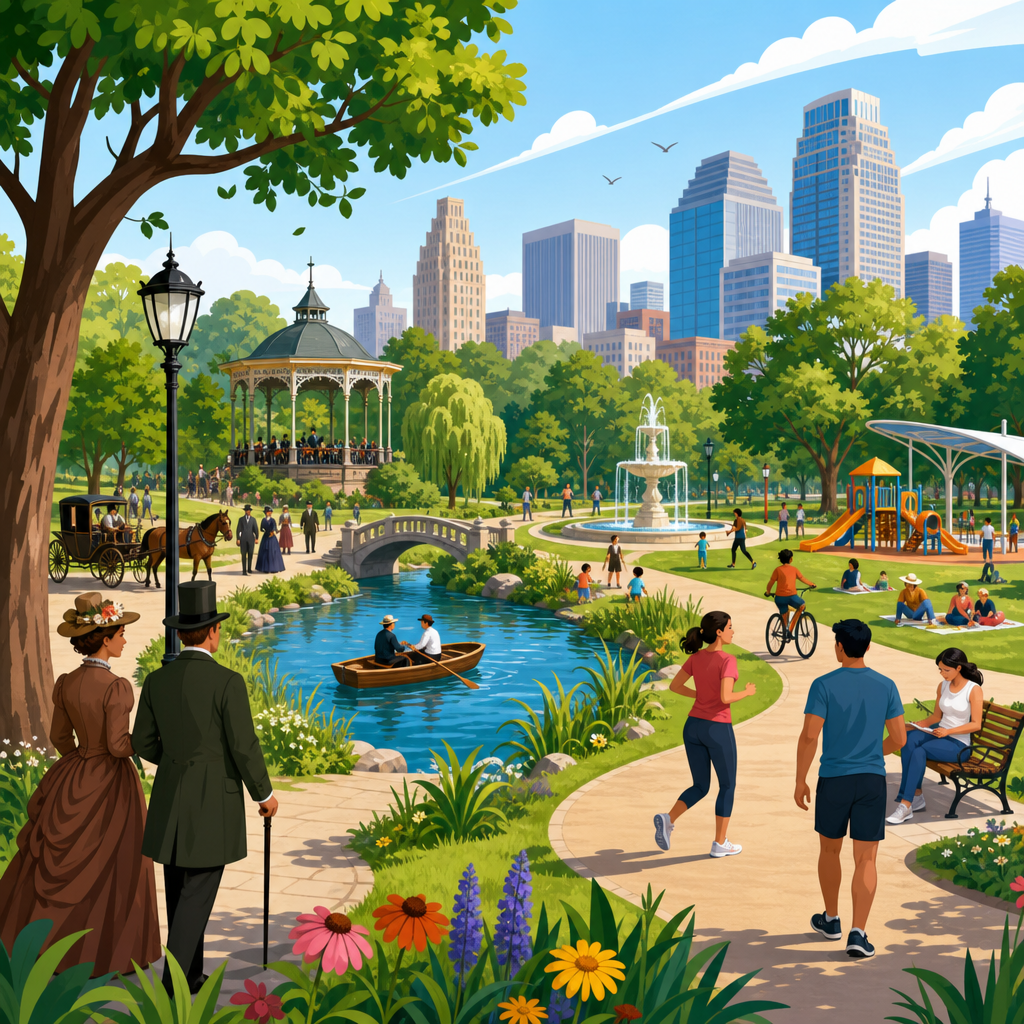
Public parks are among the most familiar parts of city life, yet their history shows they are far more than pleasant green spaces. They are urban infrastructure: planned, funded, maintained systems that support public health, circulation, social order, climate resilience, and civic identity. In urban planning, infrastructure usually means roads, sewers, transit lines, and power networks. Public parks belong in the same category because they deliver essential services at city scale, even when those services are ecological or social rather than mechanical.
The history of public parks as urban infrastructure begins with a basic question: why did cities decide to reserve valuable land for common use instead of private development? The answer changed over time. In one era, parks were seen as moral landscapes that offered relief from industrial crowding. In another, they became tools for neighborhood improvement, recreation policy, and metropolitan growth. Today, they also function as stormwater systems, heat mitigation assets, biodiversity corridors, and frontline climate adaptations. Across those phases, the core idea stayed consistent: a park is not leftover space. It is a deliberate public investment designed to shape how a city works.
I have worked with park planning documents, capital improvement programs, and site assessments, and the pattern is unmistakable. When cities treat parks as amenities, they underfund them and distribute them unevenly. When they treat parks as infrastructure, they connect them to measurable outcomes: lower flood risk, higher walking rates, better mental health, safer streets, and stronger neighborhood stability. That distinction matters for policy, budgeting, and land use decisions. It also matters historically, because each generation inherited a different understanding of what a public park should do.
Key terms help clarify the subject. A public park is land held for broad public access and managed for recreation, conservation, civic gathering, or landscape value. Urban infrastructure refers to durable public systems that enable urban life and protect public welfare. Green infrastructure describes natural or semi-natural systems, such as parks, wetlands, street trees, and bioswales, that perform environmental services. This article traces how public parks moved from elite landscapes and royal hunting grounds to democratic urban systems embedded in planning, public health, and environmental policy.
From Royal Grounds to Industrial City Reform
Before modern public parks, many cities had commons, promenades, gardens, and royal estates, but access was often limited by class, custom, or formal control. In Europe, the opening of former aristocratic grounds to wider public use marked an early transition. Hyde Park in London, originally a royal hunting park seized by Henry VIII, became increasingly accessible over the seventeenth and eighteenth centuries. Paris followed a similar pattern in selected gardens and promenades, where state power and public display were closely linked. These spaces were important predecessors, but they were not yet planned as universal municipal infrastructure.
The decisive shift came with industrial urbanization in the nineteenth century. Rapid population growth, overcrowded housing, factory pollution, and recurrent disease pushed reformers to seek open space as a remedy. Park advocates argued that cities needed lungs, sunlight, and ordered recreation. Their language mixed health concerns with social control. Access to fresh air was the humane case; supervised leisure for the working class was often the political case. Both arguments shaped the first large municipal parks.
Britain was an early leader. Birkenhead Park, opened in 1847 near Liverpool and designed by Joseph Paxton, is widely recognized as one of the first publicly funded civic parks created specifically for general urban use. Its significance lies not only in design but in governance: it was financed and managed as a municipal asset. In practice, it demonstrated that a city could reserve land for collective benefit and increase surrounding property values at the same time. That model influenced planners far beyond Britain.
The Park Movement and the Rise of Municipal Systems
In the United States, the park movement matured when cities began acquiring large tracts for public landscapes before development made land prohibitively expensive. Central Park, authorized in 1853 and designed by Frederick Law Olmsted and Calvert Vaux, was not the first urban park, but it became the most influential example. Olmsted argued that parks were as necessary to urban populations as water supply. He saw them as restorative environments that improved mental health, reduced stress, and cultivated democratic habits through shared space. That was a profound infrastructure argument, even if he expressed it through landscape language.
What distinguished this era was system thinking. Parks were no longer isolated beautification projects. Boston’s Emerald Necklace, planned by Olmsted in the late nineteenth century, linked parks, parkways, marsh restoration, and flood management into an integrated landscape network. The Muddy River improvements were both scenic and sanitary, showing how landscape design could address drainage, sewage-related conditions, and public recreation together. This is one of the clearest historical examples of parks functioning as multi-benefit infrastructure.
As cities expanded, park departments formed, bond financing increased, and standards for acquisition and maintenance became more formal. Civic leaders learned that a successful park required ongoing operations, not just initial construction. Turf, trees, paths, water bodies, lighting, staff, and policing all demanded recurring budgets. That operational reality is another hallmark of infrastructure. Unlike a decorative plaza installed once and neglected, a park system is a living public utility with lifecycle costs and measurable service expectations.
How Park Design Reflected Public Health, Recreation, and Social Policy
Early park design emphasized pastoral scenery, carriage drives, and passive relief from city stress, but by the early twentieth century the recreation movement broadened the park’s role. Settlement house workers, educators, and public officials argued that playgrounds, ball fields, field houses, and supervised activities were essential in dense neighborhoods. Jane Addams and reformers associated with Hull House supported neighborhood recreation as part of social welfare and youth development. Parks became local service platforms, not just grand landscapes for strolling.
This period also overlapped with the City Beautiful movement, which used monumental civic design to promote order and public pride. While some projects favored spectacle over access, the movement reinforced the idea that public space was a legitimate concern of urban government. At the same time, public health agencies increasingly recognized the value of exercise, sunlight, and cleaner environments. During heat waves and disease outbreaks, open space had practical significance, especially in tenement districts where indoor conditions were dangerous.
Yet park history also includes exclusion. Many celebrated parks displaced existing communities, especially poor residents and people of color. Segregation limited access in numerous American cities, whether by law, custom, or intimidation. Even where entry was technically open, programming, policing, and investment patterns often favored wealthier neighborhoods. Treating parks as infrastructure today requires acknowledging that infrastructure has never been neutral. Decisions about where parks are located, who feels welcome, and whose land was taken are central to the historical record.
| Era | Primary park purpose | Infrastructure function | Representative example |
|---|---|---|---|
| Preindustrial | Ceremonial grounds, commons, promenades | Limited public access and civic display | Hyde Park, London |
| Nineteenth century industrial reform | Fresh air, moral relief, social order | Health support and land reservation | Birkenhead Park |
| Late nineteenth century systems planning | Connected landscapes | Drainage, mobility, recreation | Boston Emerald Necklace |
| Early twentieth century recreation era | Playgrounds and neighborhood services | Youth programs and local access | Chicago field houses |
| Late twentieth century to present | Ecology, equity, resilience | Stormwater, cooling, habitat, health | High Line and Buffalo Bayou Park |
Regional Expansion, Professional Planning, and Federal Influence
By the early twentieth century, public parks were embedded in comprehensive planning. Planners began mapping neighborhood service radii, park acreage targets, and boulevard connections. The National Recreation Association, the American Society of Landscape Architects, and later the National Park Service helped standardize terminology and practice. Landscape architecture professionalized the field, but so did engineering, public administration, and public finance. Park planning increasingly required census analysis, land appraisal, maintenance forecasting, and interagency coordination.
Federal involvement became especially important during the New Deal. Through agencies such as the Works Progress Administration and the Civilian Conservation Corps, the United States funded park construction, trails, stonework, shelters, pools, and landscape improvements at a scale local governments could not have achieved alone. Many city park assets still in use date from the 1930s. The lesson was durable: when higher levels of government treat parks as employment infrastructure, health infrastructure, and civic infrastructure, the built results can last for generations.
After World War II, suburbanization changed the geography of parks. New subdivisions often included larger lawns and school grounds, but central-city neighborhoods frequently faced disinvestment. At the metropolitan edge, park districts preserved regional open space, waterfronts, and forest preserves. At the same time, urban renewal removed neighborhoods and highways severed park access. This uneven growth reinforced a planning challenge that persists today: metropolitan park acreage can increase while everyday access in low-income urban areas declines.
Modern Parks as Green Infrastructure and Climate Assets
Contemporary urban planning treats parks as working environmental systems. A well-designed park can absorb stormwater, reduce combined sewer overflows, lower surface temperatures, create pollinator habitat, and buffer neighborhoods from extreme rainfall. These functions are measurable. Agencies now use tools such as i-Tree for urban forest benefits, heat vulnerability mapping, and hydrologic models to quantify performance. This evidence has transformed park policy from aesthetic preference to infrastructure justification.
Examples are instructive. Buffalo Bayou Park in Houston combines recreation with floodplain restoration and water management. In New York, parts of Brooklyn Bridge Park use resilient waterfront design to address storm impacts while supporting public access. The High Line, although unusual and not a model for every city, demonstrated how obsolete transportation infrastructure could be repurposed into a public landscape that catalyzed investment. Its limitation is equally important: signature parks can drive land value increases so rapidly that nearby residents risk displacement without housing protections.
Climate adaptation has sharpened the case for park investment. Trees and permeable landscapes cool cities during heat waves, which are deadlier than many other weather hazards. Parks also provide emergency gathering space and support mental recovery after disasters. The strongest current practice integrates parks with transportation, water management, housing, and public health policy rather than placing them in a separate leisure category.
Equity, Access, and the Future of Park Policy
Today, the most important question is not whether parks matter, but who benefits from them. Access is shaped by distance, safety, quality, programming, maintenance, and cultural relevance. A park within a half mile is not truly accessible if a highway blocks the route, lighting is poor, or residents do not feel welcome. Trust and stewardship matter as much as acreage. That is why leading agencies now pair capital metrics with engagement metrics, condition assessments, and equity mapping.
Organizations such as the Trust for Public Land have popularized measures of proximity, investment, amenities, and acreage to evaluate park systems. Many cities now use these datasets to identify gaps and target funding. The best policies secure land early, protect maintenance budgets, and coordinate parks with affordable housing to reduce green gentrification. Community land trusts, inclusionary zoning, anti-displacement funds, and participatory design can help ensure that park improvements do not price out the residents they are meant to serve.
The history of public parks as urban infrastructure reveals a clear progression. Parks began as controlled landscapes and evolved into municipal systems that support health, recreation, ecology, and resilience. Their value is not symbolic. It is operational, financial, environmental, and civic. Cities function better when park networks are planned like essential infrastructure, funded over the long term, and distributed fairly across neighborhoods. For planners, policymakers, and residents, the practical next step is simple: evaluate your local park system not as an amenity list, but as critical urban infrastructure worthy of sustained investment and accountability.
Frequently Asked Questions
1. Why are public parks considered urban infrastructure rather than just recreational spaces?
Public parks are considered urban infrastructure because they perform essential, citywide functions in much the same way as streets, water systems, and transit networks do. Although they are often associated with leisure, their historical role has always been broader. Parks have been deliberately planned, publicly funded, engineered, and maintained to serve practical urban needs. They improve public health by offering cleaner air, shade, space for movement, and relief from overcrowded living conditions. They support circulation by creating organized public routes, promenades, and connections between neighborhoods. They also help cities manage stormwater, reduce heat, preserve ecological systems, and create buffers against environmental stress.
Historically, many urban parks were designed as solutions to problems created by industrialization and rapid urban growth. As cities became denser, dirtier, and more congested, reformers and planners saw parks as necessary public systems that could counter disease, social disorder, and environmental decline. In that sense, parks were never simply decorative amenities. They were part of the urban operating system. Just as roads move people and sewers remove waste, parks contribute to the functioning, resilience, and livability of the city as a whole.
2. How did public parks first emerge as part of modern city planning?
Public parks emerged as part of modern city planning during the eighteenth and especially nineteenth centuries, when urban populations expanded rapidly and the effects of industrialization became impossible to ignore. Before that period, many green spaces were private estates, royal hunting grounds, or commons with limited access and different social purposes. As cities grew more crowded, municipal leaders, public health reformers, and landscape designers began to argue that all residents needed access to open space. Parks became a planned response to urban problems such as poor sanitation, lack of ventilation, overcrowded housing, and the social tensions associated with fast-growing industrial cities.
In Europe and North America, the nineteenth century was especially important because it linked public parks directly to civic planning. Cities began acquiring land, designing landscapes, and building park systems with public money. These spaces were often promoted as the “lungs” of the city, a phrase that reflected the belief that open green land could improve air quality and physical well-being. Designers such as Frederick Law Olmsted helped formalize the idea that parks should be integrated into the broader urban fabric rather than treated as isolated pleasure grounds. Large parks, parkways, boulevards, and connected green networks became part of comprehensive planning strategies. This marked the moment when parks shifted from occasional civic ornaments to recognized tools of urban governance and infrastructure development.
3. What public health role have parks played throughout history?
Parks have long been tied to public health, and that connection is one of the strongest reasons they are understood as infrastructure. In the nineteenth century, when industrial cities were often filled with smoke, sewage, and overcrowded housing, parks were promoted as places where urban residents could access fresh air, sunlight, and exercise. Reformers believed that open space could reduce the physical and moral harms associated with tenement districts and factory life. Even before modern epidemiology fully developed, city leaders understood that healthier urban environments required more than hospitals and sanitation systems. They also required landscapes where people could breathe, walk, gather, and recover from the stresses of dense city living.
That health role has evolved rather than disappeared. In the twentieth and twenty-first centuries, parks became increasingly important for mental health, recreation, child development, and community well-being. Research now connects access to green space with lower stress, increased physical activity, improved cardiovascular health, and better social outcomes. Parks also support climate-related health protection by reducing urban heat and offering cooling refuge during extreme weather. During public crises, including heat waves and even periods of social isolation, parks often serve as critical low-cost public spaces where cities can maintain both health and social connection. Their history shows that they have always been more than aesthetic features; they are preventive health infrastructure embedded in the city itself.
4. In what ways have public parks been used to shape social order and civic identity?
Public parks have often been designed not only to serve environmental and health goals but also to shape how urban society behaves and sees itself. In the nineteenth century, many park advocates believed that orderly, attractive public landscapes could encourage respectable conduct, reduce unrest, and create shared civic values. Parks were places where different classes could occupy the same city space under visible rules of behavior. Paths, plantings, monuments, lawns, and programmed activities were frequently arranged to promote calm movement, family recreation, and public decorum. This reveals an important aspect of park history: they were instruments of governance as well as spaces of enjoyment.
At the same time, parks have played a major role in expressing civic identity. Cities have used them to project ideals of democracy, prosperity, culture, and public investment. Grand parks, public gardens, memorial landscapes, and waterfront promenades often became symbols of what a city believed itself to be. They hosted parades, festivals, protests, and commemorations, making them stages for public life. However, this history is not purely inclusive. Many parks were shaped by exclusionary practices related to class, race, gender, and access. Some communities were displaced to create them, and some groups were discouraged or prevented from using them equally. Understanding parks as infrastructure means recognizing both sides of this history: they have helped build civic belonging, but they have also reflected the power structures of the cities that created them.
5. Why does the history of public parks matter for today’s urban planning and climate resilience?
The history of public parks matters today because it reminds planners, policymakers, and residents that parks are not optional extras added after the “real” infrastructure is built. They are part of the real infrastructure. Looking at their history shows that cities have long relied on parks to solve practical problems, from overcrowding and sanitation concerns to social stress and unequal access to healthy environments. That historical perspective is especially valuable now, when cities face rising temperatures, heavier rainfall, biodiversity loss, and increasing public health pressures. Parks are central to urban adaptation because they absorb stormwater, reduce heat islands, support habitat, and provide flexible open space during emergencies.
Modern planning increasingly returns to ideas that have deep historical roots, especially the idea that green space should be integrated into the city as a system rather than scattered as isolated parcels. Greenways, park networks, restored waterfronts, urban forests, and multiuse public landscapes all continue the older understanding of parks as infrastructure that serves multiple functions at once. The historical record also offers a caution: when parks are treated as prestige projects rather than essential public systems, access and maintenance often become unequal. For today’s cities, the lesson is clear. Investing in parks means investing in environmental performance, public health, social resilience, and long-term urban capacity. Their history helps explain why they should be planned with the same seriousness as transportation, utilities, and housing.


