
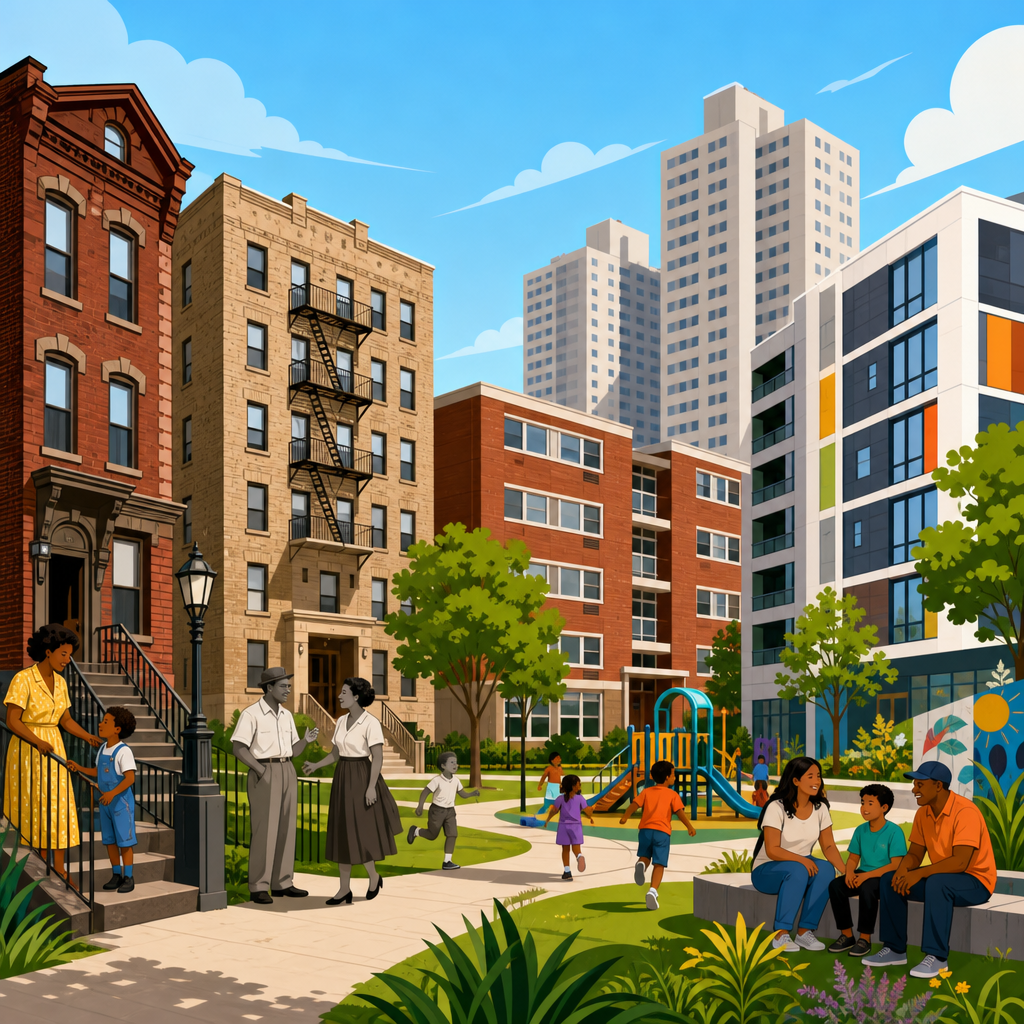
The history of public housing design in the United States mirrors the nation’s changing ideas about poverty, cities, race, family life, and the role of government. Public housing, in its narrowest sense, refers to homes owned or managed by a public authority and rented at below-market rates to households with limited income. Housing design includes building form, site planning, unit layout, materials, circulation, landscape, and the relationship between homes and streets, schools, jobs, and transit. When people ask why public housing matters, they are really asking how a society chooses to shelter workers, elders, children, and people facing hardship without isolating them from opportunity.
I have worked with housing archives, site plans, and redevelopment documents long enough to see that design decisions are never neutral. A corridor width can affect safety, a superblock can erase a neighborhood street network, and a maintenance budget can determine whether a celebrated design ages gracefully or fails quickly. Public housing in the United States has moved through several distinct eras: early reform tenements and local experiments, New Deal clearance and low-rise projects, postwar high-rise modernism, the backlash and demolition phase, and the mixed-income redevelopment period that continues today. Each era introduced a design logic shaped by policy rules, financing constraints, and social assumptions.
This history matters for urban planning and policy because public housing has been used to pursue several goals at once: eliminate slums, stabilize labor markets, segregate or desegregate communities, reshape downtown land, and demonstrate architectural progress. Many of the most debated urban design concepts in America were tested first or most visibly in public housing, including tower-in-the-park siting, neighborhood unit planning, defensible space strategies, prefabricated construction, and mixed-income redevelopment. Understanding this history helps explain why some developments became lasting community assets while others suffered from concentrated poverty, poor maintenance, and political neglect. It also clarifies a central lesson: design can support dignity and daily function, but design alone cannot overcome weak management, underfunding, or exclusionary land-use policy.
Early reform, model housing, and the road to federal involvement
Before the federal government built public housing, American cities faced severe overcrowding in tenements and industrial districts. In the late nineteenth and early twentieth centuries, reformers documented dark airless apartments, shared privies, high fire risk, and disease linked to poor sanitation. New York’s Tenement House Act of 1901 set stronger standards for light courts, windows, plumbing, and fire safety, and similar reforms spread elsewhere. Philanthropic and limited-dividend housing companies then tried to prove that better working-class housing could be built with modest returns. These projects were not public housing in the later legal sense, but they established crucial design principles: cross-ventilation, courtyards, durable materials, and access to sunlight.
During this period, ideas from the Garden City movement and settlement house reform also influenced housing design. Planners and architects promoted lower densities than the tenement districts, more open space, and a healthier domestic environment for families. Yet private and philanthropic efforts reached only a fraction of need. The Great Depression made that gap impossible to ignore. By the early 1930s, collapsing rents, unemployment, and slum conditions pushed housing onto the national policy agenda. The Public Works Administration’s Housing Division, under Rexford Tugwell and others, began sponsoring early federally backed projects such as Techwood Homes in Atlanta and First Houses in New York. These developments introduced a characteristic design language: brick walk-up blocks, landscaped courts, separation from traffic, and standardized unit plans intended to improve daily life at scale.
The New Deal era: slum clearance, neighborhood planning, and low-rise design
The Housing Act of 1937 created the United States Housing Authority and established the basic federal public housing program. The law tied new construction to local housing authorities and required slum clearance or demolition linked to development. In practice, that meant many early projects were built on cleared inner-city land, often displacing existing communities. Design in this era generally favored low-rise and mid-rise forms rather than very tall buildings. Architects drew from European social housing, American garden apartments, and neighborhood planning principles. Buildings were typically arranged around courtyards or open lawns, with ample daylight, improved sanitation, and community rooms. Streets were often simplified, and interior blocks were reserved for play areas and green space.
Harlem River Houses in New York, opened in 1937, remains one of the clearest examples of the strengths and contradictions of early public housing design. Its red-brick buildings, landscaped grounds, and quality materials represented a major improvement over overcrowded private tenements. At the same time, admission policies and local politics shaped who benefited, and similar projects elsewhere often reinforced racial segregation. In my review of original plans from this era, one consistent feature stands out: the architects took household routines seriously. Kitchens, storage, window placement, and shared laundry areas were carefully studied because public housing was meant to signal competence and civic responsibility. The best early projects aged well where maintenance stayed strong and where their urban context remained connected to jobs and services.
Postwar expansion and the rise of high-rise modernism
After World War II, several forces pushed public housing toward larger scale and taller forms. Cities faced acute housing shortages, construction costs were rising, and modernist planning gained influence among architects and public officials. The Housing Act of 1949 expanded federal urban renewal efforts, accelerating large clearance projects in central cities. High-rise public housing seemed efficient: it could house more people on expensive land while preserving open space at ground level. Superblocks replaced traditional street grids, separating cars from pedestrians and concentrating buildings within landscaped sites. Elevators, skip-stop corridors, gallery access, and repetitive prefabricated components promised economies of scale.
Not every high-rise project failed, and it is important to say that clearly. New York City Housing Authority developments, many of them tall slab buildings, often performed better than counterparts in other cities because of stronger management, more stable funding, and rigorous maintenance standards. But nationally, the high-rise model became associated with deep problems. In Chicago, St. Louis, Newark, and elsewhere, very large projects concentrated poor households in racially segregated neighborhoods already hit by job loss and disinvestment. Elevators broke, common areas became difficult to supervise, and open space often turned into leftover land rather than active parks. The design was only part of the issue, but it could magnify weak management and social stress.
| Era | Typical Design Form | Main Goal | Common Weakness |
|---|---|---|---|
| 1930s to early 1940s | Low-rise walk-ups and courtyard blocks | Replace unsafe slums with healthy family housing | Displacement and exclusion through site selection |
| Late 1940s to 1960s | High-rise towers on superblocks | Maximize units and modernize cities | Poor oversight of shared space and social isolation |
| 1970s to 1980s | Security retrofits and scattered infill | Reduce crime and stabilize troubled sites | Underfunding and deferred maintenance |
| 1990s to present | Mixed-income, lower-scale redevelopment | Reconnect housing to neighborhoods and services | Loss of deeply affordable units in some cases |
Crisis, critique, and the lessons of Pruitt-Igoe
No discussion of public housing design history can avoid Pruitt-Igoe in St. Louis, completed in the 1950s and largely demolished by the mid-1970s. It became a symbol of modernist failure, though that simple story leaves out essential context. The project’s tall slab buildings, skip-stop elevators, long galleries, and vast open areas did create management challenges. Yet its decline also reflected shrinking city population, severe racial segregation, weak maintenance budgets, political abandonment, and the concentration of extremely poor residents after middle-income households left. When people say the architecture failed, they are only partly right. The fuller truth is that design and policy failed together.
By the late 1960s and 1970s, critics such as Jane Jacobs and Oscar Newman reshaped the debate. Jacobs argued that healthy city districts depend on active streets, mixed uses, short blocks, and everyday surveillance created by ordinary urban life. Newman’s defensible space theory focused on territoriality, visibility, and semi-private zones that residents could claim and monitor. Housing authorities responded with redesign efforts such as improved entrances, controlled access, better lighting, reduced corridor lengths, and in some cases lower-density infill. However, many authorities lacked the capital to fully retrofit aging stock. Vacancy, vandalism, and stigma deepened. The design profession learned a hard lesson from this period: a site plan that ignores the surrounding city can undermine even well-built apartments, and a building with many anonymous shared spaces needs unusually strong operations to remain safe and welcoming.
From demolition to redevelopment: mixed-income planning and New Urbanist influence
The federal HOPE VI program, launched in 1992, marked a major turning point. It targeted severely distressed public housing for demolition and redevelopment, often replacing high-rise superblocks with lower-scale streets, townhouses, apartments, and mixed-income communities. Designers reintroduced traditional blocks, front doors facing sidewalks, porches, smaller buildings, and clearer distinctions between public and private space. The goal was not only physical repair but also neighborhood reconnection. In cities such as Atlanta, Chicago, and New Orleans, redevelopment teams tried to link housing with schools, transit, retail, and supportive services rather than treating it as an isolated enclave.
These redesigns solved real problems, but the record is mixed. Many new communities are safer, better integrated into street networks, and easier to manage than the projects they replaced. At the same time, redevelopment often produced fewer deeply subsidized units than existed before demolition, and some former residents faced long relocation periods or were unable to return because of screening rules, lease requirements, or simple unit scarcity. In practice, the best redevelopment efforts paired design change with resident engagement, phased relocation planning, and durable affordability commitments. From a design standpoint, the strongest projects avoided nostalgic imitation and instead focused on fundamentals: unit quality, visibility, walkability, energy performance, and access to daily needs.
Current directions: rehabilitation, resident voice, and climate-resilient design
Today, the history of public housing design is still being written. Much of the existing stock dates from the mid-twentieth century and needs major reinvestment. Programs such as the Rental Assistance Demonstration have allowed some authorities to leverage private financing for rehabilitation while keeping long-term affordability restrictions, though governance and tenant protections require careful oversight. Design priorities now include accessibility under the Americans with Disabilities Act and Fair Housing Act standards, lead and mold remediation, electrification, flood resilience, heat mitigation, and lower utility costs. These are not cosmetic concerns. In older developments, replacing failing boilers, improving insulation, and modernizing ventilation can directly improve health and operating budgets.
Another important shift is the growing recognition that residents are experts in how housing functions day to day. Contemporary planning processes increasingly use design charrettes, tenant surveys, and resident advisory groups to shape unit layouts, open space, and service delivery. This is a corrective to earlier eras when decisions were made for communities rather than with them. The most credible public housing design work today combines physical planning with asset management, trauma-informed engagement, and neighborhood-level coordination across schools, transit, public health, and workforce systems. That integrated approach reflects the clearest lesson from the past century: public housing succeeds when it is designed as part of a living urban fabric, funded for the long term, and governed with accountability to the people who call it home.
The history of public housing design in the United States is not a simple march from failure to success or from old ideas to new ones. It is a layered record of experimentation, ambition, neglect, reform, and continued necessity. Early reformers fought dangerous tenement conditions with better light, air, and sanitation. New Deal planners used low-rise projects and landscaped courts to express a public commitment to decent housing, even as clearance policies displaced communities. Postwar officials embraced high-rise modernism to build quickly and visibly, but too often paired that design with segregation, underfunding, and isolation from the broader city. Later critics exposed those weaknesses, and redevelopment efforts reintroduced streets, lower-scale buildings, and mixed-income strategies with more attention to management and neighborhood context.
The central takeaway is practical. Good public housing design depends on more than architecture. It requires stable operating funds, fair tenant policy, resident participation, strong maintenance, access to transit and services, and a city willing to treat subsidized housing as essential infrastructure rather than a temporary burden. When those conditions align, public housing can provide durable, dignified homes and strengthen surrounding neighborhoods. When they do not, even celebrated design concepts can unravel. Use this history as a guide for current planning decisions: look beyond style, ask how a project will be managed over decades, and judge success by whether residents gain safety, stability, and real connection to opportunity.
Frequently Asked Questions
What were the main design goals of early public housing in the United States?
Early public housing in the United States was shaped by a mix of reformist ideals, public health concerns, and economic necessity. In the late nineteenth and early twentieth centuries, many cities were dealing with overcrowded tenements, poor sanitation, fire hazards, and high rates of disease in low-income neighborhoods. Reformers, architects, planners, and local officials increasingly believed that the physical design of housing could improve everyday life. As a result, the earliest public housing developments were often designed to provide what private low-cost housing had failed to deliver: fresh air, natural light, indoor plumbing, durable construction, and safer shared spaces.
During the New Deal era of the 1930s, those goals became more formalized. Public housing was expected to clear so-called slums and replace them with healthier, more orderly environments. Design emphasized low-rise buildings, open space between structures, landscaped courtyards, and a separation from the crowded street patterns associated with older urban districts. Many developments used brick or other long-lasting materials and included standardized apartment layouts intended to be efficient, sanitary, and affordable to build and maintain. In this period, housing authorities often saw design as a social tool: a way to stabilize working-class families, promote domestic order, and demonstrate the benefits of government intervention.
At the same time, these goals were never purely architectural. They reflected assumptions about who deserved housing, what family life should look like, and how cities should be organized. Early public housing was often intended for the “deserving” poor or working families rather than the very poorest households, and design choices frequently supported that social vision. So while the stated goals were better health, safety, and dignity, early public housing design also embodied larger ideas about discipline, social reform, and the management of urban poverty.
Why did public housing design shift from low-rise neighborhoods to high-rise towers in many cities?
The move toward high-rise public housing in the mid-twentieth century came from several overlapping forces rather than a single design decision. After World War II, cities faced severe housing shortages, growing urban populations, and increasing pressure to redevelop land in central areas. At the same time, modernist planning ideas gained influence among architects, planners, and public officials. These ideas favored tall buildings set within superblocks, with open land around them, reduced street congestion, and a more dramatic separation between pedestrian areas and automobiles. High-rise construction seemed to offer an efficient, forward-looking answer to urban density.
Federal policy also helped drive the shift. Funding structures often rewarded large-scale clearance and redevelopment, and local authorities were under pressure to house more people while working within constrained budgets. Building upward could, in theory, accommodate many families on relatively limited land. Designers and housing officials often believed towers would provide more sunlight, better ventilation, and cleaner surroundings than older dense neighborhoods. In practice, however, the success of these plans depended on management, maintenance, social services, and neighborhood connections as much as on architecture itself.
Over time, many high-rise projects developed serious problems. Cost-cutting frequently reduced design quality. Elevators, corridors, stairs, and mechanical systems required consistent maintenance that underfunded housing authorities often could not provide. Superblock planning sometimes cut developments off from existing streets, businesses, transit patterns, and informal social networks. Shared areas could feel anonymous or difficult to supervise, especially for families with children. It is important to note that the towers themselves were not the only cause of later failures; disinvestment, segregation, political neglect, and concentrated poverty played enormous roles. Still, the shift to high-rise design became one of the most controversial chapters in the history of public housing because it revealed how ambitious planning ideals could break down when social, economic, and political support was missing.
How did race and segregation influence the design and placement of public housing?
Race and segregation were central to the history of public housing design in the United States, affecting not only who could live in certain developments but also where projects were built, how they were planned, and how they were perceived. In many cities, early public housing was explicitly segregated by race, either by policy or by local practice. White and Black residents were assigned to separate developments, and site selection often reinforced existing racial boundaries. Rather than challenging segregation, public housing frequently helped institutionalize it through the built environment.
Placement decisions were especially significant. Many developments for Black residents were located in already segregated neighborhoods or on land cleared from Black communities, often under urban renewal programs. This meant that public housing design was tied to displacement as well as shelter. Streets were erased, local businesses were removed, and long-standing social networks were disrupted. Even when the new housing offered improved physical conditions, it could still deepen racial isolation by concentrating Black households in limited areas of the city and restricting access to better-resourced neighborhoods.
Design itself was shaped by these inequities. Developments in marginalized neighborhoods were often more vulnerable to underinvestment, poorer maintenance, and stigmatization. Over time, racial discrimination in employment, lending, education, and transportation further affected how public housing functioned. Families living in segregated projects were not just dealing with building design; they were navigating a broader system that limited opportunity. This is why historians often argue that public housing cannot be understood as an architectural story alone. Its design history is inseparable from the history of racial exclusion, civil rights struggles, suburbanization, and the unequal distribution of public resources across American metropolitan areas.
What role did urban renewal and demolition play in changing public housing design?
Urban renewal dramatically reshaped public housing design and the neighborhoods around it from the 1940s through the 1970s. Under urban renewal programs, cities cleared large sections of what officials labeled “blighted” areas, often in central-city neighborhoods occupied by low-income residents and communities of color. Public housing was sometimes built on or near these cleared sites, and in many cases the scale of redevelopment changed the design logic entirely. Instead of working within a traditional street grid made up of blocks, shops, row houses, and mixed uses, planners increasingly favored large superblocks, isolated building complexes, and simplified land-use patterns.
This process had major consequences. Demolition removed not just deteriorated structures but also social infrastructure: churches, corner stores, community institutions, and informal support networks. New public housing developments were often designed as self-contained environments, separated from the complexity of the surrounding city. In theory, this separation was supposed to create order, safety, and efficiency. In reality, it often weakened neighborhood connectivity and reduced the everyday street activity that makes urban areas feel active and watched over. Children’s play areas, open lawns, parking lots, and pedestrian paths might look orderly on a site plan, but they did not always function well once the older urban fabric had been erased.
By the late twentieth century, the demolition of troubled public housing projects became a major story in itself. High-profile failures led policymakers to question earlier design models, especially large high-rise complexes. Programs such as HOPE VI encouraged the demolition of distressed projects and their replacement with lower-density, mixed-income developments that reintroduced streets, front doors facing public space, and more traditional neighborhood forms. Supporters argued that this marked a return to human-scaled design and better integration with the city. Critics pointed out that demolition also displaced many former residents and often reduced the total number of deeply affordable units. In that sense, demolition has been both a design strategy and a political act, reflecting changing beliefs about what public housing should be and whom it should serve.
How has public housing design changed in recent decades, and what lessons have planners learned?
In recent decades, public housing design has moved away from the large, isolated project model and toward approaches that emphasize integration, flexibility, and resident quality of life. Many newer developments borrow from traditional neighborhood design, using lower-rise buildings, townhouses, small apartment blocks, and layouts that reconnect to surrounding streets. Designers have paid greater attention to visibility, defensible space, accessible entrances, private and semi-private outdoor areas, and the practical needs of families, seniors, and people with disabilities. The goal is often to create housing that feels less institutional and more like a normal part of the city.
Another important shift has been the rise of mixed-income and mixed-use thinking. Rather than concentrating only the poorest households in one large development, many planners now favor communities that combine different housing types, income levels, and, in some cases, neighborhood services. This approach is meant to reduce stigma, improve access to amenities, and create stronger links to schools, transit, and jobs. Sustainability has also become more important. Contemporary public housing and subsidized housing projects are more likely to include energy-efficient materials, better insulation, stormwater management, safer common areas, and designs that support long-term maintenance.
The biggest lesson planners have learned is that design matters, but it cannot succeed on its own. Well-designed buildings can support safety, dignity, and community life, yet they cannot overcome chronic underfunding, discriminatory policy, poor management, or a lack of resident voice. The history of public housing design in the United States shows that architecture is always tied to larger systems: economic inequality, racial justice, public investment, and local governance. Today, many housing professionals recognize that successful public housing requires not just better plans and better buildings, but also stable funding, meaningful tenant participation, strong maintenance practices, and careful attention to how housing connects


