
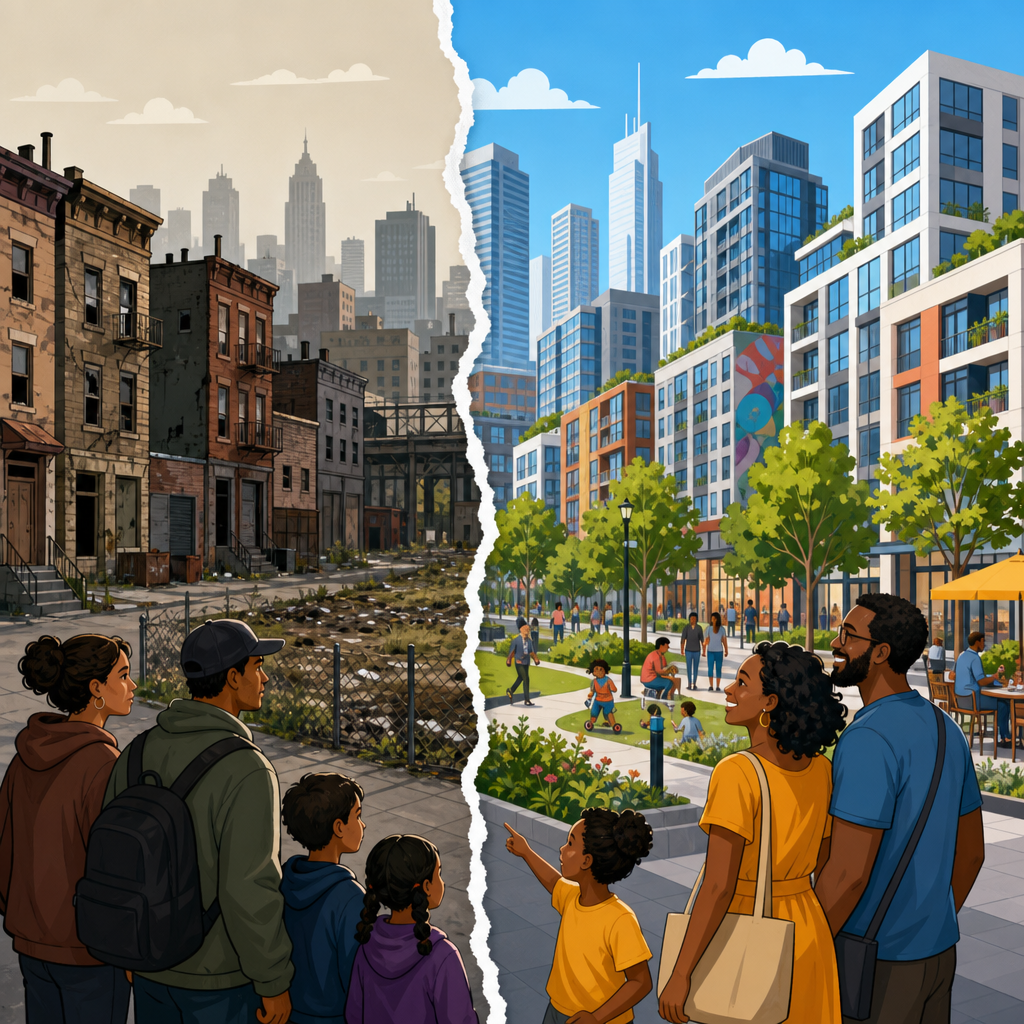
Urban renewal before and after is a story of ambition, demolition, investment, and loss. In planning language, urban renewal refers to public and private efforts to clear, rebuild, or repurpose older city neighborhoods that officials judged as obsolete, unsafe, or economically unproductive. In practice, it often meant using zoning changes, eminent domain, highway construction, tax incentives, and redevelopment authorities to reshape entire districts. I have worked with historic planning documents, displacement maps, and redevelopment plans, and one pattern appears again and again: the stated goal was modernization, but the lived outcome depended on who owned land, who rented housing, who had political influence, and who counted as disposable in the eyes of the state.
The question of who benefited and who was displaced matters because urban renewal still shapes city life today. Property values, transit access, school enrollment, neighborhood wealth, racial segregation, and even local business corridors often reflect decisions made decades ago. The term also remains relevant because contemporary policies such as transit-oriented development, downtown revitalization, climate resilience projects, and public-private partnerships can reproduce similar harms if planners ignore past lessons. Understanding urban renewal before and after is not only about midcentury history in the United States. It is about how cities define improvement, how governments value communities, and how redevelopment can either expand opportunity or transfer it from vulnerable residents to better-capitalized newcomers.
At its core, urban renewal combined physical change with social sorting. Buildings were not the only things removed; social networks, informal economies, faith communities, and multigenerational support systems were disrupted as well. Many projects did replace dangerous housing, upgrade water and sewer systems, and attract employers, universities, hospitals, and cultural institutions. Yet those benefits were unevenly distributed. Homeowners with legal assistance and relocation support fared differently from tenants with limited savings. Large institutions gained assembled land. Suburban commuters gained new road access. Developers gained subsidized sites. Meanwhile, Black neighborhoods, immigrant districts, and low-income communities repeatedly shouldered clearance. To judge urban renewal honestly, cities must compare promised public benefits with measurable social costs and ask who had the power to stay, return, and prosper afterward.
What Urban Renewal Was Designed to Do
Urban renewal emerged from a mix of reformist intent and technocratic confidence. After the Great Depression and World War II, many city leaders believed aging central-city districts were holding back economic growth and public health. Federal policy accelerated this view. In the United States, the Housing Act of 1949 funded slum clearance and redevelopment, and the Housing Act of 1954 broadened the program toward rehabilitation as well as clearance. Local agencies surveyed neighborhoods, designated areas as blighted, acquired property, and transferred land to new users. The vocabulary sounded clinical, but the power was sweeping. A blight designation could set in motion demolitions affecting thousands of residents and businesses.
Planners and elected officials usually presented urban renewal as a rational response to overcrowded housing, fire risk, deteriorated infrastructure, and declining tax bases. In some cases those problems were real and severe. Tenements lacked indoor plumbing. Industrial contamination sat next to homes. Streets were unsafe and public services underfunded. But the framework often treated entire communities as physical problems to be solved from above. Instead of targeted code enforcement, rehabilitation loans, tenant protections, and small-scale infrastructure upgrades, many cities favored clearance because it was easier to map, finance, and market. On paper, superblocks, office towers, convention centers, public housing, university expansion, and expressways looked efficient. On the ground, they often severed the street grids and social relationships that made neighborhoods function.
A crucial point is that urban renewal was not one thing everywhere. In Boston’s West End, Chicago’s Near West Side, San Francisco’s Fillmore, New York’s Lincoln Square, and St. Louis’s Mill Creek Valley, redevelopment took different forms. Some areas became civic complexes. Others became campuses, highways, or mixed-income housing. Yet the process shared common mechanisms: official designation, land assembly, displacement, and reallocation of urban space toward uses considered more valuable by institutions and investors. That is why comparisons across cities remain so instructive.
Who Benefited From Redevelopment
The beneficiaries of urban renewal were rarely a mystery. First were downtown business coalitions and property owners seeking higher land values. Clearing lower-rent districts near central business areas created sites for offices, hotels, government buildings, and medical complexes. Cities could advertise modernization, increase assessed values, and compete for employers. In many redevelopment files I have reviewed, projected tax revenue and visitor spending received pages of analysis, while the social cost of removing renters received only a relocation appendix.
Second were large anchor institutions. Universities and hospitals expanded through adjacent neighborhood clearance in city after city. The result was often a stronger regional economy, more research space, and more jobs, but the jobs did not necessarily go to displaced residents. Third were suburban commuters and motorists, especially where renewal aligned with freeway construction. The interstate era allowed workers to access central-city jobs and amenities while living outside the city tax base. Fourth were middle-class households who gained access to newly built apartments, townhouses, or suburban-style developments marketed as safer and more modern than older urban housing stock.
Some public benefits were real. Replacement infrastructure improved sanitation and utility service. New civic facilities brought libraries, performing arts venues, and government offices. In selected cases, rehabilitation programs preserved housing while upgrading conditions. Philadelphia’s Society Hill is often cited because historic preservation and reinvestment stabilized a declining area, though even there affordability changed and many lower-income residents could not capture the upside. The central lesson is not that every project failed. It is that benefits were concentrated among groups already positioned to use capital, political access, or institutional leverage.
| Group | Typical Benefit | Typical Cost or Risk |
|---|---|---|
| Developers and downtown investors | Subsidized land assembly, higher rents, stronger property values | Project financing exposure if market demand fell short |
| Universities and hospitals | Campus expansion, research space, controlled adjacent land | Long-term community opposition and reputational damage |
| Homeowners in selected renewal zones | Compensation, improved services, rising nearby values in some cases | Forced sale below emotional or future market value |
| Tenants and small businesses | Occasional relocation assistance or access to newer units | Displacement, rent increases, customer loss, weakened social networks |
| Suburban commuters | Faster road access to downtown jobs and cultural institutions | Little direct cost; burdens were shifted onto cleared neighborhoods |
Who Was Displaced and How It Happened
Displacement under urban renewal fell hardest on renters, Black residents, immigrant communities, elders, and small business owners operating on thin margins. This was not accidental. Areas labeled blighted were frequently neighborhoods already weakened by redlining, disinvestment, overcrowding caused by segregation, and exclusion from mortgage credit. Public policy first constrained where people could live and invest, then used the resulting deterioration as justification for clearance. James Baldwin captured the cruelty of this cycle when he described urban renewal as removal of Black people rather than simply removal of blight.
Displacement happened through several channels. The most visible was direct clearance: homes and storefronts were acquired, condemned, and demolished. Another was indirect pressure. Once an area was targeted, maintenance often slowed, financing dried up, and uncertainty spread, making exit more likely. After redevelopment, the replacement housing was usually more expensive, smaller in number, or reserved for different income groups. Small businesses lost walk-in trade during construction and could not afford new leases afterward. Churches and social clubs could not always relocate nearby, breaking the ties that helped residents find jobs, childcare, credit, and care for older relatives.
Consider San Francisco’s Fillmore District, a center of Black culture and jazz in the postwar era. Redevelopment displaced thousands of households and hundreds of businesses over multiple phases. While officials promoted modernization, many former residents never returned. In Detroit, Black Bottom and Paradise Valley were cleared for freeways and redevelopment, erasing a major Black commercial and cultural district. In New York, the Cross Bronx Expressway cut through established communities, reducing housing stability and accelerating disinvestment. These cases differ in design, but they share a measurable reality: displacement was not only residential. It was economic, cultural, and political.
Before and After: What Changed on the Ground
The before-and-after comparison is where urban renewal becomes concrete. Before renewal, many targeted districts had aging housing, crowded conditions, and underfunded infrastructure. They also had dense social capital: corner stores extending informal credit, sidewalks full of repeat encounters, churches coordinating mutual aid, and housing located near jobs or transit. After renewal, physical conditions in some places improved by conventional metrics. Streets were widened, utilities upgraded, and new buildings met contemporary standards. Yet the social geography often changed more dramatically than the built form. Population counts fell. Tenure shifted from renter to owner or from low-cost rental to institutional use. Locally owned storefronts gave way to offices, parking, campuses, or chain retail.
Researchers have shown that displacement effects can last generations. Families forced into more segregated or higher-poverty neighborhoods often faced longer commutes, lower school continuity, and weaker wealth accumulation. Businesses that closed lost customer history that cannot be recreated with a grant. Even where replacement housing existed, eligibility rules, timing gaps, and price differences blocked return. I have seen plans promise that former residents would have priority access, but by completion the units were fewer, qualification standards were stricter, and the original community had scattered.
The after picture also changed urban politics. Once large institutions or higher-income residents occupied renewed districts, they gained stronger influence over policing, zoning, streetscape priorities, and school investment. That shift could lock in advantage. In other words, urban renewal was not a one-time event ending with ribbon cutting. It reset who had a voice in the neighborhood’s future.
Lessons for Urban Planning and Policy Today
Current planners cannot undo every past harm, but they can stop repeating the same logic. The first lesson is that physical improvement is not enough. Any redevelopment plan should measure resident retention, business survival, rent burden, school stability, and right-to-return outcomes alongside tax revenue and construction totals. Second, communities need power early, not ceremonial input after the map is drawn. Participatory budgeting, community benefits agreements, anti-displacement overlays, and tenant legal support work best before land values spike.
Third, rehabilitation is often more equitable than clearance. Tools such as low-interest repair loans, code enforcement paired with grants, preservation tax credits, land trusts, inclusionary zoning, and small-site acquisition can improve conditions without wholesale removal. Fourth, transportation planning must be integrated with housing protection. New rail lines, bus rapid transit, greenways, and climate adaptation projects can all trigger speculative pressure unless cities preserve affordability near investment corridors.
Finally, accountability requires records. Cities should publish parcel-level acquisition histories, relocation outcomes, demographic changes, and promised-versus-delivered benefits. Without that evidence, urban renewal debates become abstract and selective memory wins. Good urban planning and policy starts with naming who gained, who paid, and what safeguards are nonnegotiable next time.
Urban renewal before and after reveals a consistent truth: redevelopment is never only about buildings. It redistributes land, access, risk, and political power. Some projects replaced unsafe housing, modernized infrastructure, and strengthened local economies. Many also displaced renters, fractured Black and immigrant neighborhoods, erased business corridors, and transferred opportunity toward institutions and higher-income newcomers. The fairest reading is neither romantic nostalgia nor blanket condemnation. It is a disciplined comparison between public promises and lived outcomes.
For anyone studying urban planning and policy, this history provides the framework for every related topic in the field: housing, transportation, zoning, preservation, economic development, environmental justice, and public finance. Ask direct questions. Who defines blight? Who receives compensation? Who can return? Which metrics count success? When cities answer those questions clearly, redevelopment becomes more accountable and less extractive. Use this hub as a starting point, then evaluate every urban policy through the same lens: who benefited, who was displaced, and what must change before the next project begins.
Frequently Asked Questions
What does “urban renewal before and after” really mean in historical terms?
“Urban renewal before and after” refers to the transformation of city neighborhoods through deliberate public policy and private redevelopment. The “before” usually describes areas labeled by officials as blighted, obsolete, overcrowded, or economically stagnant. These places were often older districts with aging housing stock, mixed-use commercial corridors, industrial sites, and long-established communities. In planning documents, the language emphasized modernization, safety, sanitation, traffic efficiency, and higher-value land use. The “after” points to the physical and economic results: cleared land, new road systems, office towers, public housing, university expansions, civic centers, suburban-style apartment complexes, or later waves of luxury development.
Historically, this process accelerated in the mid-20th century, especially after federal legislation made large-scale clearance financially and legally feasible. Cities used redevelopment authorities, zoning revisions, eminent domain, and infrastructure spending to remake entire districts. The idea was not simply to repair buildings but to reorder urban space according to new economic priorities. In many cases, older blocks were treated as problems to be erased rather than communities to be strengthened. That is why the phrase carries both a visual and moral contrast: before, a neighborhood may have looked worn but functioned as a social world; after, it may have appeared newer and more profitable while the original residents, businesses, and cultural institutions were gone.
Understanding the phrase also requires separating official narratives from lived experience. On paper, renewal promised progress. In reality, outcomes were uneven. Some cities gained tax revenue, institutional expansion, and updated infrastructure, while displaced residents lost homes, local networks, and access to central-city opportunity. The “before and after” frame is therefore not just about architecture. It is about power, whose definition of improvement prevailed, and what kinds of urban life were preserved, replaced, or pushed aside.
Who typically benefited from urban renewal projects?
The main beneficiaries of urban renewal were usually institutions and groups with political influence, access to capital, or a direct stake in land redevelopment. City governments often benefited by increasing property tax potential, attracting employers, modernizing business districts, and signaling that the city was open to investment. Downtown property owners, real estate developers, construction firms, and financial institutions frequently gained from land assembly, public subsidies, favorable zoning, and infrastructure improvements that raised land values. In many cities, major anchor institutions such as hospitals, universities, and government agencies also benefited when surrounding neighborhoods were cleared to allow for campus growth, parking, research facilities, or administrative complexes.
Middle-class commuters and suburban residents were also indirect beneficiaries in some cases, especially where renewal overlapped with highway construction and downtown restructuring. Roads, garages, and office-centered redevelopment often made central business districts more accessible to nonresident workers and consumers, even as they disrupted the people who actually lived there. Political leaders could claim visible success through ribbon-cutting projects, modern towers, convention centers, or civic plazas. These highly legible physical changes often mattered more in public narratives than whether previous residents were able to remain in place.
It is also important to note that benefits were not always immediate or universal, even among supporters. Some projects underperformed economically, leaving cleared land vacant for years or producing less public value than promised. Still, when benefits did materialize, they tended to accrue upward to investors, institutions, and constituencies positioned to shape planning decisions. That pattern is one reason urban renewal remains so controversial: the rewards were often concentrated, while the costs were socialized through displacement, cultural loss, and the weakening of neighborhood continuity.
Who was displaced by urban renewal, and why were certain communities targeted more often than others?
The people most often displaced by urban renewal were low-income residents, renters, working-class families, immigrants, and Black communities, along with other racially marginalized groups depending on the city. Small business owners, church congregations, social clubs, and neighborhood institutions were also uprooted. These communities were targeted more often not because they lacked value, but because they had less political power to resist clearance and were more likely to live in areas that officials deemed expendable. The language of blight frequently masked deeper patterns of racial discrimination, uneven public investment, and land speculation.
Many neighborhoods selected for renewal had already been shaped by redlining, disinvestment, overcrowding, exclusion from mortgage credit, and neglect of basic services. Governments and lenders had helped create the very conditions later cited as justification for demolition. Once an area was marked as declining or underproductive, it became easier for planners and redevelopment authorities to present clearance as rational and necessary. In practice, areas near downtown, transit corridors, industrial zones, universities, or future highway routes were especially vulnerable because their location made them attractive for redevelopment once existing residents could be removed.
Displacement was not only residential. It was cultural, economic, and psychological. Families lost nearby childcare, elder support, familiar businesses, and institutions that anchored community life. Renters often received the least protection because they had limited legal leverage and little chance of returning once new development was completed. Homeowners might receive compensation, but payment rarely reflected the full value of social ties, business goodwill, or future access to centrally located property. This is why critics often describe urban renewal as more than redevelopment; in many cases, it functioned as a transfer of land and opportunity away from less powerful communities toward actors with greater economic and political influence.
Did urban renewal improve cities, or did it do more harm than good?
The answer depends on what outcomes are being measured and whose perspective is centered. Urban renewal did produce visible physical changes in many cities. It helped finance new infrastructure, clear unsafe structures, support downtown reinvestment, and make way for hospitals, universities, public facilities, highways, and commercial projects that local officials believed were essential to modernization. In some places, these interventions addressed genuine problems such as deteriorated housing conditions, inadequate sanitation, obsolete industrial land use, or severe overcrowding. If the measure is physical redevelopment alone, urban renewal often looked successful from a governmental or investor standpoint.
However, if the measure includes social continuity, housing justice, cultural preservation, and equitable access to the benefits of redevelopment, the record is far more damaging. Many projects destroyed functioning neighborhoods instead of rehabilitating them. Clearance often outpaced replacement housing, and relocation programs were frequently inadequate. Residents forced out of one area commonly encountered higher rents, segregated housing markets, longer commutes, and reduced access to jobs and services. Neighborhood businesses that depended on local foot traffic disappeared, and with them went informal economies and social networks that had sustained community life for decades.
For this reason, most serious historical assessments treat urban renewal as a mixed but deeply unequal legacy. It may have improved land values, circulation patterns, and institutional growth, but those gains were often achieved by imposing steep costs on communities least able to absorb them. Today, many planners and historians argue that the central lesson is not that cities should never change, but that redevelopment without resident protection, meaningful participation, and anti-displacement policy can create long-lasting harm. The debate is no longer simply whether cities should invest in older neighborhoods. It is whether that investment can happen without repeating a model in which physical improvement for some depends on dispossession for others.
What lessons does the history of urban renewal offer for redevelopment today?
The biggest lesson is that redevelopment should be judged not only by what gets built, but by who gets to stay, who gains access to new opportunity, and who has real power in the planning process. The history of urban renewal shows that top-down decision-making can produce technically impressive projects while erasing communities and deepening inequality. Modern redevelopment efforts are increasingly evaluated through questions of displacement risk, tenant protections, community ownership, affordable housing requirements, historic preservation, and public accountability. In other words, the lesson is not to reject change altogether, but to reject change that treats existing residents as obstacles rather than stakeholders.
Another major lesson is that neighborhood decline is often the result of policy choices, not simply local failure. Disinvestment, exclusionary lending, racial segregation, neglected infrastructure, and uneven code enforcement can weaken communities over time. If public policy helped produce vulnerability, then equitable policy should help repair it. That means supporting rehabilitation alongside new construction, preserving small businesses, funding repairs for existing homeowners, protecting renters from speculative displacement, and ensuring that public subsidies come with enforceable community benefits. It also means recognizing that cultural landmarks, social ties, and informal support systems are part of a neighborhood’s value, even if they do not appear neatly on a balance sheet.
Finally, the history of urban renewal reminds planners, elected officials, and developers that trust is difficult to rebuild once communities have experienced forced removal. Public engagement cannot be symbolic. It must influence outcomes early, before routes are drawn, parcels assembled, or financing structures locked in. Transparent data, anti-displacement strategies, right-to-return policies, and long-term affordability measures are some of the tools cities now use to avoid repeating past mistakes. The enduring question is the same one raised by urban renewal before and after: redevelopment for whom? The most responsible contemporary answer is that cities should grow in ways that expand safety, opportunity, and investment without requiring the people who built neighborhood life to be pushed out in the process.


