
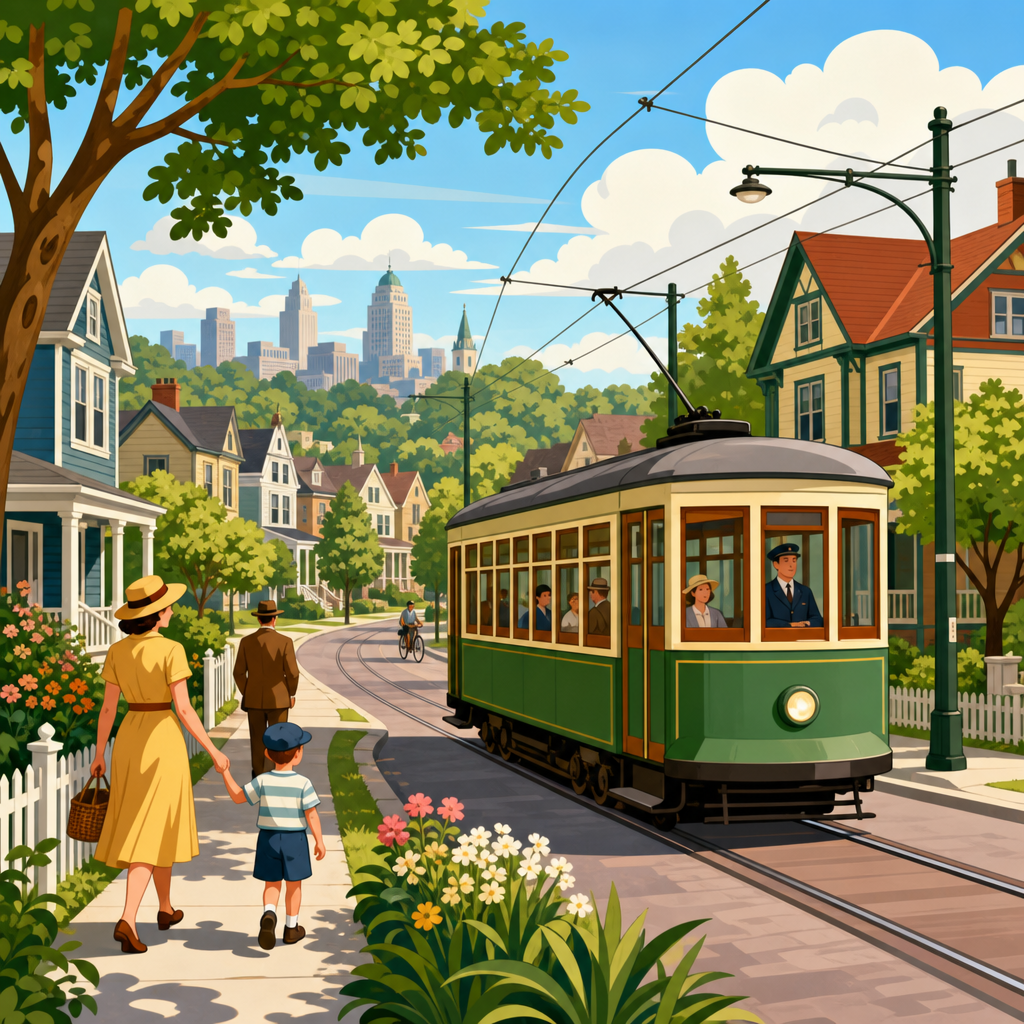
Streetcar suburbs were the first large-scale pattern of outward urban growth organized not by walking distance or private automobiles, but by electric rail transit, and understanding them explains why many North American neighborhoods still look, function, and value property the way they do today. In planning practice, the term “streetcar suburb” refers to residential districts built mainly from the 1890s through the 1930s along fixed rail lines that connected homes to downtown jobs, retail, and civic institutions. These districts usually combined compact lots, gridded or gently curving street networks, neighborhood commercial nodes, front porches, sidewalks, and housing types ranging from detached houses to duplexes and small apartment buildings. I have evaluated these neighborhoods in zoning updates, corridor studies, and historic district discussions, and the same transportation logic appears repeatedly: when daily travel depends on scheduled transit and walking at each end, urban form becomes finer-grained, more mixed, and more accessible than later automobile-oriented subdivision patterns. That logic matters now because planners, policymakers, and residents are trying to add housing, reduce traffic deaths, cut household transportation costs, and revive older commercial corridors without erasing neighborhood character. Streetcar suburbs offer a concrete model of how land use and transportation co-evolve. They also reveal limitations, including speculative development, social exclusion, and uneven public investment. As a hub within urban planning and policy, this article defines the core concepts, traces the mechanics that produced these places, and outlines why their inherited street patterns remain central to contemporary debates over transit-oriented development, missing-middle housing, parking reform, infrastructure maintenance, and equitable access to opportunity.
The transportation logic behind the streetcar suburb
The basic transportation logic was simple but powerful: fixed rail could move large numbers of people reliably over distances too long to walk daily, yet stations were close enough that most riders could reach them on foot. Before electric streetcars, urban growth was constrained by walking, horse-drawn street railways, and commuter rail serving a narrower market. Electrification changed the equation. Frank J. Sprague’s successful electric street railway system in Richmond, Virginia, in 1888 demonstrated that streetcars could climb grades, run frequently, and operate more efficiently than horsecar lines. Once that technology spread, developers no longer had to build only at the urban edge. They could plat land several miles from the central business district, advertise a healthy residential environment, and rely on the streetcar to bind that land to the city’s job market.
Because travel time rather than pure distance became the key constraint, development clustered within a short walk of the line, often described today as a five- to ten-minute walkshed. In practical terms, that usually meant roughly a quarter mile on either side of the route for the highest intensity, tapering farther where blocks were small and connections direct. Commercial uses gathered at transfer points, line intersections, or terminal loops because those were the places with the highest pedestrian traffic. Schools, churches, and small civic buildings followed population growth into these corridors. This is why many older neighborhoods still have corner stores converted to cafes, fourplexes on side streets, and modest apartment buildings near former track alignments. The transportation system did not merely serve development after the fact; it structured parcelization, lot depth, retail frontage, and building placement from the outset.
How transit companies and developers shaped land use
Streetcar suburbs were rarely accidental. In many cities, transit operators, utility holding companies, and real estate developers were financially intertwined. The street railway business was capital intensive and often struggled with fare regulation, but land development generated profits. A company could extend a line into inexpensive peripheral land, subdivide adjacent acreage, and capture rising land values as accessibility improved. This model appeared in places as different as Los Angeles, Cleveland, Philadelphia, Toronto, and Washington, D.C. In Los Angeles, the Pacific Electric and Los Angeles Railway systems supported a vast geography of growth; in the Washington region, lines opened suburban territory in Montgomery County and northern Virginia long before freeway commuting dominated.
Developers marketed these districts with a consistent set of promises: clean air compared with crowded industrial centers, quick access to downtown, modern utilities, and respectable residential surroundings. Advertisements highlighted travel times because transportation certainty sold houses. They also highlighted public improvements such as graded streets, street trees, sewers, and electric lighting, all signals that the suburb was both accessible and orderly. In my experience reviewing archival plats and sales brochures, the documents read like integrated transportation-and-housing plans long before that phrase existed. The route map was a value proposition. A line every ten or fifteen minutes could support daily life without requiring every household to own a horse, carriage, or later an automobile.
That integration also had policy consequences. Franchise agreements, fare caps, municipal annexation, and special assessment districts affected whether lines expanded and whether adjacent neighborhoods urbanized quickly or slowly. Where local governments coordinated street paving, utility extension, and school siting with the rail line, the result was often a coherent neighborhood fabric. Where speculation outran infrastructure, early residents sometimes endured muddy streets and incomplete services despite excellent transit access.
Physical design traits that still define these neighborhoods
Streetcar suburbs are recognizable because their physical form reflects the needs of riders and pedestrians. Blocks are usually shorter than in postwar suburbs, which multiplies route choices and disperses traffic. Sidewalks are standard rather than optional. Houses sit closer to the street, often with shallow setbacks and usable front porches that create social contact between private and public space. Alleys are common in many regions, allowing utilities, service access, and garages behind houses rather than dominating the frontage. Commercial buildings line sidewalks directly, with narrow bays suited to local retailers. These are not aesthetic coincidences; they are operational responses to a transportation system in which people arrived on foot.
Housing diversity is another signature trait. Because a fixed transit line increased accessibility for many household types, builders supplied detached homes, rowhouses, courtyard apartments, duplexes, and mixed-use main streets within the same district. That mix supported ridership at different times of day and created a larger customer base for local stores. It also provided incremental affordability, though not universal affordability. Many streetcar suburbs were marketed to middle-class buyers, and racial covenants, exclusionary practices, and lending discrimination restricted who could live there. The built form was adaptable; the social system was often exclusionary. Good planning analysis has to hold both truths at once.
| Feature | Typical streetcar suburb pattern | Why it followed transportation logic |
|---|---|---|
| Block size | Short to moderate blocks in connected networks | More direct walks to stops and shops |
| Lot layout | Narrower lots with shallow setbacks | Higher population within walking distance of the line |
| Retail location | Nodes at intersections and stops | Retail needed concentrated foot traffic |
| Housing mix | Detached homes, duplexes, small apartments | Diverse households supported ridership and local commerce |
| Parking | Minimal or rear-loaded | Automobile storage was not the organizing design element |
Representative examples across North America
Many well-known neighborhoods began as streetcar suburbs, although each adapted to local geography and market conditions. Shaker Heights outside Cleveland is a classic case where transit and development were explicitly coordinated, with rail access, landscaped boulevards, and controlled subdivision standards shaping a prestigious commuter suburb. In contrast, neighborhoods along streetcar corridors in Portland, Oregon, and Seattle developed as a patchwork of commercial strips and modest residential blocks, showing that the model worked for middle-income and working households as well as elites. In Toronto, areas such as The Annex and Riverdale expanded through street railway access and still exhibit mixed housing, active shopping streets, and low car dependence by North American standards.
Washington, D.C., offers especially clear evidence. Places like Mount Pleasant, Columbia Heights, Brookland, and Chevy Chase developed around streetcar service and retain walkable commercial corridors, fine-grained residential streets, and enduring transit orientation even after routes changed. Property values in these neighborhoods today reflect access to multiple transportation options, not just architectural charm. The same is true in parts of Philadelphia, where trolley corridors structured West Philadelphia’s rowhouse districts and mixed-use avenues. In New Orleans, the St. Charles line did not just preserve nostalgia; it maintained a transportation spine that continues to shape land use and tourism economics.
These examples matter because they show that streetcar suburbs were not one architectural style or one social class. They were a metropolitan growth mechanism. Their common denominator was the fixed-guideway relationship between accessibility and urban form. Where that relationship remained legible, neighborhoods have generally aged well because connected streets, nearby retail, and adaptable building stock make them resilient to changing demographics and travel behavior.
Why streetcar suburbs differ from railroad suburbs and auto suburbs
Streetcar suburbs are often confused with railroad suburbs, but the distinction is important. Railroad suburbs grew around commuter rail stations spaced farther apart, with service aimed at central-city commuters, often at higher fares. That pattern typically produced more concentrated station villages separated by larger low-density residential areas. Streetcar suburbs had more frequent stops, lower fares, and service integrated into city streets, so development spread more continuously along corridors. The result was a broader band of urbanized land with neighborhood-scale retail and a higher baseline level of walkability.
The contrast with postwar auto suburbs is even sharper. Once widespread car ownership, mortgage finance, highway investment, and zoning codes favored low-density single-use development, the transportation logic changed. Cul-de-sacs replaced connected grids. Parking minimums consumed land. Commercial activity moved into separated centers surrounded by large lots. Trip-making became car dependent because origins and destinations were physically isolated. In transportation modeling terms, streetcar suburbs internalized many short trips; auto suburbs externalized them onto arterial roads.
This difference affects current policy. Retrofitting an auto suburb for transit is difficult because the land use pattern does not generate convenient walks to stops. By contrast, restoring frequent transit in a former streetcar corridor often succeeds because the urban bones were designed for it. That is why bus rapid transit, modern streetcar proposals, and frequent local bus upgrades frequently perform best in older corridor neighborhoods with inherited density, mixed uses, and connected street networks.
Contemporary planning lessons and policy relevance
Streetcar suburbs matter today because they demonstrate that transportation and housing supply are inseparable. If a region wants more homes in locations where households can spend less on driving, then zoning has to permit the building types these neighborhoods historically contained: accessory dwelling units, duplexes, fourplexes, small apartment houses, and mixed-use corner buildings. Many municipalities now legalize some of these forms under missing-middle housing reforms, essentially rediscovering what streetcar suburbs normalized a century ago. The policy lesson is not to copy historic architecture, but to allow the same level of functional diversity.
Parking reform is another lesson. Most streetcar suburbs were built without front-loaded driveways, mandatory off-street parking, or wide curb cuts. That made walking safer and storefronts more continuous. Requiring excessive parking in these areas undermines their inherited logic by inflating redevelopment costs and reducing active frontage. Similarly, transit service planning should respect corridor intensity. Frequent service every ten to fifteen minutes supports spontaneous use and reduces the penalty of transfers; infrequent service breaks the very relationship that made the district viable.
There are also equity lessons. Historic streetcar suburbs often benefited from public investment while marginalized neighborhoods received poorer infrastructure or were later disrupted by urban renewal and highway construction. Current reinvestment can raise property values and risk displacement. Effective policy therefore pairs corridor improvement with anti-displacement tools such as inclusionary requirements where legally available, preservation of naturally occurring affordable housing, community land trusts, and targeted property tax relief for vulnerable owners. In practice, the strongest plans combine land use reform, transit operations, public realm upgrades, and housing protections rather than treating them as separate programs.
How to read a streetcar suburb today
If you want to identify a streetcar suburb in the field, start with the map. Look for a commercial spine, a connected street grid, small blocks, and a band of older housing extending outward in walkable increments. Then look for clues in building form: corner stores, porch-fronted houses, small multifamily structures, churches near intersections, and schools embedded in the neighborhood rather than isolated behind parking lots. Former track alignments may survive as unusually wide streets, planted medians, overhead wire infrastructure remnants, or commercial nodes at regular spacing.
For planners and residents, reading these landscapes correctly helps avoid bad policy decisions. A corridor of older mixed buildings is not “underutilized” simply because it lacks large setbacks and parking fields. It may already be operating efficiently by producing high accessibility per acre. Likewise, modest density in these districts is not an anomaly to be downzoned away; it is the reason local businesses, transit, and walkability can coexist. When communities understand the transportation logic that built streetcar suburbs, they can make better choices about infill, preservation, transit priority, and public investment.
Streetcar suburbs remain one of the clearest demonstrations that transportation technology shapes urban form for generations. Built around electric rail and walking, they created neighborhoods with connected streets, mixed housing, local retail, and enduring accessibility. Their success was not accidental, and their limitations were not minor. Speculation, exclusion, and uneven investment were part of the story alongside design quality and mobility benefits. For contemporary urban planning and policy, the central lesson is practical: if cities want more livable, transit-supportive, and adaptable neighborhoods, they should align land use rules, street design, and transit service the way streetcar-era development once did. Study the corridor pattern, protect the features that make it work, and update regulations so these places can evolve rather than freeze. Use this hub as a starting point for deeper exploration of transit-oriented development, zoning reform, parking policy, historic preservation, and equitable neighborhood reinvestment.
Frequently Asked Questions
What is a streetcar suburb, and how is it different from other kinds of suburbs?
A streetcar suburb is a residential district that developed primarily between the 1890s and the 1930s along electric rail lines, especially streetcar routes linking outlying neighborhoods to downtown employment, shopping, and civic institutions. What makes it distinct is the transportation logic behind its growth. Earlier urban neighborhoods were generally constrained by walking distance, which meant people needed to live close to work and daily services. Later auto-oriented suburbs were designed around private car ownership, with wider roads, larger setbacks, separated land uses, and greater distances between destinations. Streetcar suburbs fall between those two eras. They expanded the city outward, but they did so in a way that still depended on fixed-route transit and human-scale access.
In practical terms, this meant a recognizable physical form. Homes were often located on connected street grids, with blocks laid out to funnel residents toward a streetcar line or commercial node. Lots were usually narrower and houses sat closer to the street than in postwar suburbs. Corner stores, small business districts, schools, churches, and parks were commonly placed within walking distance of stops. Even where land use was mostly residential, the neighborhood was not designed on the assumption that every trip required a car. That is why many streetcar suburbs today still feel more walkable, more interconnected, and more urban in function than later suburban developments, even if they lie outside the historic core city.
Why did streetcar suburbs emerge when they did?
Streetcar suburbs emerged because electric traction changed the economics and geography of urban growth. Before electric streetcars, horse-drawn transit was slower, more expensive to operate, and less capable of supporting long-distance daily commuting. The spread of electric rail in the late 19th century made it possible for workers and middle-class households to live farther from the dense, noisy, and often polluted center city while still maintaining reliable access to downtown jobs and services. This was a major shift: urban expansion was no longer limited strictly by what people could comfortably walk every day.
At the same time, rising industrial cities were experiencing population growth, immigration, increased land values in central districts, and strong demand for new housing. Developers, transit companies, and municipal governments all had incentives to support outward expansion. In many cases, real estate interests and streetcar operators were closely linked. A transit line made peripheral land more valuable, and new housing along the route generated riders and revenue. This relationship encouraged coordinated development in which transportation and land subdivision advanced together. The result was not random sprawl, but a fairly organized pattern of linear and nodal growth radiating from the urban core.
Streetcar suburbs also reflected changing social aspirations. Many households wanted more space, cleaner air, and a residential environment separated from industrial activity without giving up access to the city. Electric rail made that tradeoff possible for a large share of the urban population. So the timing of streetcar suburbs was not accidental; it came from a convergence of new technology, urban land economics, demographic growth, and changing expectations about where city residents could live.
How did streetcar lines shape the layout and everyday function of these neighborhoods?
Streetcar lines did much more than move passengers; they organized neighborhood form. Because access to the line was essential, development tended to cluster within a comfortable walking radius of stops and corridors. This often produced elongated growth patterns along major avenues, with denser housing, retail storefronts, and community institutions concentrated near the route. Residential side streets extended outward from these corridors, typically in gridded or modified-grid patterns that made walking to transit straightforward. In many cities, the main commercial street of a neighborhood is still the old streetcar corridor.
This pattern influenced daily life in durable ways. Residents could walk from home to the line, ride into downtown for work or shopping, and also meet many local needs within the neighborhood itself. Because frequent transit required a critical mass of riders, these districts usually developed with enough density to support both the line and nearby businesses. That is why streetcar suburbs often include a mix of detached houses, duplexes, small apartment buildings, schools, churches, and neighborhood retail in relatively close proximity. The transportation system rewarded compactness, connectivity, and a certain level of mixed activity.
Importantly, the fixed nature of rail mattered. Unlike a bus route that can be moved relatively easily, a rail line signaled permanence. Developers and homebuyers could make long-term decisions with greater confidence because the transit investment was visible and embedded in the street. That perceived stability helped shape property values, settlement patterns, and commercial investment. Even after many original streetcar systems disappeared, the land-use framework they created often remained. The streets, lot sizes, business nodes, and neighborhood institutions continued to reflect the logic of a transit-shaped environment.
Why do streetcar suburbs still matter in modern planning and real estate?
Streetcar suburbs still matter because they offer a living record of how transportation infrastructure shapes land use, neighborhood value, and long-term urban form. Many of the most sought-after neighborhoods in North American cities today are former streetcar suburbs. They often have qualities that remain highly desirable: walkable streets, mature tree canopies, access to neighborhood retail, a range of housing types, and good connections to major employment areas. These attributes are not just aesthetic accidents. They are the built outcome of development patterns designed around transit access and short local trips rather than around high-speed automobile travel.
From a planning perspective, these neighborhoods are frequently studied as models for “missing middle” housing, transit-supportive density, and mixed-use design. They demonstrate that relatively compact development can still feel residential and livable. They also show that a suburb does not have to be auto-dependent to function successfully. This is especially relevant today as cities confront housing affordability pressures, climate goals, congestion, and renewed interest in public transit. Planners often look to streetcar suburb precedents when discussing infill development, corridor revitalization, zoning reform, and the reintroduction of small-scale neighborhood commercial uses.
In real estate terms, the legacy is equally important. Properties in former streetcar suburbs often command strong demand because they combine suburban features such as detached homes and quieter residential blocks with urban advantages such as walkability and access. Their enduring market appeal helps explain why these areas frequently retain value well over time. Understanding the streetcar suburb therefore helps explain current property patterns, neighborhood identity, and municipal debates about preservation, redevelopment, and transportation investment.
Did streetcar suburbs disappear when cars became dominant, or do their effects still shape cities today?
Streetcar suburbs did not simply vanish when the automobile became dominant. In many places, the original streetcar systems were dismantled, reduced, or replaced by buses, but the neighborhoods built around them remained. Streets stayed where they were, commercial corners persisted, housing stock endured, and the basic relationship between homes and local destinations often continued to define how the area functioned. In that sense, the streetcar might have gone away, but the spatial logic it established proved remarkably durable.
What changed was how those neighborhoods were used and understood. As car ownership expanded in the mid-20th century, many streetcar suburbs adapted by adding driveways, garages, widened roads, or more parking around commercial strips. Some became less transit-reliant, and others experienced disinvestment as metropolitan growth shifted farther outward into highway-oriented suburbs. Yet the underlying bones of the neighborhood often remained stronger than those of later sprawl because they had been built with connectivity, compact blocks, and proximity in mind. That resilience is one reason many former streetcar suburbs have become attractive again in the 21st century.
Today, their influence is visible across North American urban regions. You can often identify a former streetcar suburb by its main street corridor, older housing stock, fine-grained block structure, and a pattern of density that increases near historic transit avenues. These places continue to shape commuting options, redevelopment opportunities, and public debates about how cities should grow. Rather than being relics of a vanished transit era, streetcar suburbs are active participants in the present city. They help explain why certain neighborhoods remain adaptable, valuable, and central to contemporary planning discussions.


