
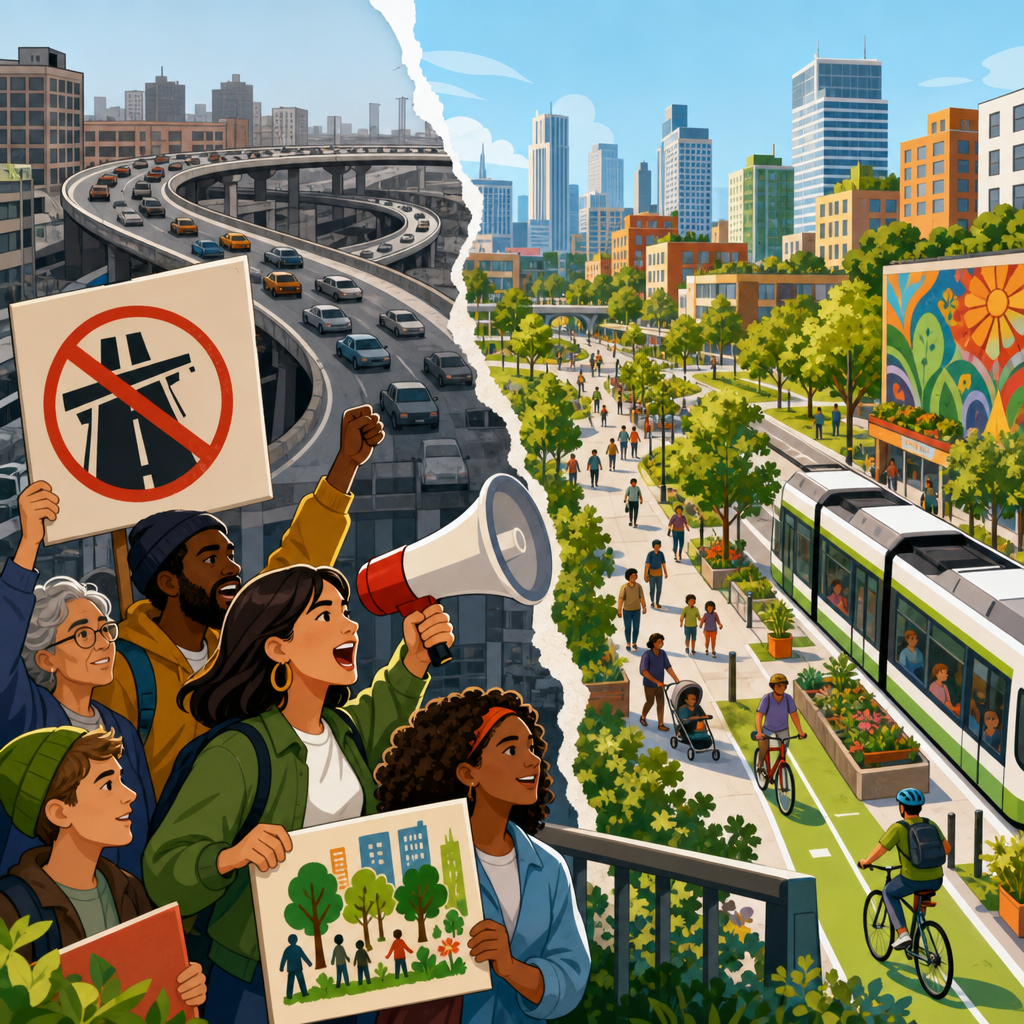
Freeway revolts changed urban planning history by proving that city transportation decisions could no longer be made solely by engineers, highway agencies, and downtown growth coalitions. The term freeway revolt refers to organized public opposition to proposed urban expressways, especially the movements that spread across North American and European cities from the 1950s through the 1970s. These campaigns often united neighborhood groups, preservationists, civil rights advocates, environmental activists, and local officials against projects that promised faster car travel but threatened homes, parks, business districts, and social stability. As someone who has worked through historic transportation plans and environmental review archives, I can say these revolts were not isolated protests. They marked a structural turning point in how cities define mobility, public interest, and the right to shape urban space.
Before these movements, postwar planning culture largely treated urban freeways as unquestioned infrastructure. Traffic forecasting models projected ever-rising car ownership, federal funding strongly favored road construction, and many planners accepted demolition as the price of modernization. Entire neighborhoods could be mapped as right-of-way corridors with limited public discussion. Freeway revolts challenged that logic in practical and moral terms. Residents asked direct questions that had often been sidelined: Who benefits from a six-lane expressway? Who bears the displacement, pollution, noise, and severed street networks? What happens to local businesses, tax bases, and community institutions when a highway trench cuts through them? Once those questions entered mainstream planning, urban policy could not return to business as usual.
The significance of freeway revolts goes beyond stopping roads. They helped shift the field toward public participation, environmental review, historic preservation, transit investment, neighborhood conservation, and a broader understanding of induced demand, equity, and quality of life. They also exposed the limits of narrowly technical planning. A corridor that looks efficient on a traffic map can be destructive on the ground. Understanding why freeway revolts changed urban planning history is essential because many current debates over highway widening, congestion pricing, bus lanes, and street redesign repeat the same core conflict: whether cities exist primarily to move vehicles quickly or to support human life at many scales.
The postwar freeway era and the planning assumptions it challenged
To understand the revolts, it helps to see what they were pushing against. After World War II, many governments embraced urban expressways as symbols of prosperity and efficiency. In the United States, the 1956 Federal-Aid Highway Act provided massive funding for the Interstate system, and many metropolitan regions used those funds to drive limited-access highways directly into city centers. Similar modernist projects appeared in Canada, the United Kingdom, France, and elsewhere. Professional guidance often relied on level of service, forecast travel times, and metropolitan growth projections. If a corridor reduced projected congestion, agencies considered it rational. Social costs were secondary, and environmental impacts were poorly measured by today’s standards.
In practice, this model produced repeated patterns. Routes were frequently placed through lower-income neighborhoods, immigrant districts, or Black communities with less political power and lower land acquisition costs. Elevated structures darkened streets. Sunken expressways created barriers that were difficult to cross on foot. Interchanges consumed taxable land and reshaped local circulation. Downtown leaders often supported these projects because they improved suburban commuter access and reinforced central business districts. Yet the same roads accelerated suburbanization, weakened neighborhood retail, and invited a cycle of disinvestment and sprawl. The contradiction became increasingly visible as residents experienced the consequences firsthand.
What the freeway revolts challenged was not only a physical project list but an entire planning philosophy. Protesters disputed the assumption that more road capacity automatically solved congestion. They questioned whether cost-benefit analysis counted the right things. They rejected the idea that displacement could be treated as an administrative detail. Over time, these objections forced agencies to widen their methods. Transportation planning began to account more seriously for social impact, environmental harm, urban design, and alternatives analysis. That methodological shift remains one of the revolts’ deepest legacies.
How local resistance became a powerful urban policy movement
Freeway revolts succeeded when local grievances connected to broader political narratives. A threatened neighborhood church, market street, or rowhouse block gave campaigns a visible stake. Residents organized meetings, circulated petitions, challenged route maps, and pressured city councils. Lawyers contested takings and procedural flaws. Journalists documented the human cost of clearance. Academics and reform planners provided counterevidence on traffic demand, land use, and community disruption. What began as site-specific opposition often matured into a critique of top-down planning itself.
San Francisco is the classic example. Public backlash against the Embarcadero Freeway and other proposed routes grew because residents and officials saw how elevated structures damaged the waterfront and threatened established neighborhoods. The city’s Board of Supervisors eventually halted several segments, helping define the phrase freeway revolt in popular memory. New York offers another landmark case through Jane Jacobs’s opposition to Robert Moses’s Lower Manhattan Expressway. Jacobs and allied residents argued that routing a high-capacity road through SoHo and Little Italy would destroy functioning urban districts in the name of abstract traffic efficiency. The project’s defeat protected a fine-grained street network and some of the most valuable urban fabric in the world.
Similar battles shaped Toronto, where opposition helped stop the Spadina Expressway after Premier Bill Davis declared that cities were built for people, not just cars. In Baltimore, Boston, New Orleans, Washington, DC, and Vancouver, highway cancellations or reductions redirected urban policy. The movement crossed ideological lines. Conservatives objected to property takings and fiscal waste. Progressives focused on displacement, segregation, and democratic accountability. Preservationists defended historic districts, while environmental groups raised alarms about air pollution and urban open space. That unusual coalition made freeway revolts politically durable.
The landmark cases that permanently changed planning practice
Not every revolt fully stopped a highway, but even partial victories altered planning standards. Boston’s Inner Belt and Southwest Expressway controversies are instructive. Public opposition, combined with changing state leadership, led to a moratorium on urban highway building in the early 1970s. The canceled Southwest Expressway corridor later supported the Orange Line relocation and the Southwest Corridor Park, a powerful example of replacing expressway capacity with multimodal investment and public space. This was not merely symbolic. It demonstrated that a corridor reserved for cars could be repurposed for transit, recreation, and neighborhood reconnection.
Portland followed a different but equally influential path. The proposed Mount Hood Freeway was canceled in the 1970s, and a significant portion of the funds was redirected toward transit, including what became MAX light rail. Planners across the country studied Portland because it showed that rejecting a freeway did not mean rejecting mobility. It meant redefining mobility around mode choice, compact development, and long-term urban form. Vancouver reinforced this lesson by largely avoiding downtown freeways, preserving a more continuous waterfront and street grid than many peer cities. The city still faces congestion, but its urban structure supports walking, cycling, and transit in ways that highway-dominated downtowns struggle to match.
| City | Contested project | Outcome | Planning legacy |
|---|---|---|---|
| San Francisco | Embarcadero and related freeway proposals | Segments halted or later removed | Waterfront reconnection and anti-freeway precedent |
| New York | Lower Manhattan Expressway | Canceled | Protection of dense mixed-use neighborhoods |
| Toronto | Spadina Expressway | Partially stopped | People-first planning language entered policy |
| Boston | Inner Belt and Southwest Expressway | Canceled after resistance | Transit and park investment in reserved corridor |
| Portland | Mount Hood Freeway | Canceled | Funding shift toward regional light rail |
These cases mattered because they produced administrative consequences. Agencies had to justify need more rigorously, compare alternatives more transparently, and recognize that public opposition could overturn long-assumed projects. The victories also influenced university planning programs, which began teaching urban transportation as a social and political field, not just a geometric design problem.
Why freeway revolts reshaped environmental, social, and democratic standards
One of the clearest reasons freeway revolts changed urban planning history is that they helped institutionalize process reforms. In the United States, the National Environmental Policy Act of 1969 required environmental impact analysis for major federal actions, including many transportation projects. The Clean Air Act, Section 4(f) protections for parks and historic sites, and later environmental justice frameworks further raised the bar. These laws did not arise only because of freeway protests, but the public conflicts around urban highways made their necessity tangible. Agencies could no longer assume that technical drawings and traffic counts were enough.
Public participation also became more formalized. Today, metropolitan planning organizations, state departments of transportation, and local agencies routinely conduct hearings, workshops, comment periods, and stakeholder outreach. The quality of participation varies, and communities still criticize token consultation, but the baseline expectation changed. When I review older highway plans, the contrast is stark: many midcentury documents treated residents as obstacles to manage, whereas contemporary practice at least requires a public record, alternatives evaluation, and documented mitigation strategies.
The social equity implications are equally important. Freeway revolts exposed how infrastructure can reproduce inequality. Highways often displaced communities that had already endured redlining, urban renewal, and underinvestment. The burden was cumulative. Modern planning now uses terms such as community cohesion, distributive impact, cumulative burden, and context-sensitive solutions because the profession learned, often painfully, that transportation networks are not neutral. They distribute access, health risk, and political power. Even current freeway removal projects, such as Rochester’s Inner Loop East conversion or Syracuse’s I-81 replacement debate, directly trace their rationale to lessons first sharpened during the revolt era.
The limits of the revolts and what they did not solve
It is important to avoid mythology. Freeway revolts did not end car dependence, suburban sprawl, or inequitable planning. In some cities, affluent neighborhoods were more successful at stopping highways than poorer districts, which meant power still shaped outcomes. Some canceled projects simply shifted traffic or development pressure elsewhere. In other cases, a revolt blocked one roadway while leaving untouched the zoning rules and parking mandates that continued to favor automobile travel. There were also places where partial freeway construction left damaging stubs, cleared land, or fragmented networks without delivering the promised connectivity.
The planning profession also absorbed the revolts unevenly. Environmental review can improve decisions, but it can also become slow, expensive, and procedural if agencies treat compliance as paperwork rather than genuine analysis. Public engagement can reveal local knowledge, but it can also privilege organized incumbents over renters, commuters, or future residents who are less visible in meetings. Good planning still requires judgment. The lesson of the revolts is not that every road project is wrong. It is that mobility investments must be tested against broader public outcomes, including safety, health, access, housing stability, fiscal performance, and urban form.
What freeway revolts still teach planners and city leaders today
The core lesson is simple: transportation infrastructure is city-building policy. A highway alignment influences land value, tax revenue, travel behavior, emissions, street safety, and neighborhood identity for generations. Freeway revolts forced leaders to see those relationships clearly. Modern planners now use tools such as complete streets policies, context-sensitive design, transit-oriented development, scenario planning, and benefit-cost frameworks that include externalities because older highway-first methods proved inadequate. Induced demand research, documented by scholars such as Anthony Downs and later by Gilles Duranton and Matthew Turner, further strengthened the critique by showing that added road capacity often fills up rather than permanently eliminating congestion.
For today’s decision-makers, the historical record offers a practical test. If a project saves drivers a few minutes but displaces residents, increases emissions, weakens walkability, and creates expensive long-term maintenance liabilities, it is not automatically progress. Cities that have removed or downgraded urban freeways, from Seoul’s Cheonggyecheon restoration to San Francisco’s post-earthquake removals, show that reclaiming land for streets, transit, parks, and development can produce stronger economic and civic outcomes. The exact strategy varies by context, but the principle endures: planning should measure success by how well a place functions for people, not by vehicle throughput alone.
Freeway revolts changed urban planning history because they replaced a narrow model of traffic efficiency with a broader model of public value. They showed that residents possess essential expertise about their own streets, that infrastructure choices carry deep social consequences, and that cities can choose transit, preservation, reconnection, and repair instead of automatic expansion. Their legacy is visible in environmental review, participatory planning, equity analysis, and current freeway removal efforts. For anyone working in urban planning and policy, this history is not background material. It is a guide for evaluating today’s transportation debates with clearer standards and better questions. Study these revolts closely, and you will understand why the best urban planning begins by asking what kind of city a project creates.
Frequently Asked Questions
What were freeway revolts, and why did they become such an important turning point in urban planning history?
Freeway revolts were organized campaigns against proposed urban expressways, especially those planned to cut through established neighborhoods in North American and European cities from the 1950s through the 1970s. They mattered because they challenged a powerful postwar planning model in which transportation decisions were often dominated by engineers, highway departments, and political-business coalitions focused on automobile traffic, suburban growth, and downtown access. In many cities, expressways were treated as technical necessities rather than social choices. Residents were expected to absorb the consequences, even when the projects meant demolition, displacement, noise, pollution, and the destruction of local street life.
The revolts changed that assumption. Community groups, preservationists, civil rights advocates, environmental activists, and local residents argued that cities were not just traffic systems; they were places where people lived, worked, built relationships, and maintained cultural identity. By forcing public attention onto the human costs of expressway construction, these movements expanded the definition of what urban planning should consider. The result was a historic shift away from viewing transportation strictly as an engineering problem and toward seeing it as a public, political, environmental, and social issue. That is why freeway revolts are widely seen as a major turning point: they helped redefine who gets to shape the city and what values should guide urban development.
Why did so many communities oppose urban expressway projects in the first place?
Communities opposed urban expressways because the impacts were often severe, unequal, and permanent. In practical terms, many proposed highways required the demolition of homes, apartment buildings, small businesses, churches, parks, and historic districts. Entire neighborhoods could be divided or erased to make room for wide road corridors, interchanges, and ramps. Residents understood that these projects were not simply adding transportation capacity; they were reshaping the social and physical fabric of the city in ways that frequently benefited commuters and developers more than the people who actually lived in the affected areas.
Opposition also grew because the burdens of highway building often fell disproportionately on working-class communities, immigrant neighborhoods, and Black communities. In many cases, expressway routes were chosen through places with the least political power, making highway construction part of a larger history of urban inequality and displacement. At the same time, people began to recognize broader environmental and quality-of-life concerns, including air pollution, traffic noise, safety risks, and the loss of walkable streets. As criticism of urban renewal and top-down redevelopment intensified, freeway plans became symbols of a planning culture that overlooked local knowledge and treated neighborhoods as obstacles rather than communities. That mix of social injustice, physical destruction, and democratic frustration explains why resistance became so widespread and so powerful.
How did freeway revolts change the way planners and governments make transportation decisions?
Freeway revolts had a lasting effect on planning practice because they exposed the limits of expert-driven decision-making. Before these movements, many transportation projects were advanced through highly centralized processes, with limited public input and a strong presumption that more urban road capacity meant progress. The backlash helped force governments and planning institutions to adopt more participatory methods. Public hearings, community consultation, environmental review, and impact studies became far more important in transportation planning, not just as procedural steps but as responses to the idea that infrastructure decisions carry social and political consequences.
Just as importantly, the revolts broadened what counted as relevant planning knowledge. Residents could now challenge official traffic models by pointing to neighborhood cohesion, local business vitality, historic preservation, public health, and environmental harm. Over time, this contributed to a more interdisciplinary approach to urban planning, one that incorporates social equity, land use, design, ecology, and community development alongside engineering. While no planning system is free of conflict, freeway revolts helped establish the principle that major transportation investments should be judged not only by how quickly they move cars, but by how they affect people and urban life. That shift still shapes modern debates over transit, bike infrastructure, highway expansion, and street redesign.
Did freeway revolts actually stop highway projects, or did they mainly change the conversation?
They did both. In many cities, freeway revolts directly contributed to the cancellation, scaling back, rerouting, or delay of major expressway projects. Some proposed roads were never built because organized opposition made them politically untenable, legally vulnerable, or publicly discredited. Activists used petitions, neighborhood organizing, lawsuits, media campaigns, alliance-building, and pressure on elected officials to challenge projects that once seemed inevitable. In that sense, freeway revolts had concrete physical outcomes: they preserved neighborhoods, protected historic areas, and prevented additional damage from urban highway construction.
At the same time, their broader historical importance lies in how they changed the conversation about what transportation infrastructure is for. Even where activists did not win a total victory, they often succeeded in reshaping public expectations and forcing institutions to justify their choices in social and environmental terms. That legacy is enormous. It helped make alternatives such as public transit investment, neighborhood preservation, traffic calming, and context-sensitive design more legitimate in planning debates. So while not every revolt stopped every road, the movements collectively transformed the political landscape. They proved that urban infrastructure could be contested and that citizen action could alter the course of city planning history.
What is the long-term legacy of freeway revolts in cities today?
The long-term legacy of freeway revolts can be seen in the values that now dominate much of contemporary urban planning. Today, planners, policymakers, and the public are far more likely to ask whether a transportation project supports livability, equity, sustainability, and neighborhood well-being. Those priorities did not appear automatically; they were strengthened by decades of resistance to destructive road-building. Freeway revolts helped legitimize preservation, environmental review, community participation, and the idea that cities should be designed for more than automobile throughput. They also influenced later movements focused on transit-oriented development, complete streets, environmental justice, and the repair of infrastructure harms.
Their legacy is also visible in current efforts to remove, cap, or redesign older urban freeways that damaged communities in the past. Many cities are now reconsidering mid-century infrastructure decisions and exploring ways to reconnect neighborhoods, restore street grids, add parks, improve transit, and address historic displacement. In that sense, freeway revolts were not just defensive battles against individual roads; they were the beginning of a much larger rethinking of urban priorities. They helped establish the modern idea that planning should be accountable to residents and that successful cities depend on balancing mobility with social, cultural, and environmental health.


