
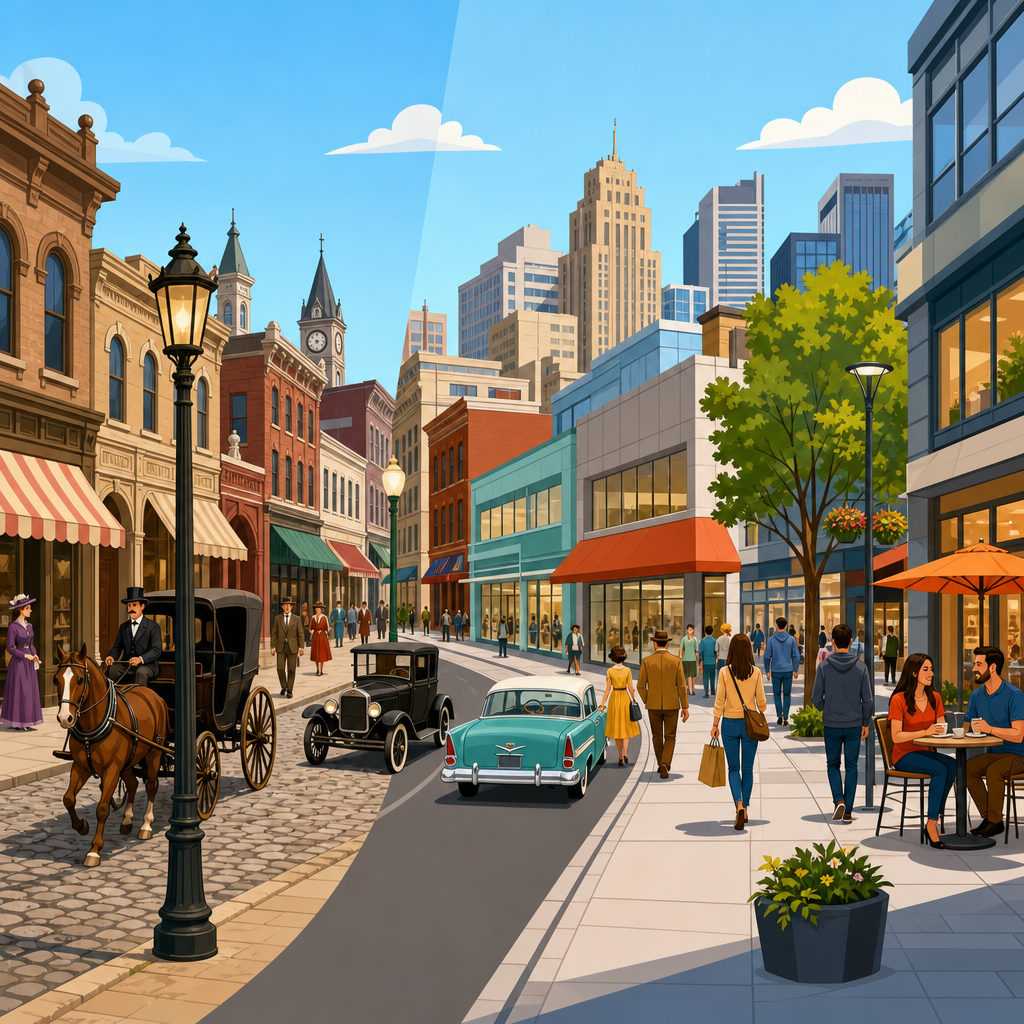
Downtown retail streets have long served as the commercial and social spine of cities, concentrating trade, movement, and public life in a few highly visible blocks. In urban planning, a retail street is more than a row of shops: it is a public realm shaped by land values, transport systems, building form, regulation, and consumer behavior. Understanding the historical evolution of downtown retail streets matters because these corridors reveal how cities grow, how economies reorganize, and why some main streets revive while others decline. I have worked on corridor studies where one block’s vacancy pattern could be traced directly to a new bypass road, a parking code change, or the loss of an anchor department store. That kind of practical observation makes the history concrete.
The story begins with exchange. Early market streets emerged where foot traffic, port activity, or crossroads produced dependable demand. Over time, these streets acquired specialized buildings, signage, arcades, and upper-floor offices or housing, creating a mixed-use urban fabric that supported all-day activity. Industrialization expanded the scale of downtown retail through plate glass, steel framing, gas lighting, and later electric illumination. Streetcars, commuter rail, and subways widened the trade area, allowing a single downtown street to draw customers from entire regions. Retail clustering then reinforced itself: comparison shopping worked best where many merchants stood close together, and landlords responded by subdividing frontage to maximize visibility and rent.
Yet downtown retail streets were never static. They evolved through successive waves of innovation and disruption, from department stores and chain retailers to enclosed malls, e-commerce, and experiential retail. Public policy repeatedly altered their fortunes through zoning, urban renewal, parking requirements, historic preservation, transit investment, and business improvement districts. Today, successful downtown retail streets are rarely pure shopping destinations. They mix food service, entertainment, services, housing, culture, and flexible public space. Their history offers practical lessons for planners, developers, and civic leaders: access matters, street design matters, tenant mix matters, and authenticity matters. To understand current revitalization strategies, it helps to trace how the classic downtown retail street emerged, flourished, fragmented, and in many cities is now being reinvented.
From market lane to mercantile corridor
The earliest downtown retail streets usually grew from informal trade routes rather than formal design. In colonial ports and inland county seats alike, commerce clustered along the easiest path between docks, courthouses, rail depots, and public squares. Merchants wanted visibility and proximity to one another because buyers preferred to compare goods without traveling far. This simple logic created the first durable retail agglomerations. In cities such as Boston, Philadelphia, and New Orleans, central commercial streets combined stalls, workshops, taverns, warehouses, and lodging. Streets were narrow, buildings were attached, and the ground floor opened directly onto the sidewalk, a pattern that still defines many successful retail environments.
Nineteenth-century industrialization transformed these corridors. Cast iron fronts, larger window openings, and better lighting allowed merchants to display merchandise to passersby in a new way. The department store became the signature institution of the mature downtown retail street. Retailers such as Marshall Field in Chicago, Wanamaker in Philadelphia, and Macy’s in New York used fixed pricing, broad assortments, and branded service to turn shopping into a destination. The street itself also changed. Paved surfaces, street trees, awnings, and electric signs extended shopping hours and improved comfort. Developers introduced arcades and corner entrances to capture heavy pedestrian movement. By the late nineteenth and early twentieth centuries, the most successful streets were those linked directly to transit nodes and surrounded by dense office employment.
Transit was decisive. Streetcar suburbs and commuter rail lines expanded the customer catchment area while still directing riders toward downtown. Retail streets near major stations benefited from predictable footfall that today’s planners would recognize as transit-oriented development. In many cities, blocks nearest the station filled with jewelers, clothiers, pharmacies, lunch counters, and theaters, while less trafficked blocks specialized in furniture, hardware, or wholesale goods. The resulting hierarchy gave downtown its commercial depth. These places were not just shopping districts; they were regional marketplaces, social stages, and symbols of civic identity.
The golden age of the main shopping street
From roughly the 1920s through the 1950s, many downtown retail streets reached their peak influence. Several conditions aligned. Dense employment brought daytime customers. Transit delivered workers and shoppers. Department stores acted as anchors. Chain stores added convenience and national advertising. Movie palaces and restaurants extended evening activity. Building owners invested in elaborate façades, recessed entries, display windows, and upper-floor offices. At street level, the merchant mix was curated by market forces long before the term became common practice.
In practical corridor analysis, this period stands out because the urban form was exceptionally efficient. Most customers arrived on foot or by transit, so the street devoted space to storefront continuity rather than parking lots. Blocks were short, intersections were frequent, and storefront bays were narrow enough to support many independent tenants. This created visual variety and a high rate of doorways per block, both of which increase pedestrian interest. The classic main street formula was simple: many small premises, strong anchors at key corners, active upper floors, and a public realm designed for walking.
Examples from North America and Europe show how adaptable the model was. State Street in Chicago, Gran Vía in Madrid, and Toronto’s Yonge Street each combined major anchors with everyday convenience retailers and cultural venues. Although architecture and regulation differed, the same urban economics applied. Concentration lowered search costs for consumers and strengthened the district brand. Retail streets also reflected social change. Ready-to-wear clothing, installment buying, and window shopping expanded participation beyond wealthy households. Downtown became the place where new products, new fashions, and new public behaviors appeared first.
| Era | Primary driver | Typical street form | Retail effect |
|---|---|---|---|
| Preindustrial | Market access | Narrow mixed-use lanes | Local trade and craft clustering |
| Industrial | Transit and display technology | Continuous storefronts with larger windows | Regional draw and comparison shopping |
| Postwar | Automobile mobility | Widened roads and parking-oriented sites | Downtown competition from suburban centers |
| Contemporary | Experience, mixed use, digital integration | Walkable streets with flexible public realm | Hybrid retail, food, service, and entertainment |
Postwar decentralization and the suburban challenge
After World War II, the historical trajectory shifted sharply. Rising car ownership, mortgage finance, highway construction, and suburban population growth redirected household spending away from downtown. Enclosed shopping centers and later superregional malls solved a problem that downtowns often ignored: easy parking and controlled convenience. A mall could offer department store anchors, weather protection, standardized leases, and a single owner able to manage tenant mix strategically. For families driving from new subdivisions, this was compelling.
Downtown retail streets faced several simultaneous pressures. Urban renewal often demolished older mixed-use fabric in favor of office towers, civic complexes, or inward-facing malls that broke the fine-grained pedestrian network. Traffic engineers widened streets for vehicle throughput, making crossings longer and sidewalks less pleasant. Minimum parking requirements consumed valuable land and weakened storefront continuity. Department stores eventually followed their customers to suburban branches, reducing downtown foot traffic and undermining nearby small businesses.
The decline was not universal or immediate, but the pattern was widespread. In city after city, one could map the loss of retail productivity to specific structural changes: the opening of a suburban mall, the removal of a streetcar line, or the clearance of several blocks for a megaproject. From a planning perspective, the lesson is that retail streets depend on ecosystems, not isolated stores. Once anchors disappear and pedestrian volumes fall below viable levels, vacancies spread unevenly but persistently. Lower rents can attract discount operators or services, which may stabilize the corridor but often change its identity. Some downtowns retained luxury niches, government-worker trade, or tourism-based retail; many others entered a long cycle of fragmentation.
Revitalization, preservation, and place management
By the 1970s and 1980s, cities began reassessing what had been lost. Historic preservation movements argued that older commercial buildings possessed economic value because their scale, ornament, and small floor plates suited independent businesses. The National Main Street Center promoted four-point revitalization methods focused on design, organization, promotion, and economic restructuring. Business improvement districts introduced dedicated cleaning, security, marketing, and maintenance funded by property assessments. These tools did not restore every corridor, but they changed the operating model from passive decline to active management.
Successful revitalization usually started with fundamentals. Sidewalk repair, lighting upgrades, façade restoration, and upper-floor code compliance made blocks usable again. Public agencies then targeted vacant anchors for adaptive reuse as food halls, universities, apartments, or civic venues. Markets, festivals, and streetscape programs helped rebuild foot traffic, but events alone rarely sustained commerce. The stronger cases paired public realm investment with realistic leasing strategies and merchant support. I have seen corridors improve only after city staff worked with landlords on subdivision of oversized spaces, because local operators could not absorb former department store footprints.
Preservation also changed consumer perception. A historic retail street offered something malls could not easily replicate: authenticity, local identity, and architectural continuity. Places such as Pearl Street in Boulder and King Street in Charleston gained value by emphasizing walkability and heritage rather than competing on sheer convenience. Still, revitalization brought tradeoffs. Rising rents could displace legacy businesses, and tourism-focused merchandising could weaken everyday usefulness for residents. The best policies balanced heritage with daily needs, ensuring that groceries, pharmacies, and services remained part of the mix alongside boutiques and restaurants.
Retail streets in the digital and experiential era
The rise of e-commerce did not make downtown retail streets obsolete; it changed what they must do well. Online channels are efficient for repeat purchases, broad inventory search, and price comparison. Physical streets now compete by offering immediacy, sensory experience, dining, events, social interaction, and services that cannot be shipped in a box. As a result, many downtown corridors have shifted from merchandise-heavy tenant mixes toward food and beverage, fitness, beauty, health care, entertainment, and showroom-style retail. This is not a temporary adaptation. It is a structural redefinition of street-level commerce.
Data from brokerage reports and municipal vacancy studies consistently show that the strongest downtown streets combine residents, workers, students, and visitors rather than relying on a single market segment. Mixed-use development is central because housing creates evening and weekend demand, while offices and institutions support daytime sales. Curb management has become another key variable. Pickup zones, bike parking, bus priority, parklets, and accessible loading all affect storefront performance. Retail success today is partly logistical. If deliveries block travel lanes, if ride-hail drop-offs conflict with sidewalks, or if transit stops are poorly placed, the customer experience deteriorates quickly.
Contemporary planning practice therefore treats downtown retail streets as managed public assets. Metrics include pedestrian counts, turnover rates, lease depth, storefront activation, dwell time, and sales tax trends. Design priorities include shade, seating, weather protection, transparent frontages, frequent entrances, and flexible curb use. The strongest corridors integrate digital discovery with physical place: merchants use Google Business Profiles, inventory visibility, click-and-collect, and social media, while districts coordinate wayfinding and programming. The historical lesson remains consistent. Retail streets thrive when transportation, land use, building design, and merchant strategy align around the customer’s real journey.
What history teaches planners and city leaders now
The historical evolution of downtown retail streets shows that no corridor succeeds by nostalgia alone. Demand must be cultivated, access must be multimodal, and space must match contemporary business models. Planners should protect fine-grained storefront patterns because small bays support entrepreneurship better than oversized spaces. Street design should prioritize walking speed, crossing safety, shade, and transit access before adding parking supply indiscriminately. Development policy should encourage upper-floor housing and office reuse, since occupied buildings create regular customers. Retail recruitment should focus on complements rather than duplication, building a district where daily needs and destination uses reinforce one another.
City leaders should also accept that not every block will return to its midcentury peak as a shopping strip. Some streets are better suited to hybrid roles that combine services, culture, education, housing, and limited retail. That is not failure; it is evolution. The enduring benefit of a healthy downtown retail street is broader than sales volume. These corridors support tax revenue, small business formation, social interaction, tourism, and civic identity in one compact public setting. If you are shaping an urban policy agenda, start with the street itself: measure foot traffic, repair the public realm, diversify tenant space, and make downtown easy to reach and pleasant to use.
Frequently Asked Questions
What made downtown retail streets so important in the early development of cities?
Downtown retail streets became important because they concentrated commerce, access, and public visibility in one place. In many cities, the earliest main shopping streets formed where people, goods, and transportation routes naturally converged, often near ports, markets, rail terminals, civic squares, or major intersections. This concentration created a powerful economic advantage: merchants benefited from foot traffic, comparison shopping, and proximity to complementary businesses. A customer visiting a tailor, for example, might also stop at a bakery, pharmacy, or dry goods store on the same block. Over time, this clustering effect made downtown retail streets the commercial spine of urban life.
These streets also mattered socially and politically. They were not just places to buy necessities; they were spaces where people gathered, observed each other, exchanged news, and participated in the rhythms of city life. Shop windows, sidewalks, arcades, and plazas turned retail corridors into public stages. In that sense, downtown retail streets helped define the public realm, linking private enterprise with civic identity. Their prominence reflected more than business success. It reflected how cities organized movement, value, and social interaction in highly visible and symbolically important locations.
How did transportation shape the historical evolution of downtown retail streets?
Transportation has been one of the most decisive forces in the evolution of downtown retail streets. In the walking city era, retail activity clustered tightly in central locations because most customers and workers traveled on foot. This made compact, dense, mixed-use streets especially valuable. As horse-drawn transit, streetcars, and later subways expanded urban reach, downtown retail corridors could grow longer, attract larger customer bases, and support more specialized stores. Streets served by transit lines often became prime shopping destinations because accessibility increased both foot traffic and land values.
The rise of the automobile changed these streets dramatically. Wider roads, parking demand, delivery access, and traffic engineering often reshaped downtown blocks to accommodate vehicles rather than pedestrians. In some cities, this increased accessibility for regional shoppers. In many others, however, it weakened the traditional retail street by dispersing customers to suburban shopping centers and strip corridors. As retail followed car-oriented development patterns, downtown streets lost some of their monopoly on convenience and visibility.
More recently, many cities have revisited this relationship by prioritizing walkability, transit access, cycling, streetscape improvements, and traffic calming. These changes reflect a broader understanding that successful retail streets depend not simply on movement, but on the quality of arrival and the experience of being there. Transportation does not just deliver customers; it shapes how long they stay, how safe the street feels, and how attractive the corridor is for investment and everyday use.
Why did some downtown retail streets decline while others remained successful?
The decline or resilience of downtown retail streets usually comes down to a combination of economic restructuring, urban policy, changing consumer habits, and physical design. Streets that declined often faced multiple pressures at once: suburbanization reduced nearby population density, department stores moved or closed, highway construction disrupted urban neighborhoods, and new retail formats offered easier parking and larger footprints. In addition, when buildings were neglected, sidewalks deteriorated, or vacancies accumulated, the street’s appeal could weaken quickly. Retail success depends heavily on momentum, and once a corridor loses enough tenants and visitors, recovery can become difficult without coordinated intervention.
By contrast, successful downtown retail streets tended to retain or rebuild advantages that could not easily be replicated elsewhere. These might include a strong historic building stock, a dense surrounding population, good transit access, cultural institutions, office workers, tourism, or a distinct local identity. Streets that adapted well often diversified beyond pure shopping. They added restaurants, entertainment venues, housing, services, and public events, making the corridor active at different times of day and less vulnerable to changes in one retail category. In many cases, resilience came from mixing economic functions rather than relying on a single shopping model.
Management also matters. Business improvement districts, preservation strategies, zoning updates, façade programs, public safety efforts, and coordinated place branding have all influenced outcomes. In other words, downtown retail streets do not succeed by accident. Their performance reflects broader urban systems, but it is also shaped by deliberate choices about maintenance, accessibility, tenant mix, public space, and long-term investment.
How did architecture and urban design influence the character of downtown retail streets over time?
Architecture and urban design have always played a central role in how downtown retail streets function and how people perceive them. Historically, the most successful retail blocks often featured narrow storefronts, transparent display windows, frequent doorways, upper-floor uses, and buildings aligned directly along the sidewalk. These elements created visual interest, encouraged browsing, and supported a lively pedestrian environment. The repetition of small shopfronts allowed for tenant variety, while upper stories housed offices, apartments, or storage, making the street economically efficient and active beyond shopping hours.
As retail modernized, building forms changed. Department stores introduced larger floor plates and more monumental façades, signaling scale, prestige, and consumer abundance. Arcades, awnings, canopies, electric signage, and later air-conditioned interiors all altered the retail experience. In some periods, modernization improved comfort and attraction. In others, blank walls, deep setbacks, parking lots, or auto-oriented redevelopment weakened the street edge and reduced pedestrian vitality. The physical design of the corridor could either support spontaneous public life or fragment it.
Today, urban designers and planners often look back at historic retail streets to understand why certain environments remain compelling. Fine-grained storefront patterns, walkable block lengths, active frontages, shade, seating, lighting, and human-scaled buildings consistently help retail streets perform better as public places. The lesson is not that every corridor must imitate the past, but that the spatial qualities that once made downtown retail streets successful still matter. Good retail urbanism depends on creating a setting where commerce and public life reinforce each other.
What does the history of downtown retail streets teach us about the future of city centers?
The history of downtown retail streets shows that city centers are constantly adapting to shifts in technology, demographics, culture, and economic organization. These corridors have survived transitions from market stalls to department stores, from streetcars to automobiles, and from local trade to e-commerce competition. The main lesson is that downtown retail streets endure when they evolve from being simple shopping channels into multi-dimensional urban places. Their strength lies in combining convenience, experience, identity, and social interaction in a way that isolated retail formats often cannot fully replicate.
This history also teaches that physical form and policy decisions matter for decades. Choices about zoning, transit investment, preservation, public space, curb management, and street design can either strengthen or undermine a retail corridor’s long-term role. A downtown street that welcomes pedestrians, supports mixed uses, and encourages flexible adaptation is more likely to remain relevant than one designed around a single economic model. Resilient city centers typically allow old buildings to accommodate new tenants, new habits, and new forms of activity without losing the qualities that make the district distinctive.
Looking ahead, the future of downtown retail streets is likely to depend less on traditional retail alone and more on a blended urban ecosystem of housing, hospitality, culture, services, workspaces, and events. In that sense, history offers both caution and optimism. It cautions against assuming that retail success is permanent, but it also shows that well-located, well-designed downtown streets can reinvent themselves repeatedly. Their evolution is ultimately a story about how cities reorganize around changing needs while preserving the value of shared public space.


