
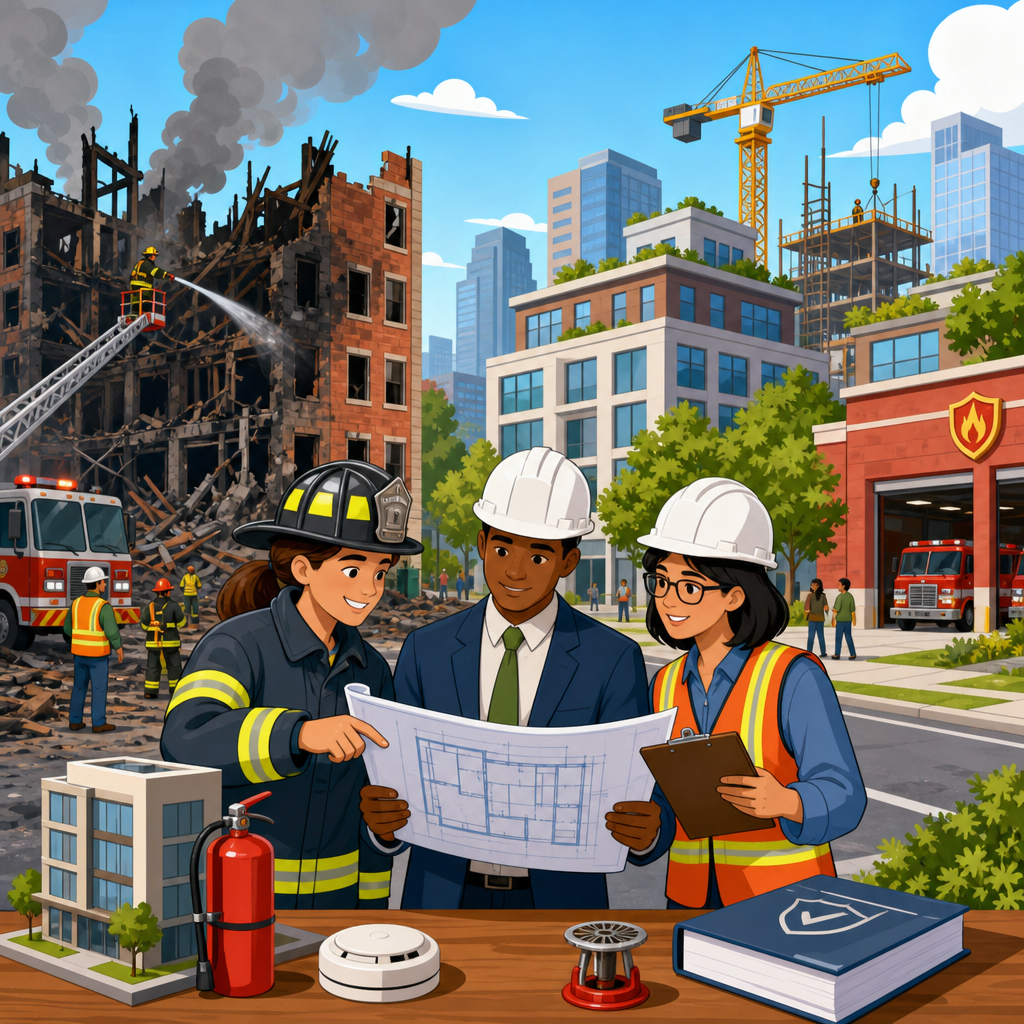
Fire codes, building codes, and the aftermath of urban disasters are inseparable subjects because every major city learns the same hard lesson: regulations are usually written in blood, smoke, collapse dust, and public outrage. Fire codes are the rules that govern ignition prevention, egress, suppression systems, alarm performance, and emergency access. Building codes are broader standards covering structural design, materials, occupancy, accessibility, sanitation, energy use, and life safety. Urban disasters include fires, earthquakes, floods, storms, explosions, infrastructure failures, and cascading emergencies that expose hidden weaknesses in the built environment. I have worked with code officials, plan reviewers, and design teams after damaging incidents, and the pattern is consistent. Catastrophe reveals where assumptions failed, where enforcement lagged, and where political compromise weakened basic protections. This topic matters because codes shape whether residents can escape, whether firefighters can operate, whether buildings remain standing, and whether a city can recover without repeating the same mistakes.
Codes are often misunderstood as bureaucratic obstacles, yet they are really negotiated public safety standards translated into dimensions, test methods, occupancy limits, fire resistance ratings, sprinkler thresholds, and inspection routines. Modern codes do not eliminate risk; they reduce the probability of death, injury, and uncontrolled loss. They also distribute responsibility. Architects must design compliant systems, engineers must calculate loads and performance, contractors must build to approved documents, owners must maintain systems, and public agencies must inspect and enforce. In urban planning, the code conversation extends beyond single buildings. Density, street width, water supply, informal construction, aging infrastructure, climate exposure, and land-use policy all affect disaster outcomes. A dense mixed-use district can be resilient if exits, compartmentation, hydrants, access roads, and retrofits are adequate. The same district becomes deadly if overcrowding, blocked egress, illegal conversions, and deferred maintenance accumulate unchecked.
The aftermath of disaster is when these systems face their most serious test. Investigations determine origin, cause, contributing conditions, code compliance status, and enforcement failures. Policymakers then decide whether to amend codes, improve inspections, fund retrofits, or simply move on. The quality of that response defines long-term urban safety. Some cities treat disaster as a narrow technical event and miss the governance lesson. Others use it to modernize standards, strengthen institutions, and link public safety with housing policy, emergency management, and infrastructure investment. Understanding how fire codes and building codes evolve after urban disasters is therefore essential for planners, property owners, public officials, and residents who want safer neighborhoods rather than temporary attention followed by predictable repetition.
How fire and building codes work together in cities
Fire codes and building codes overlap but serve different functions across a building’s life cycle. Building codes usually govern design and construction: structural loads, means of egress, fire-resistance-rated assemblies, occupancy classification, and required systems such as sprinklers or smoke control. Fire codes focus more on operations and ongoing conditions after occupancy: storage practices, hazardous materials, fire department access, alarm maintenance, exit signage, crowd management, and inspection frequency. In practice, the two frameworks work as a single life-safety system. A code-compliant stair enclosure is useless if exit doors are chained shut. A sprinkler system required at permitting does little good if valves are closed, pumps are inoperable, or maintenance logs are falsified.
Most jurisdictions base local rules on model codes such as the International Building Code, International Fire Code, NFPA 1 Fire Code, NFPA 101 Life Safety Code, and referenced standards from organizations including ASTM, ASCE, UL, and ICC. The exact adoption path varies. Some cities adopt current editions with local amendments; others lag multiple cycles because of political disagreement, staffing shortages, or concern about construction cost. That lag matters. Newer editions often incorporate lessons from recent disasters, advances in materials testing, and better understanding of evacuation behavior. When adoption is delayed, cities effectively preserve older risk assumptions even as buildings grow taller, denser, and more complex.
Urban planning intersects with codes through zoning, infrastructure, and redevelopment policy. Zoning may permit occupancy types and densities that trigger higher life-safety requirements. Street design affects aerial apparatus access and evacuation flow. Water systems determine hydrant reliability and fire flow. Informal settlements and warehouse-to-residential conversions create occupancy mismatches that codes are designed to prevent but enforcement often misses. In post-disaster settings, city leaders often discover that the problem was not the absence of rules. It was the gap between adopted text, actual construction, and day-to-day operations.
Why urban disasters change codes
Disasters change codes because they produce undeniable evidence that an accepted practice failed under real conditions. Before a catastrophe, a risk can seem theoretical or economically inconvenient. After deaths and visible destruction, technical arguments become concrete. Investigators identify ignition pathways, structural failure sequences, smoke movement, delayed alarm transmission, combustible exterior assemblies, inadequate compartmentation, or inaccessible exits. Those findings become the basis for code hearings, standards updates, and new enforcement priorities. This is why many landmark provisions can be traced to specific tragedies rather than abstract precaution.
The 1871 Great Chicago Fire influenced urban fire limits, masonry requirements, water supply planning, and professionalized fire protection approaches. The 1904 Baltimore fire exposed the lack of standardization in hose couplings and mutual aid compatibility. The 1911 Triangle Shirtwaist Factory fire in New York, where locked exits and insufficient egress trapped workers, accelerated reforms in exit access, stair requirements, occupancy regulation, and labor safety enforcement. More recently, the 2001 World Trade Center attacks reshaped high-rise egress, structural fireproofing robustness, communication systems, and emergency responder coordination in tall buildings. The 2017 Grenfell Tower fire in London intensified scrutiny of combustible cladding, façade testing regimes, resident complaints, and the governance failures that can leave known hazards in place.
Code change after disaster is not automatic or uniformly effective. Politics, lobbying, insurance incentives, housing pressure, and local capacity all shape results. Some reforms improve measurable safety. Others create paperwork without fixing root causes. The best post-disaster code changes do three things at once: they identify the technical failure precisely, they make compliance verifiable in the field, and they align enforcement resources with the new requirement. If any of those three are missing, the code may look stronger on paper while remaining weak in practice.
Common failure points revealed after major incidents
Across cities and disaster types, investigators repeatedly find a familiar set of breakdowns. Egress failures are among the most lethal: insufficient stair width, dead-end corridors, blocked exits, locked doors, missing emergency lighting, and occupant loads that exceed approved capacity. Fire growth issues also recur, especially where combustible interior finishes, concealed voids, unprotected penetrations, or delayed suppression allow a small ignition source to become unsurvivable. In structural events, failures often relate to soft-story conditions, inadequate lateral systems, corrosion, poor detailing, unreinforced masonry, or unauthorized alterations that changed load paths.
Another common issue is the mismatch between the approved use of a building and its actual use. Warehouses become event spaces, basements become sleeping rooms, offices become schools, and industrial floors become artist studios with improvised electrical systems. I have seen post-incident files where drawings showed one occupancy classification while inspections documented something entirely different years later. Once that mismatch develops, every downstream protection assumption is wrong: travel distance, fire load, ventilation, accessibility, alarm audibility, and rescue access. Disaster aftermath often reveals that officials knew conditions were deteriorating but lacked staff, authority, or political backing to intervene decisively.
| Failure point | Typical consequence | Code response | Field challenge |
|---|---|---|---|
| Blocked or locked exits | Delayed evacuation and crowd crush | Stronger egress inspection and panic hardware rules | Conditions change daily in occupied buildings |
| Combustible exterior systems | Rapid vertical fire spread | Façade testing, material restrictions, retrofit mandates | Existing stock is costly to remediate |
| Unreinforced masonry | Collapse in earthquakes | Mandatory seismic retrofit ordinances | Owners resist financing and tenant disruption |
| Illegal occupancy conversion | Overcrowding and missing life-safety systems | Reclassification, permits, targeted inspections | Enforcement is labor intensive and politically sensitive |
Utility and infrastructure dependence is another hidden vulnerability. Fire pumps need reliable power. Elevators need recall and emergency operation. Hospitals need redundant systems. Communication networks need survivability. Flood events regularly show that a structurally sound building can still fail functionally when electrical rooms, fuel supplies, or telecom equipment are located below grade. Good codes increasingly address these dependencies, but legacy buildings remain exposed unless cities pair code updates with retrofit incentives and capital planning.
Enforcement, retrofits, and the reality of older buildings
Adopting a modern code is easier than applying it to an old city. Most urban neighborhoods contain buildings erected under earlier standards, and many are legally nonconforming. That does not automatically make them unsafe, but it does mean risk is unevenly distributed. Retrofitting older stock is where policy, finance, and safety collide. A full sprinkler retrofit, seismic upgrade, façade replacement, or stair reconfiguration can be technically feasible and economically difficult at the same time. If policymakers ignore cost, they risk disinvestment or displacement. If they ignore risk, they preserve known hazards in occupied buildings.
The most effective retrofit programs are phased, data-driven, and tied to clear triggers. Cities often prioritize high-risk occupancies first: hospitals, schools, high-rise residential towers, assembly spaces, and unreinforced masonry buildings in seismic zones. Trigger mechanisms may include change of use, major renovation, sale, refinancing, recurring inspection findings, or disaster recovery permits. Financing tools matter just as much as technical rules. Property assessed clean energy structures, resilience bonds, tax abatements, low-interest public loans, and insurance premium signals can make compliance achievable without waiting for the next tragedy.
Enforcement quality depends on staffing, training, record systems, and political independence. Digital permitting platforms, GIS-linked inspection data, and incident analytics have improved the ability to spot repeat violators and neighborhood patterns. Still, technology cannot replace judgment. Inspectors need authority to issue notices, escalate dangerous conditions, and coordinate with housing, health, and emergency management agencies. In my experience, the most dangerous buildings are rarely mysteries. They are usually known properties where complaints, minor violations, and ownership neglect formed a visible trail long before a fatal event. Strong enforcement means acting on that trail early.
What urban disaster recovery should accomplish
Disaster recovery should do more than restore buildings to their previous condition. The central goal is risk reduction during reconstruction, not simple replacement. That means using damage assessments, forensic reports, and community input to decide what must change before reoccupation. After fires, this may include upgraded alarms, compartmentation repairs, sprinkler extensions, electrical corrections, and management plans for temporary housing. After earthquakes, it may require red-tagging protocols, structural peer review, and retrofit mandates tied to repair permits. After floods, recovery should elevate critical systems, revise floodplain standards, and rethink basement occupancy.
Good recovery policy also addresses social vulnerability. Low-income tenants, older adults, undocumented residents, and small businesses are often hit hardest because they occupy cheaper, older, and less protected spaces. If recovery only increases code requirements without funding support, vulnerable groups can be displaced while hazards persist elsewhere. The better approach is targeted assistance paired with nonnegotiable life-safety thresholds. Cities such as San Francisco with mandatory soft-story retrofit programs, and Los Angeles with seismic retrofit ordinances for brittle concrete and wood-frame soft-story buildings, show how a city can combine technical mandates, compliance timelines, and administrative tracking to reduce known urban risks at scale.
For planners and policymakers, the lasting lesson is simple. Urban disasters are not isolated interruptions; they are stress tests of regulatory systems, infrastructure networks, and political priorities. Fire codes and building codes work best when they are current, enforced, and connected to land use, housing, capital planning, and emergency management. Every city has older buildings, constrained budgets, and competing interests. The difference between resilient cities and vulnerable ones is whether leaders use aftermath responsibly. Review your local code adoption cycle, inspection capacity, and retrofit policies now, before the next siren turns familiar weaknesses into irreversible loss.
Frequently Asked Questions
What is the difference between fire codes and building codes?
Fire codes and building codes overlap, but they are not the same thing. Building codes are the broader framework. They regulate how a structure is designed, built, altered, and occupied, including structural integrity, materials, accessibility, ventilation, sanitation, energy performance, and overall life safety. Fire codes focus more specifically on the prevention, detection, containment, and response aspects of fire and related emergencies. That includes rules for means of egress, fire alarms, sprinkler systems, fire-resistant construction, hazardous materials storage, emergency lighting, smoke control, and fire department access.
In practice, the two work together. A building code may establish how fire-resistance-rated walls must be constructed, while a fire code may govern how the building is maintained over time so those assemblies continue to perform as intended. Building codes often apply most heavily during design, construction, and major renovation, while fire codes remain active throughout the life of the building through inspections, testing, maintenance, and operational requirements. The key point is that one code family helps create a safe building, and the other helps keep it safe under real-world conditions.
Why do major urban disasters so often lead to new codes and regulations?
Because catastrophic events expose failures that were previously ignored, underestimated, or poorly understood. After a deadly high-rise fire, a mass-casualty crowd crush, a building collapse, or a fast-moving urban conflagration, investigators usually uncover a chain of preventable problems: combustible materials, blocked exits, inadequate alarm systems, weak structural redundancy, poor compartmentation, unsafe occupancy loads, or emergency response obstacles. Those failures become impossible for the public, industry, and lawmakers to dismiss once lives have been lost at scale.
That is why people often say codes are “written in blood.” It is a harsh phrase, but an accurate one. Codes rarely evolve in a vacuum. They are often strengthened only after disaster provides undeniable evidence that older rules were insufficient, outdated, unenforced, or riddled with loopholes. Urban disasters also create political urgency. Public outrage, media attention, litigation, and official inquiries push governments to act faster than they otherwise would. In the aftermath, code committees, fire officials, engineers, architects, and legislators translate the lessons of failure into specific requirements intended to prevent recurrence. Those changes may include tighter material standards, mandatory sprinklers, improved evacuation design, stronger structural provisions, better inspection regimes, and more rigorous retrofit requirements for older buildings.
How do fire and building codes affect what happens after an urban disaster?
After an urban disaster, codes shape nearly every stage of the response and recovery process. First, they provide the benchmark for investigators trying to determine what went wrong. Officials compare the building’s design, construction, occupancy, maintenance, and emergency systems against the applicable code requirements in force at the time. That analysis can reveal whether the disaster resulted from noncompliance, weak enforcement, deteriorated systems, outdated legal standards, or conditions that the code itself failed to anticipate.
Second, codes heavily influence rebuilding decisions. Damaged structures may need to be repaired to current standards rather than the rules in place when they were originally constructed. That can trigger major upgrades involving structural reinforcement, improved fire-resistance ratings, sprinkler retrofits, alarm modernization, smoke control improvements, and accessibility corrections. In some cases, a disaster does not just lead to rebuilding a single site; it prompts jurisdiction-wide inspections, emergency orders, and code amendments affecting entire classes of buildings. The aftermath of a disaster is therefore not only about cleanup and reconstruction. It is often the moment when cities reassess their vulnerabilities, reexamine legacy building stock, and decide how much resilience they are willing to require going forward.
Are older buildings usually exempt from modern fire and building code requirements?
Not automatically, and this is one of the most misunderstood areas of code enforcement. Many older buildings are considered legally existing structures, which means they may be allowed to remain in service even if they do not meet every current code provision. However, that does not mean they are untouchable or permanently exempt. Most jurisdictions have mechanisms that require upgrades when there is a change of occupancy, a substantial renovation, an increase in hazard level, documented unsafe conditions, repeated violations, or newly adopted retrofit ordinances aimed at serious life-safety risks.
Fire codes are especially important in older buildings because operational and maintenance requirements typically continue regardless of age. Owners may still be required to maintain exits, keep fire doors functional, test alarms, inspect suppression systems, manage occupant loads, and preserve fire department access. In cities shaped by older construction, policymakers often face difficult questions after a disaster: how much risk should be tolerated in legacy buildings, who should pay for upgrades, and how quickly can compliance be achieved without displacing residents or shuttering businesses. The legal answer is rarely simple, but the practical answer is clear: age alone does not excuse conditions that put occupants and responders in danger.
What are the most important code lessons cities should take from urban disasters?
The first lesson is that enforcement matters as much as the written rule. A strong code on paper does little good if inspections are inconsistent, violations are ignored, records are poor, or political pressure weakens compliance. Many disasters reveal not just technical shortcomings, but administrative ones: understaffed inspection departments, fragmented authority, unclear accountability, and a culture of exceptions. Cities that truly learn from catastrophe invest not only in better code language, but also in the people, training, data systems, and legal authority needed to enforce it.
The second lesson is that modern urban risk is interconnected. Fire safety cannot be treated separately from structural design, emergency communications, land use, infrastructure resilience, accessibility, and occupant behavior. A building that is structurally sound but difficult to evacuate is still dangerous. A tower with alarms but poor compartmentation is still vulnerable. A neighborhood with narrow access routes, overloaded utilities, or aging building stock can turn one incident into a citywide emergency. The most effective codes recognize those connections and treat safety as a system rather than a checklist. In the aftermath of disaster, the goal should not be symbolic reform or minimal compliance. It should be measurable risk reduction, resilient design, and a built environment that gives people more time, more protection, and more ways to survive when conditions go bad.


