
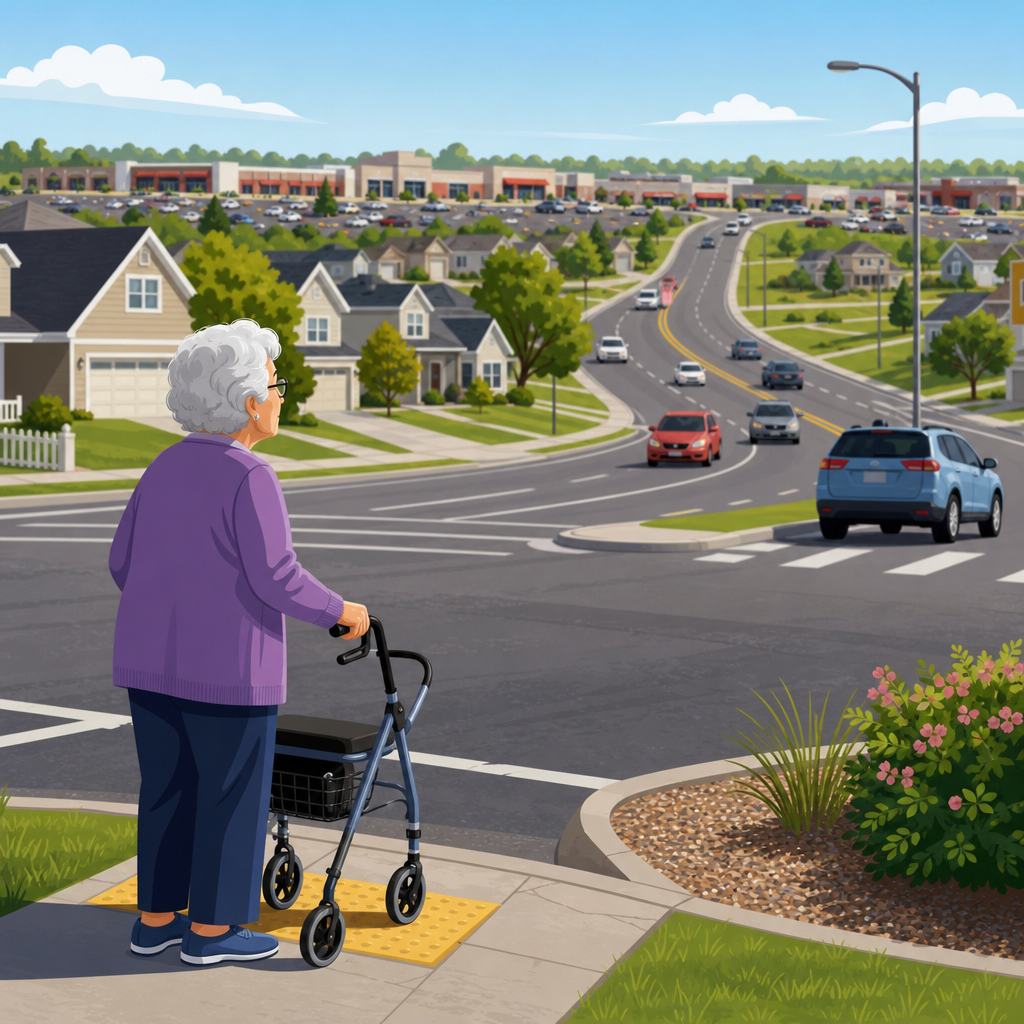
Aging in place means remaining in one’s own home and community safely, independently, and comfortably as needs change over time. In auto-oriented suburbs, that goal collides with a built environment designed around driving, single-use zoning, and homes separated from shops, clinics, parks, and social life. I have worked with suburban plans, mobility audits, and housing studies where older residents wanted to stay near neighbors and routines, yet the physical layout made ordinary tasks harder each year. The challenge of aging in place in auto-oriented suburbs is not simply personal or medical. It is a land-use, transportation, housing, and public health issue that affects families, municipalities, and regional budgets.
Auto-oriented suburbs are low-density communities where daily life generally requires a car. Streets often prioritize vehicle speed over pedestrian safety. Sidewalk networks are incomplete. Transit is infrequent or absent. Housing stock is dominated by detached single-family homes with stairs, large lots, and maintenance demands. Services may exist nearby as the crow flies, but not by a safe or direct walking route. For a healthy sixty-five-year-old driver, these conditions may seem manageable. For an eighty-two-year-old with reduced vision, slower reaction time, or a spouse who no longer drives, they can become restrictive very quickly.
This matters because demographics are changing faster than most suburban jurisdictions are adapting. In many regions, the share of residents over sixty-five is rising while household sizes are shrinking. At the same time, most older adults consistently say they prefer to remain in familiar homes rather than move into institutional care. AARP surveys have repeatedly found strong preference for staying put, but preference alone does not create accessibility. Without better planning, many suburban households face a harsh sequence: growing isolation, preventable falls, missed medical appointments, forced dependence on relatives, and eventual relocation triggered by the environment rather than by choice.
The policy stakes are large. Aging in place can reduce pressure on long-term care facilities, preserve social ties, and support mental well-being. Yet when suburbs fail to provide transportation options, accessible housing, and nearby services, public costs rise elsewhere. Emergency response calls increase. Road safety risks grow. Caregivers lose work time. Municipalities also miss an economic opportunity, because older adults contribute spending, volunteering, and civic leadership when communities remain usable. A suburb that works for an eighty-year-old usually works better for parents pushing strollers, teenagers without cars, and adults managing temporary injuries. Planning for aging is therefore not a niche agenda. It is a test of whether suburban development can become more resilient, inclusive, and fiscally realistic.
Why the suburban form creates barriers
The central problem is a mismatch between aging bodies and an environment engineered for routine driving. Distance is the first barrier. In many postwar suburbs, homes are isolated from grocery stores, pharmacies, libraries, and clinics by zoning rules that separate uses and by arterial roads that are difficult to cross on foot. Even when destinations are within one or two miles, that is far beyond a practical walking distance for many older adults, especially in heat, snow, or rain. A trip that once felt simple by car becomes impossible after driving reduction or cessation.
Street design compounds the issue. Wide curb radii, long crossing distances, sparse benches, short signal times, and missing curb ramps all discourage walking. The National Association of City Transportation Officials, the Institute of Transportation Engineers, and the Federal Highway Administration have documented how speed and crossing geometry shape safety outcomes. I have seen suburban corridors where a medical office sat across from senior housing, yet residents still called paratransit because six traffic lanes and slip turns made the crossing feel dangerous. Technically nearby does not mean functionally accessible.
Housing design is another barrier. Much of the suburban housing supply was built for younger households and assumes residents can manage stairs, bathtubs, laundry in basements, and exterior upkeep. Universal design features such as zero-step entries, wider doorways, lever handles, and first-floor bathrooms remain limited in older subdivisions. Retrofitting is possible, but costs can be substantial, particularly for fixed-income homeowners facing rising property taxes, insurance, and utility bills. Renters in suburban apartments encounter different problems, including inaccessible units, limited elevator service, or locations stranded in commercial zones without safe pedestrian connections.
Social infrastructure is often thin as well. In walkable neighborhoods, casual contact at stoops, parks, bus stops, and local shops helps prevent isolation. In auto-oriented suburbs, social participation usually requires a ride. When driving stops, spontaneous interaction falls away. That loss matters because isolation is linked to poorer health outcomes, higher depression risk, and weaker support networks during emergencies.
Transportation after driving becomes difficult
Transportation is the hinge issue in suburban aging. Most adults eventually outlive safe driving by years. The exact timing varies, but declining vision, medication effects, cognitive change, and slower motor response can make complex traffic environments hazardous. In compact urban neighborhoods, someone can shift to walking, transit, or short taxi trips. In auto-oriented suburbs, the alternatives are often fragmented, expensive, or unreliable, which turns a driving decision into a life-altering event.
Fixed-route transit can help, but many suburbs have low service frequency, indirect routing, and bus stops located on hostile arterials. A sixty-minute headway effectively makes transit unusable for routine medical trips, part-time work, or social visits. Demand-response and paratransit services fill some gaps, especially under Americans with Disabilities Act requirements in the United States, yet they usually require advance booking and can involve long pickup windows. That structure works poorly for spontaneous errands and can make riders feel dependent rather than mobile.
Families often become the informal transportation network. Adult children coordinate grocery runs, medical appointments, and social outings, sometimes across long distances. This arrangement can work temporarily, but it is uneven and fragile. Not every older adult has nearby relatives, and not every relative has schedule flexibility, money, or a car large enough for mobility devices. When I have interviewed caregivers in suburban communities, many described transportation not as one task among many but as the organizing burden that reshaped their week.
Safer street design, complete sidewalk networks, better bus stop amenities, and smaller-scale local shuttles can materially improve conditions. So can ride-hailing partnerships, volunteer driver programs, and subsidized taxi vouchers, although each has limitations around digital access, staffing, or cost control. The strongest suburban strategies combine multiple modes rather than relying on a single service to replace the private car.
| Mobility option | Main benefit | Main limitation in suburbs | Best use case |
|---|---|---|---|
| Fixed-route bus | Low cost and scalable | Infrequent service and long walks to stops | Regular trips on key corridors |
| Paratransit | Door-to-door accessibility | Advance scheduling and long windows | Medical and essential trips |
| Volunteer driver program | Human assistance and flexibility | Limited capacity and volunteer burnout | Social visits and appointments |
| Ride-hailing subsidy | Fast response and broad coverage | Smartphone barriers and variable pricing | Urgent errands and off-peak travel |
Housing, services, and the retrofit gap
For aging in place to work, the home itself must remain usable. The standard hierarchy of needs is clear: safe entry, accessible circulation, bathroom usability, kitchen functionality, and manageable maintenance. Occupational therapists often recommend grab bars, improved lighting, nonslip flooring, stair lifts, curbless showers, and bedroom relocation to the main floor. These changes can prevent falls and extend independence. The challenge in suburbs is scale. Large numbers of homes need modest but coordinated retrofits, while public policy still largely treats accessibility as an individual household matter.
Financing is a major obstacle. A simple ramp may cost a few thousand dollars; a full bathroom conversion can cost much more. Home equity may exist on paper, but monthly cash flow is often tight. Some jurisdictions offer property tax abatements, low-interest rehabilitation loans, or grants through community development programs, yet awareness is low and application systems can be cumbersome. Home modification programs linked to health systems are promising because they recognize that a safer home can reduce avoidable injuries and hospital readmissions.
Land use rules also restrict better options. Many older adults do not need or want a detached house on a large lot forever. They may prefer an accessory dwelling unit, a small cottage, a duplex near family, or an apartment above neighborhood retail. In many suburbs, these forms remain illegal, politically contentious, or too difficult to permit. That leaves residents with a false binary between staying in an unsuitable house and leaving the community entirely. Zoning reform that allows accessory dwelling units, cottage courts, multiplexes, and mixed-use nodes expands the menu of age-friendly choices without requiring wholesale redevelopment.
Services matter as much as housing type. Proximity to primary care, pharmacies, groceries, senior centers, parks, and faith communities determines whether daily life remains practical. Suburban retrofits that cluster these services in walkable centers can dramatically reduce transportation dependence. The most effective projects treat housing and services as one system rather than separate departments on an organization chart.
Health, safety, and social isolation
The consequences of poor suburban fit are measurable. Falls are a leading cause of injury among older adults, and environmental hazards inside and outside the home contribute directly. Missed preventive care increases when transportation becomes unreliable. Heat waves and winter storms become more dangerous when residents are isolated in homes they cannot easily leave. Food insecurity can emerge not from poverty alone but from mobility constraints that limit shopping frequency and choice.
Isolation deserves special attention because it is often invisible in planning documents. A resident may technically be housed, insured, and medically stable, yet still experience severe day-to-day disconnection. In many suburbs, the built environment suppresses informal contact. You leave the garage, drive, park, and return without seeing neighbors. Once driving ends, entire weeks can pass without meaningful interaction unless formal programs intervene. Public libraries, community centers, intergenerational programming, and well-designed parks can reduce this risk, but only if people can reach them safely and routinely.
Safety is not only about crime. It includes crossing design, nighttime lighting, snow clearance, pavement condition, bus shelter quality, and emergency access. I have walked suburban routes where one cracked sidewalk panel forced a wheelchair user into the travel lane for half a block. These small defects accumulate into major exclusion. Age-friendly planning succeeds when agencies audit the actual trip chain from front door to destination instead of evaluating each asset in isolation.
What local governments and communities can do
Effective action starts with a practical question: can an older resident complete essential trips and remain safe at home without driving every day. Municipalities should map gaps in sidewalks, curb ramps, crossings, benches, shade, transit frequency, and accessible housing. They should then prioritize improvements near senior housing, medical offices, grocery stores, libraries, and neighborhood centers. This is not glamorous work, but it produces immediate value.
Policy should align transportation, housing, and health. Complete Streets standards can slow traffic and improve crossings. Zoning updates can permit accessory dwelling units and small multifamily housing in single-use districts. Property standards and rehabilitation grants can support home modifications. Partnerships with hospital systems, metropolitan planning organizations, transit agencies, and nonprofit service providers can stretch limited budgets. The World Health Organization’s age-friendly framework is useful because it links outdoor spaces, transportation, housing, participation, and inclusion instead of treating them as separate silos.
Community engagement must also change. Older adults are frequently consulted too late, after major assumptions are fixed. Better practice uses walk audits, rider interviews, caregiver surveys, and co-design sessions to identify friction points planners miss. In one suburban corridor review I participated in, the most important finding was not average traffic speed but the lack of a bench halfway between senior apartments and the pharmacy. That single amenity changed whether the trip was realistic.
The challenge of aging in place in auto-oriented suburbs will not be solved by one program or one new building type. It requires a steady retrofit of ordinary places: safer crossings, gentler zoning, better transit, accessible homes, and nearby services. The payoff is substantial. Older adults keep autonomy longer, caregivers face less strain, and municipalities build neighborhoods that serve more residents across more stages of life. If you work in urban planning and policy, use this hub as a starting point and examine your own suburb through the eyes of someone making every trip with limited stamina, limited income, or no car at all. That perspective reveals exactly where change must begin.
Frequently Asked Questions
Why is aging in place especially difficult in auto-oriented suburbs?
Aging in place becomes much harder in auto-oriented suburbs because the entire physical layout assumes that residents will drive for nearly every daily need. In many suburban areas, homes are separated from grocery stores, pharmacies, medical offices, parks, community centers, and even neighbors by long distances, wide roads, and limited pedestrian infrastructure. That may function adequately for healthy adults who drive regularly, but it becomes a serious barrier when older residents reduce their driving, stop driving at night, or can no longer drive at all. What sounds like a simple errand on paper can become a complicated logistical problem when there are no sidewalks, few safe crossings, and no nearby destinations within a comfortable walking distance.
The challenge is not just transportation; it is also about independence, safety, and social connection. Older adults often want to remain in familiar homes near friends, faith communities, and long-established routines. Yet in single-use suburban environments, staying home can gradually mean becoming isolated. When every trip requires a car, ordinary activities such as picking up prescriptions, attending medical appointments, meeting a friend for coffee, or joining a recreation program can become difficult or expensive. Family members may have to step in more often, which can create stress for both the older adult and caregivers. In that sense, the problem is structural, not personal: many suburbs were simply not designed to support people across all stages of life and mobility.
What are the biggest day-to-day obstacles older adults face in these neighborhoods?
The biggest day-to-day obstacles usually involve mobility, access, and home design. Mobility challenges are often the most visible. In many suburban neighborhoods, sidewalks are incomplete or missing, intersections are designed for fast-moving traffic, bus stops are far away, and crossings may be long and intimidating. For an older adult with balance issues, limited stamina, vision changes, or use of a cane, walker, or wheelchair, these conditions can turn a short outing into a stressful and risky experience. Even when destinations are technically close, they may not be practically reachable without a car.
Access to services is another major issue. Auto-oriented suburbs often cluster essential destinations along commercial corridors rather than integrating them into neighborhoods. That means health care, shopping, social programs, and public services may be spread out and difficult to reach without reliable transportation. If driving becomes limited, missed appointments, delayed errands, and fewer social interactions can follow. This can have a direct effect on health, nutrition, and mental well-being.
Home design also matters. Many suburban houses were built for younger families, not older residents with changing physical needs. Stairs, narrow hallways, inaccessible bathrooms, poor lighting, and maintenance demands can make a longtime home harder to manage over time. Large lots and detached homes may provide privacy, but they can also create burdens related to yard care, snow removal, repairs, and utility costs. When you combine inaccessible housing with an environment that requires driving, the result is that aging in place becomes far more fragile than many people expect.
Can aging in place still work in suburbs, or does it require moving to a different kind of community?
Aging in place can still work in suburbs, but it often requires intentional changes at the household, neighborhood, and local policy levels. It does not automatically mean that someone must leave a suburban community they love. In fact, many older residents strongly prefer to remain where they have social ties, memories, and a sense of belonging. The question is less about whether suburbs are impossible and more about whether they can adapt enough to support changing needs over time.
At the household level, aging in place may involve home modifications such as no-step entries, grab bars, first-floor bedrooms, wider doorways, better lighting, and bathroom improvements. Transportation planning is also critical. Households may need to think ahead about what happens if driving becomes limited, including access to family support, ride services, volunteer driver programs, shuttle options, or paratransit. These practical adjustments can extend independence significantly.
At the community level, the most successful suburban aging-in-place strategies usually focus on improving nearby access rather than assuming every need will be met by car. That can include adding sidewalks, safer crossings, benches, traffic calming, improved transit connections, and small-scale neighborhood-serving destinations. It can also include expanding housing options such as accessory dwelling units, duplexes, cottage housing, or age-friendly apartments so older adults can downsize locally without losing their community ties. So yes, aging in place can work in suburbs, but it works best when communities acknowledge that aging is a normal part of life and plan for it directly rather than treating it as an afterthought.
What planning and design changes would make auto-oriented suburbs more age-friendly?
The most effective planning and design changes are the ones that reduce forced car dependence and bring daily life within safer, easier reach. A good starting point is pedestrian infrastructure. Continuous sidewalks, curb ramps, clearly marked crosswalks, median refuges, lower traffic speeds, and shorter crossing distances can make an enormous difference for older adults. These are not cosmetic improvements; they directly affect whether people feel confident leaving home and participating in community life.
Land use reform is equally important. Many auto-oriented suburbs separate housing from commercial and civic uses through single-use zoning, which creates distance and limits convenience. Allowing more mixed-use development, neighborhood retail, small medical offices, and civic spaces closer to homes can make suburbs more practical for residents who do not want to drive for every task. In the same way, diversifying housing options can help older adults remain in their communities even if their current house no longer fits their needs. Smaller homes, accessible apartments, senior cottages, and accessory dwelling units can provide alternatives without forcing a move far from familiar places and people.
Transportation improvements also matter. Better local transit, on-demand microtransit, more accessible bus stops, and reliable paratransit services can fill major gaps. But the strongest age-friendly strategy is usually not one single fix; it is a coordinated approach that links housing, transportation, and public space. Suburbs become more supportive of aging in place when planners stop thinking only about vehicle movement and start thinking about how people of different ages and abilities actually live, move, and maintain independence every day.
How can families, local governments, and communities support older residents who want to stay in place?
Support for aging in place works best when it is shared rather than left entirely to the individual older adult. Families play an important role by having early, realistic conversations about future needs before a crisis occurs. That includes discussing transportation plans, home safety, emergency contacts, health care access, and what kinds of help might be acceptable if mobility changes. These conversations are often easier when they focus on preserving independence, not taking it away. Families can also help identify practical supports such as home modification programs, vetted contractors, grocery delivery, telehealth tools, and local senior services.
Local governments have an especially important role because many of the barriers to aging in place are built into the physical environment and regulatory system. Municipalities can conduct walkability and accessibility audits, update zoning to allow more flexible housing choices, invest in safer streets, and improve transportation options for non-drivers. They can also support aging-in-place initiatives through grants, tax relief programs, repair assistance, and partnerships with nonprofits or health systems. Importantly, older adults should be included directly in planning processes. Their lived experience often reveals obstacles that standard traffic or land-use analysis misses.
Communities and neighborhood organizations can strengthen the social side of aging in place, which is just as important as physical design. Volunteer ride networks, check-in programs, community events, shared maintenance help, and intergenerational connections can reduce isolation and make daily life more manageable. In many suburbs, the biggest risk is not simply that older residents cannot drive forever; it is that they become cut off from the routines and relationships that give life stability and meaning. Real support means making it possible for people to remain not just in a house, but in a connected community where they can continue to live safely, independently, and with dignity.


