
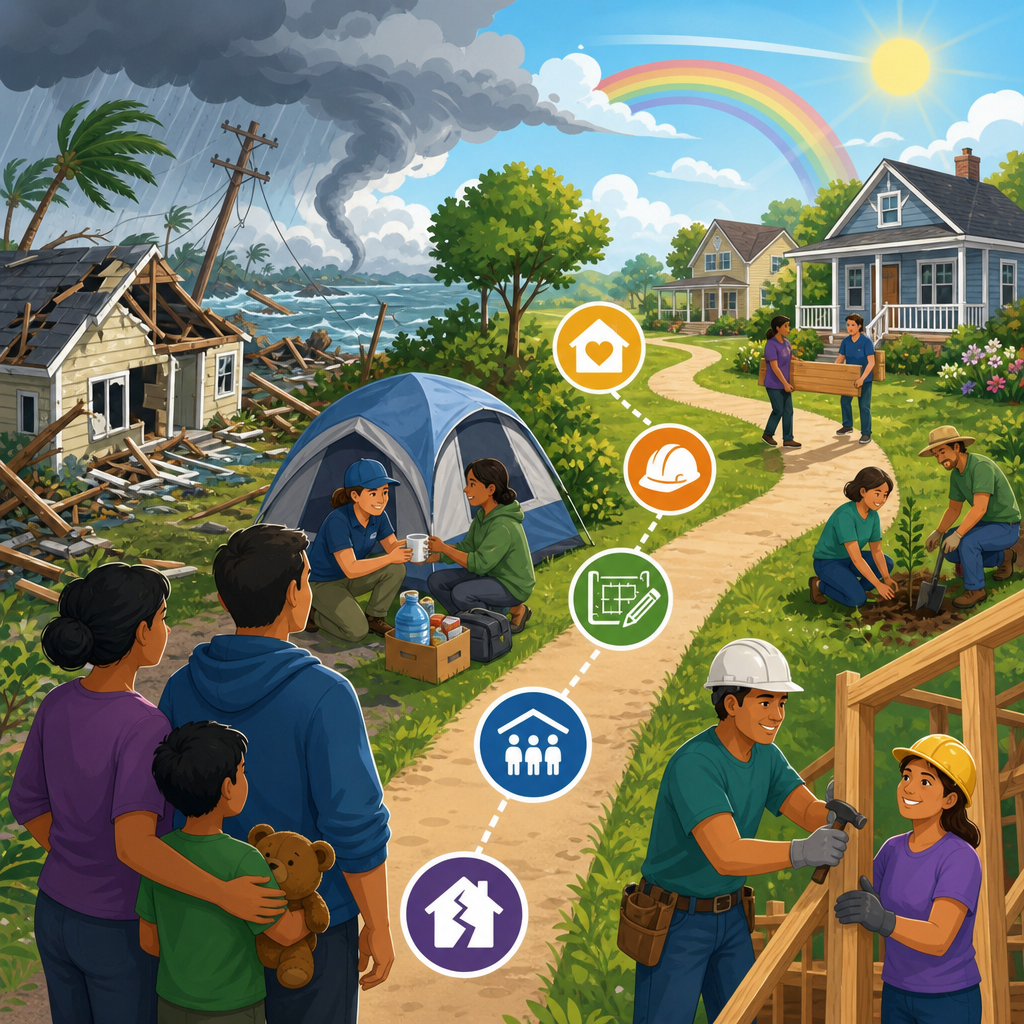
Housing instability after natural disasters begins long before a family receives a notice, a rent increase, or a relocation offer. It starts when a storm, wildfire, flood, or earthquake disrupts the basic systems that make homes livable and neighborhoods functional. Housing instability refers to the loss of safe, affordable, and predictable housing, including displacement, overcrowding, eviction risk, informal sheltering, and repeated moves. In disaster recovery work, I have seen the term used too narrowly, as if instability begins only when a structure is destroyed. In practice, it also includes the apartment that remains standing but becomes unaffordable after repairs, the mobile home park that loses utilities for months, and the subsidized unit that is withdrawn from the market during rebuilding. A recovery roadmap matters because housing is the platform for health, employment, schooling, transportation access, and community continuity. When housing recovery fails, every other recovery system weakens.
Natural disasters create housing instability through direct damage and through market shock. A hurricane can tear roofs from multifamily buildings, but the longer-term disruption often comes from insurance delays, labor shortages, code-triggered upgrades, rising rents, and the conversion of scarce units into temporary lodging for contractors or higher-income newcomers. The same pattern follows major wildfires and inland floods. After Hurricane Katrina, hundreds of thousands of residents were displaced across state lines. After Hurricane Harvey, many households lived for months in repaired-looking homes with hidden mold or incomplete remediation. In wildfire zones across California, entire rental markets tightened because destroyed owner-occupied homes pushed households into nearby apartments. These examples show why urban planning and policy must treat post-disaster housing as a system, not as a single emergency shelter problem. The goal is not only to rebuild units. It is to restore secure tenure, affordability, safety, and access to services while reducing future risk.
This article provides that roadmap. It explains how housing instability unfolds, which households face the greatest barriers, what local governments and community organizations should do in the first days and the following years, and how planners can align land use, finance, infrastructure, and tenant protections. It also serves as a hub for the broader subtopic, connecting the major policy questions that shape disaster recovery: emergency shelter strategy, temporary housing placement, code enforcement, hazard mitigation, rental market stabilization, buyouts, equitable rebuilding, infrastructure sequencing, and long-term resilience. The central lesson is straightforward. Recovery works best when leaders make housing policy decisions early, use reliable damage and market data, and protect residents from being priced out or pushed out during reconstruction.
How Disasters Turn Into Housing Crises
A natural disaster becomes a housing crisis when physical damage collides with preexisting shortages, weak tenant protections, and uneven access to insurance and credit. In many cities, vacancy rates are already low before a storm or fire hits. When even a small share of units becomes uninhabitable, the remaining stock tightens quickly. Landlords may raise rents, leases may not be renewed, and displaced households may double up with relatives or move far from jobs and schools. Planners should distinguish among four categories of disruption: destroyed units, damaged but repairable units, habitable units affected by utility or access failures, and units lost to market conversion. Each category requires a different policy response. Destroyed units need reconstruction finance and permitting. Damaged units need inspections, remediation, and contractor capacity. Utility-affected homes need infrastructure restoration. Market-converted units need stabilization tools and occupancy monitoring.
Timing matters. The first seventy-two hours are about life safety and shelter. The first ninety days determine whether temporary displacement hardens into long-term instability. By the six-month mark, recovery often shifts from humanitarian response to market competition. Households with savings, strong credit, and flexible jobs can absorb that shift. Renters, undocumented residents, seniors on fixed incomes, and people with disabilities usually cannot. FEMA assistance, insurance payouts, and Small Business Administration disaster loans help many households, but these tools have limits. FEMA grants are modest relative to total rebuilding cost. Insurance coverage may exclude floods or underpay contents loss. Loans require repayment and are inaccessible to households already carrying debt. That gap between need and available aid is where instability grows.
Who Faces the Highest Risk of Displacement
Not all households experience disaster recovery the same way. Renters generally face the highest immediate displacement risk because they control neither repair decisions nor the timing of reoccupancy. If a rental building is damaged, tenants may receive little notice, limited relocation support, and no guarantee of return after rehabilitation. In gentrifying neighborhoods, disaster damage can accelerate redevelopment pressure because older, lower-rent properties become candidates for substantial upgrade or replacement. Low-income homeowners face a different challenge. They may own land but lack liquid savings, adequate insurance, or clear title. Inherited properties without formal probate are common in some regions, especially in historically Black rural and urban communities. Without clear title, owners struggle to prove eligibility for assistance, a problem documented repeatedly after hurricanes in the Gulf Coast and Puerto Rico.
Manufactured housing residents, farmworkers, people living in accessory units, and unhoused populations are also routinely underserved by standard recovery systems. Mobile home parks can suffer extensive infrastructure damage even when individual units appear repairable. Farmworker housing may be informal, overcrowded, or tied to employment, which makes official damage assessment difficult. Residents of accessory dwelling units or converted garages may avoid aid systems entirely for fear of exposing code violations or immigration status. Effective policy starts with this reality: the most vulnerable households are often the least visible in administrative data. That is why door-to-door outreach, school district records, utility shutoff maps, and partnerships with trusted community groups are essential for accurate needs assessment.
Immediate Actions for the First Ninety Days
The first phase of a housing recovery roadmap should stabilize people before it stabilizes property. Local governments need a unified housing recovery team that includes emergency management, planning, building, public health, housing agencies, legal aid, and major nonprofit providers. In the field, I have found that fragmented command structures create avoidable delays, especially when damage inspectors, shelter operators, and permit offices work from separate datasets. A single operating picture should track habitability status, utility restoration, temporary shelter capacity, rental availability, and vulnerable-population outreach. Public communication must answer practical questions directly: Is my home safe to enter, where can I sleep tonight, what documents do I need, and how do I avoid fraud.
Temporary shelter should move quickly toward interim housing options that preserve dignity and routine. Hotels can bridge short periods, but families recover better when they have cooking facilities, privacy, school continuity, and transit access. Local governments should negotiate master leases, expand landlord incentive programs, waive parking minimums where temporary units are appropriate, and establish expedited inspection protocols for rapid reoccupancy. Moratoria on disaster-related evictions and price gouging enforcement are equally important. If rents spike while residents are still searching for habitable units, instability spreads from the damaged area into the wider region. Jurisdictions should also deploy legal clinics to help tenants interpret lease termination notices, insurance adjuster communications, and assistance applications. Fast legal guidance often prevents unnecessary displacement.
Core Recovery Tools and What They Solve
No single program fixes post-disaster housing instability. Effective recovery combines emergency aid, regulatory flexibility, targeted subsidies, and long-term rebuilding capital. The most successful local roadmaps assign each tool to a specific housing problem and publish clear eligibility rules. That reduces confusion and builds trust, especially when residents are navigating multiple agencies at once.
| Tool | Primary Use | Best For | Main Limitation |
|---|---|---|---|
| Emergency rental assistance | Preventing immediate displacement | Renters with short-term income shock | Does not replace lost units |
| Hotel or shelter vouchers | Short-term safety | Households displaced overnight | Weak for family stability over time |
| Repair grants | Restoring habitability | Low-income owners and small landlords | Funding often insufficient for code upgrades |
| Disaster loans | Reconstruction capital | Insurable owners with repayment capacity | Excludes many low-income households |
| Master leasing | Securing temporary units at scale | Families needing months, not days, of housing | Requires landlord participation and administration |
| Buyouts and relocation assistance | Moving households out of high-risk areas | Repetitive-loss properties | Slow, complex, and emotionally difficult |
These tools work best when paired with standards. Damage assessment should use consistent habitability criteria. Rebuilding assistance should prioritize primary residences, lower-income households, and properties in strategic service areas. Temporary housing should be close to schools, jobs, and healthcare whenever possible. Buyouts should be voluntary, fairly compensated, and linked to neighborhood-scale land reuse plans rather than scattered vacancies. Without these design choices, even well-funded programs can deepen inequity.
Planning and Policy Levers That Keep Residents Housed
Urban planning shapes whether recovery preserves community or accelerates displacement. Zoning, permitting, code enforcement, and capital planning are not background functions after a disaster; they are central housing tools. Expedited permits for like-for-like repairs can return units to service quickly, especially in small multifamily buildings where delays are costly. Temporary use permits can allow modular homes, accessory units, or RV placements under clear health and safety rules. Inclusionary requirements, replacement housing ordinances, and right-to-return policies can protect lower-income residents when publicly supported reconstruction occurs. In places with severe shortages, local governments should consider temporary density bonuses or adaptive reuse provisions to increase supply during the recovery period.
Tenant protection policy also matters. Anti-harassment rules, relocation assistance requirements, and registration of damaged rental properties can reduce illegal lockouts and silent displacement. I have seen registration systems work well when they require landlords to report damage status, repair milestones, and reoccupancy dates. That creates accountability and helps agencies identify units at risk of speculative withholding. On the ownership side, title clearing assistance is one of the most practical interventions available. A small investment in probate support and deed correction can unlock major recovery funds for families who would otherwise be excluded. Municipalities should also coordinate with utility providers and school districts because reopening a neighborhood without power reliability or school transportation does not produce true housing recovery.
Financing Reconstruction Without Triggering Permanent Loss
Money is usually the longest bottleneck. Construction costs rise after disasters because labor and materials tighten across a region. Insurance settlements may be delayed by disputes over scope, depreciation, or code upgrade coverage. Small landlords who provide naturally affordable housing often cannot finance repairs quickly, yet if they sell, the replacement project may serve a higher-income market. To prevent that permanent loss, local and state governments should create gap financing for affordable rental stock, with conditions tied to affordability periods and tenant return rights. Community development financial institutions can be valuable partners because they underwrite more flexibly than conventional lenders and can blend public and private capital.
Federal funding streams are powerful but unevenly timed. FEMA can support emergency measures and some temporary housing. HUD Community Development Block Grant disaster recovery funds can finance longer-term rebuilding, infrastructure, and mitigation, but they usually arrive after substantial delay because appropriations and action plans take time. That sequencing means jurisdictions need bridge strategies. Resilience bonds, revolving repair funds, local housing trust funds, and philanthropic recovery pools can cover the months when needs are high but federal long-term money has not yet landed. Transparent prioritization is critical. Residents should know who qualifies first, how awards are calculated, and what documentation alternatives are accepted when records were destroyed.
Building Back Safer While Preserving Affordability
Recovery should reduce future disaster loss, but resilience upgrades can increase housing costs if policy is poorly designed. Elevation requirements, fire-resistant materials, backup power, floodproofing, and defensible space standards all improve safety. The challenge is paying for them without shifting costs onto households least able to absorb them. The right approach is targeted subsidy plus calibrated regulation. For example, requiring substantial-damage compliance in flood zones is appropriate, but governments should pair that rule with elevation grants, technical assistance, and relocation options for owners who cannot feasibly rebuild. Similarly, wildfire hardening standards for roofs, vents, and ember-resistant zones work best when paired with insurance reform and neighborhood vegetation management, not left as isolated owner responsibilities.
Affordability preservation should be measured, not assumed. Jurisdictions need dashboards that track repaired units, demolished units, reoccupied units, rent levels, school reenrollment, and return rates by neighborhood and income band. Recovery planners often celebrate building permits issued, but permits do not tell you whether former residents came back. Better indicators include duration of displacement, share of subsidized units restored, and percentage of households spending more than thirty percent of income on housing after the disaster. When leaders monitor outcomes at that level, they can correct course early through additional vouchers, acquisition of at-risk properties, or revised land use policy. Safe rebuilding and equitable rebuilding are not competing goals. With disciplined policy design, they reinforce each other.
What a Strong Local Recovery Roadmap Looks Like
A strong roadmap has five features: pre-disaster housing inventories, rapid damage classification, resident-centered communication, layered financing, and accountability for equitable outcomes. Cities and counties should not wait for the next event to define these elements. The planning work belongs in hazard mitigation plans, housing elements, comprehensive plans, and continuity frameworks now. Agencies should map affordable housing, mobile home parks, senior complexes, repetitive-loss parcels, evacuation constraints, and likely temporary housing sites before disaster strikes. They should also pre-negotiate mutual aid for inspectors, debris management, and case management support.
The main benefit of this approach is speed with fairness. Communities that understand their housing stock, legal tools, and vulnerable populations recover faster and lose fewer residents permanently. Housing instability after natural disasters is not inevitable. It is shaped by policy choices about who gets counted, who gets protected, and how rebuilding money flows. For urban planners, housing agencies, elected officials, and community organizations, the next step is practical: audit your local recovery framework, identify the gaps that would displace residents, and build a housing-first disaster plan before the next emergency arrives.
Frequently Asked Questions
What does housing instability mean after a natural disaster?
After a natural disaster, housing instability goes far beyond a home being visibly damaged or destroyed. It describes any situation in which a person or family loses access to safe, affordable, and dependable housing because the disaster disrupted the systems that make stable living possible. That can include displacement to hotels or shelters, staying temporarily with relatives, moving repeatedly between short-term rentals, living in overcrowded conditions, facing sudden rent increases, receiving pressure from a landlord to leave, or remaining in a home that is technically standing but no longer truly livable because of mold, smoke contamination, utility failure, structural damage, or neighborhood infrastructure breakdown.
In practice, housing instability often begins well before a formal eviction notice or relocation order appears. A wildfire may leave a rental intact but fill it with hazardous smoke residue. A flood may leave electrical systems unreliable and make roads impassable. A storm may reduce local housing supply so sharply that rents rise faster than residents can absorb. An earthquake may push families into informal housing arrangements while inspections, repairs, and insurance claims drag on for months. The key issue is not only whether a roof still exists overhead, but whether the household can remain there safely, affordably, and with some level of predictability.
This broader definition matters because disaster recovery is not just about rebuilding structures. It is about protecting people from a chain reaction of instability that can affect employment, school attendance, health, transportation, finances, and community ties. When families are forced into repeated moves or uncertain living situations, recovery becomes harder, longer, and more expensive. Understanding housing instability in these terms helps survivors, advocates, and policymakers respond earlier and more effectively.
Why do so many families struggle with housing even when their home was not completely destroyed?
Many households experience serious housing problems after a disaster even if their home is still standing because habitability depends on much more than the physical shell of a building. A home may remain technically intact while becoming unsafe or impractical to live in. Utilities may be interrupted for weeks, indoor air quality may be compromised by smoke or mold, sewage systems may fail, access roads may be damaged, or the surrounding area may lose grocery stores, schools, pharmacies, medical providers, and public transportation. In these situations, a residence can exist on paper while no longer functioning as a stable home.
Economic pressure is another major factor. Disasters often trigger sudden rent spikes, reduced housing availability, repair delays, insurance disputes, and temporary job loss. Renters may discover that landlords want to renovate, sell, or re-lease units at higher prices. Homeowners may face mortgage payments on properties they cannot safely occupy, along with insurance deductibles, temporary lodging costs, and repair bills not fully covered by assistance programs. Families who were financially stable before the disaster can quickly become cost-burdened once they start paying for transportation, storage, medical needs, replacement items, and temporary shelter all at once.
There is also an administrative burden that can intensify instability. Survivors may need to navigate FEMA applications, insurance documentation, inspection appointments, local permit processes, contractor negotiations, school transfers, and employer communication simultaneously. Delays in any one of these systems can prolong displacement. For households with limited savings, disabilities, language barriers, immigration concerns, or preexisting health issues, these obstacles can multiply. That is why housing instability after a disaster should be understood as a systems failure issue, not just a property damage issue.
What are the most common warning signs that post-disaster housing instability is getting worse?
One of the clearest warning signs is when temporary housing starts becoming open-ended. A short stay with family, in a hotel, or in a shelter can quickly turn into a prolonged arrangement if repair timelines keep slipping or permanent options remain unaffordable. Repeated moves are another major indicator. When a household relocates multiple times in a matter of weeks or months, it often signals that no available option is truly stable, safe, or financially sustainable.
Other red flags include rent increases after the disaster, landlord pressure to vacate, notices related to repairs or habitability disputes, utility shutoff risks, inability to return home because of unresolved damage, or the need to double up with other households in overcrowded conditions. Families may also begin cutting essentials such as food, medicine, transportation, or school-related costs in order to keep up with housing expenses. Children missing school, adults commuting much farther to work, and family members sleeping in living rooms, cars, or informal structures are all strong signs that instability is deepening.
Less visible warning signs matter too. If a survivor is postponing repairs because of claim delays, avoiding communication with a landlord out of fear, living in a home with persistent mold or smoke exposure, or relying on verbal promises rather than written housing agreements, the household may be at high risk of displacement even if no official notice has been issued. The earlier these signs are recognized, the more options typically remain. That is why recovery planning should include regular check-ins on affordability, safety, legal status, repair progress, and backup housing options rather than waiting for a crisis point.
What should disaster survivors do first to protect their housing situation and start recovery?
The first priority is to document everything and establish a clear record of the housing situation. Survivors should take photos and videos of all damage, save repair estimates, keep receipts for emergency expenses, store copies of leases or mortgage documents, and maintain written notes of conversations with landlords, insurers, contractors, and assistance agencies. If the home is unsafe, that condition should be documented carefully, including mold, smoke damage, flooding, structural issues, utility failures, or access problems. Good documentation can strengthen insurance claims, disaster assistance applications, legal protections, and appeals if benefits are denied.
The next step is to stabilize communication and seek help early. Renters should notify landlords in writing about damage and habitability concerns. Homeowners should contact their insurance carrier and mortgage servicer as soon as possible. Survivors should also apply promptly for any available disaster assistance programs, since deadlines, inspection schedules, and eligibility requirements can affect access to aid. Local housing counseling agencies, legal aid groups, disaster case managers, and community-based recovery organizations can often help survivors understand their rights, organize paperwork, and identify resources that are not obvious at first.
Just as important, households should make a practical recovery roadmap rather than relying on day-to-day improvisation. That means identifying where the family can safely stay in the short term, estimating what current housing costs will look like over the next several months, tracking application deadlines, and preparing contingency plans if repairs or benefits are delayed. If a family is renting, they should ask for all agreements in writing and confirm how long temporary arrangements will last. If they own the home, they should clarify what repairs are essential for safe reoccupancy versus what can wait. Recovery is easier when survivors treat housing as both an emergency need and a project requiring documentation, timelines, advocacy, and backup plans.
How can communities and policymakers reduce housing instability after natural disasters?
Reducing housing instability after disasters requires planning well before the next event occurs. Communities need recovery systems that recognize housing instability as a continuum, not a single moment of displacement. That means tracking not only destroyed units, but also damaged rentals, habitability issues, rent inflation, overcrowding, informal sheltering, and repeated moves. Local governments, housing authorities, and recovery coalitions should coordinate data sharing so they can identify which households are slipping through traditional assistance systems, especially renters, low-income families, older adults, people with disabilities, and residents of manufactured housing or informal arrangements.
Policy responses should emphasize speed, affordability, and tenant protection. That can include temporary anti-price-gouging enforcement, eviction prevention efforts, legal aid for renters, emergency repair funds, flexible cash assistance, rapid habitability inspections, and support for small landlords who agree to keep units affordable during recovery. Communities also benefit from pre-disaster agreements with hotels, nonprofit housing providers, and developers so temporary housing options can be activated more quickly. When recovery programs are too slow or too rigid, families are often forced into unstable arrangements that become harder to unwind over time.
Longer term, the most effective roadmap combines disaster recovery with broader housing resilience. That includes preserving affordable housing stock, strengthening building safety, investing in infrastructure, improving insurance literacy, expanding access to housing counseling, and designing recovery programs that account for the full lived experience of displacement. A community recovers more successfully when people are not just rehoused somewhere, but returned to conditions that are safe, affordable, connected to schools and work, and sustainable over time. In other words, durable recovery happens when housing policy treats stability as essential infrastructure, not as an afterthought once debris is cleared.


