
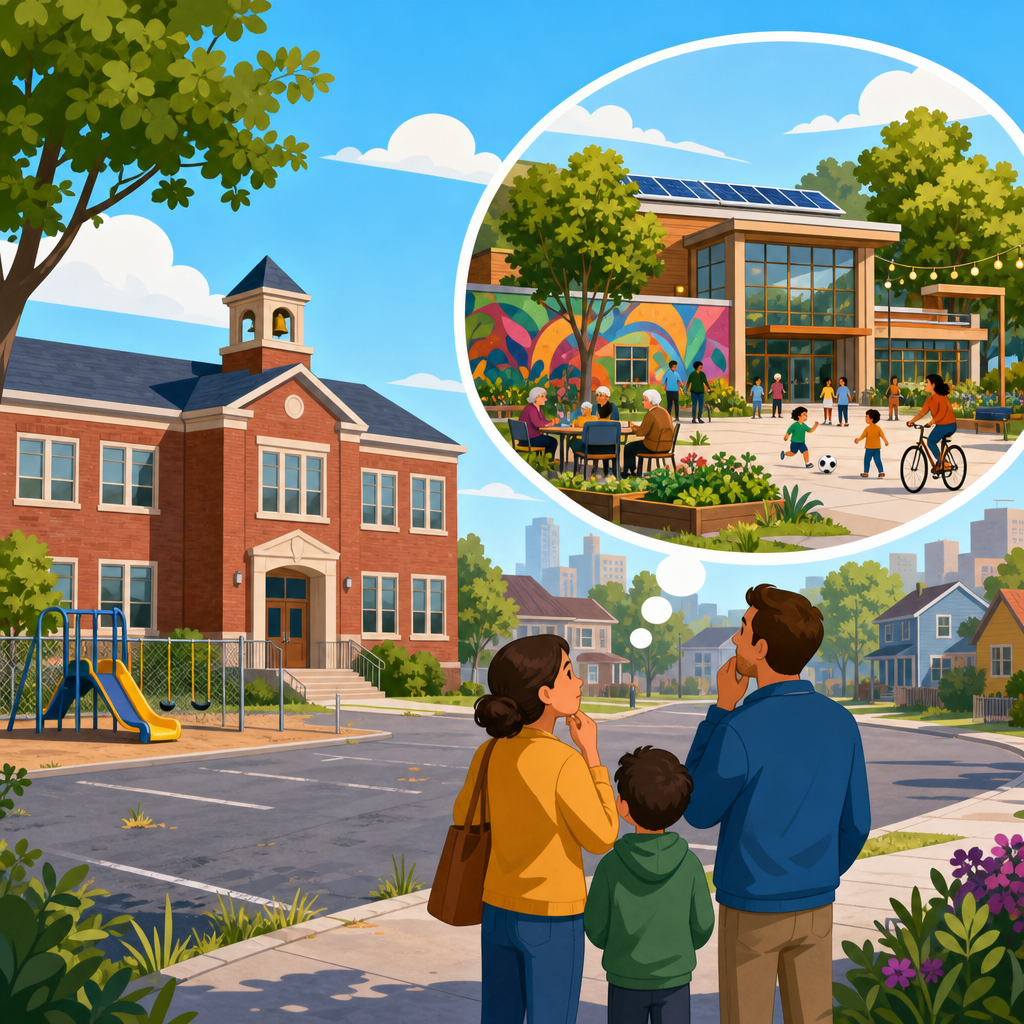
School enrollment decline is reshaping the future of neighborhood facilities, forcing cities, districts, and residents to rethink how schools, parks, libraries, childcare centers, and community services fit together in places built for larger student populations. In planning terms, enrollment decline means a sustained reduction in the number of students attending public or private schools within a district or attendance zone. Neighborhood facilities are the public-serving buildings and spaces that support daily life, including school campuses, recreation centers, health clinics, transit stops, athletic fields, and joint-use spaces. When student counts fall, the issue is not limited to education budgets. It changes land use, public finance, walkability, housing demand, infrastructure efficiency, and the civic identity of a neighborhood.
I have worked on facility assessments where a school that once ran at 95 percent capacity had dropped below 60 percent within a decade, while nearby neighborhoods were simultaneously aging, adding apartments, or losing families with children. That mismatch is now common across many regions. Birth rate declines, rising housing costs, migration shifts, charter and private school competition, remote work patterns, and uneven immigration flows all affect who lives in a community and whether they enroll in local schools. In the United States, many districts saw pandemic-era enrollment losses accelerate longer-running demographic trends. Similar patterns appear in parts of Japan, South Korea, Italy, and Eastern Europe, where shrinking school-age populations have required consolidation and adaptive reuse at scale.
This matters because school sites are often the largest civic assets in a neighborhood. They host voting, after-school care, sports, emergency response, and cultural events. A half-empty campus still incurs fixed costs for maintenance, utilities, and staffing, yet closing it can weaken social ties and reduce access to public space. Urban planners and policymakers therefore face a core question: how can neighborhoods preserve service access and community value when school enrollment no longer supports the old facility model? The answer requires coordinated planning across education, housing, transportation, public health, and parks. This hub article explains the drivers of enrollment decline, the facility consequences, the policy options available, and the principles that should guide decisions about the future of neighborhood facilities.
Why school enrollment is declining in many communities
Enrollment decline usually begins with demographics, but the full picture is more complex. Lower fertility rates reduce the number of kindergarten entrants. When housing costs rise, families with children are often priced out or choose suburbs and exurbs with larger homes. In some central-city neighborhoods, new residential development has added units but not family-sized housing, so population growth has not translated into school growth. District boundaries also matter. Parents may opt for charter schools, magnet programs, homeschooling, or private schools if they perceive quality, safety, transportation, or program advantages elsewhere.
Migration patterns can quickly alter school demand. Districts that relied on immigrant family growth may see flatter enrollment if immigration slows. Former industrial towns may lose population overall, while fast-growing Sun Belt regions can still experience localized school decline in older neighborhoods as development leaps outward. I have seen districts misread this pattern by focusing only on total city growth rather than cohort survival rates, live births, and housing turnover. A neighborhood can add residents while losing elementary-age children if older adults age in place and young singles occupy new units.
Another factor is trust. Families respond to school climate, building condition, and academic reputation. Deferred maintenance can trigger a feedback loop: weaker facilities discourage enrollment, lower enrollment reduces funding, and shrinking budgets make improvements harder. That is why facility strategy cannot be separated from educational strategy. The strongest analyses combine demographic forecasting, geospatial attendance patterns, birth data, permit activity, and qualitative community input.
What enrollment decline means for neighborhood facilities
When a school loses students, excess capacity appears first as empty classrooms, underused cafeterias, and partially scheduled gyms. Over time, the effects spread beyond the building. Bus routes become less efficient, school crossing investments feel oversized, and nearby small businesses may lose daytime activity. Public agencies often carry duplicate facilities in close proximity because a district maintains one campus, a parks department operates another gym, and a library system leases separate space, even though all three serve overlapping populations.
Underused school buildings create real financial pressure. Fixed operating costs rarely fall in proportion to enrollment. Roofs, boilers, fire alarms, accessibility upgrades, and custodial services are still required. Older buildings may have deferred capital liabilities that exceed their market value, yet they remain deeply valued by alumni and nearby residents. The planning challenge is therefore not simply whether to close a school, but how to align the facility portfolio with actual neighborhood needs while preserving access to essential services.
Some neighborhoods also face the opposite risk: cutting too much capacity too soon. Birth rates can recover modestly, redevelopment can attract families, and policy changes such as universal prekindergarten can increase facility demand. Good facility planning uses scenarios, not a single forecast. It distinguishes temporary dips from structural decline and tests which spaces could be shared, leased, modernized, or repurposed without undermining long-term flexibility.
Common facility responses and their tradeoffs
Districts and cities generally choose among consolidation, co-location, modernization, adaptive reuse, or closure. Consolidation combines students from multiple underenrolled campuses into fewer sites, improving utilization and program offerings but often increasing travel distance. Co-location places multiple users in one building, such as a school sharing space with a library branch, health clinic, or community college satellite. Modernization can make a smaller number of campuses more efficient and attractive, though capital costs are high. Adaptive reuse converts former schools into housing, offices, maker spaces, cultural centers, or public service hubs. Closure removes costs fastest on paper, but politically and socially it is usually the hardest path.
| Option | Main benefit | Main risk | Best use case |
|---|---|---|---|
| Consolidation | Higher utilization and fuller programs | Longer commutes and community resistance | Several nearby schools with persistent low enrollment |
| Co-location | Shared costs and stronger service access | Operational complexity between agencies | Stable building with excess space in a walkable area |
| Modernization | Better building performance and family appeal | Large upfront capital expense | Campus with long-term strategic value |
| Adaptive reuse | Preserves asset value and neighborhood activity | Zoning, financing, and preservation hurdles | Building no longer needed for K-12 instruction |
| Closure and sale | Immediate budget relief or revenue | Loss of public control and future flexibility | Severely obsolete site with weak civic reuse potential |
In practice, the best outcomes usually combine these approaches. A district may consolidate two elementary schools, modernize one receiving campus, lease surplus classrooms to an early childhood provider, and preserve one former school as affordable housing with community space. The key is sequencing and transparency. Residents can accept difficult changes when decision criteria are clear, alternatives are compared openly, and reuse plans show a visible public benefit.
How planners can evaluate neighborhood impact
Facility decisions should be made at the neighborhood scale, not just through districtwide averages. A school with low enrollment may still be indispensable if it anchors a transit-poor area, serves a high-poverty catchment, or houses specialized services. I advise teams to map five layers before recommending action: student origin data, walk sheds, housing pipeline, overlapping public facilities, and social vulnerability. This quickly shows where closure would create service deserts or force children across unsafe corridors.
Accessibility is a decisive metric. The difference between a ten-minute walk and a twenty-minute bus ride affects attendance, parent participation, and after-school access. Joint-use assets matter too. Some campuses host recreation fields, meal distribution, summer programs, or emergency shelters. Removing a school without replacing those functions can leave a neighborhood worse off even if the education balance sheet improves. Equity analysis should examine who bears the burden of change by race, income, disability, language, and transportation access.
Financial analysis must also go beyond annual operating savings. Lifecycle cost models, facility condition index scores, deferred maintenance backlogs, seismic risk, ADA compliance needs, and utility performance give a truer picture of whether a building is a reasonable long-term asset. Recognized tools such as GIS suitability modeling, demographic cohort forecasting, and capital asset management systems provide a more defensible basis for decisions than raw enrollment counts alone.
Adaptive reuse and the emerging civic campus model
The most promising response to school enrollment decline is not abandonment but reinvention. Across many cities, former or partially vacant school buildings are becoming multiuse civic campuses. These campuses combine education with healthcare, workforce training, senior services, recreation, and nonprofit office space. The model works because schools already sit in accessible neighborhood locations, often with kitchens, assembly areas, parking, open space, and durable construction.
Examples are increasingly practical rather than experimental. A former elementary school can be converted into affordable housing while retaining the gym as a public recreation facility. A middle school wing with separate access can house a public health clinic or mental health provider. Underused classrooms can support preschool expansion, adult ESL courses, or career and technical education labs. In rural areas, where facility loss can be especially damaging, a school can double as a telehealth site, library pickup point, and emergency resilience hub during storms or wildfires.
Successful reuse depends on building fit, zoning, and governance. Not every school converts easily. Deep classroom floor plates may limit housing layouts. Historic preservation rules can increase costs but also unlock tax credits. Shared campuses require clear agreements on security, maintenance, scheduling, and liability. Even so, keeping a civic use on site usually preserves neighborhood trust better than a private disposition with no public access. That is why many communities now prioritize community-serving reuse before considering sale.
Policy tools that shape better outcomes
Good outcomes rarely happen through district action alone. Municipal governments can revise zoning to allow mixed-use civic campuses, streamline adaptive reuse approvals, and align capital plans across agencies. Housing policy is also central. If a city wants more school enrollment in established neighborhoods, it needs family-sized housing, affordability protections, and safe routes that make those areas attractive to households with children. School facility planning and comprehensive planning should inform each other rather than operate in silos.
State policy influences the range of options. Funding formulas based heavily on seat counts can destabilize districts facing temporary losses. Capital grants that support modernization, energy retrofits, or consolidation planning can reduce reactionary closures. Some states provide surplus property rules that prioritize public or nonprofit reuse. Others make it difficult for districts to partner with health or social service providers inside school buildings. These regulatory details matter because they determine whether local leaders can act creatively or only cut costs.
Community engagement is another policy tool, not a procedural afterthought. The most credible processes publish utilization thresholds, condition data, travel impact estimates, and reuse criteria before decisions are made. They also involve students, families, staff, and neighborhood organizations early enough to shape alternatives. In my experience, resistance is highest when closure appears predetermined and lowest when people can compare realistic scenarios with transparent assumptions.
What the future of neighborhood facilities will look like
The future of neighborhood facilities will be smaller, more shared, more flexible, and more data-driven than the twentieth-century model of one fully dedicated building for every public function. Declining school enrollment does not eliminate the need for civic space. It changes the programming mix. Communities still need early childhood education, youth recreation, digital access, food distribution, elder services, and gathering places. The challenge is to deliver those functions through a facility network that matches current demographics and can adapt as neighborhoods change.
Expect more campuses designed around modular use, with secure instructional zones and publicly accessible wings. Expect stronger partnerships between districts, cities, libraries, health systems, and nonprofits. Expect facility master plans to rely more heavily on demographic scenarios, climate resilience standards, and building performance metrics. Also expect sharper public scrutiny. School closures touch identity, memory, and trust, so technical logic alone will never be enough. The communities that navigate enrollment decline best will pair rigorous analysis with visible neighborhood benefits.
The central lesson is straightforward: school enrollment decline is not only an education problem. It is an urban planning and policy challenge that affects land, access, budgets, equity, and civic life. Neighborhood facilities should not be managed as isolated assets. They should be treated as an integrated public network that can be right-sized, modernized, and repurposed to meet changing demand. Leaders who act early, use reliable data, and plan across agencies can preserve community value even when student numbers fall.
For practitioners and residents alike, the practical next step is to examine local school and facility plans together, not separately. Look at enrollment trends, building conditions, walk access, and nearby community services on the same map. Ask which sites remain essential, which can be shared, and which can be adapted without losing public benefit. That approach turns decline from a purely defensive issue into an opportunity to build stronger, more resilient neighborhood facilities.
Frequently Asked Questions
What does school enrollment decline mean for neighborhood facilities?
School enrollment decline refers to a sustained drop in the number of students attending schools within a district, attendance zone, or community over time. While it is often discussed as an education issue, its effects extend well beyond classrooms. Schools are anchor institutions in many neighborhoods, and when fewer students are enrolled, the demand patterns for nearby parks, libraries, childcare centers, after-school programs, recreation spaces, and transportation services can shift as well. Buildings and sites that were designed to serve larger student populations may become underused, more expensive to maintain on a per-user basis, or harder to justify in their current form.
For local governments and residents, this creates both pressure and opportunity. On one hand, districts may face difficult decisions about consolidating schools, resizing services, or repurposing facilities. On the other hand, declining enrollment can prompt a more integrated approach to neighborhood planning. A school building with excess space might accommodate early childhood programs, health services, adult education, nonprofit offices, or shared community uses. Nearby parks and libraries may also be reimagined as part of a coordinated network of public-serving spaces rather than separate facilities operating independently. In that sense, enrollment decline is not just about fewer students; it is about redefining how neighborhood assets are organized, funded, and used to meet changing community needs.
Why are school enrollments declining in some communities?
Enrollment decline usually results from a combination of demographic, economic, and housing-related factors rather than a single cause. In many communities, lower birth rates are a major driver. When fewer children are born over a period of years, school systems eventually see that change reflected in kindergarten and elementary enrollment. Population aging also plays a role, especially in neighborhoods where long-term homeowners remain in place while fewer young families move in. In these cases, the number of housing units may remain stable, but the number of school-age children living in them declines.
Housing affordability and migration patterns are also important. Families may move away from higher-cost neighborhoods in search of more affordable housing, larger homes, or different school options. At the same time, some districts lose enrollment because of shifts toward charter schools, private schools, homeschooling, or inter-district choice programs. Economic changes can amplify these trends, particularly in areas affected by job loss, disinvestment, or uneven redevelopment. In rapidly changing neighborhoods, enrollment may also fall when smaller households, older adults, or higher-income residents replace families with children. Understanding the local mix of causes is essential, because effective planning depends on whether the decline is temporary, cyclical, or part of a long-term structural shift in the community.
How can cities and school districts repurpose underused school buildings responsibly?
Responsible repurposing starts with recognizing that school buildings are civic assets, not just pieces of real estate. When enrollment declines leave campuses partially vacant or fully closed, the best responses usually come from joint planning among school districts, city agencies, community organizations, and residents. The first step is a clear assessment of building condition, enrollment trends, neighborhood service gaps, accessibility, and long-term financial obligations. Leaders need to determine whether a facility should remain in educational use, be adapted for shared public purposes, or be redeveloped in a way that still supports neighborhood goals.
In practice, strong reuse strategies often favor community-serving functions. Former schools can become childcare centers, pre-K hubs, workforce training sites, public health clinics, senior centers, affordable housing with community space, cultural facilities, or multi-service campuses that combine several uses under one roof. Shared-use arrangements can allow libraries, recreation programs, food access services, and nonprofits to operate in spaces that already have classrooms, kitchens, gyms, and meeting rooms. This can be more cost-effective than constructing new facilities from scratch. However, responsible reuse also requires attention to equity, historic value, environmental conditions, and neighborhood identity. Communities are often concerned about losing a beloved local institution, so transparent engagement and clear reuse criteria matter. The strongest outcomes preserve public benefit, maintain neighborhood access to services, and align redevelopment with broader planning goals rather than treating school closures as isolated property transactions.
What are the biggest planning challenges when schools are built for more students than they now serve?
One of the biggest challenges is mismatch: the physical and financial infrastructure of a neighborhood may be scaled for a population that no longer exists. A school campus designed for hundreds more students than currently attend can create high maintenance costs, excess classroom space, and inefficient operations. Transportation systems, crossing improvements, athletic fields, meal services, and utility systems may also be oversized relative to actual use. For districts already under budget pressure, maintaining underused facilities can divert funds from instruction, building upgrades, or student support services.
There are also broader neighborhood planning implications. Fewer students can affect the viability of nearby businesses, after-school programs, youth sports, and family-oriented services. If a school closes, the community may lose not just educational capacity but also a gathering place, emergency resource site, and source of neighborhood identity. Another challenge is that decline is rarely uniform. One part of a district may have excess capacity while another still needs seats, specialized programs, or modern facilities. That makes right-sizing politically and technically difficult. Planners and school leaders must balance efficiency with access, ensuring that consolidation does not create longer travel times, weaken walkability, or disproportionately burden vulnerable communities. The challenge is not simply reducing space; it is adapting physical assets in a way that supports long-term neighborhood stability and equitable access to public services.
What does the future of neighborhood facilities look like in areas with long-term enrollment decline?
The future is likely to be more flexible, more shared, and more coordinated across agencies. In places facing long-term enrollment decline, the traditional model of every public service operating in a separate building may become harder to sustain. Instead, communities may move toward multi-use neighborhood hubs that combine education, childcare, recreation, library services, health programs, and social services in fewer but better-used facilities. This approach can reduce duplication, improve public access, and help local governments invest in quality rather than simply maintaining excess square footage.
At the same time, the future will depend on whether communities treat enrollment decline as a signal to retreat or as a reason to redesign systems more intelligently. Forward-looking districts and cities are using demographic forecasting, land use analysis, and facility condition data to plan decades ahead rather than reacting building by building. They are also exploring adaptive reuse, co-location agreements, phased redevelopment, and partnerships with nonprofits and public agencies. In strong scenarios, neighborhood facilities become more resilient because they are designed to serve multiple age groups and changing needs over time. A school site might support students during the day, childcare and adult learning in the evening, and health or community services throughout the week. That kind of layered use can help preserve the civic role of neighborhood facilities even when student populations shrink. Ultimately, the future is not just about managing fewer children in schools; it is about making sure public spaces continue to serve as durable, inclusive infrastructure for the entire community.


