
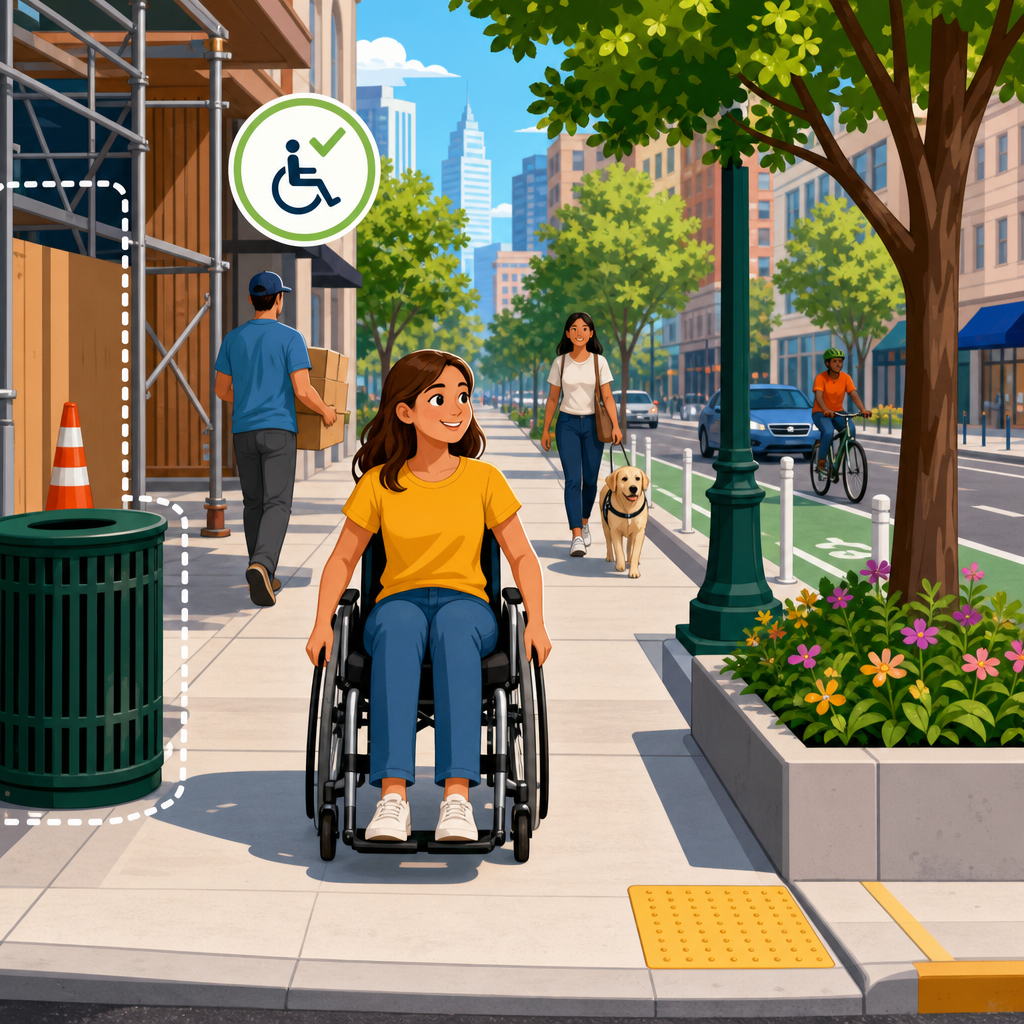
Sidewalk obstructions are one of the most persistent barriers to safe, independent travel for wheelchair users, and cities that want truly accessible streets must treat them as a core transportation and civil rights issue. In practical terms, a sidewalk obstruction is anything that narrows, blocks, destabilizes, or otherwise interferes with the pedestrian access route: utility poles placed in the middle of the path, restaurant seating that spills into the walkway, broken pavement, snow piles, dockless scooters, overflowing trash carts, poorly timed construction closures, and curb ramps that end in standing water. I have worked on accessibility reviews of streetscape projects, and the pattern is consistent across large and small municipalities: many barriers are avoidable, most are predictable, and nearly all become worse when departments manage them separately instead of through a unified street accessibility strategy.
For wheelchair users, the consequences are immediate. A missing clear path can force someone into a bike lane or traffic lane, add significant travel time, prevent access to transit, or make a routine trip impossible. The issue is not just convenience. In the United States, the Americans with Disabilities Act, the Rehabilitation Act, and public rights-of-way accessibility guidance establish that local governments and operators must provide accessible pedestrian routes. Similar duties exist in other countries through equality, building, and transportation laws. The basic design principle is straightforward: people using manual wheelchairs, power wheelchairs, mobility scooters, walkers, and other mobility devices need a continuous, stable, slip-resistant route with enough width, manageable cross slope, and reliable transitions at driveways, corners, and crossings.
Why this matters for urban planning and policy is equally clear. Sidewalk obstruction management affects safety, transit use, economic participation, public health, and legal exposure. It also reveals whether a city understands accessibility as an ongoing operational responsibility rather than a one-time capital project. A newly rebuilt sidewalk can still fail users if sandwich boards, planters, scooters, and temporary signs reduce the clear width every afternoon. Conversely, older streets can function much better when cities enforce placement rules, coordinate utility work, maintain surfaces, and respond quickly to complaints. The most effective cities combine standards, maintenance, permitting, enforcement, and data into one system. That systems approach is how cities can address sidewalk obstructions for wheelchair users in a durable, measurable way.
Start with a clear definition of the pedestrian access route
The first step is to define the part of the sidewalk that must remain continuously passable. Many agencies call this the pedestrian access route or clear path. Whatever the label, the city should adopt one operational rule that every department, contractor, permit holder, and business can understand: maintain an unobstructed route of sufficient width and quality from origin to destination, including curb ramps, landings, transit stops, and temporary detours. In the United States, Public Right-of-Way Accessibility Guidelines are the most useful technical reference for city staff because they translate accessibility principles into measurable conditions such as width, cross slope, surface quality, and protruding object limits. Local standards should align with those principles and remove ambiguity in field decisions.
That definition must cover permanent, recurring, and temporary obstructions. Permanent barriers include poles, signal cabinets, hydrants, tree pits, drainage structures, and poorly placed street furniture. Recurring barriers include trash day containers, outdoor dining enclosures, merchandise displays, and seasonal snow storage. Temporary barriers include construction fencing, utility cuts, event infrastructure, and parked maintenance vehicles. In practice, cities often regulate these through different offices, which creates gaps. Public works handles snow, transportation manages signs, planning issues café permits, sanitation controls bins, and utilities place cabinets. Wheelchair users experience the street as one connected route, so policy must be organized around that lived reality rather than around the internal chart of departments.
A simple baseline policy is effective: if an object intrudes into the required route, the city either relocates it, redesigns the space, or provides a compliant alternate path. That sounds obvious, but it changes decisions. A scooter corral belongs in the furnishing zone, not the access route. A temporary work zone needs a protected, accessible bypass, not a “sidewalk closed” sign pointing people into a dirt shoulder. A bus stop pad must connect to the sidewalk without lips or ponding. By naming the route clearly and enforcing it consistently, cities create the foundation for every other accessibility measure.
Use design standards that prevent obstructions before they appear
The cheapest obstruction to fix is the one never built. Cities should design sidewalks with functional zones: a frontage zone near buildings, a pedestrian through zone, and a furnishing or curb zone for poles, trees, benches, hydrants, bike racks, and parking meters. This structure is standard in strong streetscape manuals because it protects the through zone from clutter. Where sidewalks are narrow, the city should prioritize clear passage over aesthetic add-ons. I have seen projects spend heavily on decorative planters and custom paving while leaving too little width for two wheelchair users to pass comfortably. Good accessibility practice reverses that priority.
Materials and geometry also matter. Uneven pavers, utility covers set below grade, steep driveway cross slopes, and narrow curb ramps create functional obstructions even when nothing visibly blocks the route. Cities should favor durable surfaces, require flush utility transitions, and review driveway design carefully because frequent driveway crossings can tilt a chair unexpectedly toward traffic. Signal poles and cabinets should be grouped in the furnishing zone, not scattered. Transit stops need boarding areas that align with the sidewalk route and are not blocked by shelters, advertising panels, or bike share docks. New micromobility infrastructure should include designated parking areas so devices do not end up abandoned in the access path.
| Obstruction type | Common cause | Best city response |
|---|---|---|
| Dockless scooters | No fixed parking management | Install corrals, geofence no-parking areas, fine operators for blocked routes |
| Outdoor dining | Permits focus on business frontage, not clear width | Set minimum clear path standards and inspect routinely |
| Construction closures | Contractors prioritize vehicle flow over pedestrian access | Require accessible temporary traffic control plans before permit approval |
| Trash carts and bins | Collection rules ignore mobility impacts | Assign placement rules and timed enforcement on collection days |
| Broken pavement | Deferred maintenance and utility patch failures | Use rapid repair standards and hold utilities to restoration warranties |
Street redesign projects provide the best opportunity to eliminate chronic conflicts. If the right-of-way is constrained, cities should be willing to remove a parking lane, reduce lane widths, or consolidate street furniture rather than asking wheelchair users to tolerate a substandard sidewalk. That tradeoff is ultimately a policy choice. When cities say accessibility is nonnegotiable, design teams find space.
Build maintenance, permitting, and enforcement into one operating system
Most sidewalk obstructions are operational problems, not engineering mysteries. That is why cities need coordinated maintenance, permitting, and enforcement. A strong system starts with asset ownership: every curb ramp, signal pole, utility cover, tree pit, and bus stop should have a responsible party. If no one owns the problem, it remains on the route for months. Maintenance standards should include response times for uplifted concrete, debris, ponding, snow, and failed temporary patches. Utilities and contractors should face restoration requirements with inspections after settlement periods, because accessibility often degrades after the initial patch looks acceptable.
Permitting rules should translate accessibility into plain field conditions. Outdoor dining permits should specify exact dimensions, edge protection, queueing space, and detectable boundaries. Construction permits should require pedestrian maintenance plans that preserve an accessible route through or around the work zone using barriers, ramps, surfaces, and signals that work for blind and mobility-impaired pedestrians alike. Event permits should map all tents, generators, fencing, portable toilets, and crowd control barriers against the pedestrian route. If an organizer cannot maintain access, the permit should be revised or denied.
Enforcement must be visible and predictable. Complaint-driven enforcement alone misses daily barriers that users have stopped reporting because they assume nothing will change. Cities should combine scheduled inspections with targeted sweeps in high-conflict areas such as downtown restaurant districts, transit corridors, and school zones. Some agencies now use mobile GIS tools, 311 analytics, and contractor dashboards to prioritize repeat violations. That is smart practice. When data show that one block generates recurring scooter obstructions or one utility repeatedly leaves uneven patches, the city can intervene structurally instead of treating each incident as isolated.
Center wheelchair users in audits, reporting, and performance metrics
Cities cannot manage what they do not measure, and sidewalk accessibility is often undermeasured. Traditional pedestrian counts will not reveal whether a route is usable for a power chair after rain or during garbage collection. The best audits combine technical inspection with lived-experience review by wheelchair users. In field assessments I have joined, users identified barriers professionals initially overlooked, including the way a small lip at a driveway multiplied effort over a long trip, or how a legal minimum width still failed once café lines formed. That insight is why participatory audits matter.
Municipal reporting systems should make obstruction complaints easy to submit, geotag, and track. A useful 311 form lets residents identify the barrier type, upload a photo, note whether the route is fully blocked or partially narrowed, and flag urgency near transit stops, schools, hospitals, or government buildings. Just as important, the system should close the loop by reporting action taken and time to resolution. Public dashboards can show how many accessibility complaints were received, average repair times, repeat offender locations, and progress by district. Those metrics turn accessibility from a vague promise into an accountable service standard.
Performance measures should go beyond simple counts of repaired sidewalks. Better indicators include miles of continuous accessible route, percentage of transit stops connected by compliant paths, number of recurring obstruction hotspots eliminated, and share of permits inspected for route compliance. Equity mapping is also valuable. If low-income neighborhoods or areas with higher disability prevalence have slower response times or more unresolved barriers, the city should state that openly and redirect resources. Honest measurement is not a public relations risk; it is how improvement becomes possible.
Adopt policy tools that sustain accessibility over time
Lasting improvement comes from policy, budget, and procurement decisions that survive changes in staff and leadership. Every city should have an ADA transition plan or equivalent accessibility implementation program that specifically addresses sidewalks, curb ramps, transit access, and temporary traffic control. That plan should inventory barriers, rank priorities, assign funding, and publish timelines. Capital programs should reserve money for curb ramp upgrades, pavement repair, and accessibility corrections linked to resurfacing, utility work, and corridor redesign. When projects touch the street, the city should upgrade known barriers instead of rebuilding around them.
Procurement language is another powerful lever. Contracts for construction, snow removal, sanitation, landscaping, and micromobility operations should include explicit route-clearance obligations, inspection criteria, documentation requirements, and penalties for noncompliance. Training matters too. Parking enforcement officers, permit inspectors, and public works crews need practical instruction on what obstructs a wheelchair route and how to fix it in the field. A staff member who understands turning space, cross slope, and detectable edges will make better daily decisions than one relying on intuition alone.
Finally, cities should communicate expectations clearly to residents and businesses. Publish illustrated sidewalk rules, mark legal placement zones, and explain why a “small” encroachment can be a complete barrier for someone using a wheelchair. Accessibility improves when policy is specific, operations are coordinated, and users are treated as experts in the street environment. City leaders should review their standards, audit their routes, fund overdue fixes, and make obstruction response a routine part of street management. When the pedestrian path stays clear, wheelchair users gain safer travel, more reliable access to work and services, and a city that functions as intended for everyone.
Frequently Asked Questions
What counts as a sidewalk obstruction for wheelchair users?
A sidewalk obstruction is any condition that reduces, blocks, or makes unsafe the clear pedestrian access route that wheelchair users and other disabled pedestrians rely on for daily travel. That includes obvious barriers such as utility poles placed in the middle of a walkway, construction equipment, parked scooters or bikes, trash bins, sandwich boards, and restaurant seating that extends too far into the sidewalk. It also includes less visible but equally serious problems such as cracked or heaved pavement, missing curb ramps, puddling or drainage problems, snow and ice accumulation, low-hanging branches, and temporary closures that do not provide an accessible detour. For a wheelchair user, even a small narrowing or surface defect can force a dangerous choice: enter the street, turn back, or attempt to navigate terrain that risks tipping, getting stuck, or injury.
Cities should understand sidewalk obstructions as both a transportation problem and an accessibility rights issue. Sidewalks are not just leftover public space; they are essential infrastructure. When the pedestrian route is blocked or destabilized, wheelchair users lose access to jobs, schools, medical care, transit stops, businesses, and community life. The most effective way to define an obstruction is functionally: if it interferes with safe, continuous, independent travel along the accessible route, it is a barrier that deserves attention.
Why are sidewalk obstructions such a serious issue for wheelchair users?
Sidewalk obstructions matter because they directly affect safety, independence, and equal access. A person using a wheelchair typically needs a continuous, stable, and sufficiently wide route to travel predictably through the city. When that route is blocked by a pole, narrowed by outdoor dining, broken by pavement damage, or covered by snow, the result is not merely inconvenience. It can mean being forced into traffic, missing a bus stop, arriving late to work, skipping appointments, or avoiding certain neighborhoods entirely. What may seem minor to an able-bodied pedestrian can create a complete barrier for someone using a manual wheelchair, power chair, scooter, walker, or other mobility device.
There is also a cumulative effect. One obstruction might be manageable; repeated barriers across a corridor can make a trip effectively impossible. This is why cities should avoid treating complaints as isolated maintenance issues. Persistent obstructions can reveal broader failures in permitting, enforcement, design standards, contractor oversight, and winter operations. From a legal and policy perspective, inaccessible sidewalks can expose cities to civil rights concerns because the public right-of-way must be usable by disabled residents on equal terms. Addressing obstructions is therefore not optional housekeeping. It is a core part of building a safe, inclusive transportation network.
How can cities identify and prioritize sidewalk obstructions more effectively?
Cities are most successful when they combine proactive inspection with strong public reporting systems. Waiting for occasional complaints is not enough, because many barriers go unreported or are concentrated in places where residents have less time, trust, or ability to navigate city bureaucracy. A better approach is to conduct regular accessibility audits of sidewalks, curb ramps, transit stop connections, and major pedestrian corridors, especially around schools, hospitals, business districts, senior housing, and transit hubs. These audits should look beyond permanent infrastructure to capture recurring temporary barriers such as vendor encroachment, outdoor dining spillover, trash collection practices, and snow storage patterns.
Prioritization should be based on impact, not just visibility. Cities should rank issues higher when they completely block passage, force wheelchair users into the street, interrupt access to transit, or occur along critical routes with high pedestrian demand. Mapping complaint data, maintenance records, crash data, and ADA transition planning information can help identify hotspots and chronic problem areas. Just as important, cities should involve wheelchair users and local disability organizations directly in field reviews and policy development. People who navigate these streets every day often identify barriers that standard engineering checklists miss. A strong system makes reporting easy, tracks response times publicly, and distinguishes between immediate hazards that require rapid correction and long-term capital fixes that need design and funding.
What policies and design strategies help prevent sidewalk obstructions in the first place?
Prevention starts with treating the accessible pedestrian route as protected public infrastructure, not flexible leftover space. Cities should adopt and enforce clear standards for minimum pedestrian clear width, surface quality, placement of street furniture, utility coordination, temporary traffic control, and maintenance responsibilities. Utility poles, signal cabinets, fire hydrants, benches, bike racks, and signage should be located in ways that preserve a continuous accessible path. Permits for outdoor dining, street vending, construction staging, and special events should include explicit accessibility requirements, with measurable clearances and meaningful enforcement when operators encroach on the walkway.
Good design also reduces the likelihood of future obstructions. Wider sidewalks where pedestrian demand is high, designated furnishing zones, accessible curb ramps aligned with crossings, smoother pavement materials, and better drainage all make routes more resilient. During construction, cities should require accessible temporary paths and detours rather than allowing pedestrians to fend for themselves. In winter climates, snow removal rules should clearly assign responsibility and prohibit snow storage that blocks curb ramps or narrows sidewalks below accessible width. The most effective cities build accessibility into procurement, capital planning, permit review, inspections, and contractor training so that barriers are prevented upstream instead of repeatedly fixed after harm occurs.
What should a city do when sidewalk obstructions are already widespread?
When obstructions are already common, cities need a structured response that addresses both immediate hazards and systemic causes. First, they should establish a rapid-response process for barriers that create urgent safety risks, such as blocked curb ramps, construction closures without accessible detours, severe pavement failures, or objects that force wheelchair users into the roadway. At the same time, they should launch a citywide accessibility action plan that identifies chronic corridors, assigns agency responsibilities, sets timelines, and ties improvements to budget decisions. This is where coordination matters: public works, transportation, planning, code enforcement, parks, sanitation, utilities, and permitting offices all influence whether sidewalks remain clear and usable.
Longer term, cities should invest in sidewalk repair programs, curb ramp upgrades, utility relocation where feasible, stronger permit enforcement, and better maintenance standards. Performance metrics are important. Residents should be able to see how many complaints were received, how quickly barriers were addressed, and which neighborhoods are still underserved. Cities should also create feedback loops with disability advocates so policy changes can be tested against real-world experience. Most importantly, officials should frame the issue correctly. Widespread sidewalk obstructions are not a cosmetic problem; they are evidence that the public right-of-way is failing some residents. A serious response recognizes that removing these barriers improves safety, dignity, mobility, and access to civic life for wheelchair users and for many others as well.


