
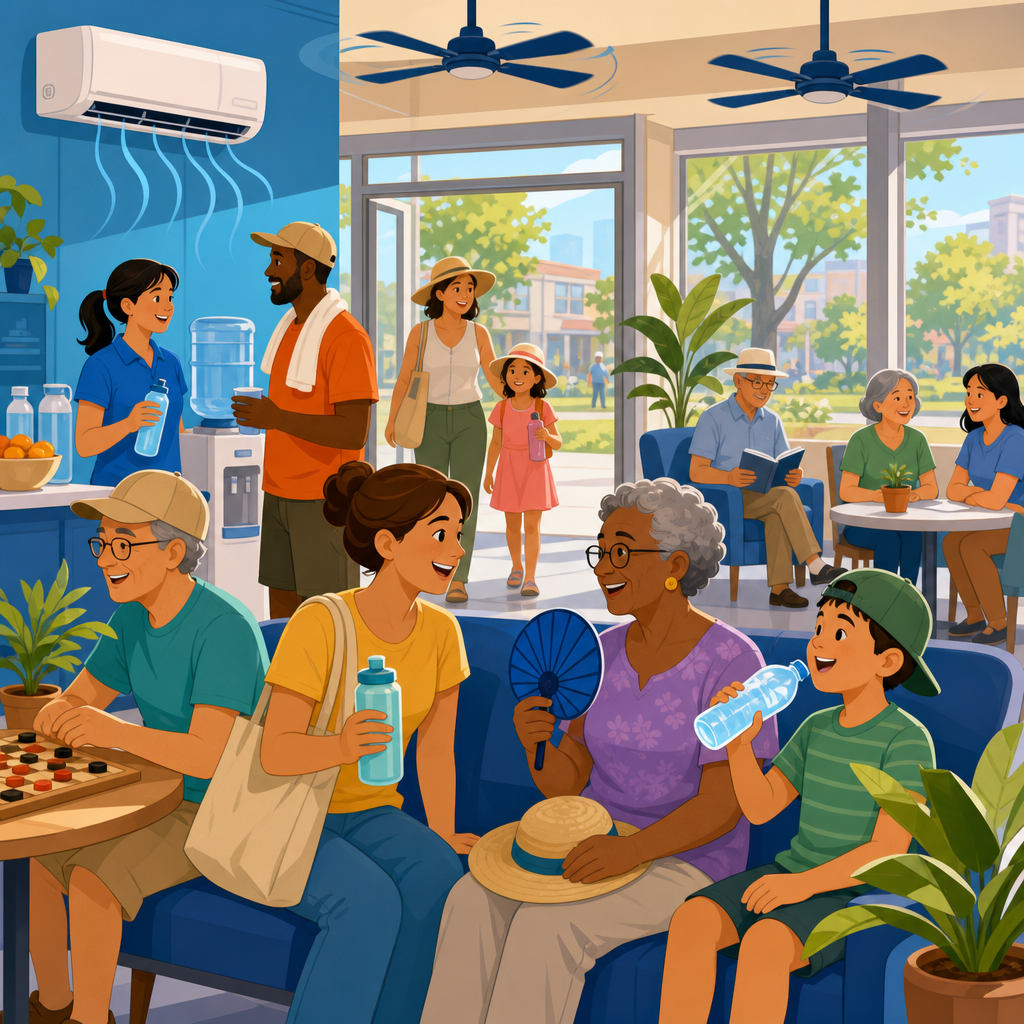
Emergency cooling centers save lives during extreme heat, but many cities discover a hard truth: opening a public building is not the same as getting residents to use it. In practice, attendance depends less on the existence of a cooling center and more on whether people trust it, can reach it, know when it is open, and believe it will meet their needs without stigma or hassle. That gap between availability and actual use matters because heat is already the deadliest weather hazard in the United States, causing more fatalities in many years than floods, hurricanes, or tornadoes. As summers grow hotter, urban planners, public health officials, housing agencies, and emergency managers need cooling centers that function as real protective infrastructure, not symbolic announcements.
A cooling center is typically an air-conditioned public or nonprofit space, such as a library, school, recreation center, senior center, or faith building, opened during high-heat events for people who lack safe indoor temperatures at home. Emergency cooling centers are activated rapidly when forecasts or observed temperatures cross risk thresholds. Residents most likely to need them include older adults, outdoor workers, people experiencing homelessness, people with disabilities, low-income renters, households with high utility burdens, and residents in neighborhoods with heavy pavement, low tree canopy, and chronic building disrepair. Yet vulnerability is never purely demographic. I have worked on heat response planning where a seemingly low-risk neighborhood produced heavy emergency calls because residents lived in top-floor apartments with failing window units and no nighttime relief.
That example points to the central question in emergency cooling center planning: what makes people actually use them? The answer sits at the intersection of urban design, public communication, behavioral science, public health, and service operations. Residents choose whether to leave home, spend money or time on transportation, risk social exposure, disrupt care routines, and enter a public setting based on concrete calculations. Is the trip short and safe? Will children be welcome? Can I bring medication, a service animal, or a pet? Will there be seating, water, restrooms, charging outlets, and staff who speak my language? Will I be turned away if I look poor, undocumented, intoxicated, or confused? Those practical questions determine usage far more than heat advisories alone.
For city leaders, understanding actual use is essential because every low-attendance cooling center reveals a policy failure somewhere upstream. Maybe the site is too far from high-risk blocks. Maybe operating hours ignore evening heat. Maybe communications rely on websites while the target audience depends on radio, door knocking, or text alerts. Maybe people fear crowded public spaces, policing, or disease exposure. A strong hub strategy therefore links facility siting, transportation, outreach, building standards, social services, and neighborhood partnerships into one heat response system. When those pieces align, residents use cooling centers earlier, more often, and with less friction, reducing heat illness, emergency department visits, and preventable deaths.
Access starts with location, transportation, and hours
The first driver of cooling center use is physical access. A site that looks adequate on a city map can still fail residents if it requires two bus transfers, crossing six-lane arterials, or walking fifteen minutes on sun-exposed sidewalks. Heat planning works best when cities map high-risk populations against transit networks, sidewalk conditions, tree canopy, and building-level vulnerability. Public health departments increasingly pair demographic indicators with land-surface temperature, overnight heat retention, and utility shutoff data to identify where people are most likely to need daytime and nighttime relief. In every city project I have seen perform well, planners started with where heat risk concentrates, not with which municipal buildings happened to be empty.
Operating hours are equally decisive. Many agencies default to standard business hours, but dangerous heat often peaks in late afternoon and continues indoors overnight, especially in poorly insulated apartments. Residents who work day shifts may not be able to visit until evening. Caregivers may need after-school access. Older adults may avoid midday travel. That is why successful programs extend hours, offer weekend availability, and create escalation triggers for overnight centers during prolonged heat waves. Phoenix, Maricopa County, and Las Vegas have shown that heat response becomes more effective when locations are distributed, transportation is coordinated, and hours match actual exposure patterns rather than office schedules.
| Factor | Low-use cooling center | High-use cooling center |
|---|---|---|
| Location | Chosen by available building inventory | Chosen by heat-risk and population mapping |
| Transit access | Indirect routes, long walks, unsafe crossings | Frequent service, short shaded approach, paratransit options |
| Hours | Weekdays only, limited daytime operation | Evenings, weekends, surge hours, overnight triggers |
| Wayfinding | Poor signage, unclear entrances | Visible signs, multilingual directions, staffed entry |
| Amenities | Bare room with chairs | Water, restrooms, charging, seating, child-friendly space |
Transport support can be the tipping point. Free transit fare during heat emergencies, rideshare vouchers, shuttle loops from senior housing, and partnerships with paratransit operators increase attendance because they remove the hidden costs of reaching safety. Some jurisdictions also publish walking-distance maps and real-time occupancy dashboards, which help residents choose a site confidently. If people are uncertain whether they can get there, or whether it will be full or closed, many will stay home and take their chances.
Trust, dignity, and social fit drive behavior
People do not enter emergency spaces purely because officials tell them to. They use them when the environment feels safe, familiar, and respectful. In neighborhood interviews after heat events, residents often say the same thing in different words: “I need to know I will be comfortable there.” Comfort is social as much as thermal. Libraries often outperform unfamiliar municipal sites because residents already know the rules, the staff, and the atmosphere. Faith centers can work for similar reasons when participation does not depend on religious affiliation. Conversely, a building associated with policing, bureaucratic scrutiny, or prior exclusion can suppress turnout even if it is physically convenient.
Dignity matters in small operational details. Staff training should cover trauma-informed service, de-escalation, disability etiquette, language access, and clear intake protocols that minimize paperwork. Residents should not have to prove need in the middle of a heat emergency. Requiring identification, extensive registration, or visible security screening can deter undocumented residents, unhoused people, and anyone with prior negative institutional experiences. The Americans with Disabilities Act also shapes usability in practical terms: accessible entrances, restrooms, seating, quiet areas, and communication supports are not extras. They are prerequisites for inclusive emergency service.
Family and household realities also determine whether a resident comes inside. Parents need sites where children are welcome and can sit safely for hours. Older adults may refuse to leave if they cannot bring a spouse, caregiver, mobility device, or essential medication. Pet owners frequently stay home rather than abandon animals in hot apartments or outside on pavement. Cities that permit pets in carriers, create co-located animal relief areas, or coordinate with shelters see better participation. This is a consistent lesson from disaster sheltering more broadly: if a center does not fit the household as it actually exists, residents will avoid it.
Communication must answer practical questions before people ask
Public messaging about cooling centers often fails because it announces locations without answering operational questions. Effective communication is specific, repetitive, multilingual, and channel-diverse. Residents need exact addresses, hours, transit options, amenities, eligibility rules, pet policies, accessibility features, and a clear statement that the site is free. They also need to know when a heat event becomes dangerous, what symptoms require immediate medical help, and why fans alone may not protect them during extreme indoor heat. The Centers for Disease Control and Prevention and National Weather Service provide strong public guidance, but local agencies must translate it into neighborhood-level instructions.
One of the most reliable methods is using trusted messengers instead of relying only on official accounts. Community health workers, tenant leaders, librarians, school staff, senior-service providers, and mutual aid groups can spread information faster and more credibly than a single city press release. Text alerts, robocalls, local radio, bus-stop signage, pharmacy posters, and door-to-door outreach all matter because vulnerable residents do not consume information in the same way. During one municipal heat activation I advised, calls to a multilingual 311 line produced far more usable referrals than social posts, simply because callers could ask whether a center had cots, wheelchair access, or space for a caregiver.
Communication also works best when it starts before the emergency. Residents should recognize the concept and locations of cooling centers in spring, not encounter them for the first time during a heat warning. Cities can normalize use through preseason campaigns, utility bill inserts, school newsletters, and clinic-based counseling for heat-sensitive patients. The goal is to reduce decision friction. When temperatures spike, people should already know where they would go and how they would get there.
Services inside the building determine whether people stay
A cooling center succeeds only if it provides meaningful relief. That means indoor temperatures maintained at genuinely safe levels, reliable power, water, seating, restrooms, and enough staff to keep the environment orderly. A room that is technically air-conditioned but crowded, noisy, under-furnished, or poorly supervised will not retain visitors. In severe heat, the ability to stay for several hours matters, so centers should support phone charging, medication storage where feasible, basic snacks, and quiet zones for older adults or people with sensory sensitivities. Thermal relief must be paired with humane operations.
Medical readiness is another differentiator. Cooling center staff do not need to operate as clinicians, but they should know signs of heat exhaustion and heat stroke, understand when to call emergency medical services, and have protocols for welfare checks and incident escalation. Partnerships with public health agencies, federally qualified health centers, and emergency medical teams can add blood pressure checks, hydration guidance, or targeted follow-up for high-risk visitors. Some cities also integrate social service navigation, connecting attendees to utility assistance, housing repair programs, and weatherization support. That approach is smart because repeated cooling center use often signals chronic housing inadequacy.
Data collection should be light but useful. Attendance counts, ZIP codes, arrival modes, peak hours, referral sources, and unmet needs help agencies improve future activations. The key is balancing insight with privacy. If cities ask intrusive questions, people stop coming. If they ask nothing, they cannot learn. The strongest programs collect only what they can act on and publish after-action reviews that explain what changed because of the data.
Cooling centers work best as part of a broader heat resilience system
No city can cool-center its way out of extreme heat if housing, streets, and infrastructure remain dangerously hot. Emergency cooling centers are necessary, but they are the backstop, not the whole strategy. Long-term success depends on home cooling access, tenant protections, utility affordability, reflective roofs, shade infrastructure, tree planting, resilient power systems, and building standards that limit indoor overheating. Urban planners increasingly treat heat as a design problem as much as an emergency management problem. That shift is correct because residents will use cooling centers more effectively when the broader system makes heat risk visible, navigable, and preventable.
Policy design strongly affects demand. Cities with strong anti-shutoff protections, air-conditioning assistance, and housing rehabilitation programs reduce the number of residents forced into crisis choices. Zoning and capital planning can support new public facilities in heat-vulnerable districts. School districts, park agencies, and libraries can align continuity plans so that familiar neighborhood spaces open automatically under defined triggers. Employers can coordinate with local government for outdoor worker protections and midday access. These are not isolated interventions. They create a coherent urban response that residents can understand and trust.
The most effective emergency cooling centers are therefore local, reachable, dignified, and predictable. They are placed where risk is highest, open when exposure is worst, communicated through trusted channels, and operated with enough services to support real human needs. When cities approach cooling centers as part of everyday civic infrastructure rather than last-minute charity, usage rises. Review your local heat plan, map who cannot safely stay home, and build centers people will actually choose to use.
Frequently Asked Questions
Why do many emergency cooling centers stay underused even during dangerous heat waves?
Many cooling centers are underused because availability alone does not remove the real barriers people face during extreme heat. Residents may not know a center exists, may not know its hours, or may assume it is only meant for people in the most severe crisis. Others avoid going because transportation is difficult, the walk to the site feels unsafe in high temperatures, or the center is open at the wrong times for people who work, care for children, or depend on rigid daily routines. In many communities, the problem is not whether a building has been designated as a cooling center, but whether that site has been made usable in practical terms.
Trust also plays a major role. People are more likely to use spaces that feel familiar, welcoming, and respectful. If residents worry they will be questioned, judged, turned away, or made uncomfortable, they may decide to stay home even when home is dangerously hot. Stigma matters too. Some people associate emergency services with personal failure, homelessness, or public scrutiny, and that perception alone can keep them away. In short, usage rises when cooling centers are easy to find, simple to reach, clearly open, physically comfortable, and framed as a normal public health resource rather than a last-resort shelter.
What factors make residents more likely to actually use a cooling center?
Residents are far more likely to use a cooling center when it fits naturally into everyday life. That starts with location. Centers placed in trusted neighborhood spaces such as libraries, recreation centers, schools, senior centers, and faith-based facilities often perform better than unfamiliar government buildings because people already know where they are and what to expect. Accessibility is equally important. A center should be reachable by public transit, safe walking routes, paratransit, or community shuttle service, especially for older adults, people with disabilities, and households without reliable vehicles.
Clear communication is another deciding factor. Residents need simple, repeated messaging about where centers are located, when they open, what amenities they offer, and who can use them. The most effective outreach is multilingual, distributed through local partners, and delivered through the channels people already use, including text alerts, radio, neighborhood organizations, health clinics, apartment managers, social service networks, and social media. Beyond communication and transportation, people also respond to comfort and dignity. A cooling center that offers seating, water, restrooms, device charging, child-friendly space, and a calm environment feels useful. If pets are accommodated or there is a clear pet plan, attendance may increase significantly, since many residents will not leave animals behind in unsafe conditions.
How important are trust and community relationships in cooling center attendance?
Trust is often the difference between a cooling center that exists on paper and one that residents actually use. During emergencies, people rarely make decisions based only on official announcements. They rely on signals from neighbors, community leaders, local institutions, and prior experience. If a center is staffed by people who are respectful, culturally competent, and familiar with the community, it immediately feels safer and more legitimate. If residents have seen the same facility support the neighborhood in other ways, they are much more likely to believe it will be helpful during extreme heat.
Community relationships also shape whether people feel welcome. Immigrant families may worry about documentation questions. Older adults may fear being overlooked or rushed. People experiencing poverty may avoid environments where they expect judgment. Residents with chronic health conditions may need assurance that the site can accommodate basic medical needs. When agencies build partnerships in advance with nonprofits, tenant groups, disability advocates, faith leaders, and local health providers, they can design cooling centers around real concerns instead of assumptions. That preparation creates a center that feels less like an emergency directive and more like a trusted neighborhood resource, which is exactly what increases participation when dangerous heat arrives.
What practical features make a cooling center feel worth the trip for residents?
A cooling center has to offer more than a lower indoor temperature. For many residents, deciding to leave home during extreme heat involves effort, planning, and discomfort, so the destination must clearly meet their needs. Basic necessities matter: reliable air conditioning, drinking water, restrooms, seating, and enough space to rest comfortably without crowding. Long or inconsistent wait times can discourage attendance, so predictable operations and visible staff support are important. Signage should be easy to understand, entry procedures should be simple, and the overall environment should feel calm rather than chaotic.
Additional amenities can strongly influence whether people see the center as usable. Phone charging, Wi-Fi, snacks, children’s activities, accessible entrances, mobility accommodations, and quiet areas can turn a technically available service into a genuinely attractive one. Hours matter just as much as amenities. If the center closes before the hottest evening period or opens too late in the day, many vulnerable residents will not benefit. In some cases, extended evening hours, overnight options, or heat-triggered transportation support are what make attendance feasible. The most effective centers are designed around the resident’s experience from the moment they hear about the site to the moment they return home safely.
How can cities improve cooling center use before and during extreme heat emergencies?
Cities can improve cooling center use by treating the issue as a public health access challenge, not just a facilities challenge. Before heat season begins, local governments should map where vulnerability is highest, identify trusted community locations, evaluate transit gaps, and ask residents directly what would keep them from using a center. That feedback can reveal barriers that are easy to miss from an administrative perspective, such as fear of leaving pets behind, confusion about eligibility, or concern about being in crowded spaces. Cities should also standardize operating plans so residents are not confronted with inconsistent hours, unclear rules, or changing service levels during an emergency.
During heat events, communication needs to be frequent, specific, and repeated across many channels. Messages should explain not only that centers are open, but exactly where they are, how to get there, who is welcome, and what support is available on site. Partnerships with neighborhood organizations, healthcare providers, senior services, and housing operators can help identify people at highest risk and connect them to transportation or wellness checks. Cities that monitor attendance, gather resident feedback, and adjust quickly tend to perform better over time. In practical terms, the most successful approach is proactive rather than symbolic: make centers easy to trust, easy to reach, easy to understand, and clearly worth using. That is what turns a lifesaving resource from a posted address into a place residents will actually enter when heat becomes dangerous.


