
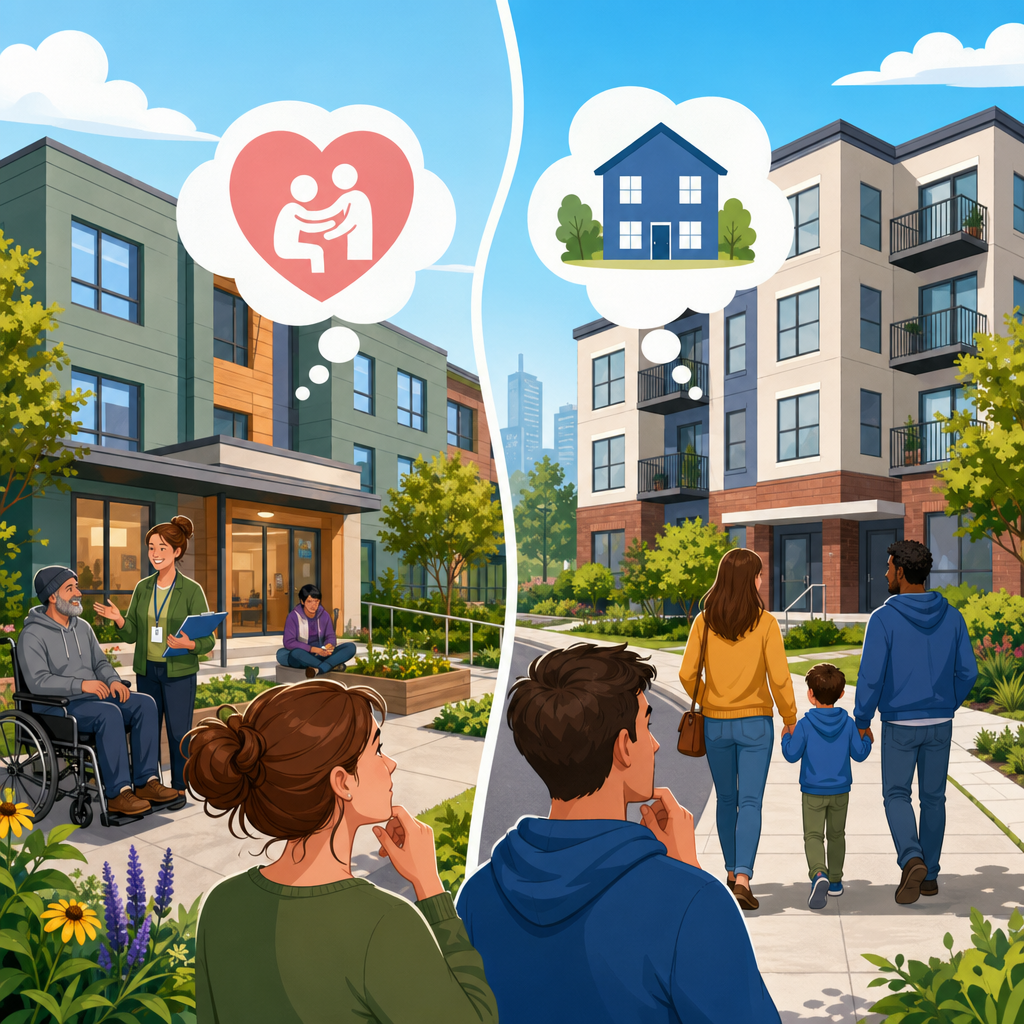
Supportive housing and affordable housing are related but not interchangeable terms, and confusing them leads to bad policy, missed funding opportunities, and poor referrals for people who need stable homes. In practice, I have seen municipal staff, nonprofit boards, and even seasoned landlords use the phrases as if they describe the same product. They do not. Affordable housing refers to homes priced so households with lower incomes can reasonably pay rent or mortgage costs. Supportive housing refers to housing paired with services for people who face barriers to stability, such as chronic homelessness, serious mental illness, substance use disorder, disability, or repeated institutional stays. A unit can be both affordable and supportive, but it does not have to be.
The distinction matters because each model is financed, regulated, and operated differently. Affordable housing usually centers on income limits, rent restrictions, and long-term affordability covenants. Supportive housing centers on tenancy plus voluntary or coordinated services, often funded through healthcare, human services, veterans programs, Medicaid-related mechanisms, philanthropy, or local operating subsidies. If a city plans for one but funds the other, outcomes suffer. If a family searches for low-cost rent but is referred only to service-enriched housing, the fit may be wrong. If a chronically homeless tenant is placed in a cheap apartment without support, the placement may fail.
For anyone asking, “What is the difference between supportive housing and affordable housing?” the shortest accurate answer is this: affordable housing solves a price problem, while supportive housing solves a housing stability problem that includes, but goes beyond, price. This article explains the key definitions, how each model works, who qualifies, how they overlap, and what decision-makers should look for when building, funding, or referring households to the right kind of home.
Affordable housing: the cost side of the equation
Affordable housing is generally defined by what a household pays relative to income. The standard benchmark used by the U.S. Department of Housing and Urban Development is that housing is affordable when a household spends no more than 30 percent of gross income on housing costs, including rent and basic utilities. Households paying more than that are considered cost-burdened, and those paying more than 50 percent are severely cost-burdened. Those thresholds matter because rising rent burdens are linked to eviction risk, overcrowding, deferred healthcare, and food insecurity.
Most affordable housing programs target households at specific percentages of Area Median Income, commonly 80 percent, 60 percent, 50 percent, or 30 percent of AMI. A tax credit property may reserve units at 60 percent AMI. A public housing authority may serve residents with much lower incomes. A city inclusionary zoning policy may require below-market units in new developments. The common thread is that the housing is priced below unrestricted market levels or subsidized to remain within reach of income-qualified households.
Affordable housing does not necessarily include on-site services. Many residents are working families, seniors, people with disabilities, students, or households in high-cost markets who simply need rent they can sustain. In one project I worked on, the largest need was not case management but predictable rents near jobs and transit. The residents wanted safe units, stable leases, and responsive maintenance. That is typical. Affordable housing is first and foremost about access to ordinary housing at a manageable cost.
Supportive housing: housing linked to services
Supportive housing combines permanent housing with services designed to help tenants remain housed and improve health, safety, and daily functioning. The best-known model is permanent supportive housing, often used for people experiencing chronic homelessness or living with disabling conditions. Core features usually include a standard lease or tenancy rights, deeply affordable rent, and access to voluntary or coordinated services such as case management, behavioral healthcare, medication support, employment assistance, tenancy coaching, and connections to benefits.
Two principles are especially important. First, housing is not conditional on treatment compliance in the way transitional programs historically often were. Second, services are intended to support tenancy, not replace it. Residents are tenants, not program participants who can be exited for failing to meet lifestyle requirements that ordinary renters do not face. This distinction is rooted in widely adopted practices such as Housing First, which prioritizes rapid placement into permanent housing and then wraps services around the tenant as needed.
Supportive housing serves a narrower population than affordable housing. It is aimed at people whose housing instability is tied to health, disability, trauma, institutional cycling, or functional impairments. Examples include a veteran leaving chronic street homelessness, an adult with schizophrenia returning from inpatient care, or a person with repeated emergency room use and untreated substance use disorder. For these residents, low rent alone is often not enough. Without service coordination, landlord engagement, and crisis response, even a discounted apartment may not lead to durable stability.
The clearest differences at a glance
The fastest way to separate supportive housing vs affordable housing is to compare purpose, target population, funding, and operations. In everyday development work, these differences shape everything from underwriting to staffing plans and referral pipelines.
| Category | Affordable Housing | Supportive Housing |
|---|---|---|
| Primary goal | Reduce housing cost burden | Maintain housing stability for tenants with significant barriers |
| Typical residents | Income-qualified households, families, workers, seniors | People experiencing chronic homelessness, disability, serious illness, or repeated system involvement |
| Key eligibility factor | Income limits, often based on AMI | Need for services plus income qualification or rental subsidy |
| Rent structure | Restricted or below-market rents | Usually deeply subsidized, often tied to tenant income |
| Services | Not required | Central component, usually voluntary or coordinated |
| Common financing | LIHTC, HOME, bonds, public housing, local trust funds | Affordable housing capital plus service contracts, vouchers, healthcare or human service funding |
| Operator staffing | Property management focused | Property management plus service staff and partnerships |
This comparison highlights the central truth: affordable housing is a broad category defined by cost, while supportive housing is a specialized intervention defined by both housing and services. Many supportive projects are physically indistinguishable from conventional apartments. What makes them supportive is the operating model, the referral structure, and the service design that follows the tenant over time.
Who qualifies for each type of housing?
Eligibility for affordable housing usually starts with income. Programs set maximum incomes based on household size and local AMI. Applicants may also need to pass standard screening tied to occupancy limits, documentation, and lease compliance. Some properties have preferences for seniors, veterans, or local residents, but the central qualification is still economic. A household earning too much usually cannot enter, even if it would benefit from lower rent.
Eligibility for supportive housing is more layered. Income still matters because most residents need rent assistance or deeply restricted rents, but supportive housing also requires evidence of service need or vulnerability. Depending on the program, this can include documentation of chronic homelessness, disability verification, high use of crisis systems, foster care transition, justice involvement, or other indicators. Continuums of Care, coordinated entry systems, and referral partnerships often play a major role in determining who is prioritized.
That difference changes access pathways. A family searching for an income-restricted apartment may apply directly to a property waitlist. A person referred to supportive housing may come through a shelter assessment, hospital discharge planning team, street outreach provider, managed care organization, or behavioral health agency. In other words, affordable housing is commonly applicant-driven, while supportive housing is frequently referral-driven. Understanding that distinction helps agencies avoid sending people into the wrong queue and helps applicants pursue realistic options sooner.
How funding and operations shape the housing model
One reason the terms get blurred is that the same building can use some of the same capital sources. Affordable housing development commonly relies on Low-Income Housing Tax Credits, tax-exempt bonds, HOME funds, Community Development Block Grant support, state housing finance agency programs, housing trust funds, or project-based rental assistance. These tools help close the gap between what low-income tenants can pay and what it costs to build and operate the property.
Supportive housing often uses those same capital stacks for the real estate, but it also needs operating and service funding. That may include Section 8 vouchers, Continuum of Care rental assistance, Veterans Affairs Supportive Housing vouchers, state behavioral health contracts, county human services dollars, Medicaid-related tenancy supports where allowed, philanthropic grants, or hospital community benefit investments. In projects I have underwritten, the real challenge was rarely the building alone. It was securing durable service funding for years after opening, because unstable service budgets can undermine an otherwise strong property.
Operations differ too. An affordable housing property may be run almost entirely by a professional management company focused on compliance, leasing, maintenance, and recertifications. A supportive housing property needs property management and services working in parallel. If those teams are not aligned, avoidable conflicts emerge around rent collection, unit inspections, crisis response, guest policies, and reasonable accommodations. The strongest operators use clear role definitions, regular case conferencing with consent, trauma-informed practices, and landlord-tenant standards that protect both housing stability and resident rights.
Where the models overlap and where confusion happens
Supportive housing and affordable housing overlap in several ways. Most supportive housing must be affordable to residents, often extremely affordable. Many affordable housing properties include some resident services such as after-school programs, financial coaching, or senior wellness checks. Some mixed-income developments set aside a portion of units for supportive housing tenants while the rest serve general affordable housing residents. Because of these hybrid structures, people start using the labels loosely.
The confusion usually comes from treating any housing with services as supportive housing or any low-rent housing as affordable enough for high-need tenants. Both shortcuts are inaccurate. A family apartment complex with a resident services coordinator is still generally affordable housing, not supportive housing, if services are light-touch and the property is not designed for a high-need referral population. Likewise, a cheap motel conversion is not supportive housing simply because residents were homeless before move-in. Without stable tenancy rights, service coordination, and ongoing supports, it may be emergency or interim housing rather than supportive housing.
A useful test is to ask two questions. First, is the defining feature reduced housing cost for income-qualified households? Second, is the defining feature long-term tenancy paired with services for people whose barriers would otherwise jeopardize housing? If the answer is mainly the first, you are looking at affordable housing. If it is mainly the second, you are looking at supportive housing. If both are true by design, the project sits in the overlap.
Which option is better?
Neither model is inherently better; each solves a different problem. Affordable housing is the right solution when the main barrier is that rents outpace wages or fixed incomes. A retail worker, childcare provider, or senior on Social Security may thrive in ordinary affordable housing without intensive services. Supportive housing is the right solution when low income intersects with disabling conditions, repeated homelessness, or complex service needs. In those cases, pairing housing with sustained support is not an add-on. It is the intervention.
Evidence supports matching the model to the need. Supportive housing has been shown in many communities to reduce shelter use, jail stays, hospitalizations, and crisis service utilization among high-need populations, particularly when targeted to people experiencing chronic homelessness. Affordable housing more broadly improves stability, lowers eviction risk, and helps households preserve income for transportation, childcare, food, and healthcare. The policy mistake is not choosing one over the other. It is underinvesting in both and expecting either one to do the other’s job.
For planners, advocates, and residents, the practical takeaway is simple: define the problem before naming the solution. If the issue is cost burden, expand affordable supply and rental assistance. If the issue is chronic instability linked to health and disability, build or fund supportive housing with reliable services. If you are assessing local needs, map both shortages separately. That step alone improves strategy, budget design, and public communication.
Supportive housing vs affordable housing is not a semantic debate; it is a basic distinction that affects how homes are financed, who gets referred, and whether residents actually remain stably housed. Affordable housing keeps costs within reach for income-qualified households. Supportive housing combines permanent housing with services for people facing serious barriers to tenancy. Some developments are both, but the terms should never be used as if they mean the same thing.
The most useful way to remember the difference is this: affordable housing answers, “Can this household pay for housing?” Supportive housing answers, “What will help this household keep housing over time?” Cost matters in both cases, yet supportive housing adds service coordination, tenancy support, and population-specific design. That added layer is what makes it effective for people cycling through homelessness, hospitals, shelters, or institutions.
If you are choosing a development strategy, writing policy, or helping someone find housing, start by identifying the real barrier: price, stability, or both. Then match the housing model to that need, use the right referral path, and build funding around long-term operations, not just construction. For more guidance within the affordable housing topic, continue exploring related pages on financing, vouchers, housing first, LIHTC, AMI limits, and project operations.
Frequently Asked Questions
1. What is the main difference between supportive housing and affordable housing?
The core difference is that affordable housing is about cost, while supportive housing is about cost plus services. Affordable housing refers to homes priced so that households with lower or moderate incomes can pay rent or mortgage costs without being overburdened. In many cases, that means the housing is restricted or subsidized based on area median income, household earnings, or other income guidelines. The defining feature is that the home is made financially accessible.
Supportive housing, by contrast, is designed for people who need not only an affordable place to live, but also ongoing support to remain stably housed. Those supports may include case management, mental health care coordination, substance use treatment connections, employment assistance, help with benefits, life-skills coaching, or health-related services. The housing itself is typically affordable to the resident, but affordability alone is not what makes it supportive housing. What makes it supportive is the intentional integration of housing with voluntary, person-centered services for people with higher needs, such as those experiencing chronic homelessness, disability, serious mental illness, or repeated housing instability.
This distinction matters because treating the two terms as interchangeable leads to planning errors. A city may count general low-cost apartments as if they meet the needs of residents who require intensive support, when they do not. Likewise, a developer may assume a supportive housing project can be funded or managed like a standard affordable housing property, even though staffing, referral systems, service partnerships, and operating structures are very different. In short, all supportive housing should be affordable to the tenant, but not all affordable housing is supportive housing.
2. Is supportive housing a type of affordable housing?
Yes, in most practical and policy contexts, supportive housing is best understood as a specialized form of affordable housing. Residents of supportive housing usually have very low incomes, and the housing is structured so rent remains within reach, often through subsidies, vouchers, project-based assistance, or deeply targeted affordability requirements. Without affordability, the supportive model would fail, because the households it serves generally could not sustain market-rate housing costs.
However, calling supportive housing “a type of affordable housing” is only useful if the added complexity is not ignored. Supportive housing is not simply an affordable unit with a social worker attached. It is a housing model built around long-term housing stability for people who face barriers that ordinary affordable housing may not address on its own. That means the property may need service funding, coordinated entry or referral relationships, specialized staff, trauma-informed practices, accessibility design, and operating policies suited to vulnerable tenants. In many communities, supportive housing also involves partnerships among housing developers, service providers, health systems, and public agencies.
So the answer is technically yes, but the distinction still matters. If a policymaker hears “supportive housing” and thinks only in terms of rent restrictions, they may underfund services. If a landlord hears “affordable housing” and assumes every low-income unit should come with intensive case management, that is also incorrect. Supportive housing sits within the broader affordable housing universe, but it serves a different function and requires a different implementation approach.
3. Who is supportive housing for, and who is affordable housing for?
Affordable housing serves a broad range of households whose incomes are too low to comfortably afford market-rate homes in a given area. That can include working families, seniors on fixed incomes, people with disabilities, young adults entering the workforce, essential workers, and others squeezed by local housing costs. The central question is financial: does the household need below-market rent, restricted rents, or some type of housing subsidy to obtain a stable home?
Supportive housing serves a narrower population with both housing needs and service needs. It is typically intended for people facing persistent or acute barriers to housing stability, such as chronic homelessness, repeated shelter use, serious mental illness, substance use disorders, complex medical conditions, developmental disabilities, or histories of institutionalization, incarceration, or trauma. These residents may struggle not only with paying rent, but also with maintaining tenancy without ongoing support. The goal is not simply placement into a cheaper unit; it is long-term housing stability through a combination of affordability and individualized services.
This difference affects referral pathways and program design. A household that earns 50% of area median income and needs a lower rent may be well served by standard affordable housing. A person cycling between hospitals, shelters, and the street may need supportive housing because lower rent alone will not resolve the instability. Understanding the intended population helps agencies avoid poor referrals, helps landlords set realistic expectations, and helps funders direct resources where they can do the most good.
4. Do residents in supportive housing have to participate in services?
In well-designed supportive housing, services are generally voluntary, even though they are readily available and strongly encouraged. This is an important principle, especially in permanent supportive housing models that follow housing-first practices. The idea is that people should not have to “earn” housing by proving treatment compliance or meeting rigid program demands before they can be stably housed. Instead, the housing is the foundation, and services are offered in ways that build trust, autonomy, and long-term engagement.
That said, the exact structure can vary depending on the program, funding source, target population, and operator. Some supportive housing environments may have regular check-ins, care plans, or lease-related expectations tied to building operations, but these are not the same as making tenancy contingent on perfect service participation. Effective supportive housing providers understand that residents often engage with services gradually. A person may first accept help with benefits, later connect to health care, and only after months choose to pursue behavioral health treatment or employment goals. The service model is designed to meet people where they are.
This is another reason supportive housing should not be confused with ordinary affordable housing. In standard affordable housing, there may be little or no service infrastructure at all. In supportive housing, services are built into the operating philosophy and partnerships, even if residents choose how much they use them. For practitioners and policymakers, this distinction is critical because service funding, staffing, and performance metrics must be aligned with the reality that housing stability often improves through voluntary engagement, not coercion.
5. Why does confusing supportive housing with affordable housing create policy and funding problems?
Confusing these terms causes real-world damage because the two models require different goals, budgets, staffing structures, referral systems, and success measures. If a jurisdiction assumes all affordable housing can serve people with the highest needs, it may underinvest in services and then conclude that the residents themselves are “failing,” when in reality the housing model was mismatched to the population. On the other hand, if leaders assume all affordable housing should function like supportive housing, they may create unnecessary complexity, discourage developers, or misallocate scarce service dollars.
Funding is one of the biggest problem areas. Affordable housing capital often comes from sources focused on construction, preservation, and rent restriction, such as housing tax credits, local trust funds, or bond proceeds. Supportive housing frequently needs those same housing dollars plus separate operating subsidies and service funding streams from health, behavioral health, homelessness, Medicaid-related, or human services systems. When decision-makers blur the definitions, they may pursue the wrong funding stack, miss eligibility rules, or approve projects without sustainable service financing. That can leave residents underserved and providers scrambling.
Poor terminology also leads to bad referrals and bad expectations. A hospital discharge planner might send a medically fragile person to standard affordable housing that has no support structure. A landlord might accept tenants with complex needs without the property supports needed to help tenancies succeed. A nonprofit board might believe it is addressing homelessness by adding low-cost units, when the highest-need residents actually require coordinated supportive housing placements. Clear language improves policy, project design, interagency coordination, and outcomes. Simply put, when communities understand that affordable housing addresses price and supportive housing addresses price plus support, they make smarter decisions at every level.


