
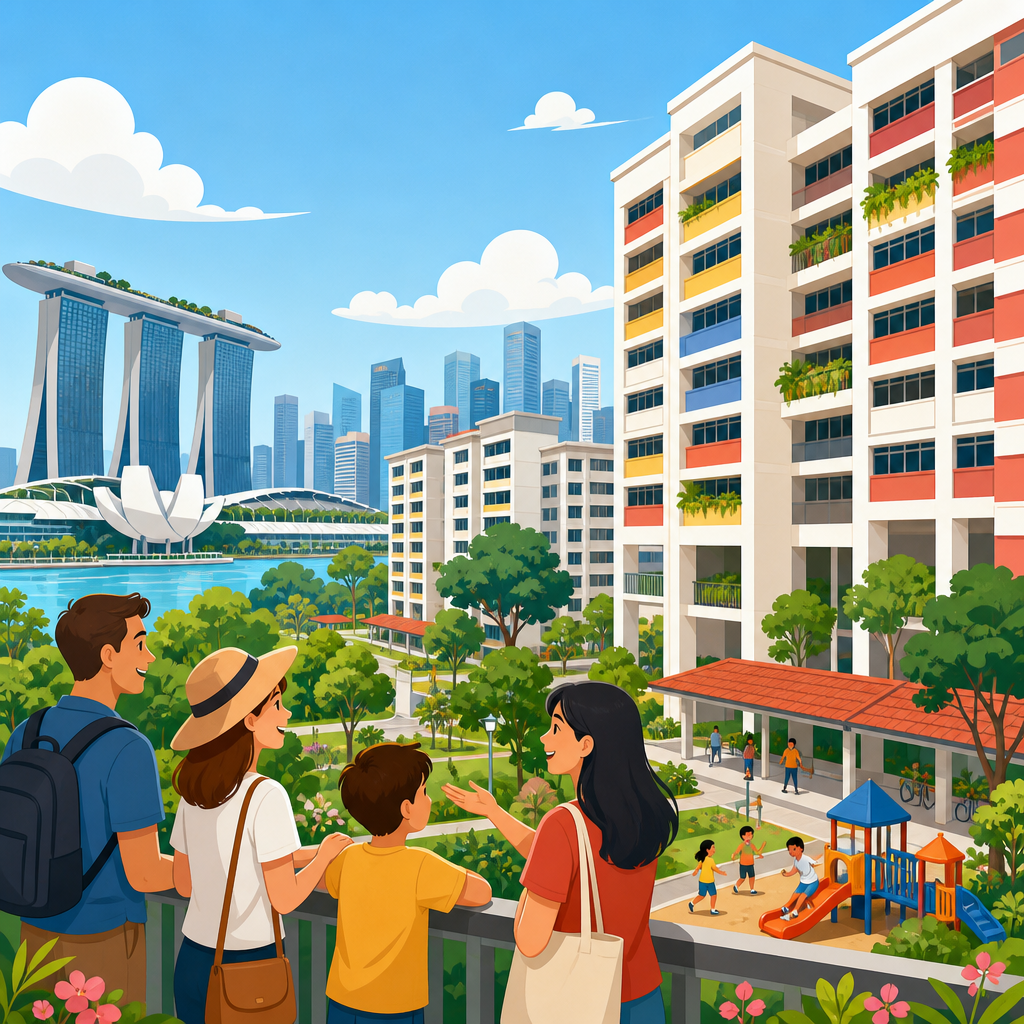
Singapore public housing is one of the most studied urban policy systems in the world because it combines mass homeownership, long-term planning, and social integration at a scale few cities have matched. For a global audience, the term “public housing” can be misleading. In many countries, public housing refers only to rental units reserved for low-income households. In Singapore, most public housing is built by the Housing & Development Board, commonly called HDB, and sold on long leases to residents who become owners under a highly regulated framework. Roughly four in five residents live in HDB flats, making this not a marginal safety-net program but the dominant housing model for the nation.
Understanding Singapore public housing matters because it sits at the intersection of land policy, finance, transport, family policy, and nation-building. The system did not emerge by accident. It was built after independence when overcrowding, informal settlements, and a severe housing shortage threatened social stability and economic development. The state responded with centralized land assembly, standardized construction, and coordinated infrastructure delivery. Over decades, the model evolved from basic shelter provision into a complex housing ecosystem that includes subsidized new flats, resale transactions, upgrading programs, estate renewal, and rules designed to maintain ethnic diversity and household formation.
Several key terms help explain how the system works. HDB is the statutory board that plans and develops most public housing estates. The leases on most flats run for ninety-nine years rather than freehold ownership. The Central Provident Fund, or CPF, is Singapore’s mandatory savings system and is widely used to finance home purchases. “Build-To-Order,” usually shortened to BTO, is the main channel for buying new subsidized flats, with projects launched based on demand. The resale market covers existing HDB flats sold by current owners. Executive condominiums, though more hybrid in character, also sit within the broader landscape of state-shaped housing policy.
What makes the model globally relevant is not that every element can be copied elsewhere. Many cannot. Singapore has unusual control over land, a strong administrative state, and a compact geography. Yet the system offers durable lessons about how housing policy can be aligned with transport, schools, public health, and fiscal discipline. I have worked with international readers who assume Singapore solved housing simply by building many apartments quickly. In practice, the deeper achievement was institutional: matching supply to demographics, subsidizing ownership without losing macroeconomic control, and renewing estates before decline became entrenched. Those design choices explain why the system still commands attention from planners, economists, and policymakers worldwide.
How the system was built and why history still shapes current policy
Singapore’s housing model begins with a crisis. In the 1950s and early 1960s, many residents lived in crowded shophouses, urban slums, and rural kampungs with poor sanitation and high fire risk. The Housing & Development Board was created in 1960, replacing the slower Singapore Improvement Trust, and moved rapidly into construction. Early HDB estates delivered simple, functional flats, but the crucial shift was not only physical production. The state also passed the Land Acquisition Act in 1966, enabling large-scale land assembly for urban development at lower cost than market-led acquisition would have allowed. That decision remains one of the foundational reasons Singapore could build entire towns rather than isolated projects.
Homeownership became central in 1964 with the Home Ownership for the People Scheme. This reframed public housing as a route to household stability and political legitimacy. A major financing breakthrough followed in 1968, when CPF savings were permitted for housing purchases. That policy connected wage income, retirement savings, and residential demand in a structured way. It also meant households did not rely solely on conventional mortgages or direct cash subsidies. Over time, towns such as Toa Payoh, Ang Mo Kio, and Tampines demonstrated a deliberate planning logic: housing blocks were integrated with markets, schools, clinics, parks, bus services, and later rail connections.
History continues to shape policy because many current debates are path dependent. The preference for owner-occupation affects retirement adequacy, since households often store wealth in housing. The long lease model creates questions about asset depreciation as flats age. Early town planning standards influenced later ideas about neighborhood centers, precinct identity, and walkable amenities. Even today, the state uses housing policy to support broader social goals, from marriage and family formation to ethnic integration. For global readers, the key point is simple: Singapore public housing is not just a building program. It is a state-crafted social infrastructure system whose past decisions still define present choices.
How flats are supplied, allocated, and financed in practice
The main pipeline for new flats is the BTO system. HDB launches projects in selected locations, applicants choose among unit types and towns, and bookings proceed after demand is assessed. Because construction starts after launch and allocation steps, waiting times can stretch several years, although the government has also introduced faster options in some periods. Eligibility matters. Most applicants must form family nuclei, meet citizenship requirements, and satisfy income ceilings that vary by flat type and scheme. Singles can buy certain flats under specific rules, usually at older ages or in limited categories. These restrictions are not incidental; they are part of how subsidy targeting and social policy are enforced.
Financing combines grants, savings, and loans. Eligible buyers may receive housing grants, use CPF balances for down payments and monthly installments, and take either an HDB concessionary loan or a bank mortgage if they qualify. The HDB loan has traditionally been linked to CPF interest rates plus a spread, making it predictable but not always the cheapest option relative to bank packages. Buyers must also observe the Minimum Occupation Period, commonly five years for many new flats, before selling on the resale market. This rule reduces speculative flipping and reinforces the intended use of subsidized housing as owner occupation rather than short-term investment.
The resale market adds flexibility and serves households who want mature locations or immediate occupancy. Prices there are market-driven, though still shaped by policy, financing limits, and ethnic quotas. Resale buyers may receive grants depending on eligibility and may purchase larger or older flats than those typically available in current new launches. During periods of strong demand, cash-over-valuation practices and resale premiums can rise, prompting tighter loan rules or cooling measures. I often explain the system as a managed market rather than a fully free one. The state builds, subsidizes, finances, regulates resale, and monitors affordability continuously. That layered control is why supply tools and demand tools can be adjusted together.
| Channel | Who it suits | Main advantage | Main constraint |
|---|---|---|---|
| BTO new flats | Eligible households seeking maximum subsidy | Lower entry price relative to market value | Waiting time and stricter eligibility rules |
| Resale HDB flats | Buyers wanting mature estates or immediate move-in | Choice of location, size, and timing | Higher prices in popular towns and older lease profiles |
| Executive condominiums | Middle-income households seeking hybrid features | Condo-style amenities with initial policy support | Income ceilings, phased restrictions, and market exposure |
Town planning, social engineering, and everyday life in HDB estates
Singapore public housing works because flats are embedded inside planned towns rather than dropped into disconnected superblocks. A typical town includes neighborhood centers, hawker food options, schools, childcare, eldercare, playgrounds, clinics, supermarkets, parks, and transit links. Over years of studying estates on the ground, I have found that the practical success of HDB often becomes visible below the apartment level: covered walkways protecting pedestrians from sun and rain, void decks for community functions, integrated bus interchanges, and consistent maintenance standards. This physical environment reduces the friction of daily life, especially for families, older residents, and people who rely on public transport instead of cars.
Social mixing is also intentional. The Ethnic Integration Policy, introduced in 1989, sets block and neighborhood quotas to broadly reflect national ethnic proportions among Chinese, Malay, and Indian or Other households. The aim is to prevent ethnic enclaves and support everyday interaction. It is one of the most distinctive features of the system and one of the least transferable internationally because it depends on strong administrative legitimacy and acceptance of state intervention in housing choices. Still, the policy has had lasting effects on residential distribution. In plain terms, where many cities allow segregation to deepen through market sorting, Singapore uses allocation rules to counter that tendency directly.
The system also supports lifecycle needs. Studio and senior-friendly flats, barrier-free upgrades, and proximity planning for multi-generational families show that the housing model is not frozen in its early mass-production form. Programs such as estate upgrading, lift access improvements, and town renewal have helped many older neighborhoods remain viable instead of declining into disrepair. Yet tradeoffs exist. Standardization can limit architectural variety, and heavy regulation can frustrate households that do not fit favored family categories. Even so, compared with global public housing examples that concentrated poverty and later required demolition, HDB estates have generally maintained social legitimacy, decent maintenance, and broad political support.
Strengths, limits, and what other countries can realistically learn
The strongest achievement of Singapore public housing is scale with continuity. Few governments have housed a large majority of residents in planned estates while maintaining broad aspirations toward ownership and avoiding the stigma often attached to public housing elsewhere. Affordability has historically been supported by subsidies, land policy, CPF-based finance, and staged controls on speculation. Infrastructure coordination is another strength. New housing is usually delivered with transport, schools, utilities, and commercial services in mind, which reduces the mismatch common in rapidly growing cities where homes appear long before jobs or transit do. Administrative capacity matters here as much as money. The model works because institutions execute consistently over decades.
However, the system has real limitations. Lease decay is a serious issue because ninety-nine-year terms are finite, and not every aging flat can be assumed to retain long-term value. This creates complexity for retirement planning and intergenerational wealth expectations. Affordability pressures also persist in desirable locations, especially where resale demand is strong or new supply lags household formation. Waiting times for new flats can be politically sensitive, as seen during pandemic-era disruptions when construction delays affected marriage and moving plans. There are also distributional debates: how much subsidy should go to first-time buyers, whether grants should be increased, and how rules should adapt to singles, nontraditional households, and an aging population.
For other countries, the most realistic lessons are institutional rather than literal. First, housing policy performs better when linked to transport and local services from the start. Second, land assembly mechanisms matter; fragmented ownership can block affordable large-scale delivery. Third, tenure design should reflect national goals. Singapore chose owner-occupied long-lease apartments, not permanent public rental as the default. Fourth, maintenance and renewal are as important as initial construction. Fifth, social outcomes can be shaped by allocation rules, but those rules require legitimacy, enforcement, and public trust. The broader lesson is that housing success is cumulative. It comes from coherent policy stacks, not a single flagship scheme copied out of context.
Singapore public housing deserves global attention because it shows how a state can turn housing from a chronic urban problem into a structured system that supports stability, mobility, and daily convenience. The model rests on several pillars: strong land and planning control, large-scale construction through HDB, financing through CPF and mortgages, regulated resale markets, and deliberate town design that integrates homes with schools, transit, shops, and public space. Its social logic is equally important. Housing is used to promote ownership, encourage family formation, support aging in place, and sustain ethnic mixing. In most countries, these goals are spread across separate agencies. In Singapore, they are tightly connected.
At the same time, the system is not a miracle template. Its success depends on specific political institutions, legal powers, and public acceptance of extensive state involvement in the housing market. Current challenges are serious: aging leases, affordability pressure in attractive towns, shifting household patterns, and the need to balance asset values with social access. Those issues do not erase the achievement. They show that even a high-capacity housing model requires constant recalibration. For urban planners, researchers, and international readers, the key takeaway is clear: Singapore public housing works because policy, finance, land, and urban design were built to reinforce one another over time.
If you are exploring urban planning and policy in depth, use Singapore’s housing system as a benchmark for asking better questions about your own city. Look beyond the number of units built. Ask who owns the land, how infrastructure is coordinated, what financing channels households use, how social mixing is protected, and how older neighborhoods are renewed. Those are the levers that shape long-term outcomes. Study the institutions first, then the buildings. That is where the real lesson begins today.
Frequently Asked Questions
1. What does “public housing” mean in Singapore, and how is it different from public housing in other countries?
In Singapore, “public housing” usually refers to homes developed by the Housing & Development Board (HDB), a government agency that plans, builds, and manages large-scale residential towns across the country. What often surprises international readers is that these homes are not mainly short-term welfare rentals for only the poorest households. Instead, the dominant model is long-lease homeownership. Most HDB flats are sold to eligible buyers on 99-year leases, which means residents can buy, sell, inherit, and build wealth through these homes within a regulated system.
This is a major difference from how public housing is understood in many Western countries, where the term often describes rental housing reserved for low-income residents and funded as a social safety net. In Singapore, HDB housing is mainstream. A large share of the resident population lives in it, including middle-income households. That makes public housing not a marginal tenure type, but a core part of the national housing system.
Another important distinction is that Singapore’s model combines housing delivery with urban planning. HDB does not just build apartment blocks. It develops complete towns with schools, parks, clinics, transport links, shops, and community spaces. So when people study Singapore public housing, they are often looking not only at housing affordability, but also at how the state shapes land use, infrastructure, social mixing, and long-term city growth through housing policy.
2. Do Singaporeans actually own their HDB flats if the homes are sold on 99-year leases?
Yes, but the ownership structure is important to understand clearly. When Singaporeans buy most HDB flats, they are purchasing a leasehold interest, usually for 99 years, rather than owning the land outright forever. That means they have strong rights to live in the flat, sell it under applicable rules, renovate it within regulations, and pass it on to heirs during the remaining lease period. In practical terms, it functions as a highly secure and widely accepted form of homeownership, even though it is not freehold ownership in the legal sense.
For a global audience, the easiest comparison is to think of it as a long-duration property right embedded in a tightly managed land system. Singapore is land-scarce, and the government plays a central role in assembling, planning, and allocating land. The leasehold structure allows the state to recycle land over the very long term and align housing policy with future redevelopment needs. That feature is one reason the system is often discussed alongside broader questions of intergenerational planning and land management.
At the household level, leasehold ownership has real economic and social significance. Owners may benefit from price appreciation, though values are also affected by factors such as flat type, location, market conditions, and the remaining lease length. At the same time, because the asset is lease-based, there is growing public discussion in Singapore about lease decay, retirement adequacy, and what happens to older flats over time. So while HDB ownership is absolutely real, it operates within a framework that balances personal ownership with national planning objectives.
3. Why is Singapore’s public housing system often described as a homeownership model rather than a welfare housing model?
Singapore’s system is widely described this way because its central goal has long been to make owner-occupation the norm rather than the exception. Instead of relying mainly on subsidized public rentals, the government created pathways for citizens to purchase flats, often with state support in the form of grants, regulated pricing structures, and access to compulsory savings through the Central Provident Fund, or CPF, for housing payments. This helped transform public housing into a vehicle for asset ownership, family formation, and long-term social stability.
The policy logic goes beyond shelter. Homeownership in Singapore has historically been tied to broader nation-building aims. Policymakers believed that giving citizens a stake in their homes and neighborhoods would strengthen social commitment, political stability, and a sense of belonging in a young, diverse, and rapidly urbanizing country. That is one reason the HDB system is often discussed not just as a housing program, but as part of a wider social contract.
That said, it would be too simplistic to say the system has no welfare dimension. Singapore still provides public rental housing for lower-income households who cannot yet buy, and it uses housing subsidies to support affordability. But the defining characteristic of the system is that public housing is not primarily designed as a residual safety-net product for a small disadvantaged group. It is structured as a broad-based ownership framework for a large share of the population, with the state actively shaping access, affordability, and resale rules along the way.
4. How does Singapore use public housing to promote social integration?
Social integration is one of the most internationally distinctive features of Singapore’s housing model. Public housing policy has not been treated solely as a matter of units and prices; it has also been used to shape the social composition of neighborhoods. One of the best-known tools is the Ethnic Integration Policy, which sets limits on the proportion of flats that can be owned by different ethnic groups in a given block or neighborhood. The aim is to prevent large-scale residential segregation and maintain mixed communities in everyday life.
Beyond ethnicity, HDB towns are also planned to include a range of flat sizes and price points, which can bring together households at different life stages and income levels. New towns are typically built as full-service communities, with transport nodes, food centers, schools, parks, eldercare, and retail integrated into the urban fabric. This helps reduce the isolation that can happen when housing estates are separated from jobs, services, and public life. In effect, the housing estate becomes a social and civic environment, not just a sleeping place.
For international observers, this matters because many countries struggle with concentrated poverty, suburban exclusion, or fragmented urban development. Singapore’s approach attempts to use state planning to reduce those risks before they become entrenched. The model is not without debate, especially regarding how much state direction is appropriate, but it is one reason Singapore public housing is studied so closely: it demonstrates how housing policy can be linked directly to social cohesion, daily interaction, and long-term urban integration.
5. Is Singapore’s public housing system still affordable and relevant today?
It remains highly relevant, but affordability is now one of the most closely watched and debated aspects of the system. Singapore’s public housing model is still central to how the country houses its population, supports household formation, and organizes urban growth. New HDB flats continue to be launched, mature estates remain in high demand, and the resale market plays a major role in giving buyers options across locations and budgets. In that sense, the system is not a historical success story alone; it is still the backbone of the housing landscape.
At the same time, affordability has become more complex than it was in earlier decades. Prices in both new and resale segments can feel challenging for some households, especially younger buyers entering the market, families with location preferences near parents or central areas, and those whose incomes do not stretch as far as property values have risen. The government responds through various subsidies, grants, supply measures, and eligibility frameworks, but public debate continues over whether housing should be viewed mainly as a home, an asset, or both.
The system is also being tested by demographic and structural shifts. Singapore has an aging population, changing household sizes, evolving expectations about location and lifestyle, and ongoing questions about the future of older leasehold flats. Yet these very pressures are part of why the model remains globally relevant. It shows how a public housing system can evolve from mass construction to a more mature stage focused on renewal, affordability calibration, intergenerational equity, and social resilience. For a global audience, the key takeaway is that Singapore public housing is not a static formula. It is a living policy system that continues to adapt to new economic and social realities.


