
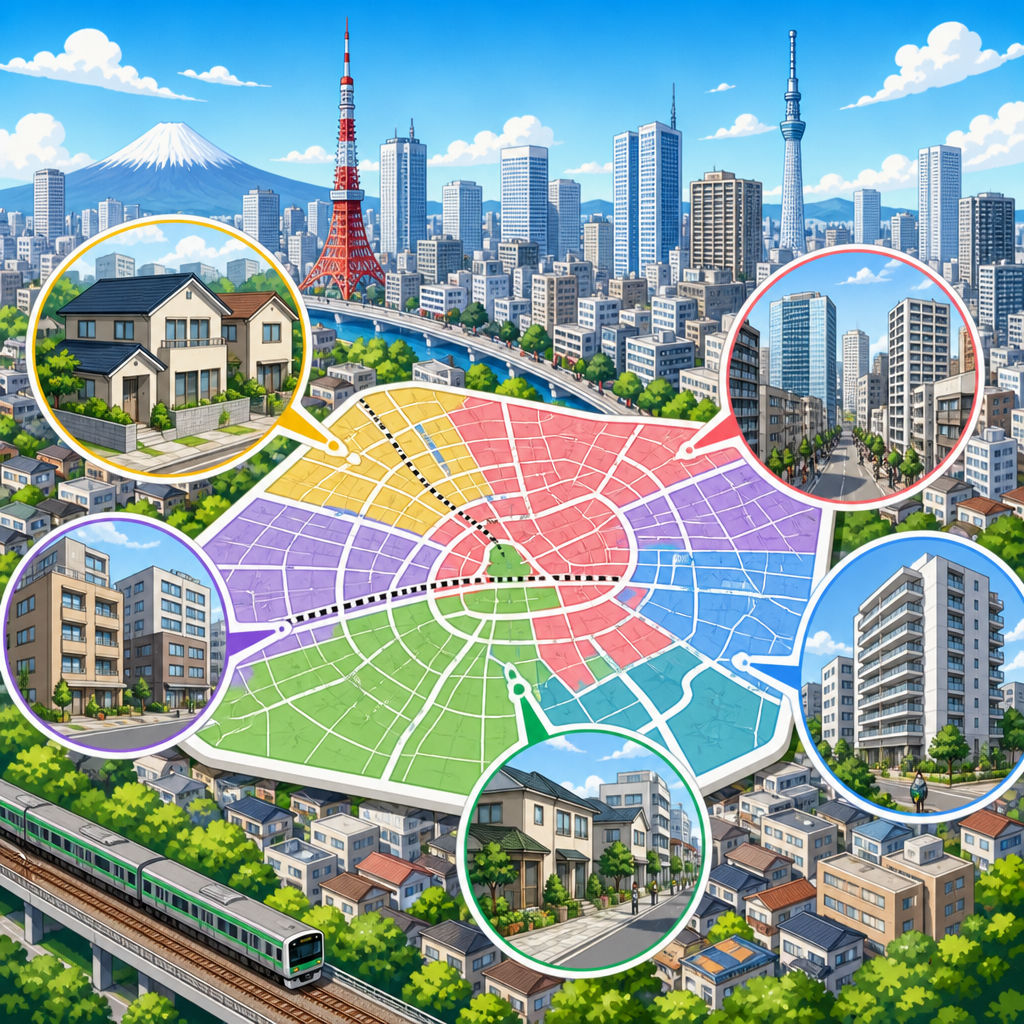
Tokyo’s zoning system is one of the most discussed examples in urban planning because it helps explain why housing supply can respond more quickly there than in many other large, wealthy cities. Zoning is the legal framework that determines what can be built on a parcel of land, including permitted uses, building size, and density. Housing supply response means how readily builders can add new homes when demand rises. In Tokyo, that response is shaped by a national zoning structure, relatively permissive residential categories, and a development approval process that is more rule based than discretionary. I have worked with comparative land-use policy research and development feasibility reviews, and Tokyo consistently stands out because the system is not simply “deregulated.” It is structured, technical, and predictable. That distinction matters.
Why does this matter beyond Japan? Because the gap between housing demand and housing construction drives affordability, commuting burdens, labor mobility, and economic productivity. In cities where approvals are slow, parcels are tightly constrained, and neighborhood objections can halt projects, rising demand often turns directly into higher prices rather than more homes. Tokyo shows a different pattern. Prices in central areas can still be high, land can be scarce, and not every household finds housing easily, but the metropolitan area has repeatedly accommodated large numbers of residents without the same degree of sustained supply paralysis seen in places such as San Francisco, London, or Sydney. Understanding Tokyo’s zoning system helps planners, policymakers, and residents separate myth from mechanism.
The key terms are straightforward. Use zoning divides land by allowable activities such as housing, shops, factories, and offices. Floor area ratio governs how much floor space can be built relative to lot area. Building coverage ratio limits the share of the site covered by the structure. Setbacks, height planes, and road-access rules shape building form. In Japan, these controls operate within twelve use zones applied nationally, then administered locally. The result is a framework that is standardized enough to reduce uncertainty but flexible enough to permit mixed urban neighborhoods. That combination is central to why housing supply responds differently in Tokyo.
How Tokyo’s zoning framework is structured
Japan’s land-use system is often described as simpler than American Euclidean zoning, and that is broadly correct. The country uses twelve zones, set under national law, ranging from low-rise residential to industrial. What matters most is that the zones are cumulative in a way many readers do not expect. If a use is considered less intensive or less harmful, it is often allowed in more intensive zones as well. Residential uses are permitted broadly. Small shops, clinics, daycare centers, and neighborhood services are frequently allowed in residential areas. This means many parts of Tokyo are not locked into single-use segregation. A street can contain apartments above retail, detached houses beside small multifamily buildings, and local businesses within walking distance.
That flexibility reduces one of the largest bottlenecks in housing production: the need to seek a rezoning simply to add homes or modest mixed-use activity. In many North American cities, a project becomes politically vulnerable the moment it requires a legislative land-use change. In Tokyo, if a proposal fits the zone and technical standards, the path is usually administrative. I have seen this difference shape feasibility directly. Predictable entitlements lower carrying costs, reduce legal risk, and make smaller infill sites worth pursuing. Developers do not need every parcel to be a tower site. A city can add substantial supply through many mid-rise and small-lot projects spread across the urban fabric.
Another important feature is that zoning is only part of the regulatory picture. Floor area ratios, building coverage limits, sunlight rules, and street-related height controls determine what gets built as much as use permissions do. Tokyo is not a free-for-all. A low-rise residential zone can still be quite restrictive on form. But because the categories themselves permit housing widely, the system tends to produce a broad pipeline of potential housing sites. This is a major reason supply responds more elastically than in cities where vast residential areas are reserved primarily for detached houses.
Why housing supply adjusts faster in Tokyo
Housing supply in Tokyo responds differently because demand can translate into construction across thousands of parcels instead of being concentrated in a small number of specially entitled districts. That matters economically. When population growth, smaller household sizes, or renewed central-city demand increase the need for homes, the market does not rely only on a handful of megaprojects. Individual owners, small builders, and larger firms all participate. In practice, Tokyo adds housing through subdivision of lots, replacement of older structures, apartment construction near stations, and redevelopment around transport nodes. The cumulative effect is large metropolitan output.
Nationally standardized zoning also lowers information costs. Architects, builders, lenders, and local officials work with a common vocabulary and legal structure. This does not eliminate local variation, but it reduces the jurisdiction-by-jurisdiction complexity that slows development elsewhere. By comparison, metropolitan regions in the United States can contain dozens of municipalities with sharply different lot size rules, parking minimums, design review procedures, and political climates. Fragmentation makes aggregate supply less responsive because each municipality can deflect growth. Tokyo’s governance is not simple, yet the national zoning template narrows the range of obstruction.
Another factor is the treatment of existing buildings. In Japan, buildings depreciate faster in market perception than in many Western countries, and redevelopment of modest, aging structures is common. Homes are not always treated as long-term appreciating assets in the same way. That changes neighborhood politics. Where existing homeowners expect scarcity to protect values, they often resist added supply. In Tokyo, replacement and incremental rebuilding are more normalized. This cultural and financial context sits alongside zoning rather than replacing it, but the interaction is powerful.
| Factor | Tokyo pattern | Typical constrained-city pattern | Effect on supply |
|---|---|---|---|
| Zoning structure | National categories with broad residential permissions | Highly local rules with extensive single-family exclusivity | More sites can add housing by right |
| Approval process | Rule based if standards are met | Discretionary hearings and negotiated approvals | Lower delay and entitlement risk |
| Neighborhood mix | Small commercial uses often allowed in residential zones | Strict separation of uses | Supports compact infill near daily services |
| Redevelopment pattern | Frequent replacement of older buildings | Long retention of existing structures with strong preservation pressure | Faster turnover into newer housing stock |
| Municipal fragmentation | Common national framework | Many local veto points | Less opportunity to block regional growth |
What Tokyo allows that many cities do not
A common misconception is that Tokyo succeeds only because it builds skyscrapers everywhere. In reality, much of the supply comes from ordinary urbanism: three- to ten-story apartment buildings, mixed-use corridors, small detached homes on compact lots, and steady redevelopment around rail stations. The zoning system permits this “missing middle” and “gentle density” far more widely than in cities dominated by detached-house zoning. If a parcel near a local station can become a small apartment building without years of political negotiation, the city gets more homes in exactly the places where demand is strongest.
Mixed use is especially important. In many Tokyo neighborhoods, residents can walk to convenience stores, clinics, restaurants, and childcare because these uses are legal nearby. That improves quality of life, but it also changes the economics of housing production. Land near daily services and transit is more suitable for compact living, and compact living is easier to finance when the regulatory system expects it rather than treating it as an exception. I have reviewed station-area projects where a narrow site that would be nearly impossible under suburban-style separation rules became a viable apartment building with ground-floor retail under Tokyo-style permissiveness.
Parking is another practical difference. Japanese urban development often operates with less on-site parking than comparable projects in car-oriented cities. Reduced parking requirements lower construction costs and let more of a lot be used for housing. Structured parking is expensive; underground parking can make moderate-density projects infeasible. In transit-rich parts of Tokyo, the rail network substitutes for some car storage need. This is not only a transport story. It is a housing supply story because every mandated parking stall consumes capital, land, or both.
Limits, tradeoffs, and what the system does not solve
Tokyo’s zoning system is effective, but it is not magic and it is not costless. Central Tokyo is still expensive by global standards. Desirable neighborhoods near major employment centers command high land prices. Smaller unit sizes are common, and redevelopment can produce less spacious homes than many households would prefer. A responsive supply system does not guarantee cheap land in the urban core. What it does is reduce the chance that demand shocks become pure scarcity rents with little physical expansion.
There are also design tradeoffs. Incremental redevelopment on small lots can create irregular building forms, narrow access conditions, and a streetscape that looks less uniform than master-planned districts. Some critics argue that Japan’s system can underdeliver on open space, long-life building quality, or coordinated urban design. Those concerns deserve attention. Planning is not only about quantity. It is also about safety, resilience, public realm quality, infrastructure capacity, and environmental performance. Tokyo addresses some of these through building codes, station planning, and infrastructure investment, but not every outcome is ideal.
Disaster risk is another important nuance. Japan’s seismic standards are among the most significant regulatory influences on construction. Rebuilding often improves safety because newer buildings must meet stronger codes. Yet the cost of seismic compliance can also shape what gets built and where. Similarly, road-access rules and fire safety standards affect redevelopment feasibility in older neighborhoods. Anyone trying to import lessons from Tokyo must remember that zoning works within a much larger legal and engineering system.
Lessons for urban planning and policy
The main lesson from Tokyo is not that every city should copy Japan’s law word for word. The lesson is that housing supply responds when rules allow many parcels to participate, when approvals are predictable, and when mixed-use, transit-oriented neighborhoods are legal by default rather than by exception. If policymakers want more homes, they should focus first on where housing is simply not allowed. Large low-density residential areas near jobs and transit create artificial scarcity. Legalizing apartments, rowhouses, courtyard buildings, accessory dwellings, and small mixed-use projects can produce meaningful supply without waiting for megaprojects.
Second, standardization matters. Clear statewide or national baselines can reduce the ability of small jurisdictions to veto regionally necessary housing. Several places are moving in this direction. California has legalized accessory dwelling units more broadly and curtailed some local barriers; New Zealand’s medium density reforms pursued similar goals before partial retrenchment. Results vary, but the direction is consistent with Tokyo’s core insight: fewer discretionary chokepoints lead to more building.
Third, planners should think in systems, not slogans. Upzoning alone may disappoint if parking mandates, setback rules, design review, infrastructure delays, or financing barriers still suppress projects. Tokyo’s relative responsiveness comes from the interaction of permissive use rules, administrative approvals, transit access, active small-scale builders, and a political economy less centered on preserving scarcity. For readers exploring urban planning and policy more broadly, this is the hub principle to keep in mind: housing outcomes reflect institutions working together. Study the code, the approval pathway, the transport network, the tax system, and the redevelopment culture as one package.
Tokyo’s zoning system matters because it shows that housing supply is not fixed by geography alone; it is shaped by rules, incentives, and administrative design. The city does not eliminate high demand, nor does it produce perfect affordability, but it allows far more homes to be added through ordinary redevelopment than many peer cities do. Broad residential permissions, cumulative zoning, mixed-use legality, fewer discretionary veto points, and transit-supported density all help explain why supply responds differently there.
For planners and policymakers, the practical takeaway is clear. If you want housing markets to absorb growth without severe price escalation, make it legal and feasible to build in more places. Start with residential exclusivity, burdensome approvals, and costly mandates that block moderate density. Then align zoning with transport, safety codes, and infrastructure so new homes can arrive steadily, not just in rare headline projects.
Use Tokyo as a serious comparative case, not a myth. Look closely at what the rules permit, how approvals work, and why many small projects matter as much as large towers. That is where the real policy value lies. If you are building an urban planning and policy agenda, begin with the legal geography of housing supply and follow its effects all the way to affordability, access, and citywide opportunity.
Frequently Asked Questions
What is distinctive about Tokyo’s zoning system compared with zoning in many other major cities?
Tokyo’s zoning system is often described as distinctive because it is organized within a relatively standardized national framework rather than being fragmented across thousands of highly autonomous local zoning codes. In practical terms, that means the broad categories governing land use are defined at the national level, and municipalities work within that structure instead of inventing entirely separate systems from scratch. This tends to make the rules more predictable, more legible, and easier for property owners, builders, and lenders to understand. Predictability matters because housing supply responds more readily when developers can evaluate a site and have a clearer sense of what is legally possible.
Another important feature is that Tokyo’s zoning categories are generally more permissive and more mixed than the strictly separated land-use systems common in some other wealthy countries. Many zones allow a range of residential forms and often permit certain commercial or institutional uses as well. Instead of sharply dividing neighborhoods into single-purpose districts, the system often tolerates a finer-grained mix of uses. That flexibility can reduce the number of legal barriers that would otherwise block small apartment buildings, mixed-use projects, or incremental redevelopment.
Tokyo also relies heavily on rules about building form, such as floor-area ratio, height limits, setbacks, and road access, rather than trying to prohibit housing in large swaths of urban land. The result is not a free-for-all, but a framework in which growth is managed through clear technical standards more than through blanket exclusion. That distinction helps explain why adding housing in Tokyo is often more feasible than in cities where large residential areas are restricted to very low-density development.
Why does housing supply respond more quickly in Tokyo when demand increases?
Housing supply responds more quickly in Tokyo because the city-region combines strong demand with a legal and administrative environment that makes new construction comparatively achievable. When more people want to live in a city, the key question is whether builders can translate that demand into actual homes. In Tokyo, the answer is more often yes because the zoning framework is relatively permissive, approval pathways are more standardized, and a wider range of land can be redeveloped for housing than in many peer cities.
One reason is that the zoning rules do not lock as much land into low-density, no-growth patterns. If a site can legally accommodate a small apartment building, a mid-rise project, or a mixed-use structure, owners and developers have more options to respond to changing market conditions. That does not mean every parcel is redeveloped immediately, but it does mean the system creates more opportunities for housing to be added through many small and medium-sized projects rather than depending only on a few giant master-planned sites.
Another factor is the institutional setting around construction. Developers in Tokyo often face fewer layers of discretionary review than builders in cities where projects can be delayed for years by politically contested approvals. When rules are clearer and approvals are less uncertain, the risk premium falls. Lower uncertainty encourages more builders to participate, including smaller firms that specialize in infill redevelopment. This broad participation matters because a responsive housing system is usually not powered by one or two mega-developers alone; it depends on thousands of decisions by landowners, builders, and investors across the metropolitan area.
Transportation also plays a major role. Tokyo’s extensive rail network supports dense development across a wide geography, allowing housing growth to occur in many nodes rather than only in a small central core. That geographic flexibility increases the number of places where new homes can be added, which helps the region absorb population and demand more effectively than cities where access to jobs is concentrated in a few tightly constrained neighborhoods.
Does Tokyo’s zoning system mean there are no restrictions on development?
No. Tokyo is more permissive than many major cities in important ways, but it is not unregulated. Development is still shaped by a substantial set of rules governing use, building envelope, safety, infrastructure access, and environmental conditions. Zoning categories establish what uses are allowed, but buildings must also comply with floor-area ratio limits, building coverage rules, height controls, setback requirements, street frontage standards, fire safety rules, and earthquake-related building regulations. These are real constraints, and they affect what can be built on any given parcel.
In fact, one of the most important lessons from Tokyo is not that regulation disappears, but that regulation is structured differently. Instead of relying as heavily on highly discretionary local veto points, the system often relies more on standardized technical rules. Builders may still face limits, but those limits are frequently knowable in advance. That difference is crucial. A strict but clear rule can be easier to work with than a nominally flexible system in which approval is uncertain, highly politicized, and vulnerable to lengthy delay.
There are also neighborhood-level realities that shape outcomes. Small lot sizes, narrow streets, irregular parcel patterns, and infrastructure constraints can complicate redevelopment. In some locations, assembling land for larger projects is difficult. In others, local conditions or market economics favor smaller buildings rather than dramatic upzoning outcomes. So while Tokyo’s system supports supply responsiveness, it does not guarantee that every neighborhood densifies rapidly or that housing becomes cheap everywhere. It simply creates a framework in which adding homes is more routinely possible.
How does Tokyo allow growth without relying entirely on massive high-rise construction?
A common misconception is that responsive housing supply requires a skyline dominated by luxury towers. Tokyo shows a different model. While the city does have high-rise districts, much of its housing growth comes from incremental redevelopment: older homes replaced by small apartment buildings, underused parcels converted into mid-rise residential structures, mixed-use buildings added near stations, and detached houses rebuilt at somewhat greater intensity. This “many projects in many places” pattern is one of the most important reasons supply can expand steadily.
The zoning structure helps by allowing a broad spectrum of housing types across large portions of the metropolitan area. Instead of treating low-rise apartments, neighborhood retail, and moderate-density housing as abnormal intrusions, the rules often make them ordinary components of urban life. That means growth does not have to wait for rare mega-sites, extraordinary public subsidies, or years of negotiation over whether housing is acceptable in principle. Smaller developers can participate, homeowners can redevelop land more easily, and the housing stock can adapt over time.
This incremental model also aligns well with Tokyo’s transportation geography. Rail stations anchor clusters of activity, and development can intensify around those nodes while still spreading through surrounding neighborhoods in varied forms. The result is a city that can absorb growth not only through iconic towers but through a large volume of ordinary buildings. From a supply perspective, ordinary buildings matter enormously. They may attract less attention, but they are often what makes aggregate housing delivery robust year after year.
What broader lessons do urban planners and policymakers draw from Tokyo’s experience?
The main lesson is not that Tokyo can be copied exactly, but that housing affordability and supply responsiveness are deeply shaped by legal capacity to build. When demand rises in prosperous cities, price pressure becomes severe if the housing stock cannot expand. Tokyo’s experience suggests that a metropolitan area stands a better chance of moderating those pressures when zoning is relatively permissive, when rules are standardized and predictable, and when many neighborhoods can accommodate at least some additional housing.
Planners also point to the importance of reducing discretionary uncertainty. A city does not need to eliminate all review or local input, but when approvals become slow, politicized, and highly case-by-case, fewer homes get built and only the most expensive projects can survive the process. Tokyo demonstrates the value of a system where developers can more readily understand what is allowed and proceed accordingly. That kind of certainty supports competition, broadens the pool of builders, and encourages steady production rather than sporadic bursts of development.
At the same time, policymakers should be cautious about simplistic interpretations. Tokyo’s outcomes are influenced by more than zoning alone. National governance, infrastructure investment, transit access, construction practices, land market norms, and demographic patterns all matter. Even so, zoning remains central because it determines whether those other advantages can translate into actual homes. The larger takeaway is that if a city wants housing supply to respond, it must make room for that response in law, in institutions, and in everyday urban practice.


