
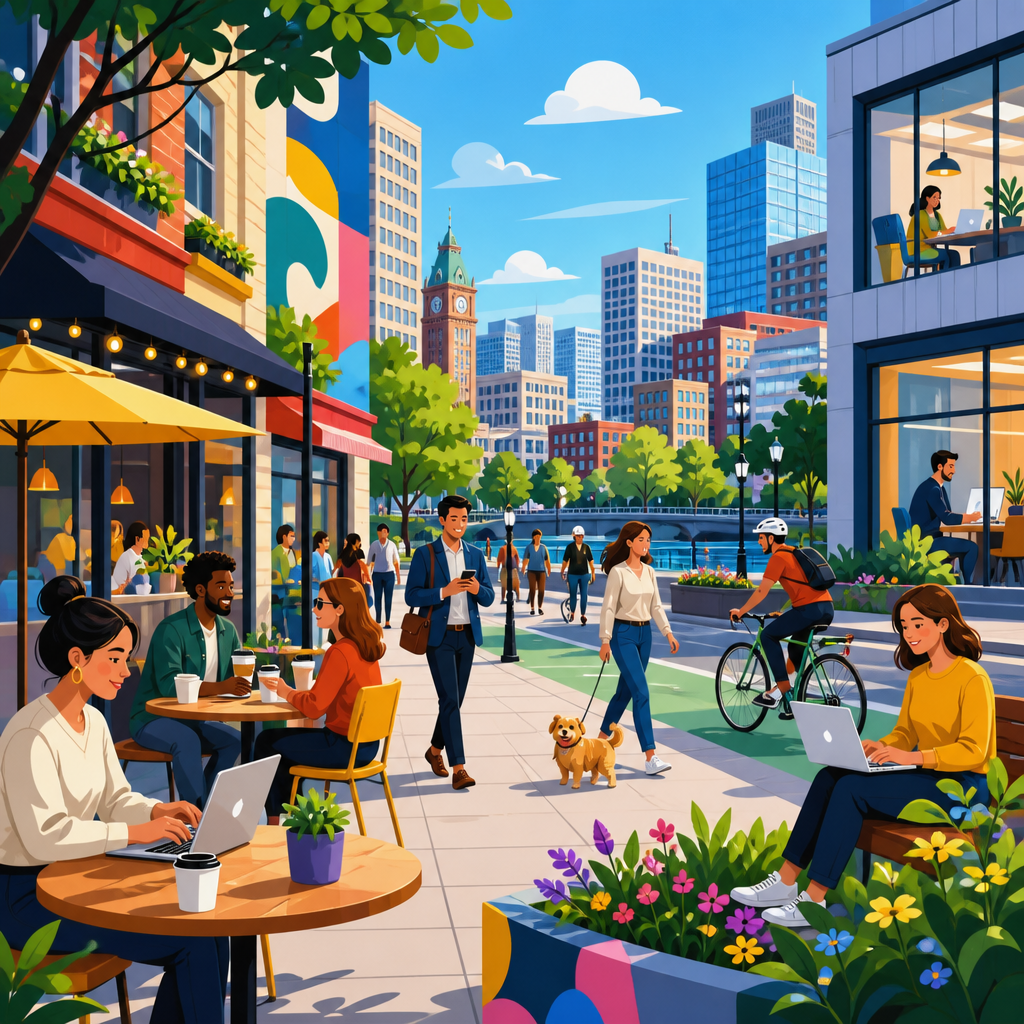
Downtown recovery without a full return-to-office is now one of the central questions in urban planning and policy. For more than a century, many city centers were organized around a predictable weekday pattern: commuters arrived in the morning, office workers bought coffee and lunch, retailers relied on midday foot traffic, and transit agencies timed service around peak demand. Hybrid work disrupted that system. In many cities, office occupancy remains well below 2019 levels even when employment has recovered, and that gap has exposed how dependent downtown economies were on a narrow set of users at a narrow set of times.
Recovery, in this context, does not mean restoring an older equilibrium exactly as it was. It means rebuilding downtown as a resilient district that can support jobs, housing, culture, public life, and tax revenue under changed travel and work habits. Return-to-office refers to employer policies that require workers to be physically present at a central workplace on a fixed schedule. A full return-to-office would recreate the five-day commuter cycle that once anchored many central business districts. The evidence from North America, Europe, and parts of Asia suggests that many employers will not return fully to that model, and many workers do not want them to.
That makes downtown recovery a design, governance, and economic development challenge rather than a human resources issue. City leaders cannot force sustained demand simply by hoping more firms tighten attendance rules. They need to broaden the downtown customer base, diversify land uses, improve public space, convert obsolete buildings, and reshape transportation and public finance systems for a less peaky pattern of demand. In practice, this means treating downtown less like a monoculture office park with towers and more like a mixed urban neighborhood with multiple reasons to visit and stay.
I have worked on downtown strategy discussions where leaders initially framed the problem too narrowly as missing office workers. That framing usually produced weak solutions: marketing campaigns, lunch discounts, and one-off events. Those tools can help at the margin, but they do not address structural vacancy, changing consumer patterns, or the mismatch between old building stock and new market demand. The cities making the strongest progress are those willing to confront fundamentals: who uses downtown, at what times, for what activities, and in what kinds of spaces.
This matters because downtowns still carry outsized economic and symbolic weight. They concentrate tax base, transit infrastructure, cultural institutions, government functions, and regional identity. Weak downtowns can strain municipal budgets, undermine small business ecosystems, and depress confidence in the wider city. Strong downtowns, by contrast, can support inclusive growth if they add housing, improve access, and create public spaces that serve residents as well as workers. The goal is not to preserve every pre-2020 office use. The goal is to create a downtown that remains productive and lively even if traditional office demand settles permanently below its former peak.
Why the old downtown model became fragile
The traditional central business district model generated impressive agglomeration benefits, but it also concentrated risk. Firms clustered to share labor pools, suppliers, clients, and prestige addresses. Transit agencies built networks to funnel commuters inward. Retail and food businesses optimized around lunch peaks and after-work spending. Municipal budgets became reliant on commercial property assessments and commuter-generated sales taxes. This worked when attendance was routine and density was an advantage every day.
Hybrid work changed the equation by reducing the frequency of office trips without eliminating office employment. A law firm, software company, or consulting practice may still lease downtown space, but workers may come in only two or three days each week, often Tuesday through Thursday. That creates what planners now describe as a “hollow calendar”: strong midweek activity and weak Mondays and Fridays. Street-level businesses lose consistency. Building systems operate below capacity. Transit ridership remains uneven. Public safety perceptions can worsen when fewer people are present during former peak periods.
Another problem is that much of the office inventory in major downtowns was built for a different era. Deep floor plates, limited operable windows, outdated mechanical systems, and high energy use make some towers less competitive for modern tenants and difficult to convert to residential use. Class A buildings in prime locations may continue to perform relatively well, while older Class B and C assets struggle. That bifurcation matters because a downtown does not recover through a handful of trophy towers alone. It needs a broad base of occupied buildings and active storefronts.
The weakness of the old model is not that offices no longer matter. They do. The weakness is dependence on a single dominant use. Healthy downtowns have always had more balanced demand profiles, with residents, students, tourists, government workers, cultural audiences, and small firms contributing at different times of day and year. The post-pandemic period simply made that diversification imperative rather than optional.
What downtown recovery looks like now
Downtown recovery without a full return-to-office is best measured through diversity and duration of activity, not only by office turnstile counts. A recovering downtown has more people living there, more reasons to visit outside business hours, safer and better-maintained streets, and a building stock that matches current demand. It does not need every tower to refill at 2019 occupancy if it can generate stronger all-day and all-week use from a wider mix of users.
In practical terms, planners should track several indicators together: office occupancy, residential population, street footfall, storefront vacancy, transit ridership by time of day, hotel performance, event attendance, and tax revenue composition. Looking at one metric in isolation leads to bad policy. For example, lower commuter counts can coexist with rising evening visitation if downtown adds entertainment and housing. Likewise, office leasing headlines can look encouraging while small business churn remains severe on underused blocks.
Mixed-use intensity is the key concept. A resilient downtown layers functions vertically and horizontally. Ground floors support retail, services, community uses, or food and beverage. Upper floors may contain offices, apartments, hotels, classrooms, clinics, or maker space. Public spaces host markets, performances, and everyday recreation. Transportation systems serve commuting, but also errands, nightlife, and weekend travel. This is not theory; it is how the most adaptable city centers have always worked.
| Recovery lever | What it changes | Plain-language example |
|---|---|---|
| Office-to-housing conversion | Adds residents and evening activity | An older tower becomes apartments, increasing demand for groceries and pharmacies |
| Street redesign | Improves safety and dwell time | Wider sidewalks, trees, and seating encourage people to stay rather than pass through |
| Cultural programming | Fills off-peak hours | Weekly concerts and museum nights draw visitors on Fridays and weekends |
| Transit service adjustment | Matches new travel patterns | More all-day frequency instead of service focused only on rush hour peaks |
| Small business support | Reduces storefront churn | Flexible leases and facade grants help local operators take downtown space |
Housing is the strongest long-term stabilizer
If there is one strategy that consistently improves downtown resilience, it is adding housing. Residents generate demand every day, not just on office days, and they use a different mix of services than commuters. They need grocery stores, schools, childcare, parks, fitness facilities, clinics, and routine retail. They also create more “eyes on the street,” a phrase associated with Jane Jacobs that remains relevant because consistent human presence supports both safety perception and actual informal surveillance.
Office-to-residential conversion has become a high-profile tool, but it is not universally easy or economical. Successful conversion depends on building geometry, window access, plumbing distribution, elevator cores, fire egress, and local code requirements. Buildings with narrower floor plates and operable windows convert more readily. Deep-plan towers may require partial demolition, light wells, or mixed-use reconfiguration, which can make projects expensive. Cities such as Calgary and Washington, D.C., have created incentive programs because the market often cannot absorb these costs unaided.
Still, conversion policy works best when it is part of a broader housing strategy rather than a standalone headline. Zoning flexibility, expedited permitting, adaptive reuse codes, tax abatements, and infrastructure planning all matter. So does unit mix. A downtown made only of luxury studios will not produce broad-based recovery. Family-sized units, affordable housing components, and amenities such as schools and playgrounds help create lasting neighborhoods instead of transient enclaves. In my experience, the most important early question is simple: after conversion, who will actually choose to live here year-round, and what daily needs will they have within a ten-minute walk?
New construction also matters. Some downtown parcels are better suited to ground-up residential or mixed-use development than to converting obsolete offices. Cities should be realistic about where demolition, infill, or land assembly will create better outcomes than preserving weak buildings indefinitely. Historic preservation has value, but not every aging structure can or should be saved in its existing form if it blocks a more viable urban future.
Public realm, safety, and mobility shape demand
People do not experience downtown through vacancy charts. They experience it block by block. That is why the public realm often determines whether recovery efforts succeed. Clean sidewalks, lighting, shade, seating, wayfinding, storefront transparency, and street trees may sound modest compared with billion-dollar development deals, but they directly affect whether people linger, spend money, and return. A downtown with excellent buildings but poor street conditions feels weaker than one with ordinary buildings and welcoming public space.
Safety requires balance and precision. Visible disorder, open drug use, aggressive behavior, and poorly managed encampments can deter downtown activity, but purely enforcement-led responses rarely solve underlying problems. The strongest approaches combine sanitation, outreach, mental health services, shelter pathways, and targeted policing focused on serious safety risks. Business improvement districts often contribute maintenance and ambassador programs, yet cities still need public-sector coordination because private management cannot replace public accountability.
Mobility policy also needs to catch up with hybrid demand. Many transit systems were built around steep commute peaks, especially morning inbound and evening outbound flows. Today, stronger downtowns often need more reliable all-day service, better weekend frequency, and safer walking and cycling connections. If the goal is a mixed-use center, transportation must support nonwork trips as well as work trips. Fare policy, station maintenance, bus lane enforcement, and first-mile access become part of downtown recovery, not separate concerns.
Parking should be approached pragmatically. In some cities, convenient parking remains important for entertainment and retail recovery, especially where transit service is weak. But overbuilding parking consumes valuable land and deadens street frontage. The better strategy is demand management: shared parking, dynamic pricing, clear wayfinding, and curb policies that support deliveries, rideshare, and short-term visits without overwhelming the public realm with garages and traffic.
Economic development must favor variety, not just volume
Downtown economic development used to focus heavily on landing large employers and maximizing daytime population. That still matters, but it is no longer enough. The current objective is a varied economy that can withstand changes in any single sector. Universities, medical uses, government offices, cultural institutions, startups, hospitality, and local-serving retail all play distinct roles. An urban center that depends mainly on finance, tech, or legal services is more exposed when those sectors reduce space demand.
Small businesses are especially important because they animate ground floors and create local identity. Yet many downtown storefronts remain difficult for independent operators: rents are too high, spaces are too large, lease terms are too rigid, and permitting can be slow. Cities and landlords can respond with subdivision of oversized retail bays, shorter leases, tenant improvement grants, pop-up programs, and transparent vacancy marketing. I have seen blocks improve quickly when landlords stop waiting for a single national chain and instead curate several smaller tenants that fit actual foot traffic levels.
Programming matters because it can reset habits. Sports events, night markets, conventions, food festivals, holiday installations, and museum partnerships all create reasons to come downtown when office attendance is low. The lesson from successful districts is not that events alone drive recovery; it is that regular programming helps bridge the gap while land use and building changes take effect. Over time, repeated visitation can support permanent business demand.
Fiscal policy also belongs in this discussion. Falling commercial assessments can pressure city budgets, especially where downtown office values funded a large share of municipal services. Leaders need realistic revenue forecasting, not denial. That may require phased reassessment, diversification of the tax base, state support for transit, and careful prioritization of capital spending. A downtown recovery plan that ignores fiscal structure is incomplete.
How cities should lead the transition
City governments cannot control every market outcome, but they do control the rules, approvals, public investments, and partnerships that shape adaptation speed. The first task is diagnostic clarity. Leaders should map underperforming buildings, identify conversion candidates, analyze pedestrian patterns by hour, and pinpoint blocks where public realm upgrades would unlock private investment. Generic downtown plans usually fail because they do not distinguish between healthy micro-markets and deeply distressed ones.
Second, cities should shorten timelines. Lengthy entitlement, code uncertainty, and fragmented agency review can kill viable adaptive reuse projects. Dedicated downtown permit teams, preapproved conversion pathways, and published design standards reduce risk for lenders and developers. The National Fire Protection Association standards, local building codes, and accessibility requirements must still be met, but process friction should not exceed safety necessity.
Third, governance has to be shared. Downtown partnerships, transit agencies, anchor institutions, philanthropic groups, and major property owners should align around a common operating plan with measurable targets. The most effective recovery efforts are managed like portfolios, with quarterly metrics and rapid course correction, not as one-time vision documents. If your city is confronting this issue now, start with a candid audit of land use, street conditions, and building viability, then prioritize housing, public realm, and diversified activity in the same geography.
Downtown recovery without a full return-to-office is not a compromise outcome. It is a more durable urban model. Office work will remain part of downtown life, but it should no longer be the single load-bearing use on which everything else depends. Cities that accept this reality can redesign their cores around residents, visitors, culture, education, and flexible employment patterns instead of waiting for a commuter routine that may never fully return.
The key takeaway is straightforward: recovery comes from diversification. Add housing where possible, reshape streets for comfort and safety, modernize transit for all-day use, support small businesses, and use policy tools to repurpose obsolete space. Do that well, and downtown can become more active across more hours with a broader tax and customer base than before.
For urban planners, civic leaders, property owners, and community organizations, the next step is to move from nostalgia to implementation. Audit what has changed, identify what can be converted or reprogrammed, and build a downtown strategy around actual demand, not old assumptions.
Frequently Asked Questions
1. Can downtown areas recover economically without a full return to five-day office attendance?
Yes. Downtown recovery does not depend entirely on restoring the old five-day commuter model, although many local economies were originally built around that pattern. What matters now is whether city leaders, property owners, employers, and small businesses can adapt to a new mix of users and activities. In the past, downtowns often relied heavily on office workers to support restaurants, convenience retail, transit ridership, and street-level services. Hybrid work weakened that daily demand, especially on Mondays and Fridays, but it also revealed how vulnerable central business districts were when they served too narrow a purpose.
A durable recovery is more likely when downtowns become less dependent on one category of user. That means expanding the role of housing, education, healthcare, entertainment, tourism, public services, nightlife, and cultural institutions. A downtown that attracts residents, students, visitors, and local families throughout the day and evening is generally more resilient than one that depends almost entirely on office occupancy. In practical terms, this can involve converting obsolete office buildings to housing, supporting street-level retail that serves multiple customer types, improving public spaces, and programming events that bring people in outside traditional work hours.
Economic recovery may look different from the pre-2020 version of success. Instead of measuring vitality only through office attendance, policymakers increasingly look at indicators such as sales tax performance, residential growth, hotel demand, foot traffic across the full week, transit use outside peak periods, and public space activity. A downtown can recover without recreating the old office routine if it becomes more mixed-use, more flexible, and more attractive to a wider range of people.
2. Why has hybrid work been so disruptive to traditional downtown business models?
Hybrid work changed not just how often people come to the office, but also when they come and how they spend money when they do. Traditional downtown systems were built around predictability. Employers leased large office footprints, workers commuted on similar schedules, transit agencies concentrated service around morning and evening peaks, and nearby businesses counted on steady weekday demand. Restaurants planned lunch service, coffee shops opened early, and retailers counted on impulse purchases from workers moving between transit stops and office towers.
When office attendance became uneven, those assumptions stopped holding. In many cities, Tuesday through Thursday became much busier than Monday and Friday. That made revenue less reliable for small businesses, especially those with high fixed costs such as rent, labor, and inventory. Transit agencies also felt the impact because fare systems designed around regular commuters no longer aligned with a more scattered ridership pattern. Commercial landlords faced weaker demand for office space, while city governments often saw pressure on tax revenues linked to downtown activity and property values.
The disruption is especially significant because many downtown ecosystems were optimized for daytime office consumption, not for all-day, all-week urban life. That means there may be plenty of square footage, infrastructure, and transit access in central locations, but not enough housing, schools, grocery stores, childcare, or evening attractions to sustain a broader customer base. Hybrid work exposed that imbalance. In that sense, the challenge is not only fewer workers in offices; it is that many downtowns must now evolve from single-purpose employment centers into more complete neighborhoods and destinations.
3. What strategies are cities using to support downtown recovery in the hybrid work era?
Cities are using a combination of land-use reform, economic development policy, transportation planning, and public realm improvements to adapt downtowns to post-pandemic realities. One major strategy is encouraging office-to-residential conversion, especially for older buildings that no longer compete well in the office market. While not every building is suitable for conversion, adding more residents can help create a stable customer base for grocery stores, restaurants, pharmacies, and neighborhood services. It also supports downtown activity beyond weekday business hours.
Another common strategy is investing in public spaces and street activation. Cities are redesigning plazas, widening sidewalks, adding outdoor dining, improving lighting, supporting farmers markets, and programming festivals or cultural events. These efforts matter because they give people more reasons to visit downtown beyond work. They also help reinforce perceptions of safety, vibrancy, and civic identity, all of which influence whether people choose to spend time and money in the city center.
Many local governments are also revisiting zoning and permitting rules to make it easier to introduce mixed uses. That can include allowing more housing, simplifying approvals for ground-floor retail changes, encouraging educational or institutional uses, and reducing regulatory barriers that make it hard to reuse underperforming properties. On the transportation side, agencies are rethinking service patterns to reflect all-day travel demand rather than focusing primarily on rush hour. Some are also improving bike infrastructure and pedestrian connections to strengthen access to downtown without requiring every trip to match the old commuter schedule.
Targeted support for small businesses is another important tool. Grants, technical assistance, facade improvement programs, and flexible leasing arrangements can help independent businesses survive periods of uneven foot traffic. In stronger recovery strategies, the goal is not simply to wait for office workers to return, but to deliberately reshape downtown into a place with multiple economic engines.
4. Is converting office buildings into housing a realistic solution for downtown recovery?
It can be an important part of the solution, but it is not a universal fix. Office-to-residential conversion receives a great deal of attention because it addresses two problems at once: excess office space and the need for more housing in many urban areas. In theory, adding residents downtown helps support local businesses, increases activity outside office hours, and makes better use of centrally located buildings and infrastructure. In practice, however, conversions are highly dependent on building design, financing, construction costs, local regulations, and market demand.
Not all office buildings convert easily. Floor plates may be too deep to provide adequate natural light for apartments, mechanical systems may need major upgrades, and the cost of reconfiguring plumbing, elevators, and life-safety systems can be substantial. Some buildings are better suited to residential reuse than others, especially older or narrower structures. Even when physical conversion is feasible, financing may still be difficult if rents or sale prices cannot justify redevelopment costs without public incentives.
That said, where conditions are favorable, conversions can play a meaningful role in long-term downtown revitalization. More residents create demand for schools, parks, grocery options, healthcare, and everyday services, which in turn helps diversify the local economy. Successful conversion programs often work best when paired with zoning flexibility, tax incentives, streamlined approvals, and infrastructure investments that make downtown living more practical and appealing. The broader point is that housing should be seen as one piece of a diversification strategy rather than the sole answer to downtown recovery.
5. How should success be measured if downtowns are no longer centered on daily office occupancy?
Success should be measured through a broader set of indicators that reflect whether downtown is becoming more resilient, active, and economically diverse. Office occupancy still matters, especially for property markets and transit systems, but it is no longer sufficient as the single defining metric. A healthier post-hybrid downtown is one that performs well across multiple dimensions rather than one that simply recreates the old commuter peak.
Useful indicators include pedestrian counts across different days of the week, retail sales, restaurant activity, hotel occupancy, cultural venue attendance, residential population growth, housing production, small business openings, and public transit ridership throughout the day. Property value trends, leasing activity, and vacancy rates also remain important, especially for understanding fiscal impacts on local governments and the commercial real estate sector. Public perception measures can matter as well, including whether people view downtown as safe, convenient, lively, and worth visiting.
It is also important to measure diversity of use. A downtown that is busy only during midweek lunch hours is more vulnerable than one with strong evening activity, weekend visitors, and a growing residential base. Policymakers should ask whether the city center is functioning as a mixed-use district, not just as a workplace zone. In that framework, recovery is not a return to one exact pre-pandemic pattern. It is the successful transition to a downtown economy that can thrive even when a full return-to-office never arrives.


