
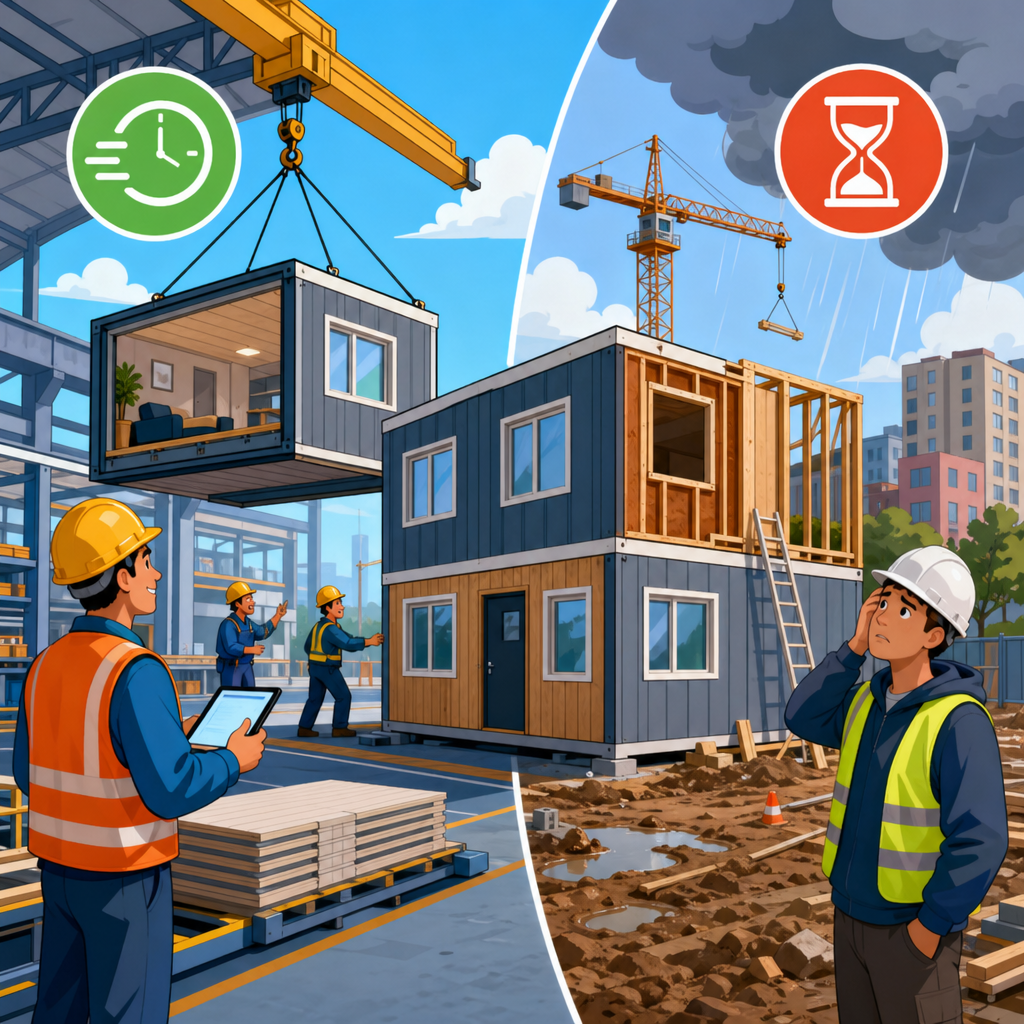
Modular affordable housing is often promoted as a faster, cheaper answer to housing shortages, but the real picture is more nuanced. In practice, modular construction can compress project schedules, improve quality control, and reduce neighborhood disruption, yet it does not automatically solve financing gaps, zoning barriers, labor shortages, or utility delays. For developers, housing agencies, nonprofit sponsors, and municipal leaders, the key question is not whether modular is good or bad. The useful question is where modular affordable housing saves time, where it merely shifts time from one phase to another, and where it can create new constraints if the team is unprepared.
Modular affordable housing generally means homes or multifamily units built in sections in a factory, then transported to a site for assembly and finishing. The modules are permanent building components, not temporary trailers. In the United States, most multifamily modular projects must comply with state modular programs, local zoning rules, and the same underlying building code requirements as site-built housing, including structural, fire, energy, accessibility, and life-safety provisions. That distinction matters because many early conversations confuse modular with manufactured housing, which is regulated under a separate federal framework administered by HUD. They are not interchangeable products, and their permitting, design constraints, and market perceptions differ.
This topic matters because affordable housing development is constrained by time as much as by money. Delays increase interest carry, extend predevelopment costs, expose projects to inflation, and can jeopardize tax credit allocations or local subsidy commitments. I have seen projects lose months waiting for utility coordination, only to discover that the factory work finished on time and sat idle because foundations, cranes, or road permits were not ready. Modular can absolutely shorten schedules, especially when factory fabrication proceeds in parallel with site work. But schedule gains depend on early design freeze, disciplined coordination, transportation logistics, lender education, and a contractor team that has completed modular projects before. Without those conditions, expected savings evaporate quickly.
As a hub within affordable housing, this article explains the full landscape: where modular works best, why it underperforms in some contexts, how cost and schedule interact, what public agencies and developers should verify, and which project types benefit most. The goal is practical clarity. If you are evaluating modular affordable housing for supportive housing, workforce apartments, student housing, small multifamily infill, or rural developments, you need to understand both the headline advantages and the hidden bottlenecks. Modular is a delivery method, not a miracle. Used in the right place, it can materially improve housing production. Used carelessly, it can become an expensive lesson in sequencing and procurement.
Where Modular Affordable Housing Saves Time
The biggest schedule advantage comes from parallel production. In a conventional project, the structure rises only after excavation, foundation work, and early site logistics are complete. In a modular project, factory fabrication of modules can begin while site crews are still working on grading, foundations, underground utilities, and retaining walls. On a well-managed multifamily development, that overlap can reduce the total delivery timeline by several months. The time savings are especially meaningful when the project is repetitive, such as a garden-style apartment community, supportive housing with repeated unit layouts, or student housing with standardized studios and one-bedrooms.
Factory conditions also reduce weather exposure. Rain, snow, wind, and temperature swings routinely interrupt framing, sheathing, drywall, and exterior envelope work on traditional sites. In a controlled plant, those delays largely disappear. Productivity is more consistent because materials, workstations, and inspections are organized around repeatable workflows. Quality control often improves as well. Modules are built with jigs, standardized checks, and more predictable supervision, which can reduce rework later. For affordable housing sponsors under pressure to meet placed-in-service deadlines or local occupancy targets, predictable throughput can be as valuable as raw speed.
Site impact is another time saver. Because major portions of the building arrive substantially complete, on-site erection can happen quickly, sometimes in days rather than months. Neighborhood disruption from noise, deliveries, and open framing stages is reduced. That can matter politically in dense urban areas where community opposition hardens when construction drags on. Faster enclosure can also allow interior completion, commissioning, and lease-up preparation to begin sooner. For occupied campuses, supportive housing redevelopments, or infill parcels beside schools and hospitals, shorter assembly windows are operationally significant.
Where Modular Does Not Save Time
The most common misconception is that modular automatically shortens the entire development cycle. It usually does not. Predevelopment can take longer because design decisions must be finalized earlier. Factories need a tighter design package before production starts, including structural coordination, module dimensions, MEP routing, finish selections, and transportation assumptions. Late changes that are manageable in site-built construction become expensive and disruptive in modular delivery. If the owner, architect, lender, or public agency is still revising unit mix, accessibility layouts, or funding conditions, the required early design freeze can delay procurement rather than accelerate it.
Entitlements, zoning approvals, environmental review, and community engagement do not become easier just because the building is modular. If a project requires rezoning, variances, historic review, wetlands permitting, traffic analysis, or public hearings, those steps remain on the critical path. The same applies to utility interconnection. I have watched modular projects miss installation windows because power upgrades, sewer taps, or water main extensions lagged behind factory production. The modules were ready; the site was not. In those cases, schedule pressure shifts from vertical construction to infrastructure coordination, and storage or resequencing costs can follow.
Transportation and craning are also frequent bottlenecks. Oversize load permits, escort requirements, route clearance, bridge restrictions, and delivery timing can be complex, especially in dense cities or mountainous rural regions. A project near the factory may move efficiently, while an otherwise identical project hundreds of miles away faces seasonal road limits and higher risk of delay. Crane picks require weather windows, staging space, and precise site readiness. If one piece is off, the installation plan slips. Modular saves time only when the full chain from factory slot to final set is synchronized.
Cost, Schedule, and Risk Tradeoffs
Developers often ask a simple question: is modular cheaper? The honest answer is that modular affordable housing can be cheaper in specific conditions, but it is not inherently lower cost on every project. Direct module pricing may be competitive because factory labor is organized efficiently and material waste is reduced. However, total development cost includes transportation, craning, specialized engineering, factory deposits, intermodal insurance, on-site marriage wall work, finish tie-ins, and sometimes duplicated supervision between the manufacturer and general contractor. Cost outcomes improve when the project has repetition, scale, and a team experienced enough to avoid redesign and field fixes.
Schedule savings can still justify equal or slightly higher hard costs. Faster completion may reduce construction interest, shorten general conditions, and accelerate rent-up or subsidy draws. In Low-Income Housing Tax Credit projects, earlier stabilization can improve compliance timing and reduce pressure around placed-in-service deadlines. But lenders and investors often scrutinize modular deals more carefully, especially if they have limited experience with off-site production contracts. Payment timing differs from conventional draws because factories often require large deposits and milestone payments before modules arrive on site. That can create cash flow strain unless the capital stack is structured deliberately.
| Project factor | Modular advantage | Common limitation |
|---|---|---|
| Repetitive unit layouts | Higher factory efficiency and faster assembly | Less flexibility for late design changes |
| Weather-sensitive markets | Reduced climate-related delays | Site work and utility delays still remain |
| Tight urban infill | Shorter neighborhood disruption during erection | Harder transport routes and crane staging |
| Rural projects | Potential labor relief where trades are scarce | Long haul distances can erase savings |
| Affordable housing finance | Earlier completion can lower carry costs | Factory deposits may not align with draw schedules |
Risk allocation deserves close attention. In conventional projects, owners are used to one primary builder taking responsibility for site and structure. Modular divides scope between manufacturer and site contractor, which creates interface risk. Who is responsible if modules arrive out of tolerance with the foundation? Who pays if site conditions force temporary storage? Who coordinates firestopping between modules and corridor assemblies? These are solvable issues, but only with precise contract language, clear submittal responsibilities, and realistic contingency planning.
Best Use Cases for Modular Affordable Housing
Modular performs best where building form, site conditions, and program requirements align with repeatable manufacturing. Multifamily projects of modest to mid-rise height, especially three to six stories depending on code path and manufacturer capability, are often strong candidates. Workforce housing, permanent supportive housing, student housing, senior housing, and family apartments with standardized kitchen and bathroom cores can fit the method well. Repetition allows factories to refine sequencing, order materials efficiently, and maintain consistent quality. Simple massing and straightforward structural grids are usually better than highly articulated facades or irregular footprints.
It is also useful in markets with persistent trade shortages. When framing crews, drywall installers, or finish trades are unreliable locally, shifting labor into a factory can stabilize delivery. That advantage appears in rural regions, resort communities, and fast-growing metros where labor competition is intense. For public agencies under pressure to deliver visible housing quickly, modular can support emergency response and bridge housing strategies, though permanent affordable projects still need code-compliant design, durable materials, and operating plans. The method is most effective when procurement, entitlement, finance, and site preparation are advanced enough to support the manufacturing timetable.
Modular is usually a weaker fit for highly customized projects, steep or constrained sites, complicated historic contexts, or developments with unresolved funding and scope. It can also struggle where local unions, inspectors, or lenders have little familiarity with modular workflows and require extended review. None of these barriers are fatal, but they affect feasibility. The strongest projects are not the ones chasing novelty. They are the ones using modular to solve a defined delivery problem with disciplined planning.
How Developers and Agencies Should Evaluate It
A practical evaluation starts with schedule mapping, not marketing claims. The team should create a true critical path that includes entitlements, utility commitments, geotechnical findings, foundation design, manufacturer lead times, shop drawing review, transport permits, crane logistics, and commissioning. If the site cannot be ready when modules leave the factory, the schedule benefit is compromised immediately. Early geotechnical coordination is especially important because foundation tolerances in modular projects are unforgiving. Small dimensional errors create major fit-up problems during setting.
Next, validate the manufacturer. Review completed projects of similar size, code type, and climate exposure. Ask about plant capacity, backlog, quality assurance processes, state approvals, warranty terms, and who carries responsibility for in-plant inspections. Confirm that the architect, structural engineer, MEP consultants, modular manufacturer, and site contractor have a defined coordination structure. Building Information Modeling can help, but software does not replace accountability. Every interface between module and site-built work should be assigned clearly.
Public agencies and nonprofit sponsors should also align procurement and funding rules with modular reality. If subsidies reimburse only after site installation, but the factory requires deposits months earlier, the project needs bridge financing or revised disbursement procedures. Lenders should understand title transfer, stored materials coverage, and off-site collateral controls. Appraisers and asset managers may need education when comparing modular to site-built housing, because permanent modular units should be valued based on utility, durability, and market performance, not on outdated assumptions about temporary structures.
What the Industry Should Expect Next
Modular affordable housing will keep expanding, but not as a universal replacement for site-built construction. The most likely path is selective adoption in project types where repetition, speed, and labor efficiency clearly outweigh transport and coordination complexity. Standardized design platforms, stronger factory networks, and better lender familiarity should improve outcomes over time. State housing agencies and large mission-driven developers are already better at underwriting delivery risk than they were a decade ago, and that matters because execution quality determines whether modular fulfills its promise.
The central takeaway is straightforward. Modular affordable housing saves time when projects are standardized, decisions are locked early, factories and site teams are tightly coordinated, and infrastructure is ready. It does not save time when approvals drag, utilities lag, routes are difficult, or the capital stack cannot match factory payment terms. In other words, modular rewards preparation. If you are building an affordable housing pipeline, treat modular as a strategic tool, not a shortcut. Assess the site, the design, the funding, and the team with discipline, then use modular where its advantages are real. That is how it delivers faster housing without creating slower surprises.
Frequently Asked Questions
1. Where does modular affordable housing usually save the most time?
Modular affordable housing tends to save the most time during the construction phase, especially when site work and building fabrication can happen at the same time. In a traditional project, the sequence is often linear: the site is prepared, the foundation is completed, framing begins, weather causes interruptions, and interior work follows. In a modular project, large portions of the building are manufactured in a controlled factory environment while the site is being graded, permitted for installation, and prepared for foundations and utility connections. That overlap can shorten the overall project schedule in a meaningful way.
Time savings also often come from greater standardization. Repeated unit types, predictable assembly methods, and factory-based quality controls can reduce rework and help teams avoid some of the delays that happen when field conditions change day to day. Weather exposure is another important factor. Because modules are built indoors, rain, snow, heat, and wind usually have less impact on the fabrication schedule than they would on site-built framing and enclosure work.
That said, the biggest schedule gains are usually seen when projects are well suited to modular methods from the beginning. Mid-rise multifamily buildings with repeated unit layouts, early coordination between architect, manufacturer, and general contractor, and a site with manageable transportation and crane access are often better candidates. In those cases, modular can reduce schedule risk and accelerate occupancy. The savings are real, but they usually come from disciplined planning and good fit, not from the word “modular” alone.
2. Where does modular construction not save time in affordable housing projects?
Modular construction does not typically save time in the early-stage hurdles that delay many affordable housing developments. Entitlements, zoning approvals, environmental review, public engagement, subsidy applications, tax credit timelines, lender underwriting, utility coordination, and local building approvals can still take just as long as they do for conventional projects. In many markets, these predevelopment steps are the true schedule drivers, and modular does not eliminate them.
Financing is a major example. Affordable housing often depends on layered capital stacks that include public subsidies, tax credits, soft loans, grants, and private debt. Each source comes with its own review process, legal requirements, and closing timeline. Even if the modular units can be built faster, the project cannot move ahead until the funding is committed and the transaction is structured. Likewise, local zoning or design review boards do not usually move faster simply because the project uses factory-built components.
Utility delays are another common bottleneck. Water, sewer, electrical, and gas connections frequently fall outside the builder’s direct control. If a project is waiting on transformer procurement, off-site sewer work, service upgrades, or agency inspections, modular fabrication speed may not translate into faster occupancy. The same is true when labor shortages affect crane scheduling, module setting crews, or final site assembly trades. In short, modular can compress the building timeline, but it does not automatically fix the external systems that often control affordable housing delivery.
3. Is modular affordable housing always cheaper than traditional construction?
No, modular affordable housing is not always cheaper than traditional construction, and it is important to separate marketing claims from actual project economics. Modular can reduce certain costs by improving productivity, lowering weather-related delays, reducing material waste, and limiting rework through factory quality control. In the right circumstances, those advantages can create savings or at least improve cost certainty. But lower cost is not guaranteed.
Several factors can offset or even eliminate those savings. Upfront design coordination is often more intensive because decisions have to be made earlier and with greater precision. Transportation costs can be significant, especially if the manufacturing plant is far from the site or if routes require escorts, restricted delivery hours, or special handling. Crane work, module setting, and on-site connections add their own cost considerations. Some sites also require podium structures, special foundations, or custom layouts that reduce the efficiency of modular repetition.
Scale matters too. A developer building one-off or highly customized projects may not get the same cost benefit as an owner with a repeatable pipeline of similar buildings. Factory availability, production volume, and regional labor pricing also influence the outcome. In some markets, modular may offer better value through schedule compression and reduced risk rather than a lower hard cost per square foot. For affordable housing sponsors, the smarter question is usually not “Is modular always cheaper?” but “Under what conditions does modular produce a better overall financial and delivery outcome for this specific project?”
4. What kinds of affordable housing projects are the best fit for modular construction?
Modular construction is often the best fit for projects with repeated unit layouts, predictable building forms, and teams that can commit to early coordination. Multifamily rental housing, supportive housing, workforce housing, student housing, senior housing, and other projects with a high degree of unit repetition are often stronger candidates than highly irregular or one-of-a-kind designs. Buildings where the structure, corridors, kitchens, bathrooms, and mechanical systems can be standardized tend to benefit the most from factory production.
Project location and logistics also matter. A site with adequate access for trucks and cranes is much more favorable than a tight urban parcel with difficult staging conditions, severe route restrictions, or limited assembly space. The local code environment is important as well. Some jurisdictions are experienced with modular approvals and inspections, while others may require extra coordination between state agencies, local officials, and third-party inspectors. Teams that understand those processes early are more likely to realize the intended schedule benefits.
The strongest candidates are usually projects where modular is considered at the concept stage, not inserted late as a cost-saving idea. When architects, engineers, manufacturers, developers, and public partners align early, the building can be designed around the modular system rather than forced into it. That usually improves both schedule and constructability. By contrast, projects with unusual massing, extensive custom detailing, steep site constraints, or late-stage redesigns may not capture the same advantages. Modular works best when the project is shaped to fit the method, not when the method is expected to rescue a project that is already struggling.
5. How should developers and public agencies evaluate whether modular is the right choice?
Developers and public agencies should evaluate modular through a project-specific lens that looks at schedule, cost, risk, approvals, logistics, and long-term operational goals together. The most useful comparison is not a generic modular-versus-stick-built debate. It is a realistic side-by-side analysis of how this project would perform under each delivery method in this market, on this site, with this funding structure, and under this timeline. That means testing assumptions early and rigorously.
A good evaluation starts with a few practical questions. Is the building type repetitive enough to benefit from factory production? Is there a qualified modular manufacturer with available capacity and a track record in this region? Can the site support trucking and crane access? Are local agencies familiar with modular inspections and approvals? Will the financing structure accommodate deposits, manufacturing milestones, and off-site construction draws? Can the project team make major design decisions early enough to support factory timelines? These questions often matter more than broad claims about innovation.
Public agencies and nonprofit sponsors should also think about policy goals beyond initial delivery. Modular may offer advantages in quality consistency, resident comfort, durability, and neighborhood disruption during construction. Shorter site activity can mean less noise, less traffic, and fewer impacts on surrounding communities. But if the project’s biggest barriers are land use approvals, utility infrastructure, or subsidy timing, then modular may not solve the core problem. The best decision-makers treat modular as a strategic tool, not a universal answer. When the fit is strong, it can be highly effective. When the fit is weak, expectations need to be adjusted before the project begins.


