
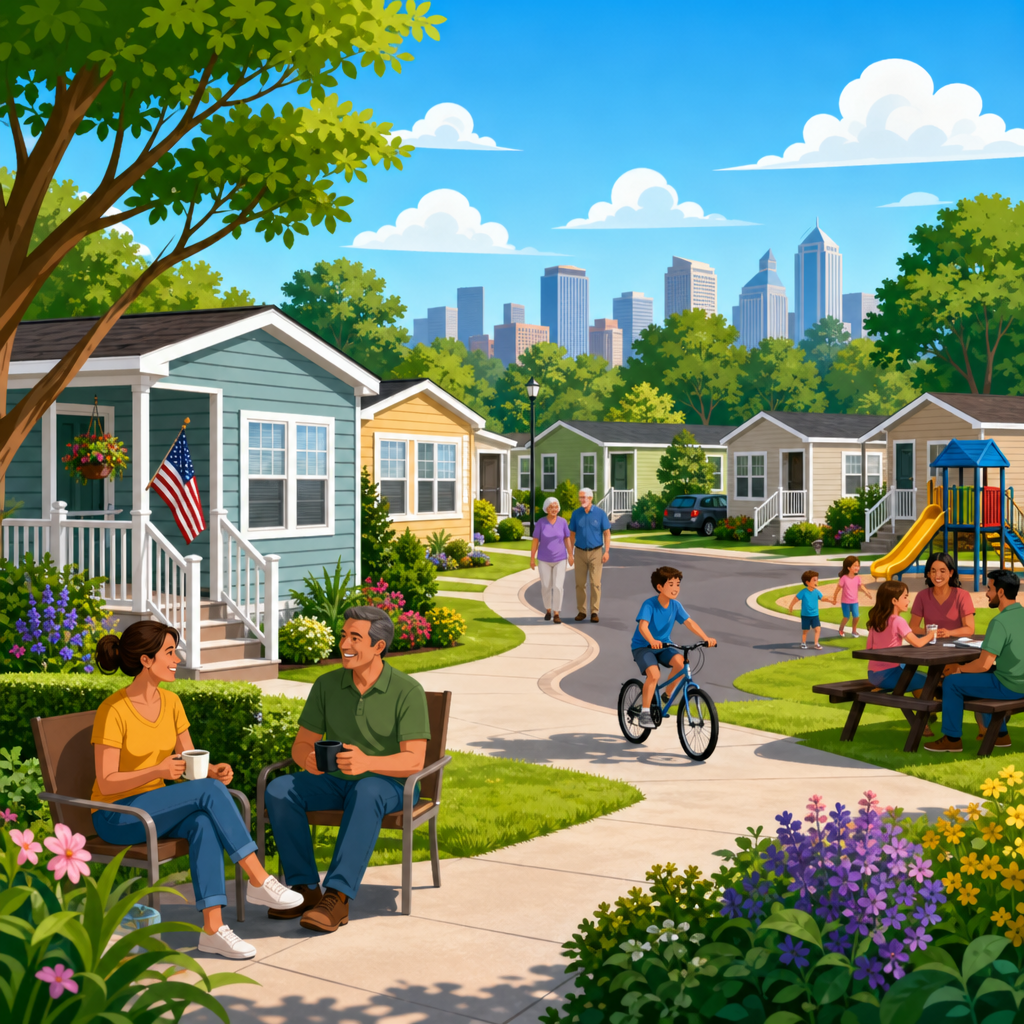
Manufactured housing communities are one of the most overlooked housing solutions in the United States, even as affordability pressures push renters, first-time buyers, retirees, and working families to search for lower-cost options that still provide stability, privacy, and neighborhood connection. In practical terms, manufactured housing refers to homes built in a factory under the federal HUD Code, the national construction and safety standard established in 1976 and updated over time to improve design, durability, energy performance, transportability, and installation requirements. A manufactured housing community is a neighborhood where many of these homes are placed on leased or resident-controlled sites, often with shared infrastructure, management, roads, utility systems, and community amenities.
This topic matters because conventional site-built housing has become unattainable for millions of households. According to national housing data, the median price of a new site-built home remains far above the price of a new manufactured home on a per-square-foot basis, and rent burdens continue to consume a large share of household income in many metro areas. I have worked with buyers comparing entry-level housing options, and the same pattern appears repeatedly: households who cannot qualify for a conventional mortgage or cannot find a reasonably priced apartment often overlook manufactured housing communities because of outdated assumptions. Those assumptions confuse modern manufactured homes with older mobile homes, ignore financing and land-use barriers, and miss the fact that many communities can offer a real path to secure, lower-cost housing.
Affordability, however, is not just about a lower sticker price. It includes total housing cost, monthly predictability, transportation access, utility expenses, maintenance, tenure security, and the ability to build financial resilience over time. Manufactured housing communities sit at the intersection of all of these factors. When they are well located, properly regulated, professionally managed, and fairly financed, they can preserve naturally occurring affordability at a scale that is difficult to match with new subsidized development alone. They are not a cure-all, and they come with tradeoffs that deserve clear attention, but they belong in any serious affordable housing strategy.
What manufactured housing communities are and why they differ from other affordable housing options
A manufactured housing community is not simply a trailer park with a new name. The distinction starts with the homes themselves. Modern manufactured homes are built in controlled factory environments under federal standards administered by the U.S. Department of Housing and Urban Development. That process creates consistency in construction, inspection, and transportation that differs from modular housing, which is also factory built but must comply with state or local building codes where it is placed. It also differs from recreational vehicles, which are not intended for permanent residence and fall under different standards.
The community model matters because land cost is often the hardest part of affordable homeownership. In many manufactured housing communities, residents own the home but lease the land beneath it through a monthly site fee. That structure lowers the upfront cost of entry because the resident is not buying a separate lot. In my experience, this is one reason buyers who have been priced out of starter homes can still find a workable monthly payment. A household may be able to purchase a manufactured home and pay a site lease for less than the combined cost of a mortgage, taxes, insurance, and maintenance on a modest site-built house in the same region.
Compared with subsidized affordable housing, manufactured housing communities usually require fewer public dollars per unit. Compared with apartments, they offer more privacy, detached living, and often a stronger sense of permanence. Compared with single-family subdivisions, they use land more efficiently and can maintain lower development costs through standardized home production and shared infrastructure. These differences explain why many housing analysts describe manufactured housing as one of the country’s largest unsubsidized sources of affordable housing.
How manufactured housing communities improve affordability in real terms
The clearest affordability advantage is lower acquisition cost. Federal housing statistics consistently show that manufactured homes cost far less per square foot than site-built homes, excluding land. Factory production reduces weather delays, material waste, and some labor inefficiencies, while repeated floor plans create economies of scale. Those savings can translate into lower monthly payments, especially for households buying modestly sized single-section or multi-section homes.
Affordability also comes from predictability. Residents typically know their mortgage or chattel loan payment, site rent, utility responsibility, and community rules in advance. In a well-run community, road maintenance, common area care, trash arrangements, and utility systems are handled centrally, reducing surprise costs that often hit owners of older site-built homes. I have seen households move from unstable rentals with annual rent spikes and repair disputes into manufactured housing communities where the monthly budget became easier to manage, even when the total payment was not dramatically lower, because the cost structure was clearer.
Location is another overlooked factor. Many communities are near employment centers, small towns, or suburban service corridors where apartments are scarce and land prices have escalated. When residents can live closer to work, school, health care, and groceries, transportation costs may fall enough to materially improve total affordability. This is especially important because housing and transportation costs should be evaluated together, not separately, when judging whether a housing option is truly affordable.
| Affordability factor | Manufactured housing communities | Common tradeoff |
|---|---|---|
| Upfront cost | Usually lower than site-built home purchase because land is often leased rather than bought | Resident may not build land equity |
| Monthly payment | Can be below local apartment rent or entry-level mortgage in many markets | Site rent increases can affect long-term affordability |
| Maintenance | Detached home living with simpler lots and shared community infrastructure | Older homes may still require significant repairs |
| Location efficiency | Often located near established roads, jobs, and services | Zoning limits reduce supply in high-opportunity areas |
| Public subsidy need | Often affordable with limited direct subsidy | Financing barriers can still require policy support |
The practical result is that manufactured housing communities can preserve affordability for households earning too much to qualify for many deeply subsidized units but too little to compete in the conventional market. That middle band includes teachers, service workers, health aides, tradespeople, fixed-income seniors, and many rural households. For them, manufactured housing can be the difference between housing stability and chronic cost burden.
The biggest misconceptions and the facts that matter
The first misconception is quality. Older pre-HUD mobile homes varied widely in safety and construction, and some were poorly maintained. Modern manufactured homes are different products. They must meet federal standards covering design, construction, fire safety, thermal performance, transport, and installation. Quality still depends on manufacturer, installer, site preparation, and ongoing maintenance, but the blanket assumption that these homes are inherently unsafe or flimsy is inaccurate. In markets affected by hurricanes or high winds, proper installation standards and wind zone requirements are especially important, and buyers should confirm compliance rather than relying on stereotypes.
The second misconception is that manufactured housing communities are temporary or transient places. Many are long-standing neighborhoods where residents stay for years, children attend local schools, and social ties are strong. Stability is influenced less by the factory-built nature of the home than by the structure of land tenure and community management. Communities with clear leases, fair rules, resident engagement, and responsible ownership often perform much better than outsiders assume.
The third misconception is value. Manufactured homes on leased land do not always appreciate like site-built homes on owned lots, especially when financed as personal property rather than real property. That is a real limitation and should be stated plainly. But affordability policy should not evaluate housing only through appreciation potential. Safe, decent, lower-cost housing that reduces rent burden and prevents displacement has value even when wealth-building outcomes are more limited. The better question is whether the housing creates stability at a sustainable monthly cost, with fair treatment and reasonable resale options.
Financing, regulation, and community ownership shape outcomes
The largest obstacle to wider use of manufactured housing communities is not consumer demand alone; it is the financing and regulatory environment. Buyers may use traditional mortgages when the home is titled as real property and placed on owned land, but many homes in leased-land communities are financed with personal property, or chattel, loans. Those loans can carry higher interest rates and shorter terms than conventional mortgages, raising monthly costs even when the home price is low. That financing gap is one reason the sector remains undervalued. Better secondary market support, more competitive lending, and clearer appraisal practices would improve affordability further.
Regulation at the local level is equally important. Many jurisdictions restrict or prohibit new manufactured housing communities through zoning, minimum lot sizes, design mandates, or political opposition based on outdated stigma. The result is constrained supply, aging existing communities, and a shortage of lower-cost development options. When local governments allow well-designed communities with modern infrastructure, landscaping, and clear management standards, they expand attainable housing without waiting years for complex subsidy deals.
Ownership structure strongly affects resident outcomes. Investor-owned communities can be well run, but aggressive rent increases and weak protections can undermine affordability. By contrast, resident-owned communities, nonprofit acquisitions, and mission-driven ownership models often align better with long-term stability. Organizations such as ROC USA have shown that when residents gain collective control of the land, they can stabilize lot rents, preserve affordability, and build stronger local governance. This model does not fit every community, but it is one of the clearest examples of how policy and ownership design can turn a vulnerable housing stock into a durable community asset.
What makes a manufactured housing community a strong affordable housing solution
Not every community delivers good outcomes. The strongest communities share several traits. First, the homes are properly installed and maintained, with reliable utility connections, drainage, road access, and code compliance. Second, management practices are transparent, with clear leases, understandable rules, and predictable fee structures. Third, the community is connected to jobs, schools, transit corridors, and essential services rather than isolated on cheap land far from opportunity. Fourth, residents have practical protections against abrupt displacement, unreasonable closures, or opaque fee escalation.
From a planning perspective, strong communities also fit into broader housing policy. States and localities can support them through infrastructure grants, rehabilitation financing, replacement programs for obsolete units, fair titling rules, and notice requirements for community sale or closure. Preservation policy is often more cost-effective than replacement. If an existing community closes, the displaced residents may struggle to move their homes, since relocation is expensive and older units may not be movable at all. In practice, preserving a viable community often costs less than trying to rehouse everyone in a tight market.
Buyers and policymakers should evaluate communities with the same rigor used for any housing asset. That means checking utility systems, flood exposure, lease terms, reserve planning, home age, insurance availability, lender options, and local code history. Manufactured housing works best when treated seriously as housing infrastructure, not as a marginal afterthought.
Why this housing type belongs at the center of affordability policy
If the goal is to expand affordable housing quickly, responsibly, and at scale, manufactured housing communities deserve far more attention than they receive. They already house millions of Americans. They can add lower-cost units faster than many site-built developments. They can serve rural towns, exurban areas, and suburban markets where apartment production is limited or politically contested. They can also complement other affordable housing strategies rather than compete with them. Deeply subsidized units remain essential for the lowest-income households, but unsubsidized and lightly subsidized options are equally necessary for households in the wide gap above those thresholds.
The policy case is straightforward. Modernize zoning to permit new communities and infill. Improve financing access for home buyers and community preservation. Support resident or nonprofit acquisition when communities go up for sale. Enforce fair management standards so affordability is not eroded by abusive practices. Replace obsolete homes with efficient new units where feasible. Evaluate housing affordability using total cost, location, and stability, not outdated image. These are practical steps, not abstract theory, and jurisdictions that adopt them can protect one of the country’s most scalable affordable housing resources.
Manufactured housing communities are not overlooked because they lack value; they are overlooked because housing debates often favor familiar categories over effective ones. A serious affordable housing agenda should correct that mistake. If you are evaluating housing solutions for your market, include manufactured housing communities in the analysis, assess them with current facts rather than old assumptions, and treat preservation and expansion as essential parts of a durable affordability strategy.
Frequently Asked Questions
1. What are manufactured housing communities, and why are they considered an overlooked affordable housing solution?
Manufactured housing communities are neighborhoods made up of homes built in a factory to the federal HUD Code, which sets national standards for design, construction, durability, transport, installation, and safety. These communities are often overlooked because they do not fit the conventional image many people have of either apartment living or traditional site-built homeownership. Yet they fill an important gap in the housing market by offering a lower-cost path to stable housing for people who may be priced out of conventional homes, townhouses, or even many rental markets. In many cases, residents can access more living space, private entrances, outdoor areas, and a stronger neighborhood feel than they might find in similarly priced apartments.
The affordability advantage typically comes from the factory-building process itself. Manufactured homes are built in controlled environments, which can reduce material waste, speed up production, and lower labor costs compared with site-built construction. When those efficiencies are combined with community-based land use, the result can be a more attainable housing option for retirees on fixed incomes, working families, first-time buyers, and others seeking a balance between cost, comfort, and stability. In a time when housing affordability has become a major national concern, manufactured housing communities deserve more attention because they can provide a practical, scalable, and often immediately available solution.
2. How is a manufactured home different from a mobile home or a traditional site-built house?
The most important distinction is that a manufactured home is built to the federal HUD Code, which took effect in 1976. Homes built before that date are commonly referred to as mobile homes, while homes built after that date are properly called manufactured homes. This is more than a terminology issue. The HUD Code created a national standard that governs structural quality, energy performance, fire safety, transportation requirements, and other key aspects of construction. Over time, the code has been updated to improve safety and performance, meaning today’s manufactured homes are very different from the outdated stereotypes many people still associate with older units.
Compared with traditional site-built homes, manufactured homes are assembled in a factory and then transported to their final location. Site-built homes are constructed piece by piece on the property itself under local and state building codes. While the construction methods differ, modern manufactured homes can include many features buyers expect from conventional housing, such as open floor plans, updated kitchens, primary suites, energy-efficient windows, and attractive exterior finishes. In many cases, they are difficult to distinguish from site-built homes at a glance. The main difference is not necessarily quality of life, but the production method and regulatory framework. For affordability-minded households, that production method can translate into meaningful cost savings without giving up the core benefits of having a home of one’s own.
3. Why can manufactured housing communities be more affordable than apartments or traditional homeownership?
Manufactured housing communities can be more affordable for several reasons, and those savings often matter a great deal in high-cost housing environments. First, factory construction tends to be more efficient than on-site building. Builders can buy materials in volume, avoid many weather delays, standardize processes, and reduce waste. Those efficiencies can lower the overall cost of producing the home. Second, many residents purchase the home itself while leasing the land or home site within the community, which can reduce the upfront cost compared with buying both a site-built home and the land underneath it. That lower entry point can make homeownership feel more realistic for households that have steady income but limited savings.
Affordability also extends beyond the purchase price. In many communities, residents benefit from a neighborhood setting that offers amenities, a sense of place, and more privacy than apartment living, often at a lower monthly cost than nearby conventional rentals. For families, that may mean more bedrooms or outdoor space for the same budget. For older adults, it may mean the ability to downsize without losing independence. For workers and first-time buyers, it can provide a stepping stone into a more stable housing arrangement. Of course, affordability depends on local market conditions, financing terms, site fees, utility costs, and community management practices, but in many regions, manufactured housing communities remain one of the clearest examples of unsubsidized affordable housing available at scale.
4. Are modern manufactured housing communities safe, well-built, and good places to live?
Yes, modern manufactured homes are built to a federal construction and safety code, and reputable manufactured housing communities can offer a strong combination of quality, comfort, and neighborhood stability. The HUD Code was specifically designed to establish consistent standards across the country, and it addresses important issues such as structural integrity, wind resistance, thermal performance, electrical systems, plumbing, and fire safety. Because these homes are built in a controlled factory setting, the construction process can also be more predictable than traditional on-site building, with repeated quality-control procedures throughout production.
The experience of living in a manufactured housing community depends not only on the home itself but also on the management and condition of the community. Well-run communities can provide residents with quiet streets, maintained common areas, clear community rules, and a strong sense of neighbor connection. Many people are drawn to the privacy of a detached home, the convenience of parking near their residence, and the ability to have outdoor living space without the cost of a conventional suburban home. As with any housing type, quality varies from one property to another, so it is wise to look closely at infrastructure, maintenance standards, lease terms, resident reviews, and overall upkeep. When properly developed and managed, manufactured housing communities can be safe, attractive, and highly livable neighborhoods that challenge outdated assumptions.
5. Who benefits most from manufactured housing communities, and what should prospective residents consider before choosing one?
Manufactured housing communities can serve a wide range of residents, which is part of what makes them so valuable in the broader housing landscape. First-time buyers may benefit from a more accessible entry point into homeownership. Working families may find that they can afford more square footage and more privacy than they could in a comparable apartment. Retirees often appreciate the lower-maintenance lifestyle, potentially lower housing costs, and community-oriented environment. People in regions with rapidly rising rents may also see manufactured housing as a practical way to gain more stability and predictability in their monthly housing expenses. In short, these communities can appeal to anyone looking for a cost-conscious housing option that still offers independence and a neighborhood feel.
Before choosing a manufactured housing community, prospective residents should evaluate both the home and the community structure. It is important to understand whether the home is being purchased, financed, or rented, and whether the land underneath it is owned or leased. Buyers should review site fees, utility arrangements, maintenance responsibilities, community rules, and any future rent increase terms if the home site is leased. They should also inspect the home’s condition, installation quality, energy efficiency, and age, especially if considering a resale property. Just as importantly, they should assess the community itself: Is it clean and professionally managed? Do residents seem satisfied? Are roads, lighting, drainage, and shared areas in good condition? Taking a careful, informed approach helps ensure that manufactured housing delivers what it can at its best: affordability, dignity, stability, and a real sense of home.


