
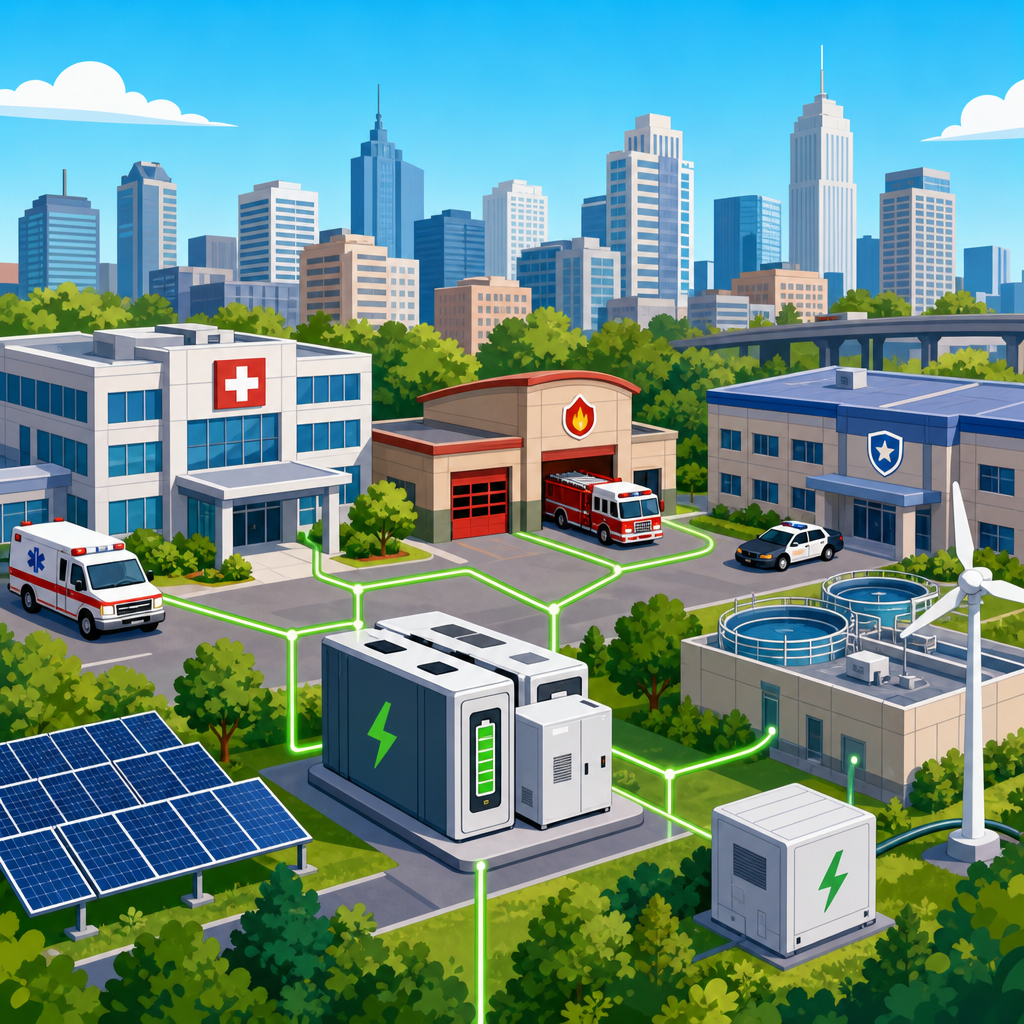
Microgrids for critical urban facilities are becoming a core resilience strategy for cities that cannot afford power interruptions at hospitals, water plants, emergency shelters, transit hubs, and public safety complexes. A microgrid is a localized energy system that can connect to the main utility grid during normal conditions and disconnect to operate independently during outages, a capability known as islanding. Critical urban facilities are buildings or campuses that support life safety, health services, communications, sanitation, transportation, or continuity of government. In practice, I have seen city leaders move from treating backup power as a compliance item to treating microgrids as essential infrastructure because storms, wildfires, cyber incidents, heat waves, and aging distribution networks are increasing outage risk while public expectations for uninterrupted services keep rising.
The topic matters because conventional standby generators solve only part of the problem. Diesel gensets can keep a facility alive for limited periods, but they depend on fuel deliveries, may cover only selected loads, and often provide little operational flexibility. By contrast, a well-designed microgrid can coordinate distributed energy resources such as solar photovoltaics, battery energy storage systems, combined heat and power units, fuel cells, and controllable loads through a central controller. That controller optimizes cost, reliability, emissions, and power quality in real time. For an urban facility manager, the benefit is not abstract. It means operating rooms stay energized, water pumps continue running, refrigerated medicines remain within safe temperature ranges, and emergency communications remain available when the surrounding neighborhood goes dark.
Microgrids also sit at the intersection of planning, policy, engineering, and finance, which makes them especially important within urban planning and policy. The same project can advance resilience targets, decarbonization goals, local air quality improvements, and capital planning efficiency if it is scoped correctly. Cities often ask the same practical questions: which facilities should be prioritized, what technologies fit dense urban sites, how should projects be paid for, and what rules affect interconnection and ownership? This hub article answers those questions directly and frames the major decisions that shape successful deployment.
At the city scale, microgrids are not a single technology but a design approach. The design begins with identifying critical loads, the duration of resilience required, and the acceptable level of risk. It then matches those requirements with generation, storage, controls, and operational protocols. Standards such as IEEE 1547 for interconnection and interoperability of distributed energy resources, NFPA 110 for emergency and standby power systems, and utility-specific tariffs all influence the final architecture. The result can range from a single-building microgrid at a clinic to a district energy network supporting multiple public facilities. Understanding these patterns is the first step toward choosing the right model.
What Microgrids Include and How They Work in Cities
A microgrid has five essential elements: loads, distributed energy resources, controls, point of common coupling equipment, and operating rules. Loads are the devices and systems that consume electricity, from elevators and HVAC to imaging equipment and water treatment motors. Distributed energy resources provide or shift power. Controls synchronize those resources, balance supply and demand, and decide when to import, export, charge, discharge, or island. The point of common coupling is the electrical boundary with the utility. Operating rules establish priorities, safety logic, maintenance schedules, and restoration procedures.
Urban microgrids usually operate in one of three modes. In grid-connected mode, the facility uses on-site assets to reduce demand charges, lower peak load, or participate in demand response markets. In transition mode, the controller detects a disturbance and separates the site from the utility while maintaining voltage and frequency within acceptable limits. In islanded mode, the system serves critical loads from local resources until the grid stabilizes or fuel and stored energy are exhausted. Fast, stable transitions are critical for facilities with sensitive equipment. Hospitals, data centers inside public buildings, and 911 call centers typically require seamless or near-seamless performance, which pushes designers toward advanced inverters, redundant controls, and careful protection coordination.
Technology choice depends on the load profile and urban constraints. Solar works well for daytime energy but needs storage or dispatchable generation for overnight resilience. Batteries respond in milliseconds and support frequency regulation, but duration is finite and cost rises with longer discharge periods. Combined heat and power is valuable at sites with steady thermal demand, such as hospitals, because it can achieve high overall efficiency by using waste heat for steam, hot water, or absorption cooling. Fuel cells offer low local emissions and reliable baseload power, especially where gas infrastructure is robust. In dense districts, project teams often combine these resources to create layered resilience rather than relying on one asset.
Which Urban Facilities Benefit Most
The highest-priority urban facilities are those where outages create immediate threats to life, public health, or civic stability. Hospitals are the most obvious example, but the list is broader. Water and wastewater treatment plants prevent contamination and service interruptions. Emergency operations centers coordinate response across agencies. Fire stations, police headquarters, and communications towers support incident management. Transit depots and signal systems can keep evacuation and worker mobility functioning. Schools and community centers designated as resilience hubs may provide cooling, heating, charging, food distribution, and shelter during emergencies.
Prioritization should be evidence based. In resilience planning workshops, I have found that facilities are often labeled critical by habit rather than by quantified consequence. A better approach uses criteria such as mission importance, outage tolerance, dependence on digital systems, vulnerable population served, replacement cost, and interdependency with other infrastructure. A wastewater lift station serving one neighborhood may be less critical than a treatment plant that protects an entire watershed. Likewise, a small clinic in a low-income district may deserve priority because residents have limited mobility and fewer alternatives during extreme heat events.
Facility clustering can produce stronger business cases than single-site projects. A civic campus that includes a hospital, shelter, police station, and district cooling plant can share generation and controls while diversifying load patterns. Mixed-use public districts may also capture more value through peak shaving and thermal integration. The key is that resilience planning should look beyond parcel boundaries. Electrical one-lines matter, but so do urban service networks, transportation access, and social vulnerability maps.
Design Principles for Reliability, Safety, and Performance
Good microgrid design starts with critical load segmentation. Not every circuit needs backup. Separating life-safety loads from comfort loads reduces required capacity and lowers cost without undermining resilience. Engineers typically define tiers such as essential, priority, and deferrable loads, then model each tier under multiple outage scenarios. This is where many projects either succeed or overbuild. If a hospital requires full HVAC for infection control in selected zones but not in administrative wings, the design should reflect that operational reality.
Protection and controls are equally important. Islanding a dense urban site changes fault current behavior, relay coordination, and power quality conditions. Inverter-based resources can complicate legacy protection schemes, so designers often update relays, breakers, and settings across the affected distribution system. Cybersecurity must also be addressed early. A microgrid controller connected to building automation systems, DER management platforms, and utility interfaces expands the attack surface. Following frameworks such as the NIST Cybersecurity Framework and applying role-based access, network segmentation, patch management, and incident response procedures are basic requirements, not optional extras.
Resilience duration should be specified in operational terms. A city should ask, can this facility operate critical functions for four hours, twenty-four hours, or seven days without utility service, and under what weather conditions? The answer determines battery sizing, fuel storage, renewable oversizing, and load shedding strategy. It also affects staffing. During long outages, operators must manage fuel logistics, maintenance windows, and manual overrides. Reliability is therefore a combination of hardware capacity, human procedures, and tested drills.
| Facility type | Typical critical loads | Common DER mix | Key design concern |
|---|---|---|---|
| Hospital | ICU, surgery, imaging, sterile HVAC | CHP, battery, solar, generator | Seamless transfer and thermal integration |
| Water plant | Pumps, controls, treatment trains | Battery, solar, generator, fuel cell | Motor starting and long-duration autonomy |
| Emergency shelter | Cooling, lighting, refrigeration, outlets | Solar, battery, generator | Affordable resilience for intermittent occupancy |
| Transit hub | Signals, ventilation, communications | Battery, solar, utility support | Power quality and passenger safety systems |
Economics, Ownership, and Policy Pathways
Microgrids are capital intensive, so project viability depends on stacking value streams. Resilience is the primary driver for critical facilities, but it is rarely the only source of value. Savings can come from reducing peak demand charges, shifting energy use with batteries, improving CHP efficiency, lowering outage losses, participating in demand response, and in some regions earning market revenues for ancillary services. Public agencies should require lifecycle cost analysis rather than comparing a microgrid only to the first cost of a diesel generator. The right baseline includes avoided outage costs, fuel volatility, maintenance, emissions compliance, and deferred infrastructure upgrades.
Ownership structures vary. A city may own the assets directly through capital budgets or green bonds. A utility may develop part of the system where regulation permits. Third-party models such as energy-as-a-service and power purchase agreements can reduce upfront cost and transfer performance risk, though contract terms must clearly define resilience obligations. In several municipal procurements I have reviewed, the weak point was not technology but ambiguity about who pays for black-start testing, software updates, and spare parts over fifteen to twenty years.
Policy can accelerate or block adoption. Interconnection timelines, standby charges, franchise restrictions, emissions permitting, and building codes all affect feasibility. State resilience grants, federal funding from programs such as FEMA’s Building Resilient Infrastructure and Communities, Department of Energy demonstration funds, and Inflation Reduction Act incentives can materially improve economics, especially for storage and clean generation. Policymakers should align emergency preparedness plans with energy master plans so departments are not pursuing separate, conflicting objectives. Clear resilience standards for public facilities can also help procurement teams justify investment decisions that would otherwise seem discretionary.
Implementation Roadmap and Common Pitfalls
Successful projects usually follow a disciplined sequence: screening, feasibility analysis, conceptual design, utility engagement, business case development, procurement, detailed engineering, commissioning, and operations planning. The screening phase identifies candidate facilities using outage history, criticality, and site constraints. Feasibility analysis then models load shapes, outage scenarios, DER options, and interconnection requirements. Utility engagement should happen early because protection studies, export limits, and service upgrades can change project economics dramatically. Waiting until late design to discuss operating modes with the utility is a common and costly mistake.
Commissioning is where resilience claims become real. Factory acceptance tests, site acceptance tests, black-start demonstrations, islanding trials, and operator training must be written into the project scope. Too many public owners assume that because equipment was installed, the microgrid is ready for an emergency. It is not. Controls tuning, relay coordination validation, and restoration sequences need repeat testing under realistic conditions. Annual exercises should include both technical staff and facility leadership so that everyone understands priorities during a prolonged outage.
The most common pitfalls are predictable: underestimating control complexity, oversizing solar without enough storage or flexible loads, ignoring thermal opportunities at hospitals, failing to secure long-term maintenance support, and treating resilience as a single number rather than a service level with conditions and tradeoffs. Another frequent issue is equity blind spots. If cities focus only on flagship downtown assets, they may miss opportunities to support neighborhood clinics, cooling centers, and public housing campuses where outages have the harshest social effects.
Why Microgrids Belong in Urban Planning
Microgrids for critical urban facilities work best when they are planned as part of broader city systems, not as isolated engineering projects. They strengthen emergency response, support decarbonization when paired with cleaner resources, and give cities more control over essential services during disruptions. The strongest projects start with a clear definition of critical loads, match technology to mission requirements, and use realistic operations planning instead of optimistic assumptions. They also account for policy, utility coordination, cybersecurity, and long-term maintenance from the beginning.
For urban planners and public leaders, the main takeaway is simple: resilient power should be mapped to public need. Start with the facilities whose failure would create the greatest harm, evaluate district-scale opportunities, and build a financing strategy that values both avoided outages and everyday operational savings. When designed carefully, microgrids can turn critical facilities from passive electricity customers into active resilience assets. The next step is to create a ranked facility list, launch a feasibility study, and align energy planning with emergency management so the city’s most important services stay on when residents need them most.
Frequently Asked Questions
1. What is a microgrid, and why is it especially important for critical urban facilities?
A microgrid is a localized energy system that can generate, store, and manage electricity for a specific site or group of buildings. It typically operates while connected to the main utility grid under normal conditions, but it can also disconnect and continue supplying power on its own during a utility outage. That independent operating mode is called islanding, and it is one of the most important reasons microgrids are gaining attention in cities.
For critical urban facilities, the value of a microgrid goes far beyond backup power. Hospitals, water and wastewater plants, emergency shelters, transit hubs, police and fire stations, and public safety campuses all perform functions that directly affect life safety, public health, and emergency response. Even short interruptions can disrupt medical equipment, communications systems, pumping operations, traffic coordination, refrigeration, and shelter services. In a dense urban environment, those disruptions can quickly cascade into wider community impacts.
Microgrids help reduce that risk by creating a more resilient and controllable energy platform. Instead of relying solely on the broader grid, a facility can use on-site resources such as solar, batteries, combined heat and power systems, fuel cells, or dispatchable generators to maintain essential loads. Advanced controls decide how to balance generation, storage, and consumption in real time. That means critical services can continue operating during storms, heat waves, equipment failures, cyber incidents, or other grid disturbances.
In many cities, microgrids are also being designed to support long-term operational goals. They can lower energy costs, improve power quality, reduce emissions, support electrification, and strengthen continuity planning. For mission-critical facilities, a microgrid is not just an energy asset. It is part of a broader resilience strategy that protects people, preserves essential services, and helps city systems function when the larger grid is under stress.
2. How do microgrids keep facilities operating during blackouts and other grid disruptions?
Microgrids keep critical facilities running by combining three core capabilities: on-site energy resources, intelligent controls, and the ability to isolate from the utility grid. Under normal conditions, a microgrid may import power from the grid, export excess energy, charge batteries, and optimize energy use based on cost or operational priorities. When a disturbance occurs, the control system detects the problem and initiates a transition to island mode so the facility can continue operating independently.
That transition has to happen quickly and safely. In a well-designed system, the microgrid controller continuously monitors voltage, frequency, power quality, equipment status, and facility load requirements. If the utility supply becomes unstable or goes down completely, protective devices separate the microgrid from the main grid to prevent unsafe backfeeding and maintain a stable local power environment. From there, on-site generation and storage resources work together to supply critical loads.
For example, a hospital microgrid might prioritize operating rooms, intensive care units, life safety systems, refrigeration, air handling, nurse stations, and IT infrastructure. A water treatment plant might prioritize pumps, controls, chemical feed systems, and communications equipment. A transit hub might keep lighting, ventilation, security, fare systems, emergency communications, and select mobility services energized. The microgrid controller can shed nonessential loads if necessary to preserve fuel, maintain stability, and extend runtime.
Batteries often play a key role because they respond instantly and help bridge the gap while other generation assets ramp up. Dispatchable resources such as natural gas generators, combined heat and power units, or fuel cells can then provide sustained energy over a longer period. Solar can also contribute when available, although it is usually paired with storage or firm generation for critical infrastructure applications. The result is a layered resilience approach that is more flexible and often more reliable than relying on a traditional backup generator alone.
3. Which urban facilities benefit most from microgrids, and how are priorities typically determined?
The facilities that benefit most from microgrids are those where power loss would endanger lives, interrupt essential public services, or create severe downstream consequences for the surrounding community. Hospitals and healthcare campuses are among the highest-priority applications because they depend on uninterrupted electricity for patient care, diagnostics, ventilation, sterilization, pharmaceuticals, and electronic records. Water and wastewater facilities are another top category because electric service is essential for pumping, treatment, pressure management, and sanitation protection.
Emergency shelters, police and fire stations, emergency operations centers, public safety communication centers, and 911 dispatch facilities are also strong candidates. During disasters, these buildings often become focal points for response and recovery. Transit hubs and transportation control centers can also justify microgrids, particularly in cities where mobility supports hospital access, evacuation routes, workforce continuity, and movement of emergency personnel. In some cases, cities also prioritize cooling centers, public housing complexes with medically vulnerable residents, university campuses, and multi-building civic campuses.
Priorities are usually determined through a structured resilience planning process rather than by technology considerations alone. City leaders and facility operators typically begin by identifying mission-critical functions, outage risks, required runtime, load profiles, fuel availability, and interdependencies with other systems. For example, a water pumping station may seem like a standalone asset, but if it loses power, hospitals, shelters, and residential districts may all be affected. Likewise, a public safety complex may depend on communications infrastructure located elsewhere.
Planners often separate loads into tiers such as life safety, mission critical, important, and deferrable. This allows the microgrid to be sized and controlled around practical priorities rather than trying to power an entire campus indefinitely. The strongest microgrid projects are usually the ones aligned with clear public-service goals: maintain emergency response, preserve public health, support vulnerable populations, and keep key city systems functioning under stress. In that sense, the best candidates are not simply large facilities. They are the facilities whose continuous operation matters most to urban resilience.
4. What technologies are commonly used in microgrids for critical urban infrastructure?
Most microgrids for critical urban facilities use a portfolio of technologies rather than a single power source. The exact mix depends on the facility’s load profile, resilience objectives, space constraints, emissions goals, utility requirements, and available budget. At the center of the system is usually a microgrid controller, which acts as the brain of the operation by coordinating generation, storage, protection systems, and building loads.
Battery energy storage systems are increasingly common because they provide fast response, ride-through capability, frequency support, and operational flexibility. They can help smooth the transition into island mode, absorb renewable generation, reduce peak demand charges, and improve power quality. Solar photovoltaics are also widely used, especially where rooftop or canopy space is available. On their own, solar panels do not guarantee resilience during an outage, but when integrated with storage and proper controls, they can meaningfully extend islanded operation and reduce fuel consumption.
For many critical facilities, firm and dispatchable generation remains essential. Combined heat and power systems are attractive where facilities need both electricity and thermal energy, such as hospitals, district energy systems, and large campuses. These systems can achieve high overall efficiency by using waste heat for steam, hot water, or space conditioning. Natural gas generators, fuel cells, and sometimes renewable fuels may also be used for dependable long-duration performance. In some locations, diesel generators are still part of the resilience mix, particularly where existing backup systems are being integrated into a more advanced microgrid architecture.
Equally important are the supporting systems: switchgear, relays, energy management software, protection schemes, cybersecurity measures, and load control infrastructure. Modern microgrids may integrate building automation systems, electric vehicle charging, thermal storage, and demand response programs. For critical urban infrastructure, the most effective designs are not just technologically advanced. They are carefully engineered to deliver safe islanding, stable operation, fuel security, maintenance access, and compliance with utility and regulatory requirements. The technology stack matters, but the real success factor is how well those components are integrated around the facility’s mission.
5. What should cities consider when planning and implementing microgrids for critical facilities?
Cities should begin with resilience goals, not equipment lists. The first question is not which battery or generator to buy, but which services must remain operational during an outage, for how long, and under what conditions. That means identifying critical loads, understanding failure scenarios, analyzing infrastructure interdependencies, and defining performance targets. A hospital may need seamless continuity for clinical systems, while a shelter may need multiday operation with heating, cooling, refrigeration, and communications. Those distinctions shape every design decision that follows.
Feasibility planning should include electrical load analysis, site constraints, fuel logistics, outage history, utility interconnection conditions, emissions considerations, and lifecycle cost evaluation. In urban environments, available space can be limited, noise restrictions may apply, air permitting can be complex, and construction may need to occur without interrupting vital services. Stakeholder coordination is therefore essential. Facility managers, emergency planners, engineers, utilities, finance teams, public officials, and community representatives often all have a role in project development.
Cities should also think carefully about ownership and financing models. Some microgrids are owned directly by municipalities or public agencies, while others are delivered through energy-as-a-service agreements, public-private partnerships, or developer-led structures. The right model depends on procurement rules, capital availability, operating expertise, and


