
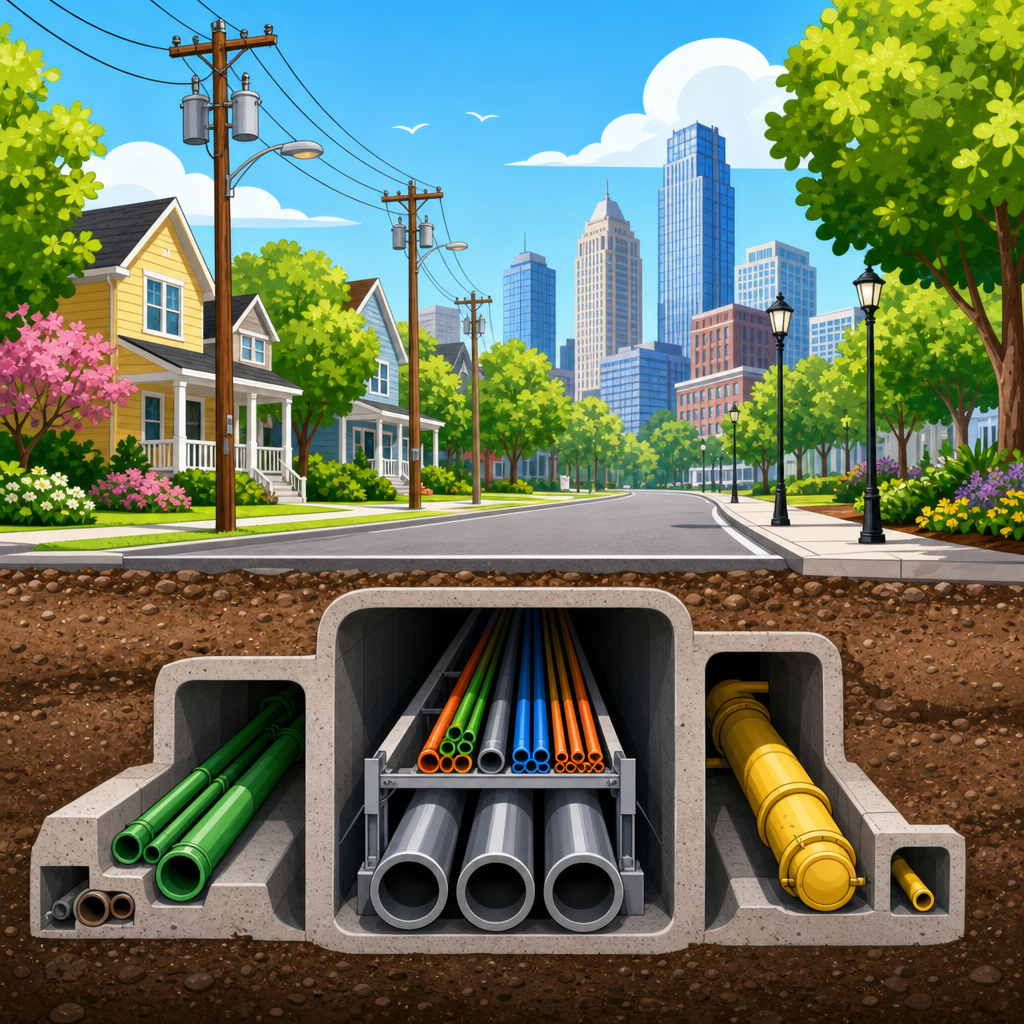
Undergrounding utilities means placing electric, telecommunications, and sometimes gas distribution lines below grade instead of suspending them on poles. In urban planning and policy, it is a deceptively simple idea with complex consequences for public budgets, infrastructure resilience, streetscape design, maintenance operations, and equity. I have worked on corridor improvement projects where utility relocation became the schedule driver, the biggest line item after paving, and the source of the hardest public meetings. The reason is straightforward: every resident sees the visual appeal of removing wires, but fewer people see the civil engineering, permitting, easements, and life-cycle costs hidden beneath the surface.
As a hub topic, undergrounding utilities touches transportation planning, disaster mitigation, housing development, historic preservation, and climate adaptation. It also requires clear definitions. Distribution lines carry electricity from substations to neighborhoods; transmission lines move bulk power over longer distances and are far less commonly buried because of thermal limits and cost. Joint trench projects place multiple services, such as power and fiber, in coordinated underground corridors. Conversion can be full, where poles are removed entirely, or partial, where selected segments are buried to solve targeted reliability, safety, or design problems. These distinctions matter because the economics and policy choices differ sharply by utility type, density, soil conditions, and project scope.
Why does undergrounding matter now? Cities face stronger storms, wildfire risk, pressure to improve public rights-of-way, and growing demand for broadband and electric service upgrades. Local governments also compete for investment and residents, making streetscape quality more than an aesthetic concern. Yet undergrounding is not automatically the best answer. Many projects cost several million dollars per mile, require lengthy coordination with investor-owned utilities, and can shift maintenance risks rather than eliminate them. A useful policy discussion starts by asking the right question: not whether undergrounding is good or bad, but where, when, and under what funding structure it delivers public value that alternatives cannot match.
What undergrounding includes and how projects are delivered
Utility undergrounding usually focuses on electric distribution and communications lines in the public right-of-way, but a complete conversion often triggers secondary work on street lighting, traffic signals, transformers, service laterals, and customer connections. In older corridors, the project team may also need to locate legacy ducts, abandoned lines, undocumented vaults, or private encroachments. That is why subsurface utility engineering, typically following the American Society of Civil Engineers standard ASCE 38 for utility investigation quality levels, is not optional. If planners rely on incomplete records, change orders multiply fast once trenching begins.
Delivery models vary. A city may initiate a capital improvement project and negotiate with utilities on cost sharing. A private developer may underground fronting utilities as a condition of subdivision approval. A utility may lead a reliability-driven conversion under an approved regulatory program. In practice, successful projects establish governance early: who designs civil works, who procures conduit and vaults, who owns the underground assets after completion, and who restores pavement and landscaping. On one downtown corridor project I supported, schedule certainty improved only after the city assigned a single utility coordinator with authority to resolve sequencing conflicts across electric, telecom, and traffic operations.
Construction methods also change outcomes. Open trenching is common and often cheapest where streets are already being rebuilt. Directional drilling can reduce surface disruption but becomes difficult around dense existing utilities or rocky formations. Vault spacing, duct bank sizing, conductor ampacity, and transformer placement all affect both cost and future capacity. A corridor designed only for today’s loads may require expensive rework once electric vehicle charging, heat pumps, or new multifamily development increases demand. Good undergrounding policy therefore treats the project as a long-horizon network investment, not merely a beautification exercise.
What undergrounding costs in real projects
The most common public question is simple: how much does it cost to bury power lines? The direct answer is that urban distribution undergrounding usually costs far more than overhead replacement, with wide variation by context. For local distribution lines, publicly cited estimates often range from roughly $1 million to more than $10 million per mile, and complex downtown conversions can exceed that once street reconstruction, property services, utility relocations, and contingency are included. By contrast, replacing or hardening overhead distribution can be dramatically cheaper. The gap exists because undergrounding requires excavation, duct banks, vaults, transformers, service reconnections, traffic control, pavement restoration, and extensive design and coordination.
Several cost drivers dominate. Existing density matters first: a narrow downtown street with water, sewer, gas, fiber, signals, and mature tree roots is much harder than a greenfield edge road. Soil and groundwater matter next; rock excavation, dewatering, and contaminated material handling can add major premiums. The third factor is customer connection complexity. Moving the main line underground is only part of the work; each building may need service entrance upgrades, meter relocation, panel coordination, and temporary outage planning. In commercial corridors, outage windows may be limited to nights or low-season periods, which raises labor costs.
| Cost driver | Why it raises cost | Typical planning response |
|---|---|---|
| Dense existing utilities | Conflicts force redesign, hand digging, and slower installation | Complete subsurface utility engineering before final design |
| Rock or high groundwater | Excavation, shoring, and dewatering increase unit prices | Use geotechnical borings and realistic contingency |
| Customer service conversions | Building-level electrical work adds labor and coordination | Survey each parcel early and phase cutovers carefully |
| Downtown traffic management | Lane closures, business access, and night work raise overhead | Bundle with planned street reconstruction and staging plans |
| Future capacity needs | Undersized duct banks cause expensive later reconstruction | Design for load growth, fiber, and spare conduits |
Funding structures are equally important. Some jurisdictions create special assessment districts, some rely on utility tariffs approved by public utility commissions, and others combine local capital funds with state or federal resilience grants. The Infrastructure Investment and Jobs Act and FEMA mitigation programs can support related resilience improvements in certain cases, but eligibility depends on hazard justification and program rules. The lesson from real projects is clear: a city should not advance undergrounding based only on rough per-mile figures. It needs parcel-level service data, geotechnical information, utility record validation, and a transparent policy for who pays for private-side upgrades.
Benefits cities and residents actually gain
The most visible benefit is streetscape improvement. Removing poles and wires can widen visual corridors, support historic district preservation, improve storefront visibility, and reduce clutter in pedestrian areas. In downtown revitalization work, I have seen undergrounding paired with lighting, trees, and curb extensions transform a corridor from functionally acceptable to investment-ready. This matters because business recruitment and property perception are shaped by cumulative small cues, not one dramatic intervention. While the value is partly qualitative, local governments often cite higher commercial appeal, stronger tourism presentation, and smoother integration of banners, public art, and street trees.
Reliability benefits are real but need precision. Underground distribution is less exposed to wind, falling branches, and vehicle strikes. In storm-prone areas, that can reduce outage frequency for certain events. In wildfire-prone landscapes, burying lines can lower ignition risk from conductor contact, an increasingly important consideration in western states. Underground systems can also reduce routine trimming needs and may improve public safety by removing pole conflicts near sidewalks and driveways. For neighborhoods with chronic tree-wire conflicts, undergrounding can support healthier canopy growth because pruning pressure declines.
There are broader planning gains as well. Pole removal can free sidewalk space needed for accessibility upgrades, bus stop improvements, or protected bike lane design. Coordinated trenching can expand fiber capacity, enabling broadband policy goals while the street is already open. On redevelopment sites, undergrounding can simplify parcel access and site planning by reducing overhead clearance issues. The strongest benefit case emerges when undergrounding is not a stand-alone beautification project but part of an integrated corridor strategy that combines utility modernization with transportation, public realm, and economic development objectives.
Trade-offs, risks, and limitations policymakers must face
The central trade-off is that underground systems usually cost more to install and can cost more to troubleshoot when failures occur. Overhead damage is often visible; crews can patrol lines and replace poles or conductors relatively quickly. Underground faults are harder to locate and may require specialized testing, excavation, splicing, or vault access. For residents, this means a buried system can have fewer routine interruptions yet still experience long restoration times when a fault does happen. Decision-makers should discuss both outage frequency and outage duration, not assume undergrounding improves every reliability metric equally.
Flood risk is another limitation. In coastal cities or low-lying corridors, vaults and handholes can be vulnerable to water intrusion unless they are designed and maintained for those conditions. Saltwater exposure can damage components and accelerate corrosion. Heat is also a design constraint. Buried power cables dissipate heat less effectively than overhead lines, which can limit ampacity unless the system uses larger conductors, better spacing, thermal backfill, or different configurations. That engineering reality helps explain why high-voltage transmission undergrounding is uncommon except in constrained locations.
Equity questions are often the hardest. Affluent districts may organize effectively for undergrounding while lower-income neighborhoods struggle to secure basic reliability upgrades. If costs are spread across all ratepayers, regulators may ask whether aesthetic improvements in one corridor justify broader system charges. If costs are localized through assessments, lower-income property owners may be priced out. Good policy addresses this directly by prioritizing projects with clear safety, resilience, or access benefits; publishing selection criteria; and comparing undergrounding against less expensive alternatives such as covered conductors, sectionalizing devices, vegetation management, or targeted pole relocation.
How to decide where undergrounding makes sense
The best screening framework combines engineering need, urban design value, and financial feasibility. Start with hazard exposure: corridors with repeated wind damage, severe tree conflicts, wildfire ignition concerns, or crash-prone pole locations deserve attention. Next assess place function. Main streets, historic districts, waterfronts, and multimodal corridors often generate higher public benefit from pole removal than purely industrial edges. Then test constructability using subsurface investigations and utility record audits. Finally, compare the concept against alternatives using life-cycle cost, outage data, and disruption impacts, not only up-front construction cost.
Utilities and cities should also align undergrounding with other capital cycles. The cheapest time to bury lines is often when a street is already being rebuilt, a sewer is being replaced, or redevelopment is consolidating parcels. Coordinating projects reduces restoration duplication and public disruption. This principle is basic but frequently ignored because agencies budget separately. In my experience, the difference between an affordable and unaffordable undergrounding project is often not engineering genius but timing. A corridor opened once for complete reconstruction can absorb utility conversion; the same corridor reopened later solely for undergrounding becomes politically and financially difficult.
Policy design should specify ownership, maintenance standards, and future access rights. Cities need easements for pad-mounted equipment, clear rules for vault placement, and restoration standards that avoid patched pavement failure. They also need public communication plans. Residents care about outages, driveway access, tree removal, and whether service upgrades inside private property are mandatory. A credible program publishes maps, phasing, anticipated outages, complaint contacts, and cost responsibility by asset type. That level of clarity builds support because it replaces the vague promise of cleaner streets with a workable implementation roadmap.
Conclusion
Undergrounding utilities can deliver meaningful benefits: cleaner streets, fewer tree-wire conflicts, stronger support for downtown revitalization, and better protection from some hazards. It can also impose substantial costs, difficult construction impacts, and maintenance complexities that the public rarely sees at the concept stage. The right policy conclusion is not that every city should bury wires, or that overhead systems are always preferable. The right conclusion is that undergrounding is a high-cost, high-impact tool that works best in carefully chosen corridors where resilience, access, redevelopment, and public realm goals align.
For urban planning and policy, the practical question is always comparative value. Can the same budget achieve more reliability through feeder automation, covered conductors, selective pole hardening, or vegetation management? Or is a specific corridor so important to safety, economic development, historic character, or multimodal design that undergrounding provides benefits no other investment can match? Strong decisions come from documented outage history, subsurface investigations, parcel-level service analysis, and early coordination with utility owners and regulators. They do not come from renderings alone.
If you are scoping an undergrounding initiative, start with one corridor, one hazard profile, and one transparent funding plan. Build the case with data, design it for future capacity, and coordinate it with broader street and infrastructure upgrades. Done selectively and planned rigorously, undergrounding utilities can be a durable public investment rather than an expensive gesture.
Frequently Asked Questions
1. What does it actually mean to underground utilities, and which services are usually included?
Undergrounding utilities means relocating infrastructure that is normally carried on overhead poles into subsurface conduits, ducts, vaults, and access structures. In practice, this often includes electric distribution lines, telecommunications facilities such as fiber and cable, street lighting circuits, and sometimes portions of gas distribution depending on the project scope and local utility standards. It sounds straightforward, but the work is rarely just a matter of “putting wires underground.” A full undergrounding project typically involves trenching or directional drilling, installing conduit banks, building manholes or handholes, creating service connections to each property, coordinating with multiple utility owners, and retiring or removing some or all of the existing poles and overhead equipment.
One of the biggest misconceptions is that all utilities move together as a single package. In reality, each network may have different design requirements, schedules, ownership structures, and funding sources. Electric utilities may need larger conduits, transformers, switchgear, and cooling considerations. Telecommunications providers may require separate duct banks and access points. Existing underground water, sewer, and storm infrastructure can constrain where new utility corridors fit. That is why undergrounding is as much a coordination and design exercise as it is a construction task. For corridor improvement projects, utility relocation can easily become the critical path because every later streetscape element, from sidewalks to trees to transit amenities, depends on where those subsurface systems end up.
2. Why is undergrounding utilities so expensive compared with leaving lines overhead?
The short answer is that underground systems require much more construction, much more coordination, and much more site-specific problem solving than overhead systems. Overhead lines use poles and airspace, which are relatively accessible and comparatively inexpensive to install, inspect, and modify. Underground systems require excavation, boring, shoring, traffic control, restoration of pavement and sidewalks, utility conflict investigation, environmental review, and often extensive service reconnections at individual buildings. In dense urban areas, crews may be threading new facilities through a crowded subsurface environment already occupied by water mains, sewers, gas lines, old abandoned utilities, and undocumented infrastructure. Every conflict discovered in the field can add redesign, delay, and cost.
Labor and materials are also significant cost drivers. Duct banks, concrete encasement, vaults, transformers, switch cabinets, and specialized cable systems are expensive on their own, and their installation is slower and more technically demanding than setting poles. Then there are indirect costs: design engineering, permitting, surveying, utility company review, right-of-way acquisition in some cases, inspection, and schedule impacts to the broader capital project. If the corridor is already being reconstructed, undergrounding may still add enough cost to become one of the largest line items after paving. That is why decision-makers usually evaluate undergrounding block by block or corridor by corridor rather than treating it as a simple beautification add-on.
3. What are the main benefits of undergrounding utilities for cities, neighborhoods, and infrastructure resilience?
Undergrounding can deliver meaningful benefits, but they vary by location and by what problem a community is trying to solve. Visually, it can transform a street by removing poles, overhead wires, and related clutter. That can improve streetscape quality, open sightlines, support historic district goals, and create more flexibility for trees, lighting, bike facilities, and pedestrian design. In redevelopment areas, undergrounding is often part of a broader effort to create a cleaner, more coherent public realm. It can also reduce conflicts between overhead lines and mature street trees, which is a major issue in many urban neighborhoods.
From a resilience standpoint, underground electric and communications lines are generally less exposed to wind, falling branches, and certain storm-related damage that commonly affects overhead systems. That can reduce outages caused by weather and improve day-to-day reliability in some environments. There may also be public safety benefits from reducing pole strikes, downed wires, and emergency hazards during severe weather. However, the resilience case is not universal. Underground systems can be more vulnerable in flood-prone areas, can take longer to diagnose and repair when they do fail, and may require more specialized crews and equipment. The strongest argument for undergrounding is usually not that it solves every reliability issue, but that it shifts the risk profile while also delivering urban design and land-use benefits that overhead systems cannot provide.
4. What are the biggest trade-offs and drawbacks that communities should understand before pursuing undergrounding?
The biggest trade-off is cost versus benefit. Undergrounding can produce real improvements in reliability, safety, and aesthetics, but those gains come at a very high capital cost that may compete with other public priorities such as road maintenance, transit, stormwater upgrades, water main replacement, or housing investments. For many communities, the key question is not whether undergrounding is desirable in the abstract, but whether it is the best use of limited funds in that location. A corridor with chronic tree-wire conflicts, high pedestrian activity, and major redevelopment potential may justify the expense differently than a low-density area where overhead service is functioning adequately.
Construction disruption is another major drawback. Undergrounding can mean prolonged excavation, lane closures, driveway impacts, noise, dust, and complicated staging for businesses and residents. It can also create maintenance trade-offs after construction. While overhead systems are easier to visually inspect and often faster to access, underground systems can be harder to troubleshoot and more expensive to repair when failures occur. Equity is also a serious policy issue. If undergrounding is concentrated only in affluent or high-visibility districts, public investment may reinforce geographic inequities rather than reduce them. For that reason, good policy frameworks typically tie undergrounding decisions to transparent criteria such as safety, reliability, hazard exposure, redevelopment goals, and lifecycle value, rather than aesthetics alone.
5. When does undergrounding make the most sense, and how should a city or agency decide whether to do it?
Undergrounding makes the most sense when it is aligned with a broader capital project or a clearly defined public objective. The economics improve when a street is already being fully reconstructed, because excavation, traffic control, and surface restoration are already part of the project. It can also make sense in corridors where overhead utilities severely constrain roadway redesign, transit improvements, streetscape enhancements, or tree planting plans. Areas with frequent outage-causing vegetation conflicts, hurricane or wind exposure, or strong urban design and redevelopment goals may also present a stronger case. Even then, the decision should be based on a structured analysis rather than a general preference for cleaner-looking streets.
A sound decision process usually includes a corridor-level utility inventory, subsurface conflict review, preliminary engineering, cost estimating, and an assessment of lifecycle implications, not just upfront construction costs. Agencies should ask practical questions: Which utilities are being relocated, and who pays for each one? Will poles actually be removed, or will some remain for lighting or other attachments? How will underground infrastructure perform in local soil and drainage conditions? What are the long-term operations and repair implications? How will service cutovers affect customers? Finally, cities should evaluate equity and opportunity cost alongside technical feasibility. In many cases, the best answer is selective undergrounding in strategically important corridors rather than a blanket citywide policy. That approach tends to deliver more defensible public value while avoiding the assumption that undergrounding is automatically the right solution everywhere.


