
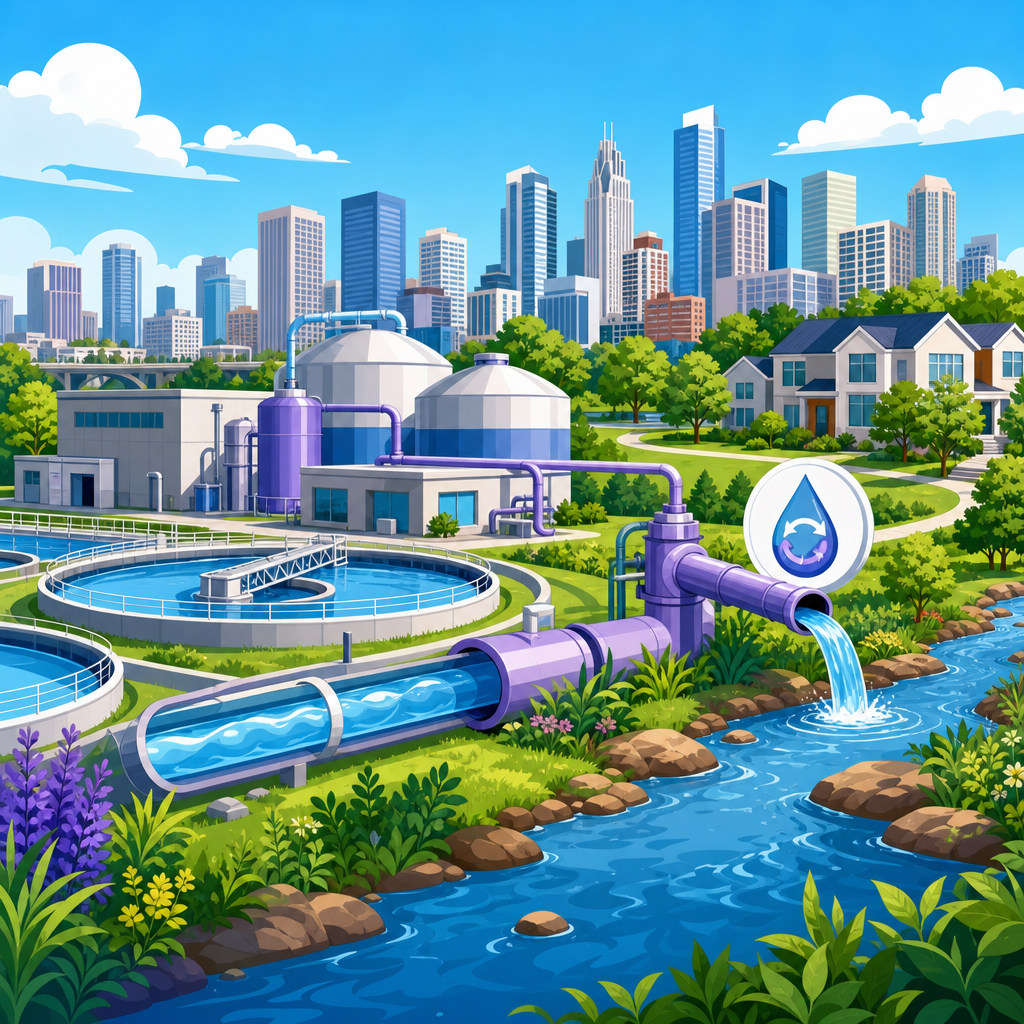
Water reuse infrastructure for fast-growing metro areas is no longer a niche sustainability project; it is a core urban planning strategy for cities facing population growth, drought risk, aging pipes, and rising treatment costs. In practical terms, water reuse means capturing wastewater or stormwater, treating it to a defined quality standard, and using it again for irrigation, industry, groundwater recharge, or even drinking water. Infrastructure includes the physical assets—collection sewers, advanced treatment plants, storage basins, pumps, distribution mains, dual-plumbing systems, monitoring sensors, and control software—that make repeated use safe and reliable. Metro areas need this systems view because reuse fails when planners focus on a single plant rather than the network, regulations, users, and financing that support it.
Fast-growing regions feel the pressure first. New housing, data centers, hospitals, and manufacturers increase demand every year, while climate variability makes historical water supply assumptions less dependable. I have seen utilities that once planned around average rainfall now model multi-year shortages, peaking energy prices, and stricter discharge permits at the same time. Reuse changes that equation by turning a local waste stream into a managed supply. It can reduce withdrawals from rivers and aquifers, defer expensive reservoir expansions, and improve resilience during drought restrictions because recycled water is produced every day from indoor water use. For planners, the value is not only water volume; it is supply diversity, regulatory flexibility, and better alignment between where water is generated and where nonpotable demand already exists.
Several terms matter. Nonpotable reuse supplies water for cooling towers, parks, toilet flushing, street cleaning, and industrial processes. Indirect potable reuse introduces highly treated water into an environmental buffer such as a reservoir or aquifer before drinking water treatment. Direct potable reuse sends purified water to a drinking water system without a long environmental buffer, using multiple engineered barriers and continuous monitoring. Decentralized reuse treats water at the district, campus, or building scale, while centralized reuse relies on large regional facilities. Purple pipe refers to the color convention used in many jurisdictions for recycled water distribution mains. Understanding these categories helps cities choose realistic projects instead of assuming every reuse program must begin with potable reuse or, conversely, that irrigation-only systems are enough for long-term growth.
Why does this matter now? Because urban water policy is shifting from disposal to circular management. Regulations such as California’s Title 22 recycled water criteria, the U.S. EPA Water Reuse Action Plan, Singapore’s NEWater framework, and guidance from the World Health Organization have shown that reuse can be governed safely when treatment, monitoring, and operator competence are rigorous. At the same time, growth corridors around Phoenix, Austin, Denver, Atlanta, and inland Southern California face hard questions about how to approve new development without overcommitting fragile supplies. Water reuse infrastructure gives metro leaders a tool that connects land use, capital planning, public health protection, and economic development in one decision framework.
Why fast-growing metros prioritize reuse infrastructure
The first reason is arithmetic: every new resident increases potable demand and wastewater flows. Utilities can either discharge that wastewater after treatment and seek new freshwater elsewhere, or recover part of it as a dependable local resource. Reuse is attractive in land-constrained metros because the source already arrives through existing sewers. In Orange County, California, the Groundwater Replenishment System has demonstrated the scale possible when advanced purified water is used to recharge aquifers that support a large urban population. In the Middle East and Australia, cities expanded reuse because desalination or imported water carried higher energy, cost, or geopolitical burdens. The lesson is consistent: when population growth outpaces conventional supplies, treated effluent becomes strategically valuable.
The second reason is resilience. Surface reservoirs are vulnerable to drought and contamination, while groundwater can be overdrawn or polluted by nitrates, PFAS, or saline intrusion. Recycled water provides a climate-insensitive component because wastewater generation is relatively stable. During dry years, outdoor irrigation demand rises exactly when river flows fall, making nonpotable reuse especially effective. Metro utilities also use reuse to comply with tighter nutrient discharge permits. Instead of paying solely to remove nitrogen and phosphorus before releasing effluent, they can beneficially use some of that water where standards allow, reducing discharge volumes and creating economic value.
The third reason is development certainty. In several western U.S. states, water availability increasingly shapes permitting timelines and housing delivery. A metro area that can document a diversified portfolio—conservation, leak reduction, stormwater capture, aquifer storage, and reuse—has a stronger basis for approving new neighborhoods and employment centers. Reuse infrastructure therefore influences real estate markets, industrial recruitment, and bond ratings, not just utility operations.
Core components of a metro-scale water reuse system
A successful system begins with source characterization. Municipal wastewater varies by sewershed, industrial pretreatment performance, infiltration, and seasonal flow patterns. Engineers evaluate biochemical oxygen demand, total suspended solids, nutrients, salinity, trace organics, and pathogen risk before selecting treatment trains. For nonpotable urban reuse, conventional secondary treatment followed by filtration and disinfection may be sufficient, but many systems now add membrane bioreactors, ultraviolet advanced oxidation, reverse osmosis, granular activated carbon, or ozone depending on end use and local rules. The principle is fit-for-purpose treatment: match water quality to the use without compromising health protection.
Distribution assets are equally important. Recycled water often requires a separate network to avoid cross-connections with potable service. That means storage tanks sized for diurnal demand swings, booster pumps for pressure zones, backflow prevention, clearly marked hydrants, and customer meter assemblies. In district-scale projects, dual plumbing inside buildings carries reclaimed water to toilets and cooling systems. Operations teams need geographic information systems, supervisory control and data acquisition platforms, online turbidity and chlorine residual analyzers, and formal cross-connection control programs. In my experience, the distribution network often determines cost and schedule more than the treatment plant, especially in built-out neighborhoods where street excavation is disruptive.
| Infrastructure element | Main purpose | Typical metro use case |
|---|---|---|
| Advanced treatment plant | Removes pathogens, nutrients, salts, and trace contaminants | Supplying industrial users, recharge basins, or potable augmentation |
| Purple pipe distribution | Delivers nonpotable recycled water safely to customers | Parks, campuses, medians, cooling towers, construction water |
| Storage and pumping | Balances hourly demand and maintains pressure | Serving large irrigation peaks in summer afternoons |
| Monitoring and controls | Verifies water quality and system integrity in real time | Automatic shutdown when turbidity or disinfectant residual falls outside limits |
| Recharge basins or injection wells | Stores purified water in aquifers and creates environmental buffer | Indirect potable reuse and groundwater management |
Storage deserves special attention. Demand for nonpotable water is often highly seasonal, while wastewater inflow is comparatively steady. Without storage, utilities can produce more recycled water than customers need in winter and too little during summer peaks. Equalization basins, clearwells, aquifer storage and recovery wells, and satellite reservoirs make the system operationally flexible. Energy planning matters as well. Advanced treatment can be electricity-intensive, so many modern facilities pair pumps and membranes with variable-frequency drives, onsite solar, demand response contracts, or biogas from anaerobic digestion to manage lifecycle cost.
Planning models, governance, and financing choices
Metro areas generally choose among centralized, decentralized, and hybrid delivery models. Centralized systems benefit from economies of scale, stronger operator specialization, and easier regulatory oversight. They work well when a large wastewater treatment plant is near industrial demand, recharge sites, or a growing corridor that can justify major trunk mains. Decentralized systems serve campuses, airports, mixed-use districts, and master-planned communities where local reuse offsets potable demand without extensive off-site piping. Hybrid systems combine both: a regional utility provides backbone treatment and standards, while districts manage local distribution or building-level systems. There is no universal best model. The right answer depends on density, topography, customer mix, and the distance between wastewater sources and reuse demand.
Governance can be harder than engineering. Reuse projects often cross municipal boundaries, utility service areas, and regulatory jurisdictions. One city may own the wastewater plant, another may host recharge basins, and a regional wholesaler may control potable imports. Clear agreements on water rights, cost allocation, outage responsibilities, and water quality liability are essential. Successful programs typically establish interagency memoranda, standardized customer contracts, and public health oversight from the beginning rather than after design. Singapore’s integrated national approach and Orange County’s long-term regional coordination show that durable institutions matter as much as treatment technology.
Financing usually blends rate revenue, impact fees, state revolving funds, federal loans under WIFIA, grants, and developer contributions. Capital planning should compare reuse not only against current water prices but against the avoided cost of future supply expansion, drought emergency purchases, wastewater discharge upgrades, and growth moratoria. Utilities that quantify those avoided costs make stronger business cases. Rate design also matters. If recycled water is priced too low, systems may not recover costs; if too high, customers will not connect. Many utilities use long-term take-or-pay contracts with industrial users and phased connection requirements for new developments to anchor demand early.
Public health, regulation, and community acceptance
Any discussion of water reuse infrastructure must start with health protection. Safe systems use multiple barriers: source control through industrial pretreatment, robust treatment processes, validated pathogen log-reduction credits, operator certification, online monitoring, alarmed shutdowns, and documented response plans. Regulations differ by jurisdiction, but the direction is clear. Standards increasingly specify treatment performance, monitoring frequency, and end-use restrictions rather than vague design intent. Potable reuse requires the highest scrutiny because it must manage viruses, protozoa, chemical constituents, and system upsets without relying on luck or dilution. Utilities that treat monitoring as a compliance checkbox rather than a real-time safety function undermine public trust.
Community acceptance depends on transparency and plain language. People support reuse when they understand what treatment removes, what barriers exist if equipment fails, and how quality is independently verified. Facilities that provide visitor centers, publish dashboards, and explain terms like microfiltration, reverse osmosis, and ultraviolet advanced oxidation consistently see better acceptance than those that communicate only during permit hearings. The phrase “toilet to tap” persists because it is emotionally vivid, but it oversimplifies treatment and ignores the fact that all urban water is reused downstream in some form. The best outreach replaces slogans with process diagrams, plant tours, and comparisons to existing indirect reuse in major river systems.
Equity matters too. Reuse infrastructure should not leave lower-income neighborhoods with higher rates, construction disruption, or lower service reliability while wealthier districts receive the first resilience benefits. Inclusive planning means mapping who pays, who benefits, where pipelines are built, and how job training or local procurement can be incorporated. That social dimension often determines whether a technically sound project survives political change.
Implementation roadmap for metro decision-makers
For most fast-growing metros, the practical starting point is a portfolio assessment. Quantify current wastewater flows, projected demand centers, industrial users, irrigated public land, groundwater conditions, and regulatory drivers. Then screen projects by distance, elevation, demand stability, treatment need, and cost per acre-foot. Early wins usually involve large nonpotable customers near existing plants: power stations, semiconductor facilities, logistics parks, universities, sports complexes, and municipal irrigation networks. These projects create revenue, operating experience, and public familiarity before potable reuse is considered.
Next, align reuse with land-use approvals. Require major greenfield developments to reserve utility corridors, install dual plumbing where justified, and contribute to backbone infrastructure through development agreements. Coordinate with transportation agencies so recycled water mains can be laid during roadway projects instead of after pavement is restored. Build design standards for signage, valve separation, meter assemblies, and cross-connection testing into municipal code. Digital asset management should be established from day one; undocumented valves and customer modifications become expensive safety risks later.
Finally, manage performance over decades, not ribbon cuttings. Track delivered volumes, substitution rates, energy intensity, membrane replacement cycles, customer retention, and incident response times. Revisit assumptions as industries change; a data center cluster may become a major anchor demand, while turf irrigation can decline under conservation ordinances. The strongest metro programs treat reuse as adaptive infrastructure within a broader urban water strategy, not as a standalone demonstration project. Cities that do this well gain a durable local supply, more predictable growth planning, and a water system better suited to a hotter, more populated future. If your metro area is updating its comprehensive plan or utility master plan, make water reuse infrastructure a central line item now.
Frequently Asked Questions
What is water reuse infrastructure, and why is it so important for fast-growing metro areas?
Water reuse infrastructure is the network of systems that allows a city to capture used water or stormwater, treat it to a specific standard, and put it back into service instead of discharging it and relying only on new freshwater supplies. In a metro area, that infrastructure can include collection sewers, pump stations, advanced treatment plants, storage tanks, purple pipe distribution networks for non-potable reuse, groundwater recharge basins, monitoring equipment, and digital controls that track water quality and system performance in real time.
For fast-growing cities, this matters because population growth puts immediate pressure on water supplies, wastewater treatment capacity, and aging utility assets. At the same time, many metro regions face drought risk, stricter environmental regulations, higher energy costs, and more intense storms that overwhelm conventional systems. Water reuse helps cities respond to all of those pressures at once. It creates a local, drought-resilient supply that does not depend entirely on distant reservoirs or imported water. It can also reduce wastewater discharge volumes, lower demand on potable systems, delay expensive supply expansions, and support economic growth by ensuring reliable water for industry, landscaping, cooling, and other non-drinking uses.
In other words, water reuse is no longer just a sustainability add-on. For many metro areas, it is becoming a core urban planning strategy because it increases resilience, improves long-term water security, and gives utilities more flexibility in how they manage growth. When designed well, reuse infrastructure becomes part of a broader “one water” approach, where drinking water, wastewater, stormwater, and groundwater are managed as connected resources rather than separate silos.
How does water get treated so it can be reused safely?
The treatment process depends on the intended end use, because different applications require different water quality standards. For example, water used for landscape irrigation, cooling towers, or industrial processes may need a different level of treatment than water intended for groundwater recharge or indirect potable reuse. That said, most reuse systems follow a multi-barrier approach, meaning they use several treatment steps instead of relying on a single process.
Typically, the process starts with conventional wastewater treatment, where solids are removed and biological processes reduce organic matter and nutrients. From there, advanced reuse systems may add filtration, membrane treatment such as microfiltration or ultrafiltration, reverse osmosis, activated carbon, ultraviolet disinfection, ozone, or advanced oxidation. Each step is designed to remove specific contaminants, including suspended solids, pathogens, nutrients, trace organics, and dissolved salts. The goal is to create consistent water quality that matches the regulatory requirements for the reuse application.
Safety comes not just from the treatment technology itself, but also from continuous monitoring, automation, operator training, and strict regulatory oversight. Modern reuse facilities often use online sensors and alarms to track turbidity, disinfectant levels, membrane performance, and other indicators in real time. If a parameter moves out of range, the system can divert water, shut down a process, or trigger corrective action immediately. That layered approach is why advanced water reuse can be highly reliable. The key is that treatment standards are clearly defined, system performance is validated, and public health protections are built into every stage of design and operation.
What are the main types of water reuse projects cities typically build?
Most metro areas develop reuse projects based on local demand, geography, regulatory conditions, and existing utility assets. One of the most common models is non-potable reuse, where treated reclaimed water is distributed through a separate pipe network for irrigation, parks, school campuses, golf courses, industrial facilities, data centers, or commercial cooling systems. This approach is often attractive because it offsets potable demand where high-quality drinking water is not necessary.
Another common category is industrial or on-site reuse. In this model, large facilities such as manufacturing plants, airports, hospitals, or mixed-use developments treat and reuse water internally for cooling, equipment washing, toilet flushing, or process needs. These projects can reduce strain on municipal infrastructure and improve local resilience, especially in areas with supply constraints or high sewer costs.
Cities also invest in groundwater recharge projects, where highly treated recycled water is allowed to percolate into aquifers or is injected underground to replenish depleted groundwater basins. This can help stabilize water supplies, reduce land subsidence, and create a buffer against drought. In some regions, utilities pursue indirect potable reuse, where advanced treated water is introduced into an environmental buffer such as a reservoir or aquifer before being treated again and supplied as drinking water. Direct potable reuse, where purified water is introduced more directly into a drinking water system, is also gaining attention in select jurisdictions with robust regulation and technical capacity.
Stormwater capture and reuse is another important category, especially in urban areas with large paved surfaces and flash runoff. Infrastructure for this may include green streets, detention basins, cisterns, treatment units, and recharge facilities that capture stormwater for irrigation, aquifer replenishment, or other beneficial uses. In practice, many metro areas build a portfolio of reuse strategies rather than relying on a single project type. That portfolio approach gives utilities flexibility and helps align infrastructure investments with neighborhood growth patterns, industrial demand, and long-term resilience goals.
What are the biggest challenges in building water reuse infrastructure at metro scale?
The biggest challenge is usually not whether reuse is technically possible, but how to implement it at the right scale, cost, and pace. One major issue is capital investment. Reuse systems often require advanced treatment upgrades, new storage facilities, dual plumbing or purple pipe distribution networks, pumping infrastructure, and sophisticated monitoring systems. Those projects can be expensive, and utilities must balance them against other urgent needs such as replacing aging pipes, expanding wastewater capacity, and meeting regulatory requirements.
Another challenge is matching supply with demand. A city may be able to produce large volumes of reclaimed water, but it still needs reliable end users in locations that are practical to serve. Distance matters because pumping and distribution costs can make otherwise promising projects less economical. Seasonal demand also matters. Irrigation demand may be high in summer and low in winter, which means utilities need storage, alternative users, or flexible operations to keep the system efficient year-round.
Regulation and public acceptance are also central issues. Water reuse projects must meet detailed health and environmental standards, and permitting can be complex, especially for groundwater recharge or potable reuse. Public trust is essential. Even when the science is strong, communities want clear information about safety, oversight, costs, and benefits. Utilities that communicate early, explain the treatment process transparently, and demonstrate performance tend to have better outcomes than those that treat public engagement as an afterthought.
There are also operational and institutional challenges. Reuse often crosses traditional boundaries between drinking water, wastewater, stormwater, planning, public works, and private development. Coordinating those stakeholders takes time and leadership. Metro-scale success usually depends on integrated planning, realistic rate structures, strong asset management, and phased implementation. Cities that approach reuse as part of a long-term water strategy, rather than a standalone pilot, are generally better positioned to overcome these barriers.
How can city leaders decide whether water reuse is a smart long-term investment?
City leaders should start by treating water reuse as a strategic planning question, not just a treatment technology decision. The right evaluation looks at the full system: projected population growth, future water demand, drought exposure, wastewater flows, industrial needs, stormwater pressures, groundwater conditions, regulatory trends, and the cost of alternative supply options. In many cases, reuse becomes attractive not because it is the cheapest project on day one, but because it reduces long-term risk and delays even more expensive investments in imported water, new reservoirs, deeper wells, or expanded discharge infrastructure.
A strong business case usually includes both direct and indirect benefits. Direct benefits can include reduced potable water demand, lower discharge volumes, more reliable industrial supply, and better use of existing wastewater assets. Indirect benefits may include drought resilience, support for housing and economic development, improved groundwater conditions, environmental compliance, and greater flexibility during emergencies. Decision-makers should also consider lifecycle costs rather than focusing only on upfront construction. Energy use, maintenance, staffing, replacement schedules, and monitoring requirements all affect long-term value.
It is also important to identify where reuse will have the highest impact first. Many cities begin with targeted projects near large customers, new developments, industrial corridors, parks systems, or recharge zones where infrastructure can be phased in efficiently. That allows utilities to build experience, demonstrate reliability, and expand over time. Financial tools such as state revolving funds, federal grants, public-private partnerships, developer contributions, and regional cost-sharing can further improve project feasibility.
Ultimately, water reuse is a smart long-term investment when it is aligned with land use planning, customer demand, regulatory realities, and broader resilience goals. For fast-growing metro areas, the question is increasingly not whether reuse should be considered, but where it fits best in the city’s future water portfolio. Leaders who evaluate reuse through that wider lens are more likely to make durable, cost-effective infrastructure decisions that support growth without compromising water security.


