
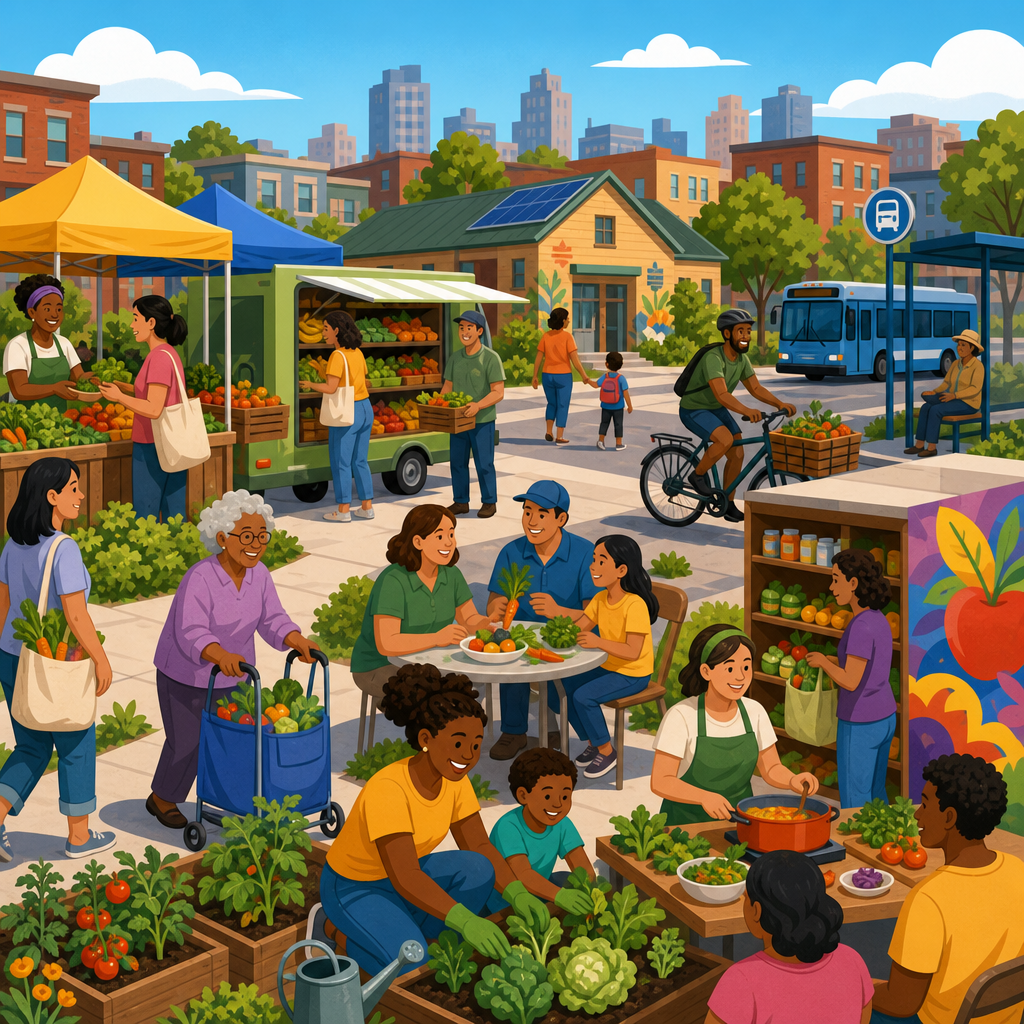
Food desert strategies that go beyond attracting a single supermarket are essential because limited food access is a systems problem, not a single real estate transaction. In planning practice, the term “food desert” usually describes a low-income area where many residents live far from a full-service grocery store, but distance alone does not capture the whole challenge. A neighborhood can have a supermarket nearby and still face unaffordable prices, poor transit connections, limited culturally relevant foods, or unsafe walking routes. Many researchers and practitioners now prefer terms such as “low food access,” “food apartheid,” or “nutrition insecurity” because they point to policy choices, historic disinvestment, and unequal power rather than implying a natural condition. Whatever term a city uses, the practical question is the same: how can local policy improve reliable access to affordable, healthy, acceptable food?
This matters because food access influences health, household budgets, economic development, and neighborhood stability. The USDA has long mapped low-access census tracts, and public health agencies consistently link poor diet quality with higher rates of obesity, hypertension, and diabetes. In my work reviewing neighborhood revitalization plans, I have seen a recurring mistake: city leaders announce success when one grocery chain signs a lease, then discover the store does not reverse deeper market and mobility barriers. Supermarkets can help, but they are only one node in a local food system that includes transportation, small retailers, public benefits, land use, distribution, and community ownership. A stronger strategy treats food access like housing or transit planning: coordinated, measurable, and tailored to the block level.
An effective food desert strategy therefore combines immediate relief with long-term market shaping. It asks who lacks access, why the private market underserves them, what public tools can close the gap, and how success will be measured beyond store openings. The best urban planning and policy approaches do not chase a single headline project. They build resilient neighborhood food ecosystems.
Why a supermarket-first strategy often falls short
Attracting a supermarket is politically appealing because it is visible, easy to announce, and associated with jobs and fresh produce. Yet many deals rely on tax incentives, discounted land, parking requirements, and infrastructure spending that can exceed the long-term public benefit. Full-service grocers operate on thin margins, often one to three percent, and they choose sites based on purchasing power, distribution efficiency, shrink risk, and expected basket size. In lower-income districts, those conditions may not support a conventional 40,000-square-foot store even after subsidies.
There is also a mismatch between store format and neighborhood need. Large supermarkets are usually designed for weekly car-based shopping. Residents without cars may shop more frequently and buy fewer items per trip, making travel time and carrying capacity central issues. If a new store sits across a six-lane arterial without safe crossings, older adults and families still face a barrier. If prices are higher than discount competitors outside the neighborhood, the store may exist physically but remain inaccessible economically. Research from several cities has shown that simply opening a supermarket does not automatically produce major dietary change without complementary education, affordability measures, and transportation improvements.
Another risk is fragility. A neighborhood that depends on one anchor retailer is exposed if the operator closes, changes ownership, or reduces service. I have seen municipal plans celebrate a grand opening yet fail to secure smaller backup channels such as produce vendors, pharmacies carrying staple foods, and community distribution points. Resilience comes from redundancy.
Start with a food access assessment, not a retail recruitment brochure
The first step is a detailed assessment that maps barriers at the household level. Planners should combine GIS analysis with on-the-ground auditing. Standard indicators include distance to food retailers, car ownership, transit frequency, sidewalk quality, disability access, household income, SNAP participation, and store-level pricing. The USDA Food Access Research Atlas is a useful starting layer, but cities should go further by measuring travel time by walking, transit, and wheelchair, not just straight-line distance.
Store audits matter because a retailer classified as a grocery store may offer little fresh food, poor quality produce, or high prices. Tools such as the Nutrition Environment Measures Survey for Stores let cities score availability, price, and quality consistently. Public health departments can pair those findings with health outcome data while protecting privacy. Community engagement is equally important. Residents can identify problems datasets miss, such as harassment at bus stops, unreliable delivery windows, or stores that do not stock culturally familiar items.
A serious assessment also distinguishes temporary shortages from structural disinvestment. For example, a neighborhood may have several corner stores but no distributor willing to deliver produce in small quantities, causing repeated spoilage and stockouts. That points to a logistics solution, not only a retail one. By diagnosing the bottleneck correctly, cities can spend less and achieve more.
Use a portfolio approach to neighborhood food access
The most durable strategy is a portfolio of interventions that work at different scales and time horizons. Some tools improve access immediately, while others change the underlying market over years. The goal is not to replace supermarkets completely; it is to avoid overreliance on one format.
| Strategy | Primary benefit | Typical limitation | Best policy support |
|---|---|---|---|
| Small grocer support | Walkable access and local ownership | Higher wholesale costs | Equipment grants and group purchasing |
| Mobile markets | Fast deployment to underserved blocks | Limited hours and volume | Flexible permits and operating subsidies |
| Transit improvements | Connects residents to existing stores | Does not change local supply | Route redesign and fare integration |
| Healthy corner store programs | Uses existing retail footprint | Shelf space is constrained | Coolers, merchandising, and technical assistance |
| Food hubs and co-ops | Build local supply chains and wealth | Need strong management capacity | Predevelopment capital and governance support |
This mix lets cities tailor solutions by district. A transit-connected corridor may benefit most from bus frequency upgrades and small-store improvements, while an isolated public housing area may need mobile markets, delivery partnerships, and a community-run cooperative. Portfolio planning also creates fallback options when one program underperforms.
Strengthen small retailers and corner stores
In many low-access neighborhoods, small retailers already exist. They are often dismissed because they sell mostly packaged foods, but that is precisely why they are strategic intervention points. A healthy corner store program helps owners add refrigeration, source produce, improve merchandising, and manage spoilage. Cities such as Philadelphia and Minneapolis have used this model to increase fruit, vegetable, and low-sodium staple availability without waiting years for a major chain.
The practical barriers are well known. Independent operators usually pay more per unit than chains because they lack purchasing power. They may not have relationships with produce distributors, and older coolers can make shrink unmanageable. Technical assistance is therefore as important as grants. In successful programs, staff help owners read category sales, set reorder points, bundle promotions with SNAP and WIC benefits, and place healthier items near checkout. Public agencies can coordinate group purchasing or connect stores to food hubs that aggregate local and regional suppliers.
Zoning and code enforcement should support this shift rather than complicate it. If permits for exterior signs, sidewalk displays, or minor equipment upgrades take months, participation drops. Cities can create a simple retail improvement permit for approved healthy food projects. The result is incremental but meaningful: better daily access within walking distance.
Improve mobility, delivery, and the last mile
Food access is also a transportation problem. I have reviewed neighborhoods where a decent supermarket sat less than three miles away, yet a round trip by bus took ninety minutes because of indirect routes, long headways, and unsafe stops. For residents carrying groceries, traveling with children, or using mobility aids, that trip can be prohibitive. Transportation planners should therefore treat grocery access as a core trip purpose, not an afterthought.
Useful interventions include bus route adjustments to serve shopping corridors, timed transfers, shelters, curb ramps, pedestrian lighting, and secure crossings near stores. Some transit agencies coordinate “shopper shuttles” from senior buildings or public housing sites on fixed days. Fare policy matters too. Free transfers and reduced fares for low-income riders can effectively lower the cost of food access.
Delivery is another underused tool. E-commerce alone will not solve inequity, especially where broadband access and banking are limited, but subsidized neighborhood delivery can reduce the burden on households without cars. Cities can partner with local grocers, cooperatives, or nonprofit operators to create phone-based and online ordering systems that accept SNAP where federal rules allow. Microfulfillment sites in existing commercial spaces can shorten delivery distances. The point is simple: if residents cannot easily reach food, systems should bring food closer.
Support alternative ownership and local supply chains
Communities are less vulnerable when they control more of their food infrastructure. Cooperative groceries, nonprofit markets, food hubs, and community-supported agriculture networks can retain wealth locally and stock products that reflect neighborhood demand. These models are not easy; governance, capitalization, and management discipline determine success. Still, they can outperform absentee retail when designed around realistic scale and strong technical support.
A food hub is especially valuable in underserved markets because it aggregates products from multiple farms and producers, then handles storage, processing, and distribution for smaller buyers. That helps corner stores, schools, hospitals, and restaurants buy fresh products without meeting the minimum order sizes of large distributors. Cleveland, Detroit, and other legacy cities have used versions of this approach to connect institutional purchasing with regional producers.
Land policy can reinforce local supply. Public land leases, accessory use rules, and water access policies can support urban agriculture, though cities should be honest about its limits. Community gardens improve education, social ties, and modest produce supply, but they rarely replace full retail demand at scale. The better use case is complementary production linked to farmers markets, school nutrition programs, or neighborhood food hubs.
Align benefits, institutions, and procurement
Food access improves fastest when cities align consumer purchasing power with stable demand from institutions. SNAP and WIC are central because they shape what households can buy and where retailers see reliable sales. Municipal outreach can increase enrollment, simplify recertification support, and promote programs that match benefits for fruits and vegetables, such as Double Up Food Bucks in participating regions. Those incentives directly affect affordability, which is often the real barrier after distance.
Anchor institutions can stabilize supply as well. Schools, hospitals, universities, and correctional systems buy large volumes of food every week. Procurement standards that favor regional distributors, minority-owned vendors, and fresh product categories can strengthen the same supply chains that neighborhood retailers use. Farm-to-school programs are a good example: they improve meal quality, build demand for local producers, and normalize healthier foods for children.
Healthcare systems are increasingly part of the solution. Produce prescription programs, medically tailored meals, and screening for nutrition insecurity can direct resources to households facing the greatest health risk. These programs work best when connected to neighborhood retail and distribution strategies rather than operating as isolated pilots.
Measure outcomes that reflect real access
Better policy requires better metrics. Counting store openings is not enough. Cities should track travel time to affordable healthy food, price differentials for a market basket, acceptance of SNAP and WIC, produce quality scores, delivery coverage, and resident satisfaction. Health indicators such as diabetes hospitalization rates are useful but move slowly, so planners need intermediate measures that show whether access is improving now.
Equity should be built into evaluation. Disaggregate results by race, age, disability, language, and housing type. A program that raises average access while leaving seniors or public housing residents behind is not successful. Financial sustainability matters too. If a subsidized market requires indefinite emergency funding with no path to steady operations, planners should say so and redesign the model.
Transparent dashboards help keep promises visible. When residents can see route changes, store upgrades, grant awards, and pricing trends, trust increases. That transparency also helps future articles within this hub topic connect food access to zoning reform, transit planning, public health, anti-displacement policy, and community wealth building.
Food desert strategies that work do not depend on landing one supermarket and hoping market forces handle the rest. They start with a precise diagnosis of barriers, then combine retail support, transportation, delivery, public benefits, institutional procurement, and community ownership into a coherent neighborhood food system. That approach is more demanding than a single ribbon cutting, but it is also more realistic, resilient, and equitable.
The core lesson for urban planning and policy is straightforward: food access is infrastructure. It depends on land use, logistics, purchasing power, and public trust as much as storefront square footage. Cities that treat it that way can improve daily life quickly while building stronger long-term market conditions. Residents gain more than fresh produce; they gain time, dignity, health, and local economic opportunity.
If you are building a food access agenda, begin with mapping and store audits, then design a portfolio strategy for each neighborhood instead of pursuing one universal fix. Use this hub as your foundation for deeper work on retail policy, transit, public health, and community development, and turn food access from a symbolic promise into a measurable public service.
Frequently Asked Questions
1. Why is attracting one supermarket not enough to solve a food desert?
Bringing in a single full-service grocery store can help, but it rarely fixes the underlying problem by itself. Food access is shaped by a web of factors that include affordability, transportation, hours of operation, product quality, cultural relevance, safety, and household time constraints. A store may be physically close yet still functionally out of reach if prices are too high, bus service is unreliable, sidewalks are unsafe, or working families cannot shop during limited hours. In many communities, residents also need foods that reflect cultural preferences and dietary needs, not simply more shelf space.
There is also a resilience issue. If a neighborhood strategy depends on one store alone, the entire local food system becomes vulnerable to one lease decision, one operator’s financial trouble, or one shift in corporate priorities. A stronger approach treats food access as infrastructure and builds multiple pathways for residents to get healthy, affordable food. That can include smaller neighborhood markets, food co-ops, mobile markets, transit improvements, community-led distribution models, support for local producers, and policies that raise purchasing power. In practice, the most durable food access strategies reduce dependency on any single business and create a network that serves people consistently over time.
2. What are the most effective food desert strategies beyond recruiting a supermarket?
The most effective strategies usually combine physical access, economic access, and community control. On the physical side, cities and local organizations can support smaller grocery formats, corner store conversions, public markets, mobile food vendors, and produce trucks that bring food directly into underserved areas. They can also improve bus routes, add safer walking and biking connections, and create pick-up points for online grocery ordering. These steps matter because a shorter trip, a safer route, or a convenient delivery option can change whether a household is truly able to buy fresh food on a regular basis.
On the economic side, affordability is often just as important as geography. Nutrition incentive programs, produce prescription programs, SNAP and WIC acceptance, healthy food financing, and targeted subsidies can help make healthier choices realistically attainable. For small retailers, grants and technical assistance can support refrigeration, inventory management, sourcing, and merchandising so they can stock fresh products successfully. For communities, cooperative ownership models and support for local food entrepreneurs can keep more decision-making and wealth local. The strongest plans do not ask one intervention to do everything; they layer retail, transit, public health, economic development, and resident leadership into a coordinated strategy.
3. How do affordability and transportation affect food access even when a grocery store is nearby?
Affordability and transportation are often the hidden barriers that make “nearby” food access far less meaningful than it appears on a map. A household may live within a mile of a grocery store, but if staple foods, fresh produce, and proteins are priced above what residents can consistently afford, the store does not solve the real problem. Families may stretch budgets by shopping less often, buying lower-cost calorie-dense items, or traveling farther to discount retailers. In that sense, food access is not just about store presence; it is about whether people can reliably purchase enough healthy food without sacrificing rent, medicine, utilities, or childcare.
Transportation adds another layer. A short distance can become a major obstacle for older adults, people with disabilities, families with young children, or workers juggling multiple jobs. Carrying groceries on foot, waiting for infrequent buses, paying for rideshare trips, or navigating unsafe crossings all increase the burden of getting food home. That is why planners and policymakers increasingly look at travel time, trip complexity, and transportation cost rather than distance alone. Practical solutions include better transit frequency, shelters and sidewalks, shuttle services, protected pedestrian routes, grocery delivery options, and neighborhood-scale retail that reduces the need for long, difficult trips.
4. What role do community-based solutions play in improving food access?
Community-based solutions are essential because residents understand local barriers in a way outside institutions often do not. They know which stores are trusted, which foods are culturally important, what hours are realistic for working households, and where safety or transportation problems interfere with routine shopping. When food access plans are shaped by residents, they are more likely to reflect actual daily life instead of relying on assumptions. This can lead to more effective interventions, such as community refrigerators, produce box programs, cooperative groceries, culturally specific food businesses, shared commercial kitchens, school-based food distribution, and neighborhood markets designed around local demand.
These solutions also build local ownership and resilience. A community food co-op, for example, can align pricing, product selection, and hiring with neighborhood priorities rather than distant corporate targets. Partnerships with faith groups, health clinics, schools, farmers, and mutual aid networks can extend food access beyond traditional retail and reach households that might otherwise be missed. Importantly, community-based approaches should not be treated as substitutes for public investment. They work best when backed by funding, technical support, policy alignment, and long-term institutional commitment. The goal is not to place the burden entirely on residents, but to give communities meaningful power in shaping a stronger local food system.
5. How should cities measure success when addressing food deserts?
Cities should measure success with a broader set of indicators than simply whether a supermarket opened. A more accurate framework looks at affordability, travel time, food quality, healthy inventory, cultural relevance, store stability, and resident satisfaction. Officials should ask practical questions: Can households buy a week’s worth of healthy food at prices they can manage? How long does the trip take without a car? Are stores well stocked with fresh items? Do they accept SNAP and WIC? Do residents feel safe getting there and shopping there? Are local businesses and community organizations part of the system?
Long-term outcomes matter as well. Cities should track whether interventions reduce food insecurity, improve diet-related health conditions, strengthen neighborhood retail capacity, and keep food access stable over time. They should also pay attention to equity impacts, including whether improvements benefit long-time residents or contribute to displacement pressures. The best evaluation plans combine quantitative data, such as pricing audits and transit access metrics, with qualitative feedback from residents about convenience, dignity, and trust. In other words, success is not just about putting food somewhere nearby; it is about creating a reliable, affordable, and community-responsive food environment that works in everyday life.


