
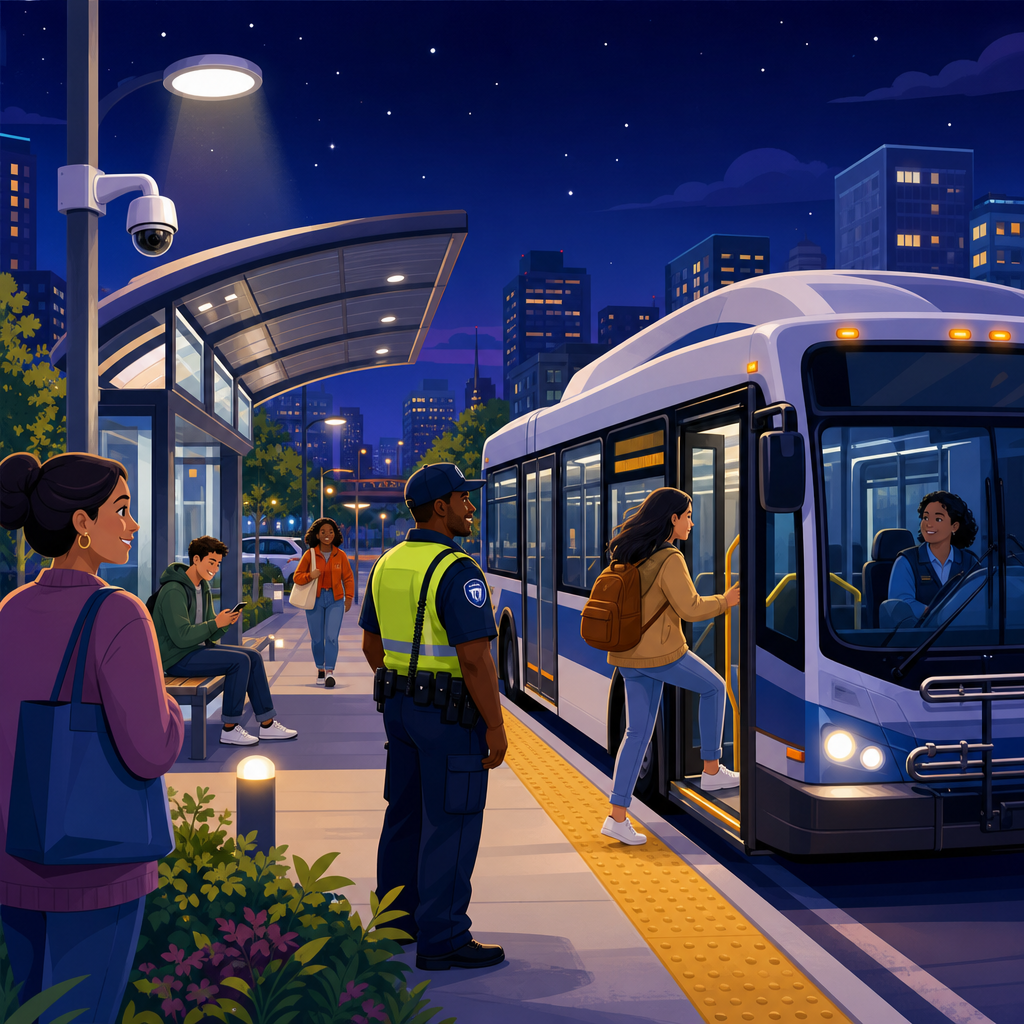
Transit safety after dark is one of the clearest tests of whether an urban transportation system serves everyone, not just peak-hour commuters. When buses, trains, platforms, stops, sidewalks, elevators, parking areas, and transfer points feel unsafe at night, ridership drops, workers lose reliable mobility, and cities undermine goals tied to equity, climate, and economic activity. In practice, after-dark safety is not a single issue. It is the combined result of physical design, staffing levels, operating policies, maintenance standards, emergency response, and the everyday experience of riders and frontline employees.
In transit planning, safety refers to protection from unintentional harm such as slips, falls, collisions, and poorly managed crowding, while security refers to protection from crime, harassment, and threatening behavior. Riders usually do not separate the two. A dim bus stop with no sightlines, no real-time information, and infrequent service feels unsafe whether the underlying risk is assault, a traffic conflict, or being stranded. That is why effective transit safety after dark depends on layered decisions across capital design and daily operations rather than a single enforcement measure.
I have worked on station-area reviews where incident data looked manageable on paper, yet night ridership still lagged because riders consistently described dark approaches, hidden corners, unreliable last trips, and uncertainty about who could help if something went wrong. Those observations match established practice in environmental design, human factors, and transit operations. Agencies that improve lighting, visibility, staffing presence, cleaning, communications, and service reliability typically see stronger customer confidence even before major capital projects are complete.
This matters because nighttime transit supports hospitals, airports, hospitality districts, warehouses, universities, and shift-based service work. It also matters for women, older adults, disabled riders, teenagers, and people with limited access to cars, who often bear the highest burden when systems feel risky after sunset. A strong approach to transit safety after dark treats the full trip as one environment: origin, walk to stop, wait time, boarding, ride, transfer, arrival, and onward walk. When each link is designed and operated intentionally, cities create networks people will actually use at night.
Designing Stops, Stations, and Access Routes for Night Use
The first principle of nighttime transit design is simple: people feel safer when they can see, be seen, and understand where to go. Good lighting is foundational, but brightness alone is not enough. Agencies need uniform illumination that reduces dark patches and glare, especially at fare machines, stair landings, platform edges, crosswalks, and bus stop waiting areas. Modern LED fixtures usually outperform older high-pressure sodium lights because they improve color rendering, use less energy, and allow targeted placement. The best systems also maintain lighting proactively, because a fixture outage in a remote stop can undo the value of the original design.
Sightlines are equally important. Walls, advertising panels, dense landscaping, storage areas, and poorly placed utility cabinets can create concealment points. At stations I have audited, removing one opaque panel near an elevator often improved visibility more than adding another camera. Clear sightlines help riders assess who is nearby, help operators monitor platforms, and help responding staff locate a problem quickly. Transparent materials, lower barriers, and open waiting zones support this without making spaces feel barren.
Access routes matter as much as the platform itself. Many after-dark incidents and near misses happen on the approach to transit, where sidewalk gaps, poor drainage, missing curb ramps, and uncontrolled crossings raise risk. A well-designed station with a dangerous half-block walk to reach it still fails the rider. Night safety therefore depends on coordination with street design: marked crossings, pedestrian-scale lighting, traffic calming, wayfinding, and active frontages that keep “eyes on the street.” Cities such as London, Tokyo, and Vancouver have shown that station access improvements often yield outsized confidence gains because they address the part of the trip riders remember most vividly.
Wayfinding should answer immediate nighttime questions: Is this the right place to wait? When is the next vehicle coming? Where is the accessible route? Where can I get help? High-contrast signs, consistent route maps, tactile guidance, and real-time displays reduce uncertainty. Uncertainty increases fear, especially when service is infrequent. If a rider knows the next bus is arriving in six minutes and can see a lit shelter, a help point, and the curbside boarding area, perceived risk drops materially.
Staffing Presence, Roles, and Rider Confidence
Visible staff presence is one of the strongest predictors of whether riders report feeling safe after dark. That does not mean every problem requires a police response. In fact, agencies with the best results usually deploy a mix of roles: station agents, platform attendants, customer service staff, fare inspectors, cleaners, outreach workers, supervisors, and transit police where appropriate. The key is coverage, clarity, and training. Riders need to know that if something is wrong, a competent person can respond quickly.
Staffing works best when it is assigned by risk pattern rather than by habit. Late-night transfer hubs, terminal stations, entertainment districts after events, and routes serving hospitals or overnight employment centers need a different staffing plan than low-volume suburban stops. Agencies should map calls for service, operator reports, customer complaints, ridership by hour, and environmental conditions to determine where human presence is most valuable. I have seen one mobile supervisor team stationed near a frequent transfer point resolve repeated disorder issues more effectively than occasional drive-through patrols spread too thinly across a network.
Training determines whether staffing improves outcomes. Frontline employees need de-escalation skills, trauma-informed communication, disability awareness, radio discipline, and a clear escalation ladder. They also need practical authority. If a station attendant can quickly summon cleaning, maintenance, medical assistance, or law enforcement through a reliable control center, riders experience the system as coordinated. If staff are present but powerless, confidence erodes fast. Operators especially need support, because they often become the first point of contact during harassment, medical events, or disputes.
There are tradeoffs. High staffing costs can strain budgets, and some riders may feel over-policed if enforcement is the dominant visible presence. The strongest approach balances reassurance with proportionality. Ambassadors and customer service teams often improve comfort by offering directions, reporting hazards, and providing a nonthreatening presence, while specialized responders handle situations that exceed their role. A layered model recognizes that after-dark transit safety is partly about crime prevention, but just as often about information, order, and immediate human help.
Operating Practices That Reduce Night Risk
Operations shape nighttime safety every day. Frequent, reliable service reduces waiting time, and waiting time is a major driver of fear. A stop with a twelve-minute headway feels fundamentally different from one with a forty-minute gap, even if both have similar lighting. Agencies that cannot fund high frequencies overnight should at minimum protect last-trip reliability, timed transfers, and accurate real-time information. Missing the final connection after midnight can leave riders stranded in conditions they did not plan for, which magnifies both actual and perceived risk.
Request-stop programs can help on buses after dark, especially for women, older riders, and disabled passengers who may prefer to alight closer to home than the formal stop location. These programs must be governed by operator judgment and roadway safety rules, but when implemented carefully they shorten exposed walking distance. Demand-responsive feeder services, guaranteed ride home policies for late shifts, and well-managed night bus networks can serve similar goals where fixed-route rail frequencies fall off.
Cleaning and maintenance are safety operations, not cosmetic extras. Broken glass, wet floors, vandalized fixtures, inoperative elevators, overflowing trash, and damaged shelters send a message that no one is in charge. The broken windows idea is often oversimplified, but in transit environments there is solid operational logic behind rapid repair: disorder obscures hazards, reduces staff morale, and lowers rider confidence. Graffiti removal, restroom management, snow and ice control, and preventive maintenance on lights, CCTV, public address systems, and fare equipment all matter more after dark because alternatives are fewer.
Control centers should integrate video, radio, CAD/AVL data, emergency call points, and incident logging so that small issues are tracked before they become repeat problems. A camera alone does not create safety; a monitored system with defined response protocols does. Likewise, public address systems should be intelligible, not merely present. During service disruptions, clear announcements reduce crowd frustration and help prevent platform congestion, conflict, and risky rider behavior such as crossing tracks or forcing doors.
Using Data, Technology, and Standards to Target Improvements
Transit agencies should measure nighttime safety with more than crime totals. Useful indicators include incidents per boarding by hour, slip and fall claims, customer survey responses, lighting outage duration, mean response time to calls for service, elevator downtime, missed last connections, operator assault reports, and stop-level ridership change after interventions. Disaggregating by gender, disability, age, and trip purpose often reveals patterns that systemwide averages hide. Women may report high harassment concern at locations where reported crime remains relatively low, signaling underreporting and a design or staffing gap.
Recognized standards help translate those findings into action. CPTED principles guide visibility, access control, territorial reinforcement, and maintenance. ADA requirements shape accessible paths, lighting around ramps and elevators, and detectable warnings. NFPA 130 informs fire life safety for rail systems. APTA guidance, NACTO street design practices, and local roadway standards all influence the nighttime journey to and from transit. Agencies should treat these frameworks as complementary rather than siloed.
| Issue | Common Nighttime Cause | Best Operational Response | Best Design Response |
|---|---|---|---|
| Rider fear at bus stops | Long waits, dim lighting, poor information | Protect headways, add real-time arrival data | Install uniform lighting and clear shelters |
| Platform disorder | Weak staff presence, delayed cleanup | Deploy attendants and rapid response cleaning | Open sightlines and reduce hidden corners |
| Unsafe station access | Fast traffic, missing crossings, dark sidewalks | Coordinate late-night inspections with city crews | Upgrade crossings, ramps, and pedestrian lighting |
| Poor emergency response confidence | Unclear reporting channels | Integrate control center, radios, and help points | Place visible call boxes and intuitive signage |
Technology is most effective when it solves a defined operational problem. For example, computer vision can flag track intrusions or platform crowding, but it should not replace staff judgment. Mobile apps can support discreet reporting of harassment, yet they must feed a staffed response workflow. Predictive maintenance systems can identify recurring lighting failures or elevator faults before they strand riders at night. Agencies that buy technology without changing maintenance cycles, staffing protocols, or customer communications rarely achieve meaningful gains.
Building a Night Safety Strategy Across Agencies and Communities
No transit agency controls the entire nighttime environment alone. Police, public works, disability offices, housing agencies, event venues, school districts, business improvement districts, and public health teams all affect what riders encounter. Successful night safety programs therefore use joint governance. A recurring nighttime mobility task force can review incident trends, coordinate street lighting repairs, align event crowd plans with transit staffing, and prioritize hotspot improvements. This is especially important at jurisdictional edges, where a station may be operated by one agency, fronted by a city sidewalk, and served by a separate bus operator.
Community engagement should move beyond generic public meetings. Night audits with riders, operators, disability advocates, women’s safety groups, and maintenance staff produce sharper findings because participants observe actual conditions in real time. In several reviews I have joined, issues that never surfaced in daytime workshops became obvious after 9 p.m.: unreadable signs under glare, confusing detours around closed entrances, informal smoking areas beside elevator doors, and bus bays that left passengers standing too close to moving traffic. Those details matter because riders judge systems through specifics, not policy language.
The hub principle for this topic is straightforward. Transit safety after dark improves when agencies treat design, staffing, and operations as one coordinated system. Good lighting without service reliability is insufficient. Visible staff without clear escalation tools is insufficient. Cameras without maintenance, data without field verification, and policing without customer care are all insufficient. The most effective networks align physical design, human presence, operational discipline, and cross-agency coordination around the full nighttime trip.
For planners and policymakers, the practical next step is to audit one corridor, one transfer hub, or one night route end to end. Measure lighting, wait times, incident response, accessibility barriers, and rider sentiment by hour. Fix the obvious gaps quickly, then build a capital and staffing plan around the patterns you find. Cities that do this consistently create transit systems people trust after dark, and trust is the condition that turns infrastructure into real mobility.
Frequently Asked Questions
Why is transit safety after dark such an important issue for cities and riders?
Transit safety after dark matters because it directly shapes who can realistically use a transportation system and when they can use it. A network may perform well during the morning and evening rush, but if riders feel vulnerable at night, the system stops serving many of the people who depend on it most. Late-shift workers, hospitality staff, healthcare employees, airport workers, students, caregivers, and riders making off-peak trips often have few alternatives. When they avoid buses, trains, stations, or stops after sunset, the result is not just inconvenience. It can mean lost income, reduced access to jobs, longer and more expensive commutes, and fewer opportunities to participate in city life.
From a citywide perspective, nighttime transit safety is also closely tied to equity, economic development, and sustainability goals. A system that feels unsafe after dark tends to push riders toward private vehicles, ride-hailing, or skipping trips altogether. That undermines ridership growth, weakens fare revenue, increases traffic and emissions, and limits the usefulness of investments made in transit infrastructure. Safety at night is therefore not a niche operational concern; it is a core measure of whether public transportation truly works as public infrastructure.
It is also important to understand that after-dark safety includes both actual risk and perceived risk. Crime statistics matter, but so do lighting quality, visibility, cleanliness, staffing presence, signage, maintenance, and whether riders believe they can get help quickly if something goes wrong. In many cases, a rider’s decision to use or avoid transit at night is based on a combination of these factors. Agencies that take nighttime safety seriously recognize that creating confidence is just as important as reducing incidents.
What design features make transit systems safer and more comfortable at night?
Good after-dark transit design starts with visibility and legibility. Riders should be able to clearly see their surroundings, identify entrances and exits, understand where to wait, and know how to move between services without confusion. High-quality lighting is one of the most important elements, but it is not only about brightness. Effective lighting reduces shadows, eliminates dark corners, improves facial recognition, and makes pathways, stairs, ramps, elevators, and platform edges easier to navigate. Lighting should be consistent from the station entrance to the stop, platform, parking area, sidewalk, and transfer path, because a safe platform alone does not solve the problem if the route to it feels threatening.
Clear sightlines are equally important. Design should minimize hidden areas, obstructed views, blank walls, overgrown landscaping, and isolated spaces where riders feel trapped or unseen. Transparent materials, open layouts, and well-positioned seating and shelters can all improve passive surveillance by making it easier for riders, staff, and nearby businesses or residents to see what is happening. Wayfinding also plays a major role. If a rider has to wander through a confusing station, search for an elevator, or guess where the bus stop moved, stress and vulnerability increase quickly at night.
Other high-impact design features include reliable emergency call systems, visible help points, working cameras, maintained elevators, clean stations, and real-time arrival information. These elements reduce uncertainty and signal that the environment is monitored and managed. Basic upkeep matters more than many agencies assume. Graffiti, broken fixtures, dirty platforms, malfunctioning lights, and damaged shelters can communicate neglect, which tends to lower confidence even when actual crime levels are stable. In short, safer nighttime design is created through a combination of lighting, visibility, intuitive layouts, active monitoring, accessibility, and strong maintenance standards across the full rider journey.
How do staffing levels affect transit safety after dark?
Staffing is one of the strongest operational tools available for improving nighttime transit safety because visible personnel can deter problematic behavior, assist riders, and respond quickly when issues arise. Riders consistently report feeling safer when they see station agents, platform staff, fare inspectors, customer service employees, security personnel, maintenance workers, or transit ambassadors in the system after dark. The presence does not always need to be law enforcement-led. In many environments, a mix of trained customer-facing staff and safety personnel is more effective because it combines reassurance, information, de-escalation, and enforcement when necessary.
The key is not simply adding people somewhere in the network, but placing the right staff in the right locations at the right times. Late-night safety problems often cluster at transfer points, isolated platforms, terminal stations, poorly connected bus stops, elevators, parking lots, and areas with long wait times. Staffing plans should reflect these patterns rather than relying on daytime deployment models. Consistent patrols, mobile teams, and targeted staffing during known risk periods can make a meaningful difference. Riders are especially sensitive to whether help feels immediately available, so visibility and response time matter as much as headcount.
Training is just as important as staffing numbers. Personnel should know how to support vulnerable riders, handle harassment complaints, respond to medical incidents, communicate with disabled passengers, and de-escalate conflicts. A strong nighttime staffing strategy also depends on coordination behind the scenes. Operations control centers, dispatch teams, vehicle operators, maintenance crews, and emergency responders all contribute to safety outcomes. When staffing is thin, delays in reporting, poor communication, and slow incident response can undermine trust quickly. Effective after-dark staffing therefore combines visibility, strategic deployment, training, and coordinated operations rather than relying on a single security measure.
What operational changes can transit agencies make to improve safety at night?
Operational improvements often have immediate safety benefits because they reduce the conditions that make riders feel exposed. One of the most important is minimizing wait times. When buses or trains run infrequently at night, riders spend longer periods alone on platforms, at stops, or walking between poorly activated spaces. More reliable service, better schedule adherence, and better timed connections can significantly reduce that exposure. Even modest frequency improvements on key routes can strengthen the overall sense of safety because riders spend less time waiting in uncertain conditions.
Real-time communication is another major factor. Agencies should provide accurate arrival information, delay alerts, platform changes, elevator outage notices, and transfer guidance through signs, apps, announcements, and accessible communication tools. Uncertainty increases anxiety at night. A rider who knows the next bus is arriving in four minutes feels more in control than a rider who has no idea whether the bus is coming at all. Operations teams can also support safety by ensuring fast reporting and resolution of broken lights, damaged shelters, blocked walkways, malfunctioning elevators, and cleanliness issues that affect rider confidence.
Agencies can also improve nighttime safety through targeted service design. Request stops on bus routes, front-door boarding policies in certain contexts, better coordination with paratransit and microtransit, and safer first-mile and last-mile connections can all help. Incident response protocols should be clear and fast, with strong communication between operators, supervisors, security staff, and local emergency services. Reviewing data by time of day is essential. Many systems plan around total daily ridership, but nighttime operations require a different lens that focuses on isolation, transfer conditions, vulnerable users, and service gaps. The most effective agencies treat after-dark safety as an operational discipline, not just a policing issue or a facilities issue.
How can transit agencies measure and improve riders’ sense of safety after dark over time?
Improving nighttime transit safety starts with measuring more than crime rates alone. Agencies need a broader set of indicators that captures both actual incidents and rider experience. That includes reported crimes, harassment complaints, medical calls, response times, lighting outages, elevator reliability, cleanliness scores, customer service interactions, and on-time performance during evening and overnight hours. Rider surveys are especially valuable because they reveal where people feel unsafe even when incident data appears limited. Perception often predicts behavior; if riders avoid a station or route after dark, that signal matters whether or not it shows up in police reports.
Disaggregated data is crucial. Agencies should examine differences by gender, age, disability, race, trip purpose, and time of travel, because safety concerns are not experienced uniformly. A station that feels acceptable to one rider group may feel inaccessible or threatening to another. Mapping trouble spots across the full journey can also uncover problems that standard transit metrics miss, such as dim sidewalks approaching a stop, poor visibility at parking areas, confusing transfer routes, or unstaffed elevator lobbies. Nighttime safety should be assessed from curb to platform to destination, not just within fare gates.
Long-term improvement usually comes from an ongoing cycle of assessment, intervention, and follow-up. Agencies should identify priority locations, make visible fixes such as lighting upgrades or staffing changes, communicate those improvements to the public, and then measure whether rider confidence and usage improve. Pilot programs can be useful, but they should be evaluated carefully and expanded only if results are clear. Public transparency helps as well. When agencies share what they are tracking, what they are changing, and what outcomes they are seeing, they build credibility. Ultimately, the goal is not only fewer incidents, but a system that riders trust enough to use at night without hesitation.


