
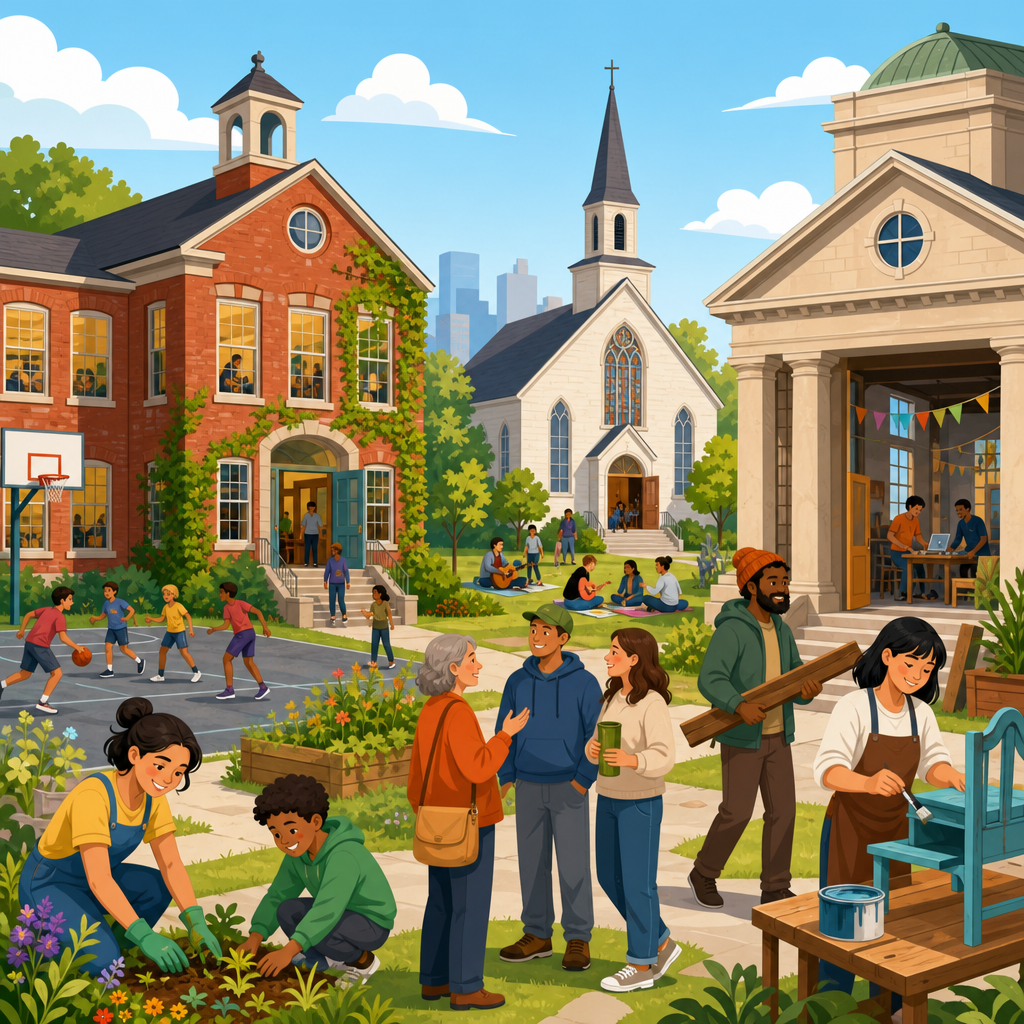
Vacant schools, churches, and civic buildings are increasingly central to affordable housing conversations because they combine one scarce asset—land in established neighborhoods—with another that is often overlooked: durable, adaptable structures already tied to community identity. In practice, community reuse strategies are the planning, financing, design, and governance methods used to convert or repurpose these empty properties for housing, services, economic activity, or mixed public benefit. I have worked on redevelopment teams evaluating former campuses, parish halls, armories, and municipal buildings, and the pattern is consistent: when reuse is handled well, a liability becomes a neighborhood anchor; when handled poorly, vacancy deepens decline, blight, and mistrust. This matters now because many communities face simultaneous pressures from rising rents, shrinking public budgets, aging institutional real estate, and demand for local services such as childcare, clinics, food access, and supportive housing. Reuse can lower acquisition costs compared with assembling new sites, preserve embodied carbon, and shorten entitlement timelines where zoning and infrastructure already exist. Yet reuse is not simply a cheaper substitute for new construction. Former schools may contain asbestos, churches may have landmark restrictions, and civic buildings often carry political expectations that complicate disposition. The strongest reuse strategies start with realistic assessment of physical condition, title, zoning, environmental risk, and community priorities before anyone talks about floor plans or ribbon cuttings.
Why these buildings are uniquely valuable for community reuse
Schools, churches, and civic buildings are different from ordinary commercial vacancies because they were designed to gather people. They usually sit on visible corners or full blocks, have kitchens, assembly rooms, parking or playground space, and are embedded in neighborhoods that already understand them as public-facing places. That makes them unusually flexible candidates for adaptive reuse. A former elementary school can become family apartments with a childcare center in the gym. A closed church can support senior housing, a food pantry, and community meeting space while retaining a sanctuary for events. An obsolete municipal building can house permanent supportive housing above workforce training or health services. These combinations work because the original building typology often includes circulation, accessibility potential, and room sizes that support multiple uses.
Location is another major advantage. In many cities, institutional buildings occupy transit-served, utility-connected parcels near parks, schools, and neighborhood retail. For affordable housing, that reduces transportation burdens on residents and can improve outcomes tied to employment, schooling, and health. Reuse also preserves neighborhood memory. Residents may oppose a vacant school being demolished for speculative development but support a plan that keeps the façade, honors alumni history, and delivers apartments plus public services. That emotional continuity is not soft sentiment; it is a real implementation factor that can determine whether a project secures approvals and philanthropic support. I have seen projects gain momentum only after teams stopped describing buildings as surplus assets and started treating them as community infrastructure with both market value and civic meaning.
How to evaluate feasibility before a project fails
The first question is not “What should this become?” but “What can this site credibly support?” Feasibility begins with four screens: physical, legal, financial, and social. Physical due diligence includes structural review, envelope condition, roof life, mechanical systems, hazardous materials, seismic needs, and floorplate efficiency. Old schools often have deep corridors and classroom wings that convert well to apartments, but large gyms and auditoriums may require subsidy-supported community uses because they are expensive to heat and difficult to monetize. Churches can be challenging because sanctuaries have dramatic volume but limited floorplate efficiency. Civic buildings may include secure areas, obsolete service cores, or inaccessible entries that trigger expensive upgrades under current accessibility standards.
Legal review should cover ownership, deed restrictions, landmark status, zoning, parking minimums, and any public disposition rules. Many municipalities require surplus property to be offered through a transparent process or at appraised value unless a public benefit transfer is authorized. Religious property can involve denominational approval, cemetery issues, or donor restrictions. Financial feasibility depends on total development cost, operating assumptions, financing sources, and likely absorption. Reuse frequently costs more per square foot than people expect because hidden conditions emerge after demolition starts. Social feasibility is just as important. If residents fear displacement, loss of sacred space, or inadequate public access, even technically sound plans stall. Strong teams test several scenarios early: all-housing, mixed-use, service-enriched housing, and phased reuse. They compare each option against local housing need, capital stack complexity, and long-term operating risk before selecting a preferred direction.
Housing-led models that make reuse financially and socially durable
For many communities, the most resilient strategy is housing-led reuse with mission-aligned ground-floor or shared-space programming. Affordable rental housing creates predictable long-term revenue, which can support debt and operations better than relying entirely on event income, co-working memberships, or short-term grants. Former school buildings are especially suited to this model. Classrooms convert into studios, one-bedrooms, or family units with large windows and high ceilings, while cafeterias and libraries become resident amenity space, clinics, after-school rooms, or nonprofit offices. Developers often use Low-Income Housing Tax Credits, tax-exempt bonds, HOME funds, Community Development Block Grant support, state historic tax credits where eligible, and local gap financing to close the capital stack.
Not every site should become apartments alone. Senior housing fits former churches well when neighborhood demographics show aging households and demand for accessible units near familiar institutions. Supportive housing can work in civic buildings if service providers can occupy lower floors and the site has transit access. Mixed-income structures may help cross-subsidize preservation of significant architectural elements, but they require careful underwriting and community messaging. A practical rule from experience is that community uses must have an operator, not just a concept. “Space for a future nonprofit” is not a strategy. A signed lease with a health provider, early learning operator, or workforce agency is. Durable projects pair the building’s physical strengths with uses that have stable demand, credible operators, and funding sources independent of housing rents.
| Building type | Best-fit reuse models | Common obstacles | Typical solutions |
|---|---|---|---|
| Vacant school | Family housing, senior housing, childcare, clinic, nonprofit hub | Asbestos, oversized common spaces, outdated systems | LIHTC financing, phased renovation, shared community facilities |
| Closed church | Senior housing, supportive housing, food pantry, event space | Landmark limits, sanctuary layout, community sensitivity | Partial preservation, mission-based partnerships, selective additions |
| Civic building | Mixed-use housing, public services, workforce training, shelter conversion | Public approval rules, security retrofits, complex title issues | Public benefit transfer, layered funding, service-provider leases |
Financing, policy, and partnerships that unlock stalled properties
Capital stacks for community reuse are almost always layered. Conventional debt alone rarely works because rehabilitation costs, code upgrades, and public-space preservation reduce returns. Successful projects combine public subsidy, mission capital, and operating partnerships. For affordable housing components, the Low-Income Housing Tax Credit remains the dominant equity source in the United States, often paired with soft loans from housing trust funds, state housing finance agencies, Federal Home Loan Bank Affordable Housing Program awards, and local subordinate debt. Historic tax credits can be powerful for eligible schools and civic buildings, though compliance requirements affect design decisions. New Markets Tax Credits may help mixed-use projects with commercial or community facility components in qualifying census tracts.
Policy tools matter as much as money. Cities can adopt surplus property policies prioritizing affordable housing and community-serving reuse, reduce parking minimums for adaptive reuse, allow by-right residential conversion in certain institutional zones, and create predevelopment funds for due diligence. Land banks and redevelopment authorities can assemble title, clear liens, and hold property while project teams are formed. Partnerships also determine success. The most effective structures usually involve a mission-driven developer, a service provider, a municipality or faith institution as legacy stakeholder, and often a community development financial institution. Each party solves a different problem: real estate execution, resident support, site control, and flexible capital. When these roles blur, projects drift. Clear governance documents, development agreements, and operating memoranda prevent confusion years after opening, when deferred maintenance and staffing pressures test the partnership.
Design, preservation, and neighborhood trust
Design decisions in adaptive reuse are not cosmetic; they affect cost, code compliance, resident experience, and public acceptance. The central challenge is balancing preservation with livability. Historic corridors, stained glass, bell towers, murals, and masonry façades may be worth retaining because they anchor identity and can unlock preservation incentives. But preservation should not force poor unit layouts, inaccessible entries, or unsustainable operating costs. Good design teams distinguish between character-defining features and expensive nostalgia. They also communicate clearly about what cannot reasonably be saved. Communities respond better to specific tradeoffs than vague promises.
Neighborhood trust is built through process and proof. Early engagement should include former students, congregants, nearby residents, service providers, and local businesses. Teams need to answer practical questions directly: Who will live here? How will the building be managed? Will public space remain public? What traffic changes are expected? How will safety be handled? On one school conversion I observed, opposition softened only after the team presented a management plan, service partner commitments, and examples from comparable properties rather than abstract renderings. Operating quality is especially important for affordable and supportive housing. Reuse projects are highly visible; if maintenance slips, critics frame the entire concept as failed. Strong asset management, reserve planning, and on-site services protect both residents and neighborhood confidence. The best projects respect the old building without becoming captive to it.
What a strong community reuse roadmap looks like
A reliable roadmap follows a sequence. First, confirm public goals: affordable housing units, services, preservation, tax base, or neighborhood stabilization. Second, complete baseline due diligence before issuing requests for proposals, including environmental reports, basic architectural assessment, title review, and zoning analysis. Third, invite proposals that specify developer experience, financing assumptions, resident protections, and long-term operations. Fourth, select for deliverability, not just highest price or most attractive rendering. Fifth, negotiate community benefits that are measurable: unit mix, affordability term, public-space access, local hiring commitments, and preservation scope. Sixth, maintain transparent milestones through design, financing closing, construction, and lease-up.
The biggest mistakes are avoidable. Communities lose time when they market buildings without real data, choose teams with no adaptive reuse track record, or insist on too many unsupported uses in one project. They also falter when they treat disposition as the finish line rather than the start of a decade-long operating commitment. The practical benefit of community reuse strategies is not merely saving old buildings. It is producing affordable housing and essential services in places people already know, trust, and can reach. For local governments, faith institutions, and neighborhood leaders, the next step is simple: inventory vacant institutional properties, assess them honestly, and build reuse plans around feasible housing-led outcomes with strong partners and clear accountability.
Frequently Asked Questions
Why are vacant schools, churches, and civic buildings so important in community reuse and affordable housing strategies?
Vacant schools, churches, and civic buildings matter because they offer something that is increasingly difficult to assemble in many cities and towns: well-located land, substantial existing structures, and a built-in connection to neighborhood identity. Unlike greenfield development, these properties are often already embedded in established communities with streets, utilities, transit access, nearby jobs, and social infrastructure such as parks, libraries, and local businesses. That makes them especially valuable for affordable housing and mixed-use redevelopment, where location can be just as important as the number of units created.
These buildings also tend to be physically durable. Many were constructed with long-lasting materials, generous floor-to-floor heights, large windows, and flexible layouts that can support new uses with thoughtful design. A former school may become apartments with community rooms, childcare space, and health services. A church campus may support senior housing, food distribution, counseling offices, or a combination of residential and nonprofit uses. Former civic buildings can be adapted into workforce housing, maker space, public services, or neighborhood-serving commercial space. In each case, reuse can preserve historic character while responding to current housing and service needs.
Just as important, reuse strategies can help communities retain a sense of continuity. These are not anonymous structures; they often hold emotional and cultural meaning. When handled well, adaptive reuse can transform a property from a symbol of disinvestment into a platform for stability, affordability, and local benefit. That is why these sites are increasingly central to housing policy conversations: they can deliver housing, services, and community value at the same time.
What are the most effective community reuse strategies for turning empty institutional buildings into housing or mixed-use projects?
The most effective community reuse strategies are comprehensive from the start. They do not treat conversion as a simple real estate transaction; instead, they combine planning, community engagement, finance, design, and long-term governance into one coordinated process. A strong strategy begins with a realistic assessment of the site: ownership status, zoning, structural condition, environmental concerns, utility capacity, historic designation, neighborhood priorities, and market demand. That early due diligence helps determine whether the best outcome is full residential conversion, partial reuse, phased redevelopment, or a mixed-use model that includes housing alongside public-serving functions.
Community engagement is another core element. Residents, former users, faith leaders, local institutions, preservation advocates, and public agencies often have different priorities for these sites. Effective reuse efforts create a process to surface those priorities early and translate them into design and development goals. For example, a project might preserve a sanctuary space for community events, retain a gymnasium for recreation, or dedicate part of a school campus to supportive services while adding affordable apartments elsewhere on the property. The best projects are usually not those that maximize one single use, but those that balance financial feasibility with visible neighborhood benefit.
Financial strategy is equally important. Because adaptive reuse can involve higher predevelopment costs, successful projects often layer multiple funding sources, such as low-income housing tax credits, historic tax credits, local housing trust funds, grants, philanthropic support, energy incentives, and public land write-downs. On the design side, teams need architects and engineers experienced in conversion work, since code compliance, accessibility, life safety upgrades, and mechanical retrofits can significantly affect feasibility. Finally, long-term governance matters. Whether the owner is a nonprofit, housing authority, faith-based entity, public-private partnership, or mission-oriented developer, there must be a clear plan for affordability, operations, maintenance, and community accountability after construction is complete.
What are the biggest challenges in converting vacant schools, churches, and civic buildings, and how can communities address them?
These projects are promising, but they are rarely simple. One of the biggest challenges is physical complexity. Older institutional buildings may have asbestos, lead paint, outdated systems, inaccessible entrances, inefficient layouts, or deferred maintenance that is not fully visible at first inspection. Schools may have long corridors and oversized common spaces that are difficult to convert efficiently. Churches may have sanctuaries that are architecturally significant but not easy to adapt for housing. Civic buildings may require major seismic, fire safety, or accessibility upgrades. These conditions can increase costs and complicate timelines.
Another major challenge is the mismatch between community expectations and project economics. Residents may want a beloved building fully preserved, deeply affordable housing delivered, public space retained, parking protected, and neighborhood services added—all at once. Those goals are understandable, but they must be weighed against construction costs, financing constraints, and operating realities. Without transparent communication, reuse efforts can stall due to mistrust, opposition, or unrealistic assumptions about what is financially possible. This is why early feasibility studies and open public processes are so important.
Ownership and regulatory issues can also slow progress. Title problems, reversion clauses, denominational approvals, public disposition rules, landmark review, and zoning restrictions may all affect what can happen on a site. In some cases, a property may need a rezoning, subdivision, or negotiated development agreement before any financing can close. Communities can address these barriers by assembling interdisciplinary teams early, conducting thorough predevelopment analysis, and creating clear public policies for acquisition and reuse. Municipalities can help by streamlining approvals, offering technical assistance, reducing land costs for mission-driven projects, and aligning preservation, housing, and economic development goals rather than treating them as separate agendas.
How can adaptive reuse projects preserve community identity while still meeting modern housing, safety, and design needs?
Preserving community identity does not mean freezing a building in time. In practice, it means identifying the features, uses, and stories that matter most to residents and then integrating them into a viable future. That could involve retaining a recognizable façade, preserving a bell tower or entry hall, repurposing a gym as a community gathering space, displaying archival materials, or maintaining portions of a campus for public use. In many successful projects, the goal is not simply to save architecture, but to carry forward the social meaning of the place.
At the same time, modern reuse projects must comply with current building codes, accessibility standards, energy expectations, and life-safety requirements. Housing must be safe, efficient, and functional for contemporary residents. That often requires significant intervention, including elevators, ramps, new plumbing and electrical systems, upgraded insulation, sprinkler systems, unitized layouts, and better indoor air quality measures. Good design teams approach these upgrades as opportunities rather than compromises. They look for ways to insert new systems discreetly, maintain historic materials where possible, and create homes that are practical without stripping the building of its character.
The strongest projects often use a “preserve what matters most, adapt what must change” approach. This balances historic integrity with long-term usability and affordability. It also helps communities avoid false choices between preservation and housing production. When done well, adaptive reuse can honor memory, meet present-day needs, and strengthen neighborhood confidence that redevelopment can happen without erasing local identity.
Who should be involved in a community reuse project, and what does long-term success look like after redevelopment?
Community reuse projects work best when they involve more than just a developer and a property owner. Because these buildings sit at the intersection of housing, public memory, and neighborhood change, the stakeholder group should be broad. That typically includes local residents, municipal planning and housing staff, preservation officials, nonprofit service providers, community development corporations, faith leaders, school or church representatives, lenders, architects, engineers, and property management teams. In some cases, public health agencies, workforce organizations, arts groups, and small business advocates should also have a seat at the table, especially if the project is intended to provide mixed public benefits beyond housing alone.
Each stakeholder contributes something different. Residents provide local knowledge about neighborhood needs and concerns. Public agencies can align policy tools, subsidies, and approvals. Mission-driven developers and nonprofits can structure projects around long-term affordability and service delivery. Design and construction teams translate vision into code-compliant, financially realistic plans. Property managers and service partners ensure that the building functions well after ribbon-cutting, which is often where the true success of a reuse project is determined.
Long-term success is not just occupancy or architectural preservation. It means the project remains financially stable, physically maintained, and accountable to the community over time. It means the housing stays affordable if affordability was promised. It means services operate effectively, public spaces remain welcoming, and the project contributes to neighborhood well-being rather than displacement. In the best cases, a once-vacant school, church, or civic building becomes a lasting community asset again—one that supports residents, respects local history, and proves that reuse can be both practical and deeply place-based.


