
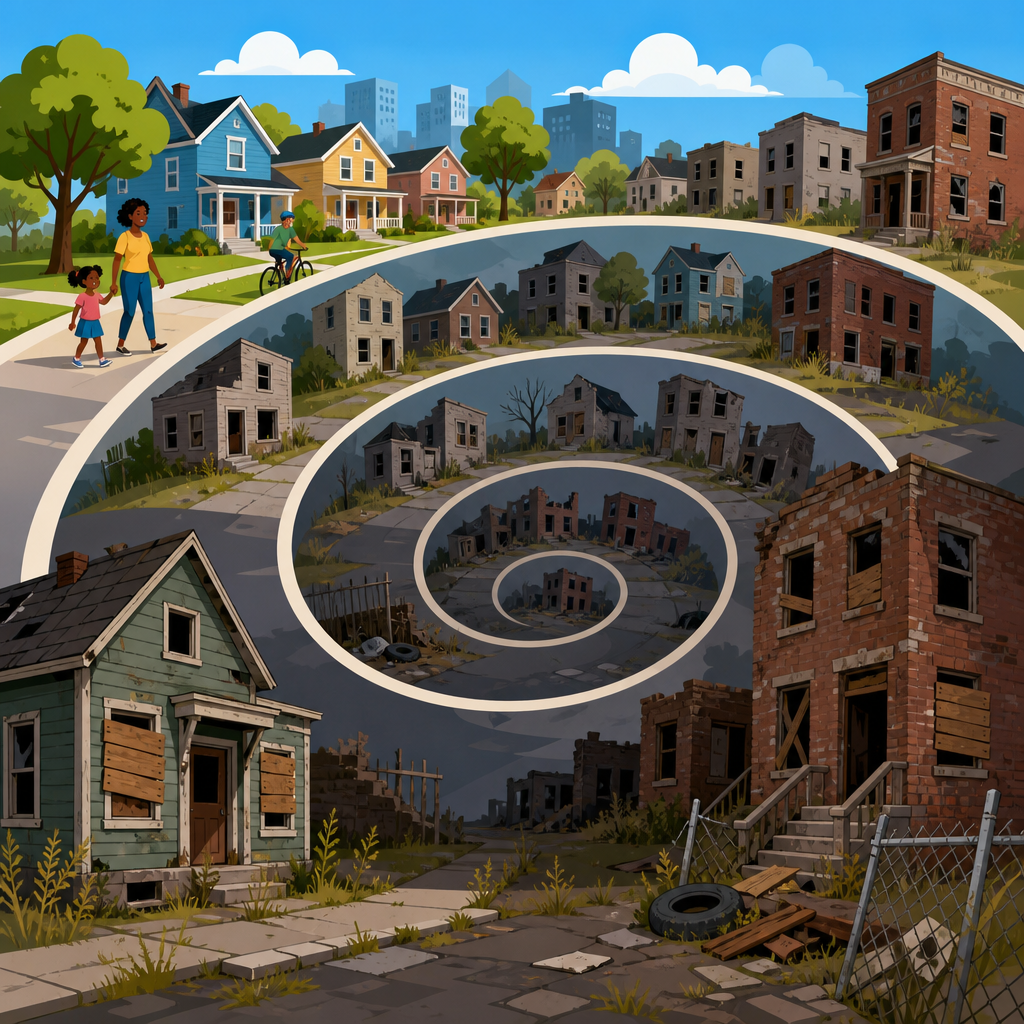
Vacancy, abandonment, and neighborhood disinvestment are tightly linked conditions that reshape housing markets, public finance, safety, and everyday quality of life in cities and older suburbs. In planning practice, vacancy usually refers to properties that are unoccupied but still potentially marketable or habitable, while abandonment implies a deeper failure of stewardship, often marked by delinquent taxes, deferred maintenance, code violations, or unclear ownership. Neighborhood disinvestment describes the broader cycle in which residents, lenders, businesses, and public agencies reduce spending and commitment in a place because they perceive rising risk and declining returns. These terms are related, but they are not interchangeable, and policy responses fail when local governments treat them as the same problem.
I have worked with parcel-level housing data, code enforcement files, and redevelopment plans, and the pattern is consistent across regions: one empty house rarely causes a neighborhood crisis, but clusters of distressed properties can trigger a visible downward spiral. A vacant duplex may attract dumping, theft of copper piping, or water intrusion after a small roof leak goes unaddressed. Nearby owners then face lower appraisals, insurance concerns, and weaker buyer interest. Retail corridors lose foot traffic. Municipal service costs rise as tax collections fall. The cumulative effect is not only physical decline but also institutional retreat, where banks tighten lending, landlords defer repairs, and families who can move often do.
This topic matters because the consequences reach far beyond real estate. Vacancy affects fire risk, public health, school enrollment, transit performance, and local government budgets. Research from legacy cities such as Cleveland, Detroit, Baltimore, and St. Louis has shown that concentrations of vacant and abandoned properties are associated with elevated crime opportunity, lower neighboring property values, and more expensive infrastructure maintenance per resident. At the same time, not every empty building signals collapse. Some neighborhoods have seasonal vacancy, redevelopment-related vacancy, or short-term turnover that looks troubling in a raw count but reflects an active market. Effective urban planning begins with distinguishing normal churn from structurally weak demand.
As a hub within urban planning and policy, this article explains how vacancy starts, why abandonment persists, how disinvestment spreads, and which interventions actually stabilize neighborhoods. It also frames the key questions people ask first: What causes widespread vacant housing? How do cities measure it? Why do some blocks recover while others keep declining? What tools are available to local governments, community development corporations, land banks, code agencies, and residents? The answers require looking at housing economics, demographic change, property law, fiscal systems, and the practical realities of implementation on the ground.
How vacancy begins and when it becomes abandonment
Vacancy begins through many pathways, and the distinction matters because each pathway suggests a different remedy. A home may become vacant after a death, divorce, foreclosure, job loss, landlord insolvency, storm damage, title dispute, or speculative purchase. In stronger markets, these events often lead to quick resale or rehabilitation. In weaker markets, especially where sale prices are below repair costs, the same events can strand a property for years. That is the threshold where ordinary vacancy starts moving toward abandonment: the owner lacks capacity or incentive to act, and the market does not supply a replacement investor quickly enough.
Urban planners often describe this through the gap between after-repair value and total development cost. If it costs $180,000 to acquire and rehabilitate a small house, but the market supports a sale price of only $110,000, private capital will usually not close the gap without subsidy. That is why abandonment is common in places with weak demand, aging housing stock, and shrinking populations. It is not simply a matter of neglectful owners. The economics can be structurally upside down. I have seen blocks where roofs, porches, and masonry all needed work at the same time, and even responsible owners could not finance repairs because appraisals came in too low.
Administrative systems can worsen the slide. Lengthy probate, opaque ownership records, tax sale procedures that do not produce rehabilitation, and fragmented code enforcement all allow distressed properties to sit unresolved. Utilities may be shut off, but mowing and boarding still become public responsibilities. If a property enters repeated cycles of citation, tax delinquency, sheriff sale, and speculative transfer, it can remain legally owned yet functionally abandoned for years. That legal limbo is one of the clearest signs that vacancy has become a governance problem, not just an individual property problem.
Why abandonment spreads into neighborhood disinvestment
Abandonment becomes neighborhood disinvestment when distressed properties begin altering expectations for the whole area. Households make decisions based on visible cues and perceived trajectory. A boarded structure, chronic dumping site, or collapsing porch communicates risk. Appraisers use comparable sales that reflect distressed conditions. Insurers price hazards. Lenders look at loan performance and collateral quality. Small businesses track customer traffic and storefront occupancy. Once enough actors expect decline, they reduce investment even in properties that are still viable. This is the spiral: declining confidence reduces spending, and reduced spending deepens decline.
The process is cumulative because housing markets are spatial. One problem parcel can impose costs on adjacent parcels through nuisance activity, moisture spread in attached buildings, pest infestation, and stigma. Several studies in older industrial cities have found measurable price effects on nearby homes, especially when vacancy is persistent rather than brief. Municipalities are affected as well. They spend more on fire response, demolition, lot maintenance, and inspections while collecting less in property taxes. In extreme cases, service levels fall, reinforcing the narrative that the neighborhood is being left behind.
Disinvestment also has a social dimension. Residents who remain often carry a heavier burden of informal maintenance and surveillance. They call in dumping, cut grass on side lots, secure fences, watch for trespassing, and organize cleanup days. That effort is valuable, but it can become exhausting when public systems do not respond quickly. Over time, civic fatigue sets in. Families may decide not to improve their own homes because they no longer trust the block’s future. That loss of confidence is one of the hardest conditions to reverse, and it explains why visible early intervention matters.
How cities measure vacancy, distress, and market weakness
Good policy starts with accurate diagnosis. Cities should not rely on a single vacancy number from the decennial census or a windshield survey alone. In practice, the strongest analyses combine postal data, utility shutoffs, tax delinquency status, code violations, fire incidents, demolition records, foreclosure filings, assessor values, sales data, and field observation. The U.S. Postal Service vacancy indicator can reveal persistent non-delivery, but it does not tell whether a building is salvageable. Utility inactivity can signal non-occupancy, yet seasonal properties or recent rehabs may distort the picture. Parcel-level integration is essential.
I usually advise planners to classify properties by condition and market context, not merely occupied versus vacant. A secure house vacant for three months in a hot market is different from a fire-damaged rowhouse with five years of delinquent taxes on a block where half the structures are empty. Triage works best when cities establish categories such as stable vacancy, distressed vacancy, likely abandonment, public nuisance, and redevelopment opportunity. That lets staff sequence tools rationally instead of treating all empty buildings as demolition candidates.
| Indicator | What it reveals | Main limitation |
|---|---|---|
| Postal vacancy data | Persistent non-occupancy at address level | Does not show physical condition |
| Utility shutoff records | Likely inactivity or uninhabitable status | Can miss informal occupancy |
| Tax delinquency | Owner distress and elevated intervention risk | Some owners recover before enforcement |
| Code violations | Maintenance failure and nuisance patterns | Complaint-driven systems undercount issues |
| Field surveys | Actual visible condition and block context | Labor intensive and quickly outdated |
Market weakness also needs to be mapped. Analysts should compare sale prices, rent levels, rehabilitation costs, foreclosure rates, and population trends across neighborhoods. Tools such as GIS, assessor databases, and property condition surveys help reveal where private investment can lead, where subsidy can unlock viable rehabilitation, and where long-term land assembly or greening may be more realistic. This is where a hub approach is useful: the best vacancy strategy links housing, code enforcement, land banking, public safety, public health, and capital planning instead of leaving each department to act alone.
Policy tools that stabilize neighborhoods
No single tool solves vacancy and abandonment. Effective strategies match intervention to market conditions, property condition, and ownership status. In relatively stable neighborhoods, early code enforcement, emergency repair grants, foreclosure prevention counseling, and small landlord support can stop vacancy before it spreads. In transitional markets, acquisition-rehabilitation programs, gap financing, and targeted infill housing can restore confidence. In severely distressed areas, land banks, strategic demolition, side-lot programs, green reuse, and infrastructure right-sizing may be necessary. The key is sequencing: prevent avoidable vacancy first, recover salvageable structures second, and remove hazards when rehabilitation is not feasible.
Land banks are especially important where title problems and tax delinquency clog the pipeline. When designed well, a land bank can acquire troubled parcels, clear liens when allowed by state law, assemble contiguous sites, and transfer property to responsible owners under performance requirements. The strongest land banks use transparent disposition policies and neighborhood plans rather than selling to the highest bidder with no redevelopment standard. The Center for Community Progress has documented how this approach helps cities convert legal chaos into manageable inventory.
Code enforcement works best when it is predictable, data-driven, and connected to assistance. Purely punitive systems often fail because owners with no resources cannot comply, while absentee owners treat fines as a cost of doing business. Better practice combines escalating enforcement with receivership, emergency stabilization, repair loans, and clear timelines. Some jurisdictions use vacant property registration to identify responsible parties and recover public costs. Others appoint housing receivers who can rehabilitate dangerous buildings when owners do not act. These tools are technical, but they matter because the core challenge is often not discovering distress; it is creating a lawful path from distress to productive reuse.
Community development corporations, tenant groups, and block associations are also essential. They know which properties create chronic problems, which owners might cooperate, and which vacant lots could become side yards, gardens, or future housing sites. In my experience, plans succeed when residents see visible wins within a year: cleaned lots, boarded structures secured properly, nuisance houses transferred, and a few strategic rehabs completed. Small, credible improvements can reset expectations and attract private follow-on investment faster than a glossy master plan with no implementation capacity.
Tradeoffs, equity, and what long-term recovery requires
There are real tradeoffs in every vacancy strategy. Demolition can remove immediate danger, but it also erases historic fabric, embodied carbon, and potential affordable housing if used indiscriminately. Rehabilitation preserves structures and streetscapes, yet it can cost far more than new construction and may still require ongoing subsidy. Greening vacant land can reduce blight and stormwater runoff, but open space is not a substitute for a functioning housing market. The right choice depends on block-level conditions, not ideology. Planners need clear criteria and must explain them publicly.
Equity should guide those decisions. Neighborhoods facing the heaviest abandonment burdens are often places shaped by redlining, contract selling, exclusionary zoning, highway construction, urban renewal displacement, and unequal infrastructure investment. Disinvestment is rarely an accident. It reflects decades of public and private decisions that sorted risk and opportunity unevenly. Because of that history, cities should be careful not to frame current residents as passive victims or current conditions as self-generated failure. Stabilization policy is strongest when it repairs systems as well as structures: fair appraisal practices, accessible credit, reliable municipal services, lead hazard control, and transparent development processes.
Long-term recovery requires patience and institutional discipline. Cities need parcel data that stays current, capital budgets aligned with neighborhood priorities, and cross-agency leadership that survives election cycles. They also need realistic goals. Some places will rebound through market growth; others will stabilize at lower density with improved safety and land management rather than immediate rebuilding. Success is not always rapid appreciation. Often it is fewer fires, safer housing, stronger tax collection, cleaner blocks, and residents who believe staying is a rational choice.
The central lesson is straightforward: vacancy, abandonment, and neighborhood disinvestment are not isolated property issues but linked urban systems problems. They begin with weak market signals and personal crises, deepen through legal and fiscal dysfunction, and spread when visible disorder changes expectations. Cities that respond early, classify distress accurately, and match tools to conditions can interrupt the spiral. Cities that rely on one-off demolitions, complaint-driven enforcement, or short-term grant cycles usually cannot. If you are building an urban planning and policy strategy, start with a parcel-level diagnosis, connect housing tools to neighborhood priorities, and focus on visible, accountable action that residents can trust.
Frequently Asked Questions
What is the difference between vacancy, abandonment, and neighborhood disinvestment?
These terms are closely related, but they do not mean the same thing. Vacancy generally describes a property that is unoccupied at a given moment. A vacant home, apartment, or commercial building may still be structurally sound, legally owned, and capable of being sold, rented, or reused. In some cases, vacancy is temporary and relatively normal within a housing market, such as when a unit turns over between tenants or a property is being renovated before sale. The key point is that vacancy alone does not automatically signal deep distress.
Abandonment is more severe. It usually refers to a breakdown in responsibility and stewardship over a property. Signs of abandonment often include delinquent property taxes, prolonged utility shutoffs, unresolved code violations, unrepaired damage, overgrown lots, broken windows, water intrusion, or unclear ownership due to probate issues, foreclosure complications, or absentee control. In practice, abandoned properties are often harder to return to productive use because the barriers are not just physical, but also legal, financial, and administrative.
Neighborhood disinvestment is the broader process that emerges when these property-level problems spread and begin to affect an area’s market confidence, public image, and day-to-day livability. As more properties sit vacant or abandoned, private investment slows, property values weaken, municipal service costs rise, and residents may begin to leave if they perceive fewer opportunities or declining safety. In that sense, vacancy can be an early warning sign, abandonment can be a deeper stage of deterioration, and neighborhood disinvestment is the wider pattern of economic and social withdrawal that can follow.
Why do vacant and abandoned properties create a cycle of neighborhood decline?
Vacant and abandoned properties often trigger a self-reinforcing spiral because they affect both market behavior and public conditions at the same time. When a property is left unoccupied for too long, routine maintenance tends to lapse. Small problems such as roof leaks, broken doors, standing water, or pest intrusion can quickly become major structural issues. As visible distress spreads, neighbors, buyers, lenders, insurers, and businesses may begin to view the area as riskier, less stable, and less desirable.
That shift in perception matters. Buyers may be unwilling to pay as much for nearby homes, appraisers may record weaker comparable sales, and lenders may become more cautious about financing rehabilitation or new development in the area. Property owners who do want to reinvest may find that the expected return no longer justifies the cost. This leads to fewer renovations, slower sales, and reduced confidence, which further weakens the local market.
At the same time, local governments can face rising costs and falling revenue. Distressed properties often generate less tax revenue, especially when assessments decline or taxes go unpaid. Yet these same properties may require more code enforcement, inspections, mowing, boarding, trash removal, fire response, legal action, or even demolition. That mismatch strains public budgets. Residents then experience the decline not as an abstract economic trend, but through everyday realities such as blight, safety concerns, poorer service conditions, and fewer neighborhood amenities. Over time, these factors interact and deepen one another, making recovery more difficult unless coordinated intervention interrupts the cycle.
How do vacancy and abandonment affect housing markets, public finance, and community safety?
The effects are wide-ranging because distressed properties influence far more than the building they occupy. In housing markets, persistent vacancy and abandonment can suppress nearby property values, lengthen marketing times, and discourage investment from owner-occupants, landlords, and small developers. Appraisals may come in lower when surrounding conditions signal instability, and that can make it harder for qualified buyers to secure financing for purchase or rehabilitation. Even when demand exists, the cost of repairing a neglected structure may exceed what the market will support, creating a stubborn gap between redevelopment costs and resale or rental value.
For public finance, the consequences can be serious. Municipalities depend heavily on a stable tax base to fund core services, and vacant or abandoned properties often contribute less than occupied, maintained properties. Delinquent taxes reduce collections, while lower values can reduce assessments over time. Meanwhile, local governments may need to spend more on enforcement, public works, nuisance abatement, emergency stabilization, environmental remediation, legal processing, or demolition. In older suburbs and legacy cities where fiscal capacity is already constrained, a concentration of distressed properties can create long-term budget pressure.
Community safety is also affected, both directly and indirectly. Poorly secured structures can attract trespassing, illegal dumping, arson, theft of materials, and other forms of disorder. But the issue is not only crime in a narrow sense. Residents may feel less safe walking on blocks with dark, deteriorated, or visibly unmanaged properties. Children may have fewer usable outdoor spaces, and older adults may experience greater isolation if nearby properties make the street feel less active or watched. The loss of routine occupancy reduces “eyes on the street,” which can weaken informal social control. The result is a decline in perceived and actual safety that can further accelerate population loss and disinvestment.
What causes properties to become abandoned in the first place?
Abandonment usually does not happen for just one reason. It is typically the result of several stresses building over time at the property, household, market, and policy levels. At the property level, deferred maintenance can accumulate until repair costs become unmanageable. A leaking roof, outdated mechanical systems, foundation issues, fire damage, or water damage may push rehabilitation costs beyond what an owner can afford. If the local market is weak, the owner may conclude that repairing the building makes little economic sense.
Ownership complications are another major factor. Properties can become tangled in probate after an owner dies without a clear estate process. Heirs may disagree, may live out of state, or may not have the resources to maintain or transfer title. Foreclosure can also leave properties in limbo, especially when legal proceedings drag on or when lenders decide a distressed asset is not worth aggressively reclaiming. In some cases, absentee landlords stop investing after repeated losses, nonpayment, or deteriorating market conditions.
Broader structural factors matter as well. Population loss, job decline, deindustrialization, discriminatory lending histories, suburbanization, infrastructure disrepair, and uneven public investment can all weaken neighborhood demand and leave some areas more vulnerable to abandonment. In hot markets, vacancy may be temporary and speculative; in weak markets, even modest distress can tip a property into long-term abandonment because there is no easy path back to occupancy. That is why abandonment is best understood not simply as a personal failure by an owner, but as an outcome shaped by household finances, institutional processes, and larger economic geography.
What strategies can cities and communities use to stop the spiral of disinvestment?
Effective response usually requires more than cleaning up a few troubled properties. Because vacancy, abandonment, and disinvestment reinforce one another, successful strategies tend to combine early intervention, legal tools, targeted public investment, and market-sensitive redevelopment. One of the most important steps is identifying distress early. Timely code enforcement, proactive inspection, utility shutoff monitoring, tax delinquency tracking, and property condition surveys can help local governments and community organizations detect properties before they deteriorate beyond recovery.
Clear ownership resolution is also essential. Land banks, receivership tools, tax foreclosure reform, quiet title action, and probate assistance can help move stalled properties back into responsible hands. In some places, small grants or low-interest loans for emergency repairs can prevent an occupied property from slipping into vacancy. In others, rehabilitation subsidies, gap financing, or partnerships with nonprofit developers are necessary because private market returns alone will not support reuse. The right approach depends on local demand, construction costs, and neighborhood conditions.
Just as important is the need to pair property-level action with neighborhood-level investment. Stabilizing a block often involves better lighting, lot maintenance, infrastructure repair, public space improvements, resident engagement, and support for existing homeowners and tenants. Anti-displacement measures may also be needed in areas where reinvestment is returning, so that long-time residents can benefit from improvement rather than be pushed out by rising costs. In very weak markets, selective demolition and lot reuse may be appropriate where rehabilitation is not feasible, but even then, the goal should be strategic stabilization rather than unmanaged loss. The most durable results come from coordinated action that treats vacancy and abandonment not as isolated nuisances, but as symptoms of broader market and governance challenges that must be addressed together.


