
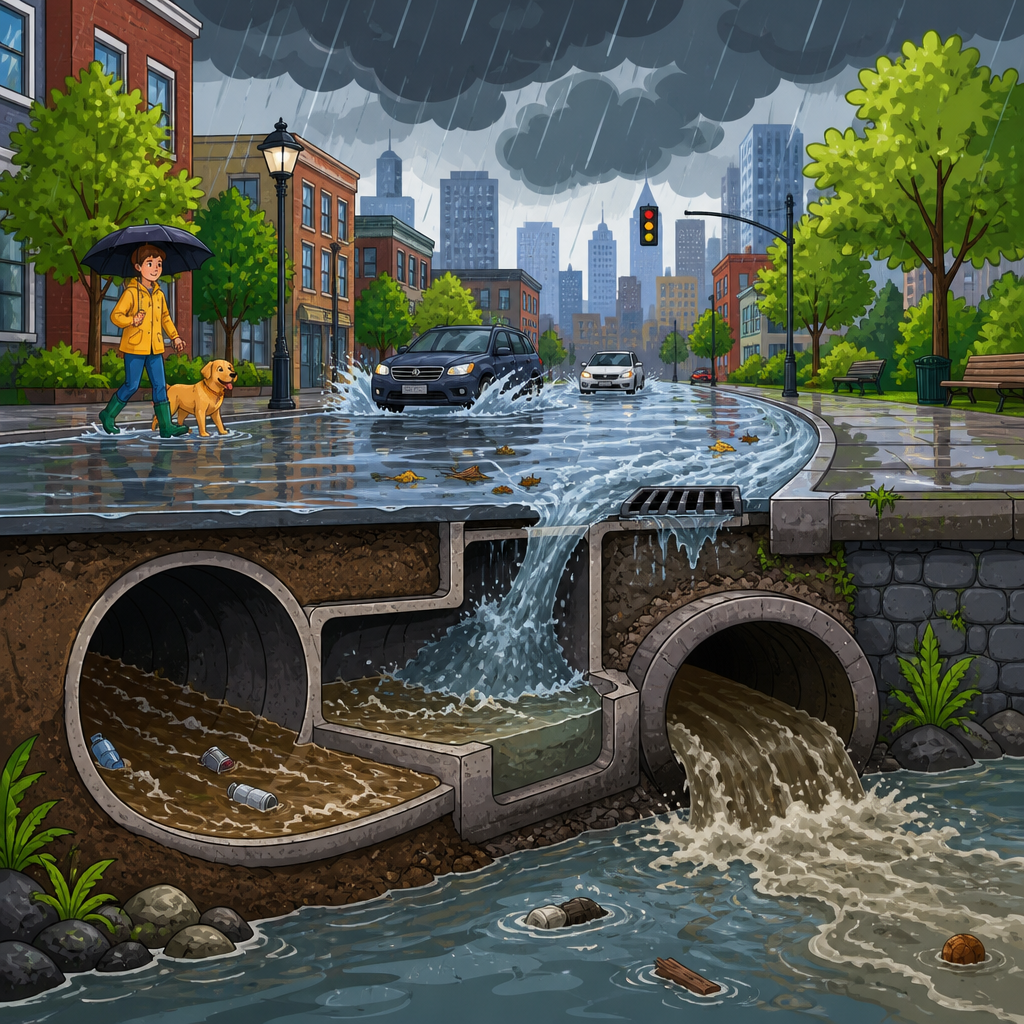
Extreme rain exposes one of the least visible but most consequential weaknesses in older cities: combined sewer systems that carry stormwater and wastewater in the same pipes. During dry weather, these networks can function adequately, moving sewage from homes, businesses, and streets to treatment plants. During intense downpours, however, the same infrastructure can be overwhelmed within minutes, forcing untreated mixtures of storm runoff and sewage into rivers, basements, streets, and sometimes homes. For urban planners, public works departments, utilities, and residents, the problem is not abstract. It affects public health, water quality, transportation reliability, housing, insurance costs, and local budgets.
A combined sewer system, or CSS, is a legacy drainage design common in nineteenth- and early twentieth-century cities. Engineers originally favored it because a single pipe network was cheaper to build and easier to install beneath dense streets than separate sanitary and storm sewers. The design made sense when cities were smaller, paved surfaces were fewer, and rain patterns were more predictable. Today, many of those same cities face larger populations, aging pipes, more impervious cover, and heavier bursts of rainfall. The result is a mismatch between historical design assumptions and present-day urban conditions.
When rainfall exceeds the carrying capacity of a combined system or the treatment plant connected to it, a combined sewer overflow occurs. These overflows are controlled release points intended to prevent sewage from backing up catastrophically through the network, but they create their own serious consequences. Polluted water can discharge directly into nearby streams, lakes, or coastal waters, carrying pathogens, nutrients, trash, oils, heavy metals, and organic matter. In the worst events, the hydraulic pressure also pushes water into basements and street-level properties, creating indoor contamination and expensive cleanup.
This topic matters because extreme rain is no longer a rare planning scenario. Short-duration, high-intensity storms are stressing drainage systems in cities across North America and Europe, and combined systems are especially vulnerable. The challenge sits at the intersection of climate adaptation, infrastructure finance, environmental regulation, and neighborhood equity. Cities cannot solve it with one project or one department. They need a hub approach that connects hydrology, land use, asset management, transportation design, watershed policy, and public communication. Understanding how combined sewer systems fail under extreme rain is the first step toward choosing practical, defensible responses.
How Combined Sewer Systems Fail During Extreme Rain
The hydraulic problem is straightforward: rain falls faster than the system can store, convey, or treat it. In a combined system, runoff from roofs, roads, parking lots, and other hard surfaces enters the same pipes that already contain sanitary flow. As intensity rises, pipe capacity is consumed rapidly. Once the flow exceeds what downstream interceptors or treatment plants can accept, regulators divert excess water through overflow structures. I have seen this dynamic in older downtown catchments where a ten-minute cloudburst produces surcharging manholes before the storm has fully moved through the district.
Several factors make extreme rain especially disruptive. Impervious cover converts rainfall into runoff almost immediately, reducing infiltration and shortening the time of concentration. Sediment, grease, roots, and structural defects reduce pipe efficiency even before storms arrive. Tidal backwater, high river stages, or pump station failures can further limit discharge capacity at precisely the wrong moment. Treatment plants also have finite peak wet-weather throughput; even where pipes can move the water, the plant may not be able to process it. The entire system is therefore constrained by its weakest link, not by average dry-weather performance.
Design standards highlight why the problem persists. Many legacy combined systems were built around storms far smaller than those now appearing in updated Intensity-Duration-Frequency curves published by agencies such as NOAA. What once counted as an unusual event may now occur much more often. The difference between a system sized for historical rainfall and one stressed by current extremes is not incremental. A modest increase in rainfall intensity can create a much larger increase in peak runoff because the urban surface sheds water so efficiently. That nonlinearity is why nuisance flooding can suddenly become a public health emergency.
Public Health, Environmental, and Economic Consequences
Combined sewer overflows create immediate health risks. Untreated sewage can contain E. coli, enterococci, norovirus, Giardia, and other pathogens associated with gastrointestinal illness and skin infections. When floodwater enters homes, the hazard becomes personal and expensive. Porous materials often require removal, mechanical systems may need replacement, and mold can follow within days. Residents without savings or adequate insurance face the greatest hardship. In lower-income neighborhoods, repeated wet-basement events can depress property values and erode trust in local government.
Environmental impacts extend well beyond the outfall. CSO discharges increase biochemical oxygen demand, introduce ammonia and nutrients, and transport floatables and sediment-bound contaminants into receiving waters. Streams that already suffer from urban flashiness are then hit with both hydraulic shock and pollutant loads. Fish kills, beach closures, shellfish bed contamination, and algae-promoting nutrient pulses are documented outcomes in many regions. Under the U.S. Clean Water Act, municipalities with combined systems are often subject to permits and long-term control plans because these discharges violate water quality objectives if left unmanaged.
The economic burden is broader than sewer utility budgets. Road closures disrupt commerce. Transit can be delayed when underpasses flood. Emergency response costs rise as fire departments and public works crews deploy pumps, barricades, and cleanup teams. Treatment plants incur higher operating costs from peak pumping and solids handling. Employers lose productive hours when workers cannot travel or must deal with flooded homes. A city may postpone needed investments because sewer upgrades compete with schools, housing, and public safety, but delay usually increases life-cycle cost. Deferred rehabilitation in a combined system is rarely neutral; it compounds risk.
Why Urban Form and Policy Make the Problem Harder
Extreme rain becomes a sewer crisis partly because cities are shaped to move water quickly. Dense street grids, curb-and-gutter systems, rooftop drainage, and expansive pavement all accelerate runoff into inlets. Urban redevelopment can intensify this effect when former industrial lots are converted into high-coverage mixed-use blocks without proportional drainage upgrades. Even well-intentioned infill can increase burden on a downstream combined network if site plans focus on building yield more than watershed performance. Zoning, street standards, parking ratios, and tree canopy policy all influence how much stormwater reaches combined pipes.
Institutional fragmentation is another obstacle. In many cities, the sewer utility manages pipes, transportation departments control curbs and streets, parks departments own green space, and planning departments review development. Each agency affects runoff, yet no single office controls all the levers. I have worked on projects where utility engineers wanted detention, planners wanted density, and transportation staff prioritized lane geometry, all within the same corridor. Without a shared watershed framework, each decision can be rational in isolation but harmful in combination.
Policy timelines also conflict with infrastructure realities. Elected officials often need visible results within budget cycles, while sewer separation, storage tunnels, and treatment plant expansion take years of design, permitting, and construction. Rate increases needed to fund capital work can be politically difficult, especially where customers already struggle with affordability. Federal and state regulators may require measurable overflow reduction, but local leaders must balance compliance with housing supply, economic development, and neighborhood disruption. Effective policy therefore depends on sequencing, transparency, and a realistic understanding of tradeoffs.
Response Options Cities Use to Reduce Combined Sewer Impacts
No single intervention solves extreme-rain stress on combined sewer systems. The most effective programs combine gray infrastructure, green infrastructure, operational controls, and land-use policy. Gray infrastructure includes larger interceptors, storage tunnels, offline tanks, upgraded pump stations, and treatment plant expansion. These measures provide reliable hydraulic capacity, but they are expensive, disruptive to build, and often slow to deliver. Green infrastructure reduces inflow before it reaches the pipe network through bioswales, permeable pavement, green roofs, rain gardens, urban tree trenches, and detention features integrated into streetscapes and public land.
Operational strategies can deliver meaningful gains without waiting for major construction. Real-time control systems use sensors, gates, and forecasting to optimize available storage across the network, moving flow strategically before bottlenecks form. Utilities increasingly pair SCADA platforms with rainfall radar and predictive models to make short-horizon decisions during storms. Asset management is equally important. Cleaning critical lines, repairing defects, disconnecting improper roof leaders, and maintaining outfalls can restore lost capacity at relatively low cost. These are not glamorous projects, but in practice they often produce some of the fastest risk reduction.
| Strategy | Primary benefit | Typical limitation |
|---|---|---|
| Sewer separation | Removes stormwater from sanitary flow path | Very high capital cost and street disruption |
| Storage tunnels or tanks | Captures peak wet-weather volume for later treatment | Land, tunneling, and maintenance costs |
| Green infrastructure | Reduces runoff and adds urban design benefits | Performance varies by soil, maintenance, and storm size |
| Real-time control | Improves use of existing system capacity | Requires instrumentation, modeling, and operator training |
| Development standards | Prevents new runoff burden from redevelopment | Needs consistent enforcement and market acceptance |
The strongest city programs use portfolios rather than single bets. Philadelphia’s Green City, Clean Waters plan is widely cited for scaling distributed green stormwater tools, while cities such as Chicago, Cleveland, and Washington, D.C., have also invested in deep tunnels, storage, and treatment improvements. The lesson from these examples is not that one model fits all. It is that successful implementation matches local geology, density, regulatory deadlines, available funding, and watershed behavior. A dense downtown with little open space may need storage and control first, while a redeveloping district can lock in runoff reductions through site design standards.
Planning a Practical Long-Term Strategy
A credible long-term strategy starts with measurement. Cities need a current map of overflow locations, basement backup hotspots, pipe condition, impervious cover, critical facilities, and social vulnerability. Hydrologic and hydraulic models such as EPA SWMM help test storm scenarios, but models must be calibrated with field data from rain gauges, level sensors, and plant operations. Good planning also distinguishes between nuisance flooding, structural flooding, and water quality exceedance because each problem may require a different intervention. Treating every wet-weather issue as a sewer capacity problem can lead to overspending or the wrong project mix.
Capital planning should align projects with risk, not just with asset age. Hospitals, transit hubs, schools, and low-lying residential blocks deserve priority because failure there causes cascading harm. Cities should also evaluate co-benefits. A redesigned street that adds bioretention, shade trees, traffic calming, and sidewalk improvements can deliver more public value than a buried pipe upgrade alone, even if the pipe remains necessary. Funding packages often work best when they combine utility rates, state revolving funds, federal grants, resilience programs, and redevelopment contributions. Clear performance metrics, such as overflow volume reduced or backups prevented, keep programs accountable.
Public communication is the final, often underestimated, part of strategy. Residents need to know what causes overflows, what the city is doing, and what property owners can do themselves, from sump pump practices to downspout disconnection where appropriate. Businesses and developers need predictable rules so stormwater requirements can be priced into projects early. When agencies explain timelines honestly and publish progress, they build support for difficult investments. Extreme rain will continue to test combined sewer systems, but cities that integrate engineering, planning, policy, and maintenance can reduce overflows, protect health, and make neighborhoods more resilient. Use this hub as your starting point for smarter urban planning and policy decisions.
Frequently Asked Questions
What is a combined sewer system, and why does extreme rain create such serious problems for it?
A combined sewer system is an older type of underground infrastructure designed to carry both wastewater and stormwater through the same network of pipes. In normal conditions, that means sewage from homes and businesses travels alongside rainwater flowing off roofs, streets, sidewalks, and parking lots to a treatment plant. The system was often considered efficient when it was built, especially in dense urban areas where space and construction budgets were limited. The trouble is that these pipes and treatment facilities were typically designed for historical rainfall patterns, smaller populations, and less paved surface than many cities have today.
During extreme rain, runoff enters the system far faster than it can be transported or treated. Because so much urban land is covered by concrete and asphalt, water cannot soak into the ground easily, so it rushes into drains almost immediately. That sudden surge can push the combined system past capacity within minutes. When that happens, pressure builds in the pipes, water backs up, and cities may experience street flooding, basement flooding, and combined sewer overflows, where untreated wastewater mixed with storm runoff is discharged directly into rivers, streams, or coastal waters. What makes the problem especially serious is that the impacts are not limited to inconvenience. These events can affect public health, damage property, disrupt transportation, strain emergency services, and pollute waterways in a single storm.
What happens when a combined sewer system is overwhelmed during a major downpour?
When a combined sewer system is overwhelmed, the sequence is both fast and disruptive. First, intense rainfall enters catch basins and storm drains, quickly filling pipes that are already carrying regular wastewater from toilets, sinks, showers, restaurants, hospitals, and industrial buildings. As volumes rise, treatment plants may no longer be able to accept or process all incoming flow. To prevent catastrophic backups at the plant or failures in the pipe network, many combined systems include overflow points that release excess flow into nearby waterways. These are known as combined sewer overflows, or CSOs.
At the same time, neighborhoods can feel the effects at street level and below ground. Manholes may surcharge, intersections can flood, and water can back up into basements through floor drains, toilets, and lateral connections. In some cases, standing water in streets is not just rainwater. It can contain sewage, oil, trash, road salt, bacteria, chemicals, and other contaminants washed off urban surfaces. That creates health risks for residents, cleanup crews, and anyone who comes into contact with the floodwater. There are also indirect consequences: roads may be closed, transit systems delayed, power and utility access disrupted, and businesses forced to shut down temporarily. In short, an overwhelmed combined sewer system turns a rainfall event into a multi-system urban emergency.
Why are older cities especially vulnerable to combined sewer overflows and sewer backups?
Older cities are especially vulnerable because many of them still rely on infrastructure built generations ago, often in the late 19th or early 20th centuries. Combined sewer systems were common at that time because they matched the engineering standards, development patterns, and public health priorities of the era. But urban conditions have changed dramatically since then. Populations have grown, buildings have expanded, and more land has been paved over, which means rainfall now produces more rapid runoff than these systems were originally expected to handle.
Age also affects performance. Pipes can crack, settle, corrode, clog, or lose capacity over time. Connections that were added incrementally over decades can create bottlenecks, and deferred maintenance can make weak points worse. In many cities, treatment plants and pumping facilities have been upgraded, but the buried network feeding them remains undersized relative to modern storm intensity. Climate change adds another layer of vulnerability by increasing the frequency of short-duration, high-intensity rainfall in many regions. So the issue is not just that the infrastructure is old; it is that the infrastructure is old in cities that are denser, more impervious, and now facing storms that may be more extreme than the system was ever designed to manage.
What are the public health and environmental risks when sewage mixes with stormwater in urban flooding?
The risks are significant because combined sewer overflows and backups expose people and ecosystems to untreated or partially treated waste. Floodwater affected by a combined sewer system can contain bacteria, viruses, parasites, and other pathogens from human waste. It may also carry fertilizers, heavy metals, motor oil, cleaning chemicals, and debris picked up from streets and industrial areas. If that water enters homes, schools, parks, or businesses, it can create immediate exposure hazards through skin contact, accidental ingestion, or contaminated indoor surfaces. Mold growth and lingering moisture after a backup can also cause longer-term indoor air and respiratory problems.
Environmental damage can be just as serious. When overflow discharges reach rivers, lakes, or coastal waters, they reduce water quality, lower oxygen levels, and introduce nutrients and contaminants that harm fish, aquatic plants, and other wildlife. Beaches may need to close, shellfish beds can become unsafe, and recreational waterways may pose illness risks for swimmers and boaters. Even smaller, repeated overflow events matter because they create cumulative pollution loads over time. This is why combined sewer problems are not only an infrastructure issue but also a public health, ecological, and quality-of-life issue. The effects can ripple well beyond the storm itself and well beyond the neighborhood where the flooding first appears.
How can cities reduce the impact of extreme rain on combined sewer systems?
Cities usually need a layered strategy, because there is rarely a single fix for combined sewer challenges. One major approach is gray infrastructure expansion: building larger storage tunnels, underground tanks, higher-capacity interceptors, upgraded pump stations, and treatment plant improvements so the system can temporarily hold or process more water during storms. In some places, sewer separation is also pursued, which means constructing separate pipes for wastewater and stormwater. That can be highly effective, but it is expensive, disruptive, and often takes decades to complete in built-out urban neighborhoods.
Equally important is green infrastructure, which aims to keep stormwater out of the combined system in the first place. Examples include rain gardens, bioswales, permeable pavement, green roofs, tree trenches, detention basins, and restored open space that helps water soak into the ground or be stored temporarily. These features reduce runoff volume, slow peak flows, and can improve neighborhood livability at the same time. Cities also benefit from better real-time monitoring, predictive weather tools, targeted maintenance, backflow prevention requirements, and stricter land-use and drainage standards for new development. For residents and property owners, practical measures such as sump pump maintenance, sewer backflow valves, and flood-resistant basement improvements can reduce damage during intense storms. The most effective long-term response combines engineering upgrades, watershed planning, climate adaptation, and sustained public investment rather than relying on emergency response alone.


