
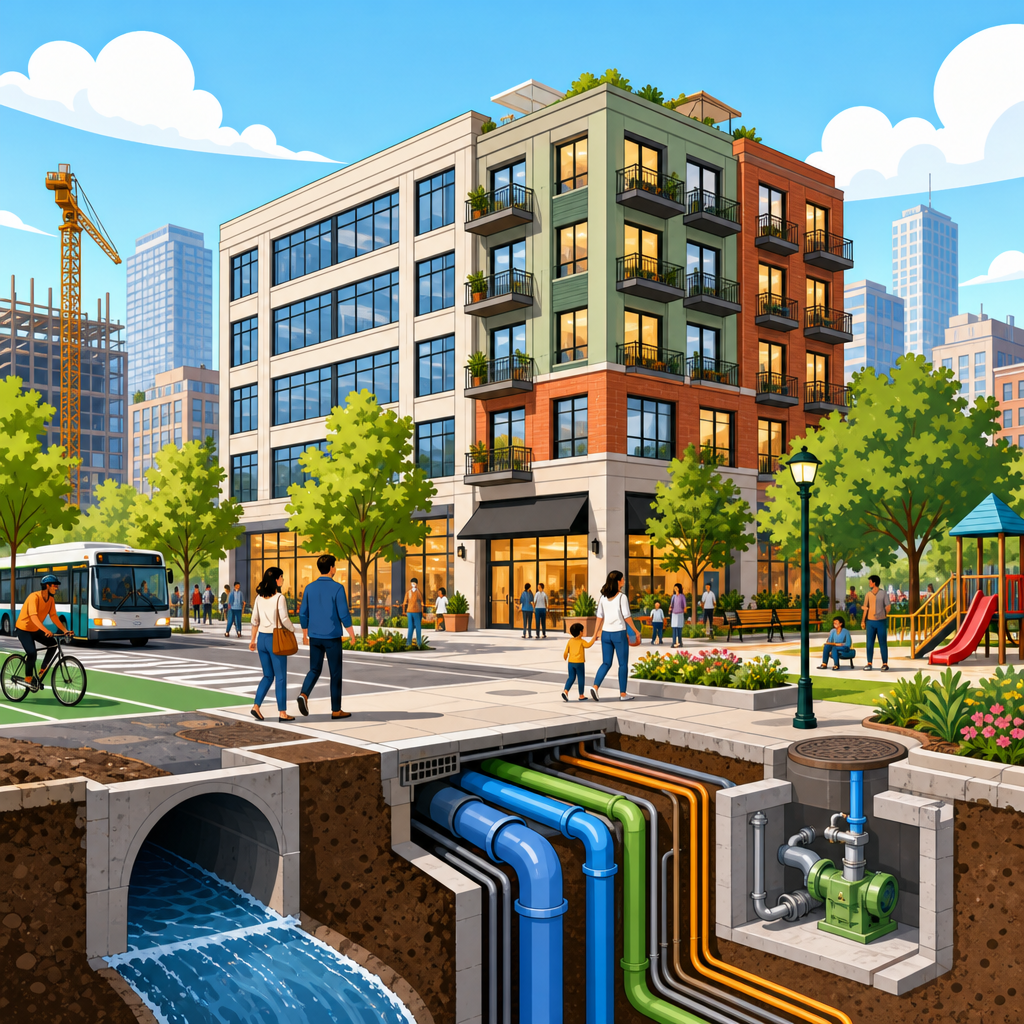
Office-to-residential conversion districts are emerging as one of the most practical responses to downtown vacancy, housing shortages, and the changing economics of central business districts. In urban planning, an office-to-residential conversion district is a defined area where policy, infrastructure, financing, and design standards are aligned to support the reuse of obsolete commercial buildings as housing. The concept sounds straightforward, but successful districts depend on far more than zoning amendments or developer interest. They require coordinated investments in water, sewer, power, transit, streets, schools, parks, digital networks, public safety, and social services. Without that backbone, conversions can stall, underperform, or create new pressure on systems designed for daytime office populations rather than full-time residents.
The infrastructure needs of office-to-residential conversion districts matter because conversions change how buildings and neighborhoods function at every hour. Office towers concentrate people during business hours, with predictable peaks in elevator use, cooling loads, restroom demand, and transit trips. Residential buildings create a different pattern: morning and evening domestic water use, overnight occupancy, parcel deliveries, school travel, waste streams, and demand for grocery stores, clinics, open space, and neighborhood amenities. I have worked on downtown reuse strategies where the building form looked adaptable on paper, yet the surrounding district lacked the utility capacity, curb management, or family-serving services needed to sustain long-term residential life. That gap between building feasibility and district readiness is where many projects succeed or fail.
Understanding these needs is increasingly important for cities pursuing downtown recovery. Hybrid work has reduced demand for older office space in many markets, especially in buildings with deep floor plates, outdated mechanical systems, and high capital needs. At the same time, many regions face severe housing undersupply, rising rents, and public pressure to make better use of existing urban land. Conversion districts can address both problems, but only when planners treat them as integrated urban systems rather than isolated real estate deals. The most effective approach combines land use policy with infrastructure planning, service delivery, and public realm upgrades, creating districts where people can live safely, comfortably, and affordably for decades.
Utility systems must be recalibrated for residential occupancy
Water, wastewater, stormwater, electricity, gas, and telecommunications are the first infrastructure layers that need careful review in any office-to-residential conversion district. A common mistake is assuming that if an office building already has utility service, it can automatically support housing. In practice, residential use changes flow patterns, fixture counts, hot water demand, metering arrangements, and code requirements. Domestic hot water systems may need complete replacement. Sewer laterals and stacks may need reconfiguration because apartment kitchens and bathrooms must be distributed differently across floor plates than office restrooms. Electrical systems often require more panel capacity per unit, life safety upgrades, and separate metering strategies. Buildings that were once centrally conditioned for daytime occupancy may need entirely new ventilation, operable windows where feasible, heat pump systems, and smoke control modifications.
District-level analysis is just as important as building retrofits. Water mains sized for offices can usually handle residential use, but pressure, fire flow, and redundancy still need verification. Sewer systems may face different peak timing, especially if a district shifts from office-dominant to mixed-use with thousands of new residents. Older combined sewer systems can become a constraint because added residential wastewater and stormwater runoff from public realm improvements may trigger regulatory concerns under consent decrees or long-term control plans. Cities should map utility age, capacity, condition, and planned capital projects before approving large clusters of conversions. Coordinated trench work, district energy planning, and utility incentives can lower cost and reduce disruption. In several downtowns, I have seen utility coordination save months of permitting by aligning building service upgrades with scheduled street reconstruction rather than requiring repetitive cuts after occupancy.
Street networks and public realm design have to shift from commuter logic to neighborhood logic
A conversion district cannot function well if its streets still behave like a nine-to-five office environment. Residential districts need safer crossings, lower travel speeds, better lighting, shade, seating, street trees, bike storage, play opportunities, and curb management that accounts for move-ins, deliveries, ride-hail, trash collection, and accessibility needs. Office districts are often dominated by one-way streets engineered for throughput, long signal cycles, and narrow pedestrian comfort zones. Those conditions are tolerable for workers passing through but less appropriate for households walking dogs, pushing strollers, or returning home after dark. The infrastructure need here is not cosmetic beautification; it is operational redesign that supports daily life.
Transit remains important, but the relevant metrics broaden. Office districts prioritize peak inbound service. Residential districts need all-day frequency, weekend reliability, and strong links to schools, supermarkets, parks, and health care. Sidewalk continuity matters more when residents make short trips at varied times rather than arriving in concentrated commute waves. Curb lanes once used for commuter parking may be better reassigned to loading zones, bus priority, protected bike lanes, or outdoor public space. Traffic engineers should use tools such as level of traffic stress analysis, pedestrian level of service, and Vision Zero design standards to evaluate whether the district can support more vulnerable users. When downtown streets are redesigned with narrower crossing distances, daylighted intersections, and universal design features, conversions become more attractive to older adults, families, and people with disabilities, widening the market beyond young professionals.
Social infrastructure determines whether conversions create a real neighborhood
Housing alone does not create a livable district. Social infrastructure includes schools, child care, libraries, clinics, recreation centers, parks, community organizations, grocery access, and spaces for civic life. This layer is often underestimated because many office conversion projects target studios and one-bedroom units first, leading some policymakers to assume there will be limited family demand. In reality, household composition changes over time, and districts that ignore social infrastructure can become transient and less resilient. Families may avoid the area, older residents may lack nearby services, and local retail may struggle if the neighborhood does not support routine daily activity. Planning for social infrastructure early also reduces political resistance, because residents and stakeholders can see how growth will be supported rather than simply imposed.
Public agencies should evaluate both existing facilities and service catchments. If the nearest elementary school is already over capacity, additional housing may require capital planning, boundary changes, or partnerships with nearby institutions. If the district lacks a full-service grocery store, planners should assess ground-floor loading needs, retail depth, lease structures, and population thresholds that could support one. Parks can be particularly challenging because downtown land is expensive and often fragmented. In those cases, cities should think in layers: pocket parks, schoolyard shared use, rooftop recreation requirements, greened setbacks, waterfront access if available, and improved walking connections to larger parks. Libraries and community hubs can also anchor conversion districts by providing services, meeting rooms, digital access, and cultural programming. The goal is to support everyday needs within a reasonable walking distance, not to replicate suburban service patterns.
Building form and code compliance shape infrastructure feasibility
Not every office building is a good residential candidate, and district policy should reflect that reality. Deep floor plates, low window-to-floor ratios, irregular structural grids, and limited shaft space can make unit layouts inefficient or code compliance expensive. Infrastructure planning must therefore be tied to building typology. Prewar office buildings with operable windows and narrower floor plates often convert more easily than 1980s towers with sealed curtain walls and large core depths. Life safety rules under the International Building Code, local fire codes, accessibility standards under the Americans with Disabilities Act, and energy performance requirements can all affect project viability. Cities that create conversion districts should publish typology studies and model retrofit pathways so developers, lenders, and utility providers can evaluate likely infrastructure needs early.
Codes themselves may need targeted reform, but reform should be precise rather than permissive for its own sake. Adaptive reuse ordinances can streamline egress rules, allow alternate compliance methods, or clarify seismic triggers while preserving safety outcomes. Existing Building Code provisions already offer tools for phased and performance-based approaches, yet many jurisdictions underuse them. The most successful districts pair code flexibility with predictable review, dedicated staff, and technical guidance. That reduces uncertainty without lowering standards. From experience, project teams move faster when planning, building, fire, utility, and public works departments review conversion proposals together instead of in sequence. The issue is rarely one single regulation; it is the cumulative friction of multiple systems that were not designed to evaluate adaptive reuse as a district strategy.
Financing and governance are infrastructure issues, not just administrative details
Conversion districts often fail because governance is fragmented and infrastructure costs are misallocated. Streets, pipes, substations, parks, and schools are long-lived public assets, yet conversion incentives are frequently designed building by building. A district approach needs capital planning, cost sharing, and implementation authority. Tax increment financing, special assessment districts, infrastructure banks, payment in lieu programs, and public utility incentives can all play a role, but each works differently depending on state law and local fiscal capacity. Cities should also evaluate whether impact fees calibrated for greenfield development make sense for adaptive reuse in established downtowns. In some cases, fee deferrals or targeted waivers are justified because reuse avoids new land consumption and leverages existing infrastructure. In other cases, waivers can create service gaps if no replacement funding is identified.
Governance matters just as much as money. Someone has to coordinate public works scheduling, utility upgrades, permitting, housing policy, streetscape maintenance, and community engagement. That role may sit with a redevelopment authority, downtown partnership, housing department, or interagency task force, but it must be explicit. Clear governance also improves accountability for affordability goals. If a city offers tax incentives for conversions, it should define what public outcomes are expected: affordable units, family-sized units, energy upgrades, historic preservation, public open space, or local retail retention. A district scorecard helps officials track whether infrastructure and policy investments are producing the intended mix of housing, services, and public benefits.
| Infrastructure category | Key district question | Typical office condition | Residential conversion need |
|---|---|---|---|
| Water and sewer | Can utilities handle different peak patterns and fixture layouts? | Concentrated daytime restroom use | Distributed kitchens, baths, and 24-hour occupancy |
| Streets and curb | Do streets support walking, loading, and slower travel? | Commuter-focused traffic flow | Neighborhood access, deliveries, safety, and accessibility |
| Social services | Can residents reach schools, parks, groceries, and clinics? | Lunch retail and office amenities | Daily living services within walking distance |
| Building systems | Can older offices meet housing, fire, and energy standards? | Large floor plates and central systems | Unit plumbing, ventilation, egress, and code upgrades |
| Governance and finance | Who pays for upgrades and coordinates delivery? | Parcel-by-parcel decision making | District capital planning and shared implementation |
Climate resilience and energy performance should be built into every district plan
Office-to-residential conversion districts are long-term urban investments, so resilience cannot be an afterthought. Many downtown office buildings were designed before current expectations around decarbonization, extreme heat, flood protection, indoor air quality, and backup power. Residential occupancy raises the stakes because people are in these buildings overnight and during emergencies. District plans should assess floodplain exposure, basement vulnerability, emergency egress, cooling resilience, and utility redundancy. In coastal cities, that may mean deployable flood barriers, raised electrical equipment, and sewer backflow prevention. In hotter inland cities, it may mean high-performance envelopes, exterior shading, tree canopy expansion, cool materials, and efficient heat pump systems that can maintain habitable conditions during heat waves.
Energy strategy is especially important because older conversions can otherwise lock in poor performance for decades. Benchmarking data from tools such as ENERGY STAR Portfolio Manager can help cities identify which buildings are likely to need major upgrades. Electrification should be evaluated alongside service capacity, demand management, and potential district energy opportunities. Battery storage, microgrids, and onsite solar may not fit every building, but they can be valuable at district scale when paired with resilience hubs or critical facilities. Water reuse, green roofs, permeable paving, and bioswales can also support stormwater compliance while improving the public realm. The key principle is that conversion districts should not merely repopulate downtowns; they should modernize them for a more climate-constrained future.
Market fit, affordability, and phased implementation determine lasting success
The final infrastructure need is strategic phasing based on realistic market absorption and housing goals. A district can have supportive zoning and strong utility capacity, yet still struggle if all conversions target the same renter profile or arrive before essential amenities. Cities should assess demand for micro units, family units, workforce housing, senior housing, and mixed-income models rather than assuming one product type fits all. Affordability is central because conversions often involve high per-unit costs, especially when major mechanical and life safety work is required. Public subsidy may be necessary, but subsidy should be tied to outcomes and coordinated with infrastructure timing so lower-income residents are not brought into under-served environments.
Phasing works best when cities identify catalyst buildings, quick-win public realm projects, and longer-term capital improvements. For example, a district might start with a cluster of historically adaptable buildings near an existing transit hub and grocery corridor, while scheduling school expansion or park acquisition for later phases as population grows. Retail strategy should also be phased; filling every storefront immediately is less important than supporting a critical mass of durable uses that match resident demand. Over time, a well-planned conversion district can stabilize tax base, reduce vacancy, and create a more balanced downtown economy that is not solely dependent on office employment.
The infrastructure needs of office-to-residential conversion districts are therefore broader and more interdependent than many early policy discussions suggest. Conversions succeed when cities treat them as neighborhood-building programs supported by utilities, streets, social services, resilient buildings, and clear governance. They struggle when policy focuses only on zoning relief or tax incentives while leaving underlying systems unchanged. The central lesson is simple: reuse at the building scale must be matched by readiness at the district scale.
For planners, elected officials, developers, and civic institutions, the benefit of getting this right is substantial. Well-supported conversion districts can absorb obsolete office space, expand housing supply, strengthen downtown retail, reduce sprawl pressure, and make better use of existing urban infrastructure. They can also create mixed-use neighborhoods that stay active beyond business hours and feel safer, healthier, and more inclusive. The work is complex, but the framework is clear: assess infrastructure honestly, coordinate agencies early, align public investment with housing goals, and phase implementation around real service capacity.
If your city is considering downtown conversions, start with a district infrastructure audit before negotiating individual deals. Map utility constraints, street design gaps, school and park access, code barriers, resilience risks, and funding tools. That baseline will reveal which buildings are truly convertible, which public investments unlock the most housing, and how to turn isolated projects into a functioning residential neighborhood.
Frequently Asked Questions
What infrastructure upgrades are usually needed to make office-to-residential conversion districts successful?
Successful office-to-residential conversion districts depend on a full range of infrastructure improvements, not just building renovations. At the district level, cities often need to reassess water, sewer, stormwater, power, broadband, waste management, street design, and public realm capacity to make sure systems built for daytime office occupancy can support full-time residential life. Office districts were typically designed around commuter peaks, large floor plates, and limited overnight use. Housing changes that pattern entirely. Residential demand is more continuous, with higher expectations for domestic water pressure, hot water systems, trash collection, package delivery, internet reliability, and neighborhood amenities.
Utility infrastructure is often the first major issue. Sewer lines may need to be resized or reconfigured to support kitchens, showers, laundry, and other household uses distributed across multiple units. Water service may require upgrades for fire suppression, pressure balancing, and metering. Electrical systems also frequently need modernization, especially when older office buildings are being converted to all-electric or mixed-energy residential use. In many districts, substations, transformers, and building connections were not designed for widespread electrification, including heat pumps, induction cooking, and electric vehicle charging.
Transportation and public realm infrastructure are equally important. A district that once emptied out after business hours must become livable in the evenings and on weekends. That means safer sidewalks, better lighting, traffic calming, bike facilities, accessible transit stops, street trees, open space, and improved pedestrian connections to schools, grocery stores, healthcare, and parks. Social infrastructure matters too. Residents need access to childcare, community services, recreation, and daily retail. In short, the most successful conversion districts treat infrastructure as a neighborhood system, not just a building-by-building checklist.
Why are utility systems such a major concern in office-to-residential conversions?
Utility systems are central because office buildings and apartment buildings place very different demands on physical infrastructure. An office tower may have concentrated restroom use, large mechanical systems, and predictable weekday occupancy patterns. A residential building, by contrast, has distributed plumbing needs across many units, around-the-clock water use, higher expectations for thermal comfort, individual kitchens, laundry, and more constant electrical demand. That mismatch can create major technical and financial challenges if utility systems are not carefully evaluated at both the building and district scale.
Plumbing is a common constraint. Deep floor plates in older office buildings can make it difficult to bring natural light and ventilation into units while also creating efficient layouts for kitchens and bathrooms. New vertical plumbing stacks may need to be added, which can affect structural systems, rentable area, and construction sequencing. Sewer and stormwater connections may also need upgrades if a district adds thousands of residents in a relatively short period. Similarly, electrical service can become a bottleneck when conversions require more panel capacity, unit-level metering, upgraded life-safety systems, and modern residential appliances.
Heating and cooling systems present another layer of complexity. Central systems designed for commercial occupancy may not perform well for apartments, where residents expect individual control and year-round comfort. Ventilation, indoor air quality, acoustics, and envelope performance also become much more important in residential settings. On top of all this, many cities are pushing building decarbonization, resilience, and electrification goals, which means utility planning must account not only for today’s needs but for future policy requirements as well. That is why cities that want conversion districts to succeed typically coordinate closely with utility providers early, rather than leaving each project to solve infrastructure issues in isolation.
How does transportation infrastructure need to change when a downtown office district becomes a residential district?
Transportation infrastructure needs to shift from serving a commuter-focused business district to supporting a mixed, all-day residential neighborhood. Traditional downtown office areas were often optimized for inbound morning traffic, structured parking, peak transit loads, and fast movement through the area. Residential districts work differently. Residents need safe, convenient, and comfortable access at all hours, including evenings, weekends, and school travel times. As a result, the transportation strategy usually becomes more multimodal, local, and pedestrian-oriented.
In practical terms, this often means redesigning streets for slower vehicle speeds, adding protected bike lanes, improving sidewalks and crossings, upgrading ADA accessibility, and making transit stops more visible and comfortable. Curb management becomes more complex as well. Residential districts generate different loading patterns than office districts, including ride-hailing, moving trucks, grocery delivery, package drop-offs, maintenance vehicles, and paratransit use. If curb space is not managed well, conflicts can quickly emerge between residents, service vehicles, and remaining commercial tenants.
Parking policy also tends to evolve. Some conversion districts benefit from repurposing excess parking or relaxing minimum parking requirements, especially in transit-rich downtowns. Others may need shared parking strategies during a transition period. The key is to align transportation infrastructure with actual residential travel behavior rather than inherited office-era assumptions. A district becomes more viable when residents can walk to essentials, use transit easily, and move safely without depending on a car for every trip. That transportation shift is not cosmetic; it is foundational to making converted downtowns function as true neighborhoods.
What role does public realm and community infrastructure play in these districts?
Public realm and community infrastructure often determine whether a conversion district feels like a real neighborhood or simply a collection of adapted buildings. Housing can bring people into former office areas, but long-term livability depends on what exists between and around those buildings. Residents need places to walk, gather, play, rest, shop, and access services. Without that ecosystem, even technically successful conversions can struggle with retention, street activity, and neighborhood identity.
The public realm includes sidewalks, plazas, street trees, lighting, seating, wayfinding, bike storage, parklets, and open space. These elements influence safety, comfort, and social interaction. Streets designed for office workers rushing in and out each day often feel exposed or inactive at night. Improving lighting, activating ground floors, creating small public spaces, and making sidewalks more welcoming can significantly change how a district is experienced. For families, older adults, and residents with disabilities, these details are especially important because they shape whether daily life can happen easily and safely without long trips.
Community infrastructure extends beyond streetscape design. A growing residential population increases demand for schools, childcare, healthcare, grocery access, libraries, recreation, and social services. In many downtowns, these uses are either underrepresented or unevenly distributed. Planning for conversion districts therefore requires coordination across agencies, not just zoning approvals and building permits. Cities that approach conversions strategically often map service gaps, identify priority sites for civic uses, and encourage mixed-use ground floors that support daily life. In effect, public realm and community infrastructure turn adaptive reuse into place-making, which is what allows a former business district to become a stable residential environment.
How can cities finance and coordinate infrastructure improvements for office-to-residential conversion districts?
Financing and coordination are critical because infrastructure gaps can easily undermine otherwise feasible conversions. Individual developers can often absorb certain building-specific costs, but district-wide needs such as sewer upgrades, power capacity improvements, streetscape redesign, open space investments, and community facilities usually require public leadership or structured partnerships. If each project is left to negotiate infrastructure on its own, costs become unpredictable, timelines stretch out, and the district may develop in a fragmented way.
Cities typically use a combination of tools. These may include tax increment financing, infrastructure banks, utility cost-sharing agreements, special assessment districts, federal and state housing or resilience grants, low-interest public financing, and targeted capital improvement programs. Some jurisdictions also pair infrastructure funding with zoning incentives, tax abatements, density bonuses, or expedited permitting to make conversions more financially viable. The most effective approaches recognize that conversions serve broader public goals such as reducing vacancy, expanding housing supply, revitalizing downtowns, and reusing existing buildings more sustainably than demolition and new construction.
Coordination matters just as much as funding. A successful conversion district usually involves planning departments, building officials, transit agencies, utility providers, housing agencies, economic development staff, and private owners working from a shared implementation framework. That framework may include phased infrastructure planning, standardized code pathways, utility capacity assessments, public realm priorities, and benchmarks for affordability or mixed-income housing. In other words, infrastructure planning for conversion districts works best when cities stop treating projects as isolated exceptions and instead manage them as part of a district strategy. That is what turns scattered conversions into durable neighborhood transformation.


