
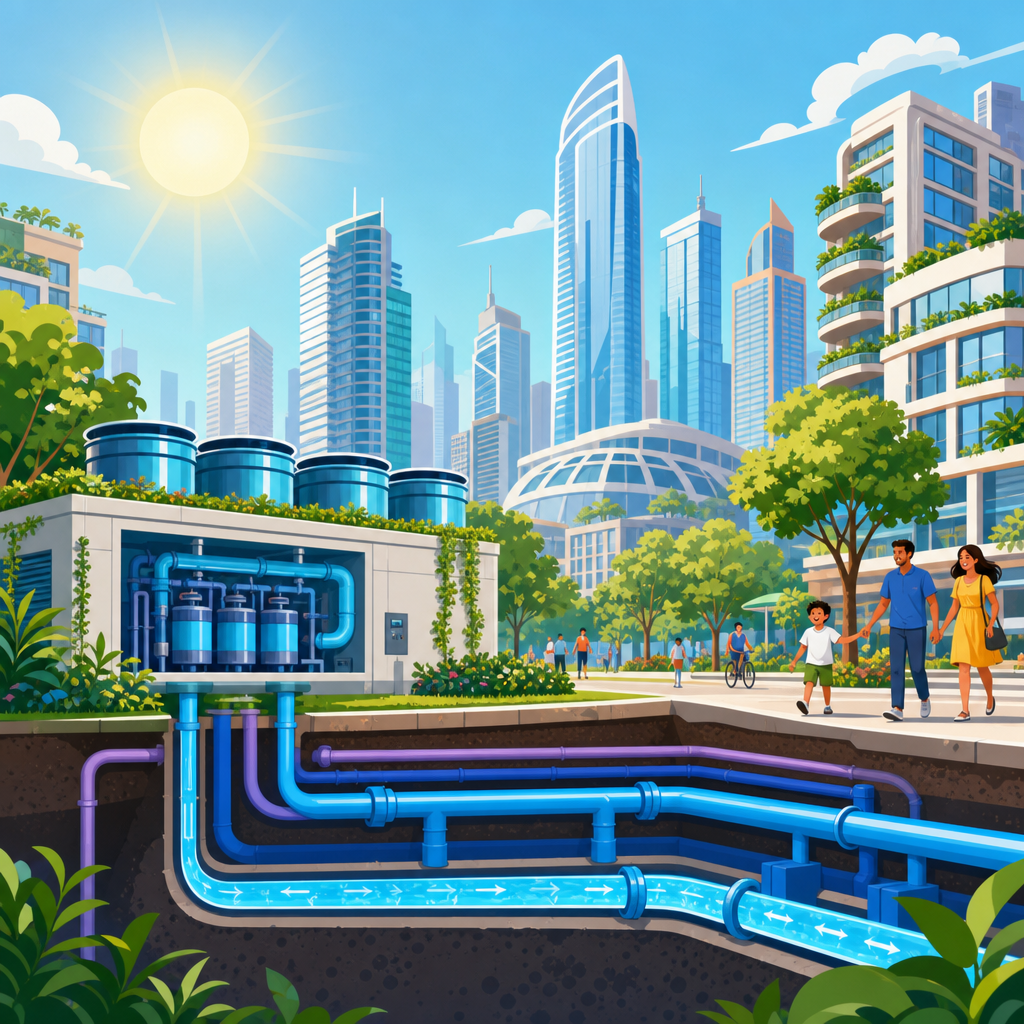
District cooling is moving from a niche infrastructure strategy to a central urban planning priority as hotter cities confront longer heat waves, rising electricity demand, and stricter climate targets. In simple terms, district cooling is a system that produces chilled water at a central plant and distributes it through insulated underground pipes to multiple buildings for air conditioning. Instead of every tower, hospital, mall, or campus running its own chiller, connected buildings use heat exchangers to receive cooling from a shared network. I have worked on energy and urban infrastructure projects where the difference between standalone cooling and networked cooling was not theoretical; it showed up in peak load calculations, plant room footprints, maintenance budgets, and resilience planning. That practical contrast is why district cooling now deserves attention from city leaders, developers, utilities, and property owners.
The future of district cooling in hotter cities matters because urban heat is intensifying at the same time that cooling demand is becoming a public health issue. The International Energy Agency has repeatedly highlighted that space cooling is one of the fastest-growing uses of electricity in hot regions. In dense cities, conventional air conditioning adds stress to already constrained grids, raises operating costs, and can worsen the urban heat island effect by rejecting heat at building level. District cooling changes that equation by shifting cooling production to optimized central plants, using larger and more efficient equipment, thermal energy storage, advanced controls, and in some cases seawater or treated wastewater for heat rejection. The result is lower peak electricity demand, more predictable asset management, and a stronger foundation for low-carbon urban growth.
Key terms are important here. Cooling load is the amount of heat that must be removed from a building. Peak demand is the highest level of cooling or electricity use over a short period, often driving infrastructure sizing and utility costs. Thermal energy storage usually means chilled water tanks or ice storage that allow plants to make cooling when power is cheaper or cleaner, then deliver it later. Coefficient of performance, or COP, measures cooling efficiency: the higher the value, the more cooling output is delivered per unit of energy input. A concession model refers to a long-term arrangement in which a private or public-private operator builds and runs the system under agreed performance and tariff rules. These concepts shape whether district cooling succeeds at city scale.
Hotter cities need solutions that work beyond individual buildings. A new office tower can install efficient chillers, but that does not solve district-wide network congestion, land constraints, refrigerant management, or emergency cooling continuity for critical services. District cooling can. It supports compact development, frees rooftop and basement space, centralizes maintenance, and creates a platform that can integrate renewable electricity, waste heat recovery, and digital optimization over time. For fast-growing metropolitan areas in the Gulf, South Asia, Southeast Asia, and parts of Africa, it offers a way to urbanize without locking in millions of inefficient compressors. For established cities facing heat adaptation and building retrofits, it provides a structured path to modernize cooling at precinct scale rather than one property at a time.
Why hotter cities are turning to district cooling
The main driver is heat, but the planning logic goes further. District cooling is most compelling where cooling loads are dense, concurrent, and relatively predictable. Mixed-use districts with offices, hotels, hospitals, airports, data centers, universities, and high-rise housing create exactly that profile. In these areas, a central plant can be designed around diversified demand instead of oversized individual systems. I have seen master plans where every parcel originally reserved separate chiller capacity, cooling towers, backup equipment, and access for maintenance. Once the district load was modeled as one system, the required plant capacity dropped materially because not all buildings peak at the same minute. That diversity factor is one of the strongest economic arguments for networked cooling.
Another reason cities are adopting district cooling is electrical infrastructure pressure. In many hot climates, summer afternoons already strain transformers, substations, and generation fleets. If a city can shift cooling production to nighttime through thermal storage, it can avoid expensive grid upgrades and reduce reliance on high-cost peaking plants. This is not a marginal benefit. A well-designed storage strategy can flatten demand curves and improve system stability during heat events, when blackouts become both economically damaging and life threatening. For municipalities, that translates into resilience. For utilities, it can defer capital expenditure. For building owners, it can reduce demand charges and improve tariff predictability.
Policy is also pushing change. Building performance standards, net-zero roadmaps, and refrigerant regulations under frameworks such as the Kigali Amendment are making decentralized cooling less attractive when evaluated over full life cycles. Large district systems can manage refrigerants more professionally, monitor leakage rates more rigorously, and adopt lower-global-warming-potential options faster than fragmented building portfolios. Cities pursuing decarbonization are recognizing that electrifying everything without addressing cooling efficiency simply moves the problem upstream. District cooling reduces the amount of electricity required in the first place, which is often the cheapest and fastest decarbonization measure available.
How district cooling systems work in practice
A district cooling network has four core components: central production, distribution, energy transfer, and controls. The central plant contains electric chillers, pumps, cooling towers, and often thermal storage. Water is chilled to a supply temperature, commonly around 4 to 6 degrees Celsius, then pumped through insulated pipes to connected buildings. At each building, an energy transfer station uses heat exchangers to separate the district loop from the internal building loop. That design simplifies maintenance and protects network water quality. Return water, warmed by building loads, goes back to the plant to be cooled again. The economics depend on pipe routing, load density, connection timing, and plant utilization over many years.
Modern systems are increasingly digital. Variable speed drives, predictive load forecasting, building management system integration, and real-time optimization software allow operators to sequence chillers, adjust pumping, and manage storage with high precision. In the best projects, operators do not simply produce cold water; they orchestrate an urban cooling platform. Dubai’s district cooling networks, Empower being the best-known example, demonstrate how large portfolios can coordinate multiple plants and customer connections while maintaining service reliability. In Singapore, the Marina Bay district cooling system shows how cooling can be embedded into the original development strategy of a high-density financial district, improving efficiency and reducing building plant space from the outset.
Network design must account for future phases. One common mistake is sizing the first plant and pipework only for initial tenants, then struggling to expand when the district fills in. Good planning uses scenario analysis for phased buildout, anchor loads, and redundancy. Hospitals, metro stations, airports, and campuses often serve as anchor customers because they have stable, large cooling needs. Once those anchors are secured, surrounding commercial and residential projects become easier to connect. Tariff design matters too. Customers want clear formulas covering capacity charges, consumption charges, service standards, and escalation. Without transparent contracts, even technically strong projects can stall in procurement or leasing negotiations.
| City or District | Main Driver | Typical Advantage | Key Challenge |
|---|---|---|---|
| Dubai | Extreme heat and rapid urban growth | Large efficiency gains at scale | Capital intensity and connection timing |
| Singapore Marina Bay | High-density master planning | Reduced building plant space | Coordinating phased development |
| Toronto Waterfront | Low-carbon cooling using lake water | Lower electricity use for cooling | Site-specific source constraints |
| Doha and Lusail | Peak demand management | Grid relief during hot periods | Long-term tariff confidence |
The strongest benefits: efficiency, resilience, and urban form
The first major benefit is efficiency. Large centrifugal chillers operating under optimized controls generally outperform the smaller, unevenly maintained equipment found across individual buildings. When thermal storage is added, plants can run closer to ideal conditions and avoid the worst efficiency penalties of afternoon peaks. That reduces energy consumption per ton-hour of cooling delivered. In projects I have reviewed, the efficiency advantage was not only about equipment size; it came from professional operations, continuous commissioning, and the ability to replace or retrofit plant components without disrupting each connected building separately. Scale creates operational discipline that many decentralized systems never achieve.
The second benefit is resilience. In a hotter city, cooling is not a luxury for hospitals, elder care facilities, transit hubs, laboratories, food distribution centers, and dense apartment towers. District cooling improves resilience by enabling redundancy at plant and network level. Multiple chillers, backup power strategies, looped pipe networks, and diversified water systems can provide continuity that a single building chiller plant often cannot. This matters during heat waves, when equipment failures cluster because all systems are stressed at once. A professionally operated district plant can also monitor faults centrally and dispatch maintenance faster than dozens of building teams acting independently.
The third benefit is better urban form. District cooling reduces the need for cooling towers, chiller yards, and large mechanical floors in every building. That frees space for leasable area, public realm improvements, or additional housing units. It can cut rooftop clutter, improve acoustics, and simplify architectural massing. On constrained sites, those advantages directly affect project viability. In waterfront and downtown precincts, removing repetitive plant equipment from each parcel also reduces visual and operational conflict. Urban planners often underestimate this value because it does not always appear in narrow energy models, yet developers immediately understand the commercial impact of reclaiming premium floor area.
What will shape the future of district cooling
The future will be shaped by integration, not by chillers alone. The most successful next-generation systems will combine district cooling with thermal storage, on-site solar where useful, demand response, advanced metering, and grid-interactive controls. They will also connect with broader water and heat strategies. Some cities can use deep lake water cooling, seawater heat rejection, or treated sewage effluent to reduce freshwater consumption and improve thermodynamic performance. Toronto’s Enwave system is a well-known example of using lake water for cooling, showing how local geography can transform system economics and emissions. Hotter coastal cities should evaluate these source options early in master planning, not as retrofits.
Finance and governance will matter just as much as engineering. District cooling requires high upfront capital, patient investors, and confidence in long-term customer demand. That means bankable concessions, enforceable connection policies in designated zones, and procurement that rewards lifecycle value rather than lowest first cost. Cities that treat district cooling as optional after building permits are issued usually get fragmented outcomes. Cities that designate network corridors, align utilities, and require compatibility in development approvals create investable demand. I have seen projects move quickly once the public sector clarified rights of way, customer obligations, and tariff oversight. Uncertainty, not technology, is the more common barrier.
Another future trend is retrofitting existing urban districts rather than serving only greenfield developments. This is harder because roads are already built, basements are occupied, and building systems vary widely. Still, rising heat and asset decarbonization pressures are making retrofit networks more attractive. Universities, medical campuses, business parks, and redevelopment zones are logical starting points because they combine ownership coordination with concentrated loads. Digital twins, non-destructive utility mapping, and modular energy transfer stations are improving retrofit feasibility. The lesson from recent projects is clear: district cooling is no longer limited to master-planned megaprojects if the district has enough density and a credible transition plan.
Limits, tradeoffs, and what city leaders should do next
District cooling is not the right answer everywhere. Low-density suburbs, highly dispersed loads, and areas with weak utility governance often struggle to justify the network cost. Pipe installation is disruptive and expensive. If customer uptake is slower than forecast, early plant utilization can be poor, hurting returns. Water use must be managed carefully, especially in arid climates where cooling tower strategies face scrutiny. Some owners also resist losing control over building-level cooling assets, even when the economics favor connection. These are real tradeoffs, and credible planning must address them directly with sensitivity analysis, stakeholder engagement, and phased investment rather than assumptions.
For hotter cities, however, the strategic case is strengthening every year. District cooling offers lower peak electricity demand, higher system efficiency, better resilience, and more flexible urban development than a patchwork of isolated chillers. It is most powerful when treated as civic infrastructure, similar to water, wastewater, or transit, rather than as a narrow mechanical service. The cities that will lead are the ones that map cooling demand, protect energy corridors, set connection rules for dense zones, and use procurement models that reward performance over decades. If you are shaping urban planning and policy, start with district-scale cooling assessments now, before today’s heat emergency becomes tomorrow’s locked-in inefficiency.
Frequently Asked Questions
1. What is district cooling, and why is it becoming more important in hotter cities?
District cooling is a centralized air-conditioning approach in which chilled water is produced at one or more central plants and then delivered through insulated underground pipes to multiple buildings. Those buildings use the chilled water to remove heat from indoor spaces instead of relying entirely on individual on-site chillers. In practical terms, it replaces a fragmented, building-by-building cooling model with a coordinated urban energy system.
Its importance is rising because hotter cities are facing a difficult combination of longer heat waves, growing populations, denser development, and rapidly increasing electricity demand for cooling. Traditional cooling systems put heavy pressure on power grids during the hottest hours of the day, exactly when electricity systems are already under stress. District cooling helps cities manage that challenge more efficiently by allowing cooling production to be optimized at scale, often with better equipment, smarter controls, and opportunities for thermal energy storage.
It also matters from a climate and planning perspective. As cities adopt stricter emissions targets and resilience standards, district cooling offers a way to reduce energy waste, lower peak demand, and integrate cleaner power sources more effectively than isolated building systems. For many urban districts, airports, campuses, hospitals, mixed-use developments, and waterfront projects, district cooling is no longer viewed as a niche idea. It is increasingly treated as core infrastructure for livability, grid reliability, and long-term heat adaptation.
2. How does district cooling improve energy efficiency and reduce strain on the electrical grid?
The biggest efficiency advantage comes from scale. A central cooling plant can use large, high-performance chillers, advanced controls, and optimized operating strategies that are often more efficient than dozens or hundreds of separate building systems. Instead of each property owner installing and maintaining equipment independently, the district system can be engineered to match real demand across many users, which smooths out peaks and avoids duplicated capacity.
Another major benefit is load diversity. Not every connected building needs maximum cooling at the same time. Offices, hotels, residential towers, hospitals, retail centers, and campuses all have different occupancy patterns and cooling profiles. A district cooling network can take advantage of that diversity, reducing the amount of installed capacity needed compared with a scenario where every building must size its own system for worst-case conditions. That translates into lower overall energy use and better asset utilization.
District cooling can also reduce strain on the electrical grid by shifting when energy is used. Many systems incorporate chilled water storage or thermal energy storage, which allows operators to produce cooling during off-peak hours and use it later during high-demand periods. This is especially valuable during afternoon and early evening heat spikes, when air-conditioning demand surges. By flattening demand curves, district cooling can help utilities avoid overloads, reduce reliance on expensive peaking power, and improve grid stability.
In addition, centralized systems are often better positioned to integrate renewable electricity, waste heat recovery, seawater cooling, treated wastewater, or other alternative energy strategies where local conditions allow. That flexibility can further improve system efficiency and reduce carbon intensity over time.
3. What are the main environmental and climate benefits of district cooling?
District cooling can deliver meaningful environmental benefits when it is well designed and paired with efficient operations. First, it typically lowers total electricity consumption for cooling compared with a landscape of separate, aging, or poorly optimized building chillers. Lower energy use generally means lower greenhouse gas emissions, especially in cities where electricity still comes partly from fossil fuels.
Second, district cooling can reduce peak electricity demand, which has important climate implications. Peak periods often trigger the use of the least efficient and most carbon-intensive power plants on the grid. By reducing or shifting cooling loads, district systems can help cities avoid those high-emission hours. Over time, this makes it easier to align urban cooling needs with cleaner energy systems and broader decarbonization goals.
There are also refrigerant-related benefits. Instead of having many separate cooling plants spread across buildings, district cooling can consolidate equipment and reduce the number of individual systems that need refrigerant management. With proper design, maintenance, and modernization, that can support better leak control and easier adoption of lower-impact refrigerants. In dense cities, centralized infrastructure may also reduce rooftop equipment clutter, noise, and maintenance burdens across multiple properties.
From an adaptation standpoint, district cooling helps cities respond to extreme heat more reliably. Cooling is no longer just about comfort; it is increasingly a public health requirement. Hospitals, transit hubs, data centers, commercial districts, and residential developments all need dependable cooling during prolonged high-temperature events. A robust district cooling network can support that resilience while advancing emissions reduction, making it a practical bridge between climate mitigation and climate adaptation.
4. What kinds of cities, districts, and buildings are the best fit for district cooling systems?
District cooling works best where cooling demand is large, dense, and relatively concentrated. That usually means fast-growing urban centers, mixed-use developments, financial districts, medical campuses, university campuses, airports, tourism zones, industrial parks, and large master-planned communities in hot or humid climates. The economics improve when many buildings are located close enough to be connected efficiently through a pipe network and when they have steady or complementary cooling loads.
High-rise clusters are often strong candidates because they require significant air-conditioning and would otherwise need substantial in-building mechanical equipment. Hospitals and laboratories are also attractive users because they have year-round cooling needs and place a premium on reliability. Hotels, malls, office towers, residential complexes, and public facilities can all benefit, especially when they are part of a coordinated district development plan.
That said, district cooling is not only for new megaprojects. Existing urban areas can also be good fits if they have aging cooling infrastructure, high electricity costs, limited space for new mechanical systems, or redevelopment plans that justify phased network expansion. In many cases, the most successful projects are those integrated early into land-use planning, utility planning, and building design standards. The closer district cooling is aligned with long-term urban growth strategies, the more value it can deliver in cost control, resilience, and emissions reduction.
Ultimately, the best fit depends on several variables: local climate, energy prices, development density, ownership patterns, financing models, policy support, and the ability to aggregate demand over time. Cities that treat cooling as strategic infrastructure rather than a private building-level afterthought are generally the ones most likely to unlock the full benefits.
5. What challenges could slow adoption of district cooling, and what will shape its future?
The most common challenge is upfront cost. District cooling requires major capital investment in central plants, underground distribution pipes, customer connections, controls, and often thermal storage. Those costs can be significant, especially in built-up urban areas where trenching and utility coordination are complex. Even when lifecycle savings are strong, financing the initial infrastructure can be difficult without long-term demand commitments, supportive regulation, or public-private partnership structures.
Another challenge is coordination. District cooling sits at the intersection of real estate, utilities, engineering, public policy, and urban planning. Projects often require multiple stakeholders to align on timelines, technical standards, concession models, tariffs, rights-of-way, and future expansion plans. If that coordination happens too late, cities may miss the opportunity to design cooling networks into new districts before streets, utilities, and buildings are locked in.
Adoption can also be slowed by market familiarity. In places where developers and building owners are used to controlling their own cooling systems, there may be hesitation about connecting to a shared network. Concerns often include pricing transparency, service reliability, contractual flexibility, and performance guarantees. Strong governance, clear service standards, and proven operational track records are essential to building trust.
Looking ahead, the future of district cooling will be shaped by several forces: worsening urban heat, pressure on electric grids, tougher building-efficiency rules, decarbonization targets, and advances in digital system optimization. Thermal storage, AI-driven load forecasting, low-carbon cooling technologies, and integrated energy planning will likely make these systems even more attractive. As cities search for scalable ways to stay livable in a hotter climate, district cooling is poised to move from selective deployment to a much more mainstream role in urban infrastructure strategy.


