
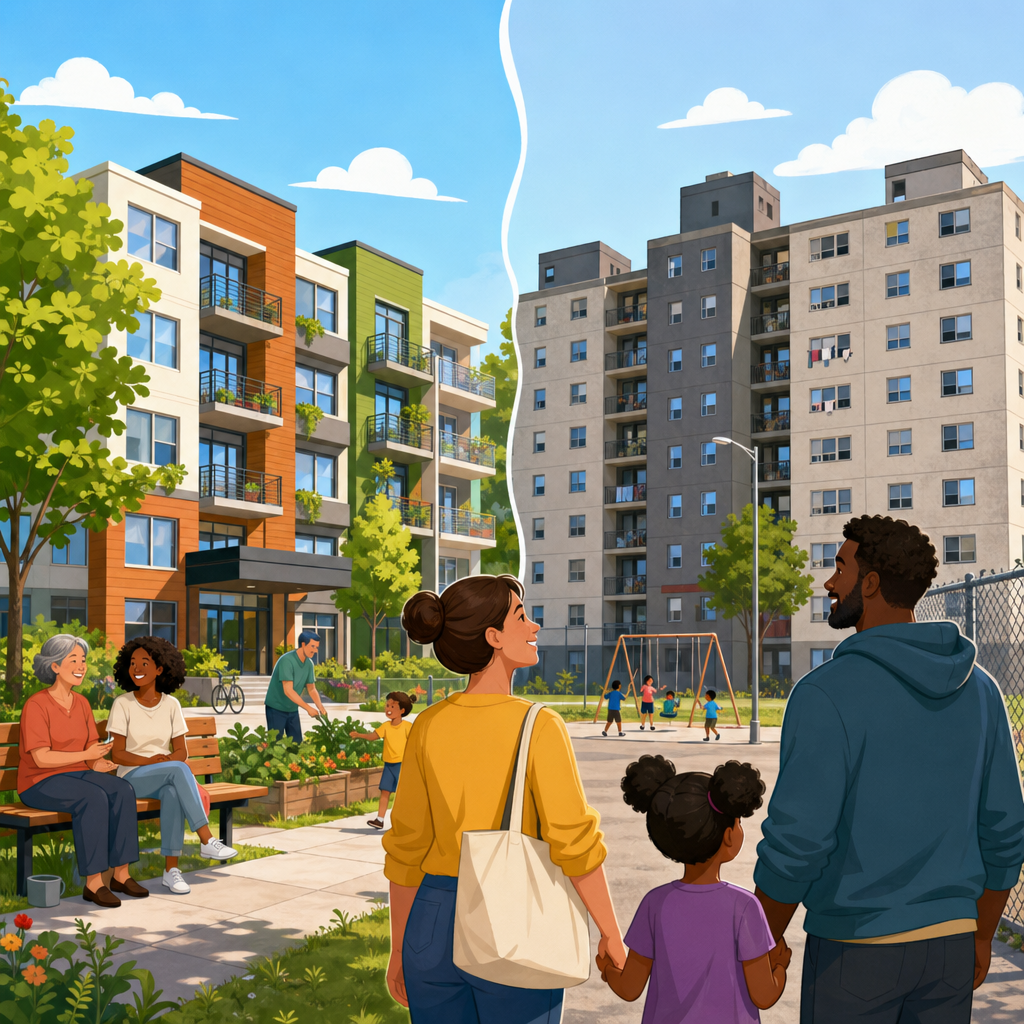
Social housing in the U.S. refers to permanently affordable homes that are owned or controlled for public benefit, while public housing usually refers to a specific federal program of government-owned rental developments managed by local housing authorities. The distinction matters because housing debates often collapse very different models into one category, leading residents, policymakers, and journalists to miss practical options that sit between private market housing and the traditional public housing system. I have worked on housing content and policy analysis long enough to see this confusion shape public meetings, zoning fights, and even funding decisions. When people hear “social housing,” many picture distressed towers built decades ago under the public housing program. In practice, the term is broader. It can include municipally developed mixed-income apartments, community land trust homes, limited-equity cooperatives, nonprofit-owned rental housing, and state-backed developments with long-term affordability restrictions.
In plain terms, social housing is a housing approach, not one single program. Its core idea is that homes should remain affordable over time because ownership, financing, governance, or land control is structured around public purpose rather than maximum profit. Public housing, by contrast, is a legally defined part of the U.S. affordable housing system, funded mainly through the U.S. Department of Housing and Urban Development and administered by public housing agencies. It serves some of the country’s lowest-income households, but the stock is limited, aging, and shaped by decades of underfunding. Understanding the difference is important for anyone trying to follow affordable housing policy, evaluate local proposals, or compare models used in cities such as New York, Seattle, Montgomery County, and Vienna abroad. The U.S. housing shortage, rising rents, and widening cost burdens have made these distinctions more than academic. They now affect how communities think about supply, equity, segregation, and long-term affordability.
What social housing means in the U.S.
In the American context, social housing usually means housing that is insulated from pure market pricing and preserved as affordable through public, nonprofit, cooperative, or mission-driven ownership. The rents or resale prices are generally tied to income standards, regulated formulas, or long-term affordability covenants rather than whatever the market will bear in a hot year. A city may own the building. A nonprofit may own it on public land. A community land trust may hold the land while residents own or rent the homes. A limited-equity cooperative may let residents build modest wealth while preventing speculative resale. The common thread is durable affordability backed by governance rules.
This broader definition matters because the U.S. does not have one unified social housing system. Instead, it has fragments: public housing developments, mixed-income projects financed with tax-exempt bonds and Low-Income Housing Tax Credits, shared-equity homeownership models, and locally created housing authorities or public development corporations. Some advocates use the term narrowly to mean government-developed mixed-income housing available to a wide range of residents, including middle-income households. Others use it more broadly to cover any permanently affordable, decommodified housing. In policy conversations, the safest reading is this: social housing is an umbrella category centered on long-term public benefit, while public housing is one branch under that umbrella.
How public housing works and why it is different
Public housing in the U.S. is a federal program created under the U.S. Housing Act of 1937. Properties are typically owned by a local public housing agency and funded through federal capital and operating subsidies. Residents usually pay an income-based rent, commonly set at about 30 percent of adjusted income. Eligibility is targeted to low-income households, and in many places the program serves extremely low-income residents, seniors, and people with disabilities. This structure makes public housing one of the deepest forms of rental assistance in the country.
It is different from social housing in three main ways. First, it is program-specific. Public housing has its own statutes, regulations, inspection protocols, waiting list systems, and funding streams. Second, it is usually narrower in income targeting. Most social housing proposals in current U.S. debates imagine mixed-income buildings, where cross-subsidies from moderate rents help support lower rents and reduce concentration of poverty. Third, public housing carries historical baggage tied to segregation, urban renewal, demolition, and chronic capital backlog. None of those problems are inevitable features of all social housing. They are outcomes of how the U.S. designed, funded, and politically constrained one program over many decades.
Core differences at a glance
| Feature | Social housing | Public housing |
|---|---|---|
| Meaning | Broad approach to permanently affordable housing for public benefit | Specific federal affordable housing program |
| Ownership | Public, nonprofit, cooperative, land trust, or mixed structures | Usually owned by a public housing agency |
| Income mix | Can be mixed-income or targeted | Primarily low-income households |
| Affordability term | Often permanent or very long term | Program-based and income-based |
| Funding | Local funds, public land, bonds, tax credits, nonprofit capital, rents | Federal operating and capital subsidies |
| Policy goal | Stabilize housing costs and expand nonmarket stock over time | House very low-income residents with deep subsidy |
Examples of social housing models beyond public housing
One useful way to understand social housing is to look at real operating models. Community land trusts separate land ownership from building ownership, which keeps resale prices below market and preserves affordability across generations. The Champlain Housing Trust in Vermont is one of the best-known U.S. examples, with shared-equity homes and rentals designed for lasting access rather than windfall appreciation. Limited-equity cooperatives offer another model. Residents collectively own the building through shares, but resale formulas cap gains to keep units affordable for the next household. New York City has used cooperative models for decades, and Washington, D.C., has supported tenant opportunity-to-purchase structures that can lead to resident control.
Nonprofit-owned affordable rental housing also fits the social housing concept when affordability restrictions are long term and governance is mission driven. Organizations such as Mercy Housing and Enterprise-supported partners often develop and operate housing with layered financing, professional management, and resident services. Montgomery County, Maryland, provides a particularly important example through the Housing Opportunities Commission, which develops mixed-income housing and uses public tools with more flexibility than traditional public housing. On the West Coast, some cities are exploring public development authorities that can build housing on public land with lower financing costs and stronger affordability requirements. These examples show that social housing is not a theory imported from elsewhere. Versions of it already exist in U.S. practice.
Why social housing is gaining attention now
Three pressures are driving interest. First is affordability. According to widely cited federal housing data, millions of renters are cost burdened, meaning they spend more than 30 percent of income on housing, and severe cost burdens remain common among extremely low-income households. Second is supply. Private construction often produces homes at price points above what lower-income residents can afford, especially in high-cost metro areas where land, labor, and insurance expenses are elevated. Third is permanence. Many affordable housing deals in the U.S. rely on expiring covenants, refinancing cycles, or subsidies that require constant renewal. Social housing appeals to local governments because it promises an asset that stays affordable rather than one that must be rescued every few decades.
There is also a governance reason. When cities depend entirely on private developers to deliver below-market homes through inclusionary zoning or negotiated concessions, production can rise and fall with the market. A social housing strategy gives the public sector or mission-driven sector a standing role in producing and holding housing through both booms and downturns. During periods of high interest rates, I have seen local officials rediscover this point quickly: if every affordable unit depends on private market timing, pipeline volatility becomes a policy problem. Social housing is attractive because it can anchor long-term capacity, especially when paired with public land, revolving loan funds, or municipal bond financing.
Common misconceptions and the historical context behind them
The biggest misconception is that social housing is simply a rebranding of failed public housing towers. That reading ignores both international evidence and the uneven U.S. history that shaped public perceptions. Early public housing in the United States was heavily influenced by racial exclusion, local political compromise, and later disinvestment. In many cities, public housing became housing of last resort because higher-income residents were excluded from or moved out of the program, maintenance funding lagged, and segregationist policies concentrated poverty. Those outcomes reflected policy design and neglect, not an iron law that publicly oriented housing must fail.
Another misconception is that social housing means free housing. It does not. Residents usually pay rent or carrying charges, but the pricing structure is intended to cover operations, maintenance, reserves, and reasonable financing costs without extracting maximum profit from land scarcity. A third misconception is that only large cities can do it. Smaller jurisdictions can support social housing through land banking, acquisition funds, accessory dwelling unit programs tied to affordability, or partnerships with land trusts and nonprofit developers. The more accurate lesson from history is this: long-term affordability requires durable institutions, predictable funding, competent property management, and resident accountability. Without those, any model—public, nonprofit, or private—can underperform.
What social housing can do that standard affordable housing programs often cannot
The main advantage of social housing is durability. When a city or mission-driven entity controls land and keeps affordability restrictions in place permanently, each new unit adds to a stock of housing that future generations can still use. That is different from programs that subsidize a unit for fifteen or thirty years and then risk losing affordability through expiration, conversion, or speculative sale. Over time, a social housing portfolio can function like infrastructure. It moderates displacement, offers stable rents during market spikes, and gives employers and schools more predictable communities.
It can also support broader income mixing. Traditional public housing generally targets residents with very low incomes because the subsidy structure is deep and scarce. Social housing proposals often spread units across income bands, for example serving households at 30, 50, 80, and sometimes 120 percent of area median income within the same development. That mix can reduce stigma, broaden political support, and create more stable operating revenue. The tradeoff is that mixed-income social housing is not a substitute for deep subsidy for the poorest households. In practice, the strongest housing systems combine both: deeply subsidized homes for those with the greatest need and permanently affordable mixed-income housing for workforce stability and long-term supply.
Limits, tradeoffs, and what successful implementation requires
Social housing is not a shortcut around basic housing economics. Land still costs money, construction is expensive, and buildings need professional management for decades. If a city launches a social housing program without a capital plan, reserve policy, and clear governance structure, it can reproduce the same maintenance backlogs that damaged confidence in public housing. Successful implementation requires dependable revenue, whether from dedicated taxes, bond proceeds, cross-subsidies from mixed-income rents, value capture, or public land contributions. It also requires standards for tenant selection, fair housing compliance, asset management, and resident participation.
There are political tradeoffs as well. Some advocates want universal access, while some funders prefer strict targeting to the lowest-income households. Some residents support publicly backed housing in principle but oppose it on specific sites. Some nonprofit providers welcome social housing as a partner model, while others worry about competing for scarce subsidies. These tensions are manageable, but only if policymakers are precise. The best proposals define ownership, financing, income mix, tenant protections, and long-term stewardship before slogans take over. If you are evaluating a local plan, the central question is simple: will this create housing that remains affordable and well managed for the next fifty years, not just the next funding cycle?
Social housing in the U.S. is best understood as a broad family of permanently affordable housing models designed for public benefit, while public housing is one specific federal program within that larger landscape. That distinction clarifies policy choices. Public housing remains essential because it delivers deep subsidy to households with the greatest needs. Social housing expands the conversation by showing how cities, nonprofits, cooperatives, and land trusts can build and preserve housing outside pure market logic and keep it affordable for the long term.
The practical takeaway is that communities do not have to choose between the private market and the traditional public housing model alone. They can use mixed-income public development, community land trusts, limited-equity cooperatives, nonprofit ownership, and public land strategies to create housing that stays within reach. If you follow affordable housing issues, use this framework when reading local proposals: ask who owns the land, how affordability is preserved, who is served, and how the property will be managed over time. Those questions reveal whether a proposal is temporary assistance or lasting housing infrastructure. Start there, and the social housing debate becomes much clearer.
Frequently Asked Questions
What is social housing in the U.S.?
In the U.S., social housing generally refers to homes that are kept permanently affordable because they are owned, governed, or controlled for public benefit rather than operated purely for private profit. That can include housing owned by public entities, nonprofit organizations, community land trusts, limited-equity cooperatives, or other mission-driven structures designed to preserve affordability over the long term. The core idea is not just that the housing is inexpensive today, but that it remains affordable across generations through legal, financial, and governance mechanisms that limit speculation and prioritize stable access.
What makes social housing especially important in current housing debates is that it describes a broader category than many people realize. It is not limited to one program, one funding stream, or one building type. Social housing can include apartments, mixed-income developments, cooperative housing, and community-controlled models that blend public investment with non-market ownership. In practice, it sits between purely private-market housing and traditional public housing, offering a wider menu of options for cities and states that want to expand affordability without relying exclusively on conventional federal programs.
How is social housing different from public housing?
Public housing usually refers to a specific federal housing program in which rental developments are owned by a government entity and managed by local public housing authorities. These properties were historically funded through federal programs and designed to provide affordable homes to eligible low-income households. When people in the U.S. say “public housing,” they are often talking about this established program with its own rules, funding structure, resident eligibility standards, and management systems.
Social housing is broader. Public housing can be one form of social housing, but not all social housing is public housing. Social housing includes a wider range of permanently affordable models in which the housing is controlled for public benefit, even if it is not directly owned and operated by a housing authority. For example, a nonprofit-owned building with long-term affordability restrictions, or a development on community-owned land with limited resale prices, may fit within the idea of social housing without being part of the federal public housing program. This distinction matters because it helps policymakers and residents see that affordable housing does not have to be limited to either fully privatized development or the traditional public housing system.
Why does the distinction between social housing and public housing matter so much?
The distinction matters because housing policy discussions often become less effective when very different models are lumped together. If every publicly supported or permanently affordable development is casually called “public housing,” people may overlook innovative approaches that address affordability, community control, and long-term stability in ways that differ significantly from the traditional federal model. That confusion can shape public opinion, media coverage, and legislation, sometimes causing people to reject useful ideas simply because they associate them with a narrower and often misunderstood category.
Being precise also opens up more practical policy choices. A city debating social housing is not necessarily deciding whether to replicate older public housing developments. It may be considering mixed-income housing with public or nonprofit ownership, resident-governed cooperatives, or new financing tools that remove land from speculation while still allowing professional management and high-quality design. For journalists, policymakers, and residents, understanding the difference makes it easier to compare proposals fairly, identify what problem each model is meant to solve, and discuss housing solutions with more clarity and less ideology.
Does social housing in the U.S. have to be government-owned?
No. Government ownership is one possible form, but it is not the only one. A defining feature of social housing is that it is controlled in a way that serves the public interest and preserves affordability over time. That control can come through municipal ownership, nonprofit stewardship, community land trusts, cooperative structures, public development authorities, or layered agreements that limit rents or resale prices. The ownership model can vary, as long as the housing is protected from speculative market pressures and governed to support long-term affordability and community benefit.
This is one reason the term is useful. It allows a conversation about outcomes and structure rather than focusing only on who holds title to the building. In some cases, a local government may own the land while a nonprofit develops and manages the homes. In others, residents may participate directly in governance through a cooperative or community-based board. The point is that social housing can be flexible in design while still pursuing the same core goals: stability, affordability, accountability, and protection from the price escalation that often defines private housing markets.
What kinds of housing models can fall under the social housing umbrella?
Social housing can include a range of models that share a commitment to long-term affordability and public benefit. Examples may include municipally owned mixed-income housing, nonprofit-owned affordable rental buildings, community land trust homes, limited-equity cooperatives, and developments built with strong affordability covenants that keep rents or resale prices below market over the long term. Some models focus on rental housing, while others support shared-equity homeownership. Some are targeted to very low-income residents, while others are intentionally mixed-income to create broader financial stability and social inclusion.
The unifying factor is not that all of these models look the same, but that they reduce dependence on pure market pricing and embed affordability into the structure of ownership or governance. That makes social housing a helpful concept for thinking beyond a one-size-fits-all approach. In the U.S., where housing costs vary dramatically across regions and local political conditions differ, this umbrella can encompass multiple tools adapted to local needs. For communities searching for alternatives to both rising market rents and the limitations of existing federal programs, social housing offers a framework for building housing that remains accessible, durable, and accountable over the long term.


