
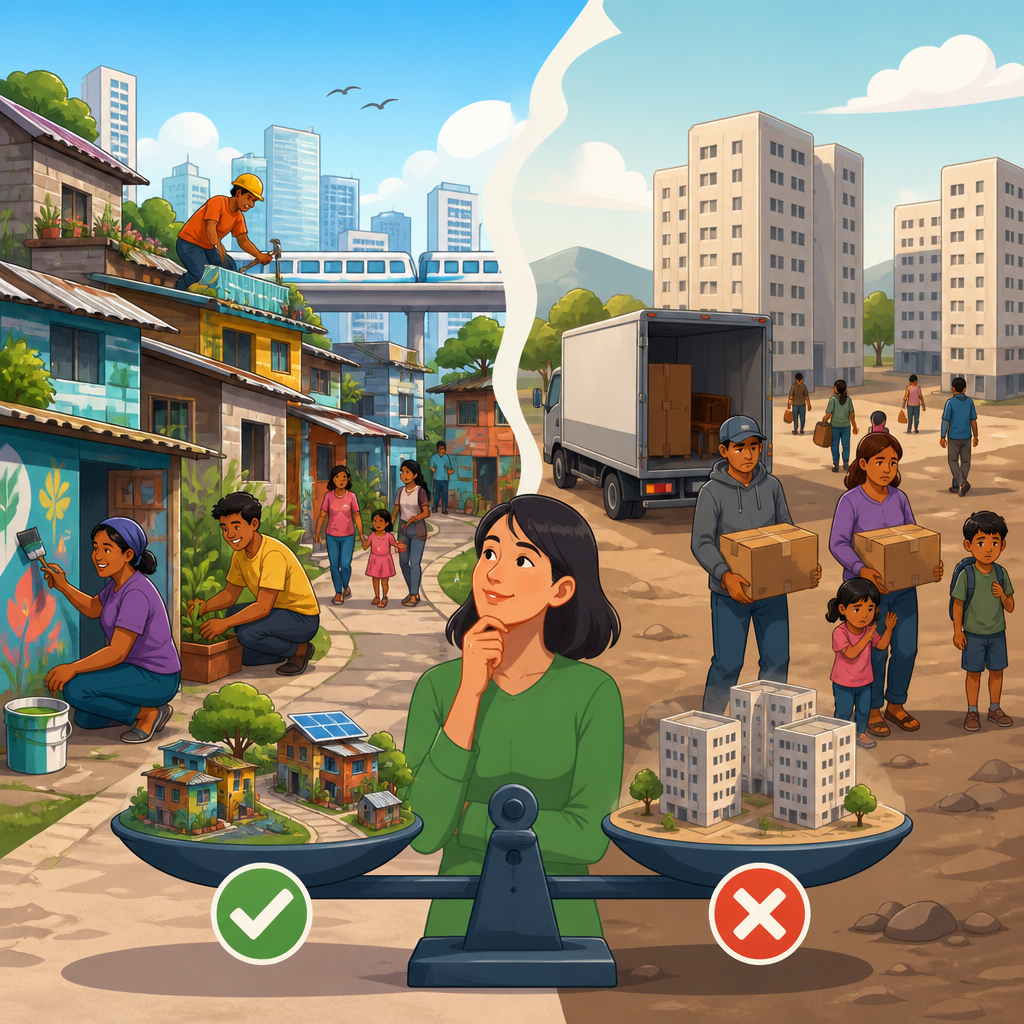
Slum upgrading vs relocation is one of the hardest choices in urban planning because it forces governments to balance land, livelihoods, public health, and human rights in places where formal systems have already failed residents. In practice, “slum upgrading” means improving services, housing quality, tenure security, drainage, roads, sanitation, and social infrastructure while people remain in or near their communities. “Relocation” means moving households from informal settlements to another site, either temporarily or permanently, usually because land is unsafe, needed for infrastructure, or targeted for redevelopment. I have worked on policy reviews and neighborhood assessments where both approaches were presented as technical solutions, yet the real outcomes depended less on the label and more on design, consent, finance, and follow-through. This matters because roughly one billion people worldwide live in informal settlements, according to UN-Habitat, and decisions made by cities today shape poverty, climate resilience, and social stability for decades.
The core policy question is not which option sounds cleaner on paper. It is which option preserves life, opportunity, dignity, and affordability under actual local conditions. Upgrading is often more humane because it protects social networks, access to jobs, schools, and informal markets that keep low-income households afloat. Relocation can still be necessary when settlements sit on floodways, unstable slopes, toxic land, airport safety zones, or rights-of-way for essential public works. The international lesson is clear: forced removal framed as modernization usually produces worse social and economic results than planners expect, while patient, participatory upgrading often delivers stronger long-term returns. Humane policy starts by recognizing informal settlements as part of the city, not an error outside it.
What Slum Upgrading Usually Gets Right
Upgrading works best because it addresses deprivation without destroying the neighborhood economy. In cities from Bangkok to Medellín, the most effective programs began with basic services: piped water, toilets or sewer connections, drainage, street lighting, paved access lanes, and waste collection. Those investments immediately reduce disease, flood damage, fire risk, and time spent collecting water or navigating mud roads. Upgrading also supports incremental housing improvement. When families believe they can stay, they invest in roofs, walls, floors, and room additions. That private investment multiplies public spending. The World Bank and Cities Alliance have repeatedly found that in-situ improvement can cost less than distant resettlement once transport, infrastructure extension, compensation, and livelihood losses are counted.
Tenure security is central, but full individual titles are not the only route. In my experience, planners often overestimate the speed and benefits of titling while underestimating simpler protections such as occupancy certificates, long-term leases, community land trusts, or collective tenure arrangements. Residents need confidence against eviction first. In Thailand, the Baan Mankong program showed how community-led upgrading tied to secure tenure and infrastructure subsidies can unlock neighborhood planning at scale. Savings groups, local cooperatives, and flexible layouts allowed residents to reblock crowded areas, widen lanes, and negotiate land use while staying close to livelihoods. The program’s strength was not just construction. It institutionalized participation, local finance, and negotiation, which made improvements stick.
Upgrading also aligns with the reality that informal settlements are deeply embedded in urban labor markets. Street vendors, domestic workers, construction laborers, transport operators, recyclers, and service workers depend on proximity. Move them far away and commuting costs rise, work hours lengthen, and incomes fall. I have seen relocation sites where new apartments looked orderly but ground-floor commerce was prohibited, transit was weak, and households quietly returned to central informal areas within months. A humane policy therefore treats location as a livelihood asset. It asks a simple question before any intervention: if residents move, can they still reach jobs, childcare, schools, clinics, and social networks at the same cost and reliability?
When Relocation Is Justified and How to Do It Without Harm
Relocation is justified when the site is genuinely unsafe or when critical public interests cannot be reconciled with continued settlement. Examples include homes on active railway corridors, eroding riverbanks, contaminated industrial land, landfill slopes, or zones repeatedly struck by deadly floods or landslides. After disasters, governments often invoke safety broadly, but humane policy demands risk evidence, not blanket assumptions. Hazard maps, geotechnical studies, flood modeling, and public health assessments should be disclosed in plain language. If upgrading plus mitigation can reduce risk to acceptable levels, that option deserves priority. If not, relocation must be treated as a complex social transition rather than a one-time housing delivery exercise.
The first rule is proximity. International evidence shows that near-site or within-district resettlement consistently outperforms peripheral relocation. In Mumbai, where high land values intensify pressure on informal settlements, relocation linked to redevelopment has often struggled when families were shifted into tall buildings far from prior work patterns and community management systems. By contrast, projects that preserved access to local labor markets and supported resident organizations produced more stable occupancy. In Brazil, the shift from eradication toward favela urbanization recognized this lesson. Programs in Rio de Janeiro and elsewhere combined service provision, public space, and legal integration more effectively than wholesale removals, though uneven maintenance and security conditions limited results in some areas.
The second rule is affordability over time. A relocated family does not benefit from a formal unit if utility bills, transport fares, condominium fees, or mortgage payments trigger distress. South Africa’s post-apartheid housing delivery expanded formal access, yet many peripheral projects reproduced spatial exclusion because jobs remained distant and municipal services were costly to sustain. The housing unit solved one problem while deepening another. Humane relocation packages therefore include operating-cost analysis, transit planning, social services, and livelihood restoration. Compensation should reflect not only structure value but income disruption, moving costs, school continuity, and support for informal enterprises that cannot simply restart on command.
International Lessons from Successes and Failures
Across countries, three patterns separate durable progress from policy failure: participation, land strategy, and implementation capacity. Participation is not a ceremonial meeting after decisions are made. It means residents help define options, sequencing, compensation rules, design standards, and grievance systems. When Pakistan’s Orangi Pilot Project demonstrated low-cost sanitation through community organization and technical support, it showed that residents are not obstacles to infrastructure delivery. They are co-producers. Similar lessons appear in community mapping by Slum Dwellers International, where settlement data collected by residents has improved enumeration, negotiation, and investment targeting in cities across Africa and Asia.
Land strategy is the second differentiator. Cities often treat informal settlements as temporary even when they have existed for decades. That assumption blocks investment and invites speculation. Successful programs identify where regularization is feasible, where land sharing can work, where readjustment can unlock roads and open space, and where relocation is unavoidable. The choice should follow a transparent typology. For example, settlements on publicly owned land with manageable density may be suitable for incremental upgrading. Settlements occupying land needed for ports, flood channels, or rail expansion may require negotiated relocation. The mistake is using one instrument everywhere because it is politically simpler.
Implementation capacity is the third lesson, and it is often ignored. Upgrading fails when agencies cannot coordinate utilities, cadastral records, engineering, social development, and maintenance. Relocation fails when housing departments deliver units without schools, clinics, buses, or livelihoods. The strongest cases use dedicated delivery institutions, ring-fenced finance, and phased work plans. Medellín’s broader urban transformation offers a relevant lesson even though it extends beyond slum policy narrowly defined: integrating transport, public space, social facilities, and hillside access changed how marginalized areas connected to the city. Physical works mattered, but institutional coordination mattered more.
| Policy issue | Upgrading performs better when | Relocation performs better when |
|---|---|---|
| Safety risk | Hazards can be mitigated through drainage, slope stabilization, fire access, or infrastructure redesign | Risk is extreme, recurrent, or technically impossible to reduce on site |
| Livelihood access | Residents rely on nearby informal and formal jobs, markets, and services | Comparable access can be preserved through near-site moves and strong transit links |
| Land constraints | Reblocking, densification, or tenure agreements can regularize the area | Land is required for essential infrastructure or is legally and physically unusable for housing |
| Household affordability | Incremental improvements keep costs aligned with resident incomes | Long-term utility, transport, and maintenance costs are demonstrably affordable |
| Community cohesion | Existing social networks support safety, childcare, and local enterprise | Groups can move together with governance support and continuity of services |
Principles for Humane Urban Policy
A humane policy begins with a presumption in favor of in-situ upgrading, then tests exceptions rigorously. That is the approach most consistent with the right to adequate housing recognized in international human rights practice, including security of tenure, habitability, accessibility, location, and cultural adequacy. It also fits the World Bank Environmental and Social Framework and other safeguard systems that require avoidance or minimization of displacement, meaningful consultation, and livelihood restoration when resettlement cannot be avoided. These are not abstract standards. They provide a practical checklist for city governments that want fewer conflicts and better outcomes.
First, diagnose the settlement before choosing the instrument. Map hazards, ownership, densities, infrastructure gaps, rental patterns, and livelihood dependence. Many settlements include both owners and tenants, and tenants are frequently missed in compensation plans despite being highly vulnerable. Second, create resident-led data processes. Community enumeration often reveals household numbers, business activity, and service deficits more accurately than administrative records. Third, compare scenarios honestly. A city should model the full cost of upgrading, near-site relocation, and distant relocation over at least ten years, including transport, income loss, and municipal operating costs. In many cases, the seemingly cheap option becomes the most expensive after social failure, vacancy, and return migration.
Fourth, finance incrementally. Small, sequenced investments often outperform grand clearance schemes. Service trunks, drainage, lanes, retaining walls, toilets, and tenure measures can be staged while residents continue working. Microfinance, community savings, and subsidy blending help households improve structures over time. Fifth, protect renters, women, elderly residents, migrants, and informal workers explicitly. Without safeguards, benefits flow to structure owners and politically connected groups while vulnerable households are displaced by rising rents or redevelopment pressure. Finally, build grievance systems that residents trust. Every intervention produces disputes over eligibility, plot boundaries, compensation, and construction impacts. Fast, transparent dispute resolution is not optional; it is core infrastructure for legitimacy.
The strongest international lesson is that humane policy is less about choosing a slogan and more about governing complexity responsibly. Upgrading is usually the better default because it respects the social and economic logic that residents have built under conditions of exclusion. Relocation has a place, but only where evidence shows that staying would leave people in unacceptable danger or make essential public functions impossible. Even then, the move must preserve livelihoods, affordability, and community continuity as far as possible. Cities that ignore these principles often spend more and achieve less.
For leaders working in urban planning and policy, the practical path is clear: start with evidence, plan with residents, calculate full long-term costs, and treat location as part of housing value rather than a separate issue. Whether the intervention is drainage in an existing settlement, land readjustment for safer streets, or a carefully designed near-site move, the test is the same: are people safer, better connected, and more secure five years later? Use that test to guide every program decision, and humane policy becomes not only possible but measurable. That is the standard worth adopting now.
Frequently Asked Questions
What is the difference between slum upgrading and relocation in urban policy?
Slum upgrading and relocation are both responses to informal settlements, but they start from very different assumptions about people, land, and the role of government. Slum upgrading focuses on improving living conditions where residents already are, or as close to those communities as possible. That usually includes safer housing, drainage, paved paths or roads, sanitation, water access, electricity, waste collection, flood mitigation, schools, clinics, and stronger tenure arrangements that reduce the constant threat of eviction. The core idea is that low-income communities are not simply problems to be removed; they are neighborhoods with social ties, economic activity, and survival systems that can be strengthened.
Relocation, by contrast, involves moving households from an informal settlement to a different site. Governments often consider relocation when settlements are located in areas exposed to severe environmental danger, needed for major public works, or constrained by land ownership disputes that make in-place upgrading difficult. In theory, relocation can offer safer structures and planned infrastructure. In practice, however, it often disrupts access to jobs, schools, childcare, transport, and community support networks if the new site is too far from the city’s economic core.
The policy distinction matters because the costs and benefits are not only physical but social and economic. Upgrading tends to preserve livelihoods and local networks, which is why many international agencies and urban practitioners view it as the preferred option whenever it is feasible and safe. Relocation may still be necessary in specific high-risk situations, but humane policy requires that it be treated as a last resort rather than a default solution. The strongest international lessons show that the best approach is not ideological; it is evidence-based, participatory, and centered on residents’ actual lives.
Why do many experts prefer slum upgrading over large-scale relocation?
Many experts prefer slum upgrading because it usually produces better long-term outcomes for residents at lower social cost. Informal settlements are often located close to jobs, transport routes, markets, domestic work opportunities, small-scale trade, and public services, even when the physical conditions are poor. When governments upgrade these areas in place, residents can keep earning an income while improvements are made. That continuity is critical. For low-income households, even a short interruption in work can trigger debt, hunger, school dropout, or loss of shelter.
International experience also shows that relocation schemes frequently underestimate the importance of proximity. Families may be moved into structurally better housing but find themselves hours from employment centers, forced to spend more on transport, or cut off from informal income sources such as street vending, recycling, day labor, or home-based enterprises. If the new housing is unaffordable to maintain or badly connected to the city, some households abandon it, rent it out, or return to informal settlements closer to work. That pattern has been observed in multiple countries and is one reason why relocation alone rarely solves urban poverty.
Upgrading is also often more respectful of human rights and social dignity. It recognizes that residents have built communities under conditions of state neglect and should not be punished for systemic failures they did not create. When done well, upgrading can improve public health, reduce disaster risk, formalize service delivery, and create a pathway toward legal recognition without destroying community life. Experts do not support upgrading because it is easier; they support it because the evidence repeatedly shows that preserving livelihoods and social networks is essential to humane and durable urban policy.
When is relocation justified, and what makes it humane rather than harmful?
Relocation is generally justified when remaining in place would expose residents to serious and persistent danger that cannot be adequately reduced through upgrading. This may include settlements in highly flood-prone riverbeds, unstable hillsides at risk of landslides, toxic industrial zones, or sites required for critical safety infrastructure. Even then, the burden is on public authorities to prove that in-place or nearby alternatives have been seriously evaluated. Too often, relocation is presented as necessary when the real motivation is land clearance, image management, or development pressure rather than resident safety.
For relocation to be humane, it must be planned around people’s full lives, not just the physical transfer of households. That means early consultation, transparent risk assessments, meaningful resident participation, legal safeguards, fair compensation where applicable, secure tenure in the new location, and housing that is actually habitable, affordable, and connected to livelihoods. A humane relocation site should have transport access, schools, healthcare, water, sanitation, electricity, drainage, and opportunities for income generation. Transitional support is equally important, including moving assistance, temporary income protection, help with documentation, and mechanisms for grievance redress.
The most important international lesson is that relocation fails when governments treat housing as a standalone product instead of part of an urban ecosystem. Moving people to distant, isolated sites may reduce visible informality in one location, but it often transfers hardship elsewhere. Humane policy requires minimizing displacement, prioritizing nearby resettlement where possible, and measuring success by resident well-being over time rather than by the number of structures removed. If families are safer but poorer, more isolated, and less able to access the city, the policy cannot honestly be called successful.
What international lessons help governments choose between upgrading and relocation?
International experience points to several consistent lessons. First, governments should begin with detailed, settlement-level data rather than assumptions. Informal settlements vary widely: some are primarily infrastructure deficits that can be upgraded effectively, while others face severe environmental or legal constraints that may require partial or full relocation. Good policy starts with mapping hazards, services, density, land tenure conditions, transport access, and local livelihoods. Without that baseline, authorities risk choosing the most visible option rather than the most effective one.
Second, participation is not a cosmetic step; it is a practical necessity. Communities usually understand local drainage patterns, tenancy arrangements, safety risks, service gaps, and livelihood systems better than outside planners do. Programs that involve residents in design, sequencing, budgeting, and monitoring tend to perform better because they identify real priorities and build trust. Internationally, one of the clearest lessons is that top-down interventions often fail not because the engineering is weak, but because the social planning is weak.
Third, successful policies are incremental and integrated. Upgrading works best when it combines physical improvements with tenure regularization, service delivery, public health measures, and access to finance or social support. Relocation works best when it is phased, well-connected, and designed to preserve social and economic continuity. Fourth, governments should avoid false binaries. In many cities, the best solution is a mixed strategy: in-place upgrading for most residents, selective nearby resettlement for households in extreme-risk zones, and broader land and housing reforms to prevent new informal growth. The strongest international lesson is that humane policy is flexible, evidence-driven, and accountable to the people most affected.
How can governments protect livelihoods and human rights while improving informal settlements?
Protecting livelihoods and human rights begins with recognizing residents as rights-bearing urban citizens rather than temporary occupants standing in the way of development. In practical terms, that means avoiding forced evictions, ensuring due process, providing clear information, and creating real opportunities for residents to influence decisions. Security of tenure is especially important. People are much more likely to invest in their homes and neighborhoods when they believe they can remain without arbitrary displacement. Tenure protection does not always require immediate full land titles, but it does require credible legal assurances against sudden removal.
Livelihood protection must be built into every stage of policy design. Governments should ask not only where people sleep, but where they work, how they travel, who provides childcare, where children attend school, and how local informal economies function. Street vendors, home-based producers, waste pickers, domestic workers, and day laborers often depend on location-specific networks. If upgrading disrupts these systems through construction phasing, or relocation severs them entirely, households can become more vulnerable even if their new homes appear better on paper. That is why transport planning, market access, workspace, and affordability are central to humane urban policy.
Finally, governments should measure success using resident-centered indicators: reduced disease, lower disaster exposure, improved school attendance, shorter commutes, stronger tenure security, stable or improved incomes, and higher satisfaction with safety and services. Physical units delivered are not enough. A rights-based approach also requires independent oversight, accessible complaint mechanisms, and ongoing monitoring after implementation. The broader lesson from international practice is simple but demanding: humane policy does not treat low-income communities as objects of urban management. It works with them as partners in creating safer, healthier, and more just cities.


