
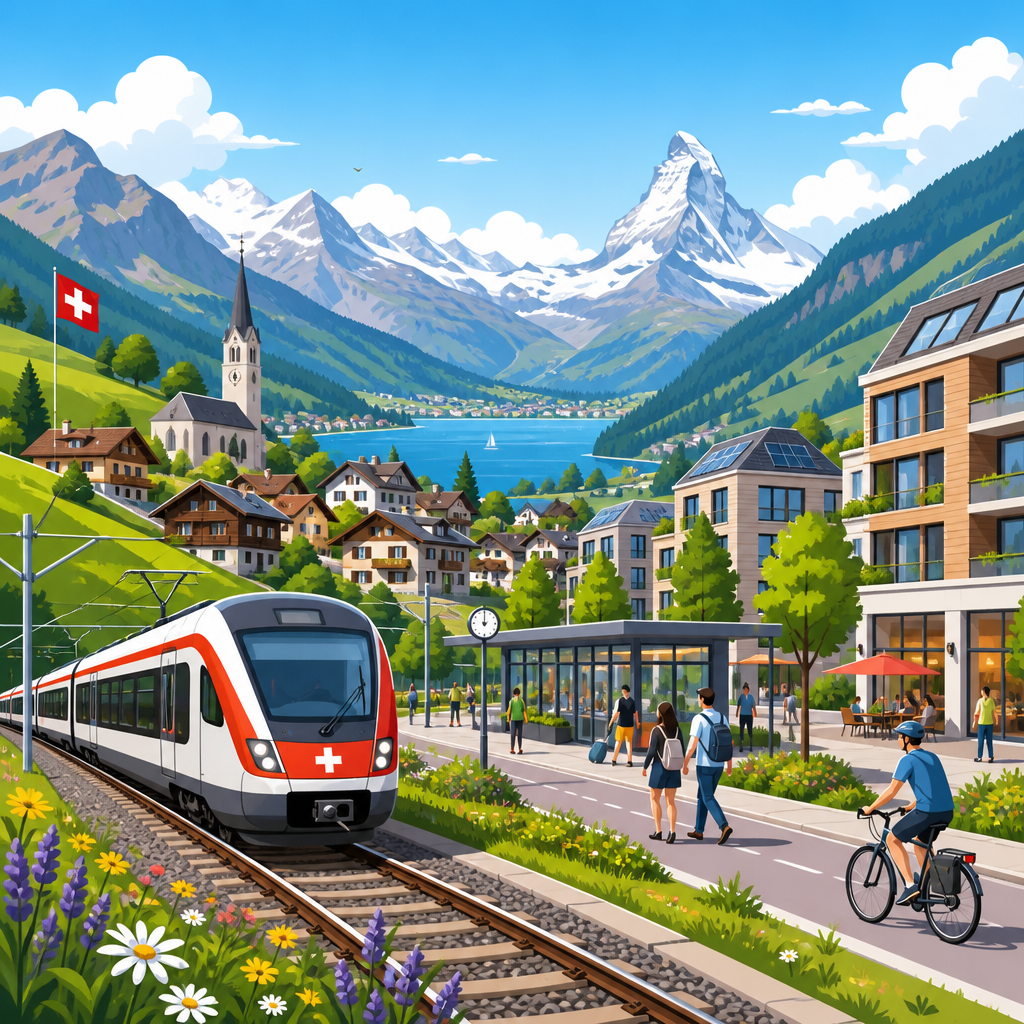
Switzerland offers one of the clearest examples of how rail-oriented regional development can shape a prosperous, balanced, and livable country. Rail-oriented regional development means organizing housing, jobs, public services, and land use around high-quality rail networks so that towns and cities grow in step with mobility capacity rather than against it. In practice, this approach ties planning decisions to station access, coordinated timetables, and long-term investment in public transport corridors. It matters because regions everywhere face the same pressures I have seen repeatedly in planning work: rising housing demand, road congestion, uneven economic growth, climate targets, and political resistance to sprawl. Switzerland did not solve these issues through one megaproject. It built a system in which national rail policy, cantonal land-use control, municipal development rules, and dependable operations reinforce one another. That is the central lesson. Regional development works better when transport is treated not as a separate engineering service but as the framework for where growth goes and how daily life functions. For planners, policymakers, and investors, the Swiss model is useful not because it can be copied exactly, but because its principles are practical, tested, and measurable across metropolitan areas, small cities, and rural regions.
Integrated planning starts with the timetable, not the road map
The most distinctive Swiss practice is that service planning leads infrastructure planning. Instead of first asking where to lay tracks and later deciding what to run on them, Swiss agencies often begin with a target timetable and then identify the infrastructure required to operate it reliably. This nationwide pulse timetable, commonly called the Taktfahrplan, coordinates trains to arrive and depart at repeating intervals so passengers can transfer with minimal waiting. In plain terms, a resident in a small town benefits not only from a local train but from a predictable network that connects buses, regional rail, and intercity services. That predictability changes development behavior. Employers can locate near stations knowing workers from several directions can reach them. Households can choose towns beyond the largest cities without becoming car-dependent. Universities, hospitals, and retail centers can serve wider catchments with fewer parking burdens.
I have found that many regions undervalue schedule design as a land-use tool. Switzerland treats it as foundational. The federal rail program Rail 2000 was not mainly about top speed; it focused on frequency, connections, and travel times that fit clock-face scheduling. A line capable of slightly faster travel but poor transfers delivers less regional value than a line that fits the network pulse. This is why Swiss rail stations function as development anchors. They are not isolated stops on separate lines; they are nodes in a synchronized system. The planning implication is decisive: when accessibility is dependable all day, developers and municipalities can support higher densities, mixed uses, and reduced parking ratios with greater confidence.
Station areas succeed when land use is disciplined and incremental
Swiss regional development around rail is not defined by only high-rise districts around central stations. It includes a wide range of places: metropolitan hubs like Zürich Hauptbahnhof, secondary cities such as Bern and Lausanne, and smaller municipalities where modest density near stations supports frequent service. The common factor is disciplined land use. Swiss municipalities generally channel growth toward already served areas, preserve open landscapes outside settlement boundaries, and require new development to fit infrastructure capacity. This creates a cumulative effect. Each station area may add housing, offices, schools, and shops gradually, but over decades the network gains a chain of compact, productive urban centers.
Zürich illustrates this especially well. The Zurich S-Bahn, launched in 1990, did more than improve commuting. It reorganized the metropolitan region around frequent rail access, enabling suburban municipalities and smaller centers such as Winterthur to absorb growth while maintaining strong connectivity to the core. Developments near stations became more attractive because travel was simple in multiple directions, not only into the city center. At the same time, Swiss planning law and local political culture limited unchecked edge expansion. The result was not zero sprawl, but a far tighter relationship between mobility and urban form than in most car-oriented regions.
This incremental pattern matters because many governments expect rail-oriented development to appear as a single transformative project. In reality, Swiss success comes from repeated, ordinary decisions: rezoning land near stations, improving pedestrian access, consolidating bus interchanges, allowing mixed-use buildings, and protecting agricultural land beyond settlement edges. These actions may look modest individually, yet together they shape regional structure. For fast-growing regions elsewhere, the practical lesson is to align every zoning update, public land strategy, and service expansion with station-area priorities instead of waiting for a flagship redevelopment to carry the entire policy agenda.
Reliable funding and governance create development confidence
Rail-oriented regional development depends on trust that service will remain strong over time. Switzerland provides that trust through durable institutions and funding mechanisms. Federal, cantonal, and local governments share responsibilities, but they operate within a framework that gives public transport a stable policy position. Voters have repeatedly backed rail investment packages, and dedicated funding tools support operation, maintenance, and expansion. The point is not simply that Switzerland spends money on rail. It spends consistently, which is more important for development decisions than sporadic bursts of capital.
When I advise on station-area strategy, the hardest challenge is often not design quality but uncertainty. Developers hesitate if future service levels are unclear. Municipalities hesitate if a station upgrade might be delayed for years. Households hesitate if schools, public space, and last-mile connections are not planned in parallel. Switzerland reduces that uncertainty by publishing long-range investment programs and embedding rail in national identity as essential infrastructure. The National Railway and the federal transport office are complemented by cantonal transit agencies and integrated fare associations, so the user experiences one network rather than competing operators.
Governance quality also shows up in project sequencing. Swiss authorities often pair timetable improvements with targeted infrastructure such as passing loops, tunnel upgrades, or platform extensions instead of defaulting to expensive new lines. This staged approach preserves public credibility because benefits arrive sooner and costs are easier to justify. It also helps regional development because station areas can respond to phased improvements. A town does not need to wait for a generational megaproject before planning new housing near its rail stop. It can grow as service reliability and frequency improve in steps.
What Switzerland gets right in regional rail development
The Swiss model combines several advantages that are often separated elsewhere. The table below summarizes the most important elements and why they matter for regional development outcomes.
| Element | Swiss practice | Regional development effect |
|---|---|---|
| Service design | Clock-face schedules with timed transfers across rail and bus networks | Expands labor and service catchments for towns beyond major cities |
| Land use | Growth directed toward existing settlements and station areas | Supports compact development and limits dispersed sprawl |
| Funding | Long-term federal and cantonal investment programs | Gives municipalities and developers confidence to plan around rail |
| Governance | Integrated institutions, fare systems, and coordinated planning | Creates a seamless network that users can trust for daily travel |
| Station design | Strong pedestrian access, bus interchange quality, and clear wayfinding | Makes station districts practical places for housing, jobs, and services |
These strengths reinforce one another. A synchronized timetable is more valuable when station areas permit more homes and workplaces. Higher station-area density is more acceptable when public transport is frequent and reliable. Stable funding is easier to defend politically when rail visibly supports balanced regional prosperity. This systems logic is why Switzerland consistently performs well on public transport mode share, rail ridership, and territorial cohesion. Even peripheral areas gain from the network because they remain connected to stronger regional centers without requiring universal car dependence.
Balanced decentralization is the deeper regional lesson
The most important Swiss lesson is not simply “build more rail.” It is to use rail to support balanced decentralization. In many countries, economic growth concentrates in one or two dominant metros while smaller cities lose talent and investment. Switzerland has major urban centers, but it also maintains a network of strong secondary cities and well-served smaller towns. Rail plays a central role by shrinking perceived distance. A business can operate in St. Gallen, Fribourg, or Biel/Bienne and still connect efficiently to national markets, universities, and government institutions. Residents can access specialized services without relocating to the largest city. This helps distribute opportunity more evenly across the territory.
Balanced decentralization works because accessibility is multidirectional. Traditional commuter systems often focus on bringing workers into one central core in the morning and sending them back at night. Swiss regional rail supports that pattern but goes beyond it. Frequent all-day service allows trips between secondary centers, suburb-to-suburb commuting, student travel, health care access, and nonwork trips without punishing transfer times. That broader utility strengthens local economies. It also supports social inclusion, especially for young people, older adults, and lower-income households who may not drive regularly.
There are limits, and they should be stated clearly. Switzerland benefits from relatively high institutional capacity, political trust, and a long tradition of public investment. Its geography creates natural settlement constraints that discourage unconstrained outward growth. Land values and construction costs are high, which can complicate housing affordability even in transit-rich locations. Yet those limitations do not weaken the core lesson. They show that rail-oriented regional development must be paired with housing policy, governance reform, and clear land protection measures if it is to deliver equitable results.
How other regions can adapt the Swiss approach
Regions outside Switzerland should not imitate the visible pieces while ignoring the operating logic underneath. A new station alone will not reorganize growth. Nor will a rail line with poor frequency, weak transfers, or fragmented ticketing. The first step is to define a regional access strategy built around repeating service patterns and transfer hubs. If trains arrive every thirty or sixty minutes at consistent times, local buses, schools, hospitals, and employers can align around them. The second step is to update land-use rules so the best-served places permit more housing and mixed-use development by right, especially within walking distance of stations. The third step is to make station access easy: safe sidewalks, bicycle parking, universal design, and direct bus interchange are not amenities; they are core capacity investments.
Phasing also matters. In lower-density regions, begin with strategic corridors where existing towns already provide a base of ridership and services. Improve frequency first, then target infill housing, civic buildings, and employment uses near stations. Use public land to set quality standards. Coordinate parking policy so valuable station land is not consumed by low-yield surface lots. Where full rail expansion is unrealistic, bus rapid transit can feed rail hubs and preserve the network principle. The test is simple: does each investment make it easier for more daily needs to be met through connected regional centers rather than longer car trips?
Planners should also measure success correctly. The goal is not only ridership on one line. It is regional accessibility, reduced transport cost burdens, stronger town centers, protected open land, and more resilient economic geography. Switzerland demonstrates that when rail, land use, and governance are aligned, these outcomes reinforce each other over decades rather than election cycles.
Lessons from Switzerland on rail-oriented regional development are valuable because they move the debate beyond infrastructure as an isolated asset. The Swiss record shows that regional prosperity is shaped by the relationship between service design, station-area planning, land protection, and dependable governance. Frequent rail alone is not enough, and dense development alone is not enough. What works is the combination: a synchronized network, growth directed to accessible places, stable funding, and institutions that plan transport and urban form together.
For urban planning and policy, this matters at every scale. Metropolitan regions can use rail to distribute growth across multiple centers instead of forcing everything into one congested core. Secondary cities can strengthen their role in national economies when they are linked by reliable all-day service. Smaller towns can remain viable when residents can reach jobs, schools, and services without total car dependence. Just as important, open landscapes and agricultural land can be protected when growth is steered toward existing settlements rather than scattered outward.
The practical takeaway is straightforward: start with the network, plan around the timetable, and let land use follow accessibility. That is the Swiss lesson in its most useful form. If your region is revising a comprehensive plan, transport strategy, or station-area framework, use this model as the benchmark and build the next policy decision around connected regional centers.
Frequently Asked Questions
What does rail-oriented regional development actually mean in the Swiss context?
In Switzerland, rail-oriented regional development is more than simply building train lines and hoping growth follows. It is a planning model in which transport infrastructure, land use, housing, employment centers, and public services are deliberately coordinated so that development happens where high-quality rail access already exists or is being strategically expanded. Rather than allowing cities and towns to spread outward in a car-dependent pattern, Swiss planning emphasizes concentrating growth around stations, strengthening links between urban centers and smaller municipalities, and ensuring that mobility capacity supports new development from the start.
A defining feature of the Swiss approach is that rail is treated as the backbone of the regional system. Local buses, trams, walking routes, cycling networks, and even zoning decisions are aligned with the train network and its timetable. This creates a coherent geography of access: people can live in smaller towns, work in larger cities, reach schools and health services efficiently, and travel without needing a car for every trip. The result is not just better transportation, but a more balanced territorial structure in which prosperity is shared across regions instead of being concentrated only in a few large metropolitan cores.
What makes the Swiss model especially instructive is its long-term consistency. Rail-oriented development is supported by stable public investment, disciplined spatial planning, and a strong public expectation that transport and development policy should reinforce one another. The lesson is that successful regional development around rail does not happen through isolated projects. It depends on sustained coordination across sectors and across decades.
Why is Switzerland often seen as a leading example of balanced regional development through rail?
Switzerland stands out because it has used rail not only to improve mobility, but also to shape the relationship between major cities, mid-sized towns, and rural communities. In many countries, economic opportunity becomes heavily concentrated in a handful of large metropolitan areas, leaving smaller places with weaker access to jobs, services, and investment. Switzerland has addressed this challenge by creating a dense, reliable rail network that allows many different places to function as part of a connected national system. This means people and businesses do not have to cluster exclusively in one or two dominant cities to benefit from economic integration.
The country’s integrated timetable system is a major reason this works so well. Trains are scheduled to connect predictably across the network, making transfers practical and reducing travel friction. That reliability increases the effective reach of labor markets, universities, hospitals, cultural institutions, and commercial activity. A smaller town with a well-served station can remain highly competitive because residents and firms can access larger regional centers quickly and consistently. This supports regional vitality while reducing pressure for uncontrolled growth in already crowded urban cores.
Switzerland also combines transport investment with land-use discipline. Development near stations is typically encouraged, while dispersed, infrastructure-heavy expansion is constrained. That alignment helps protect landscapes, supports efficient public service delivery, and keeps transport systems more financially and operationally viable. In short, Switzerland is seen as a leader because it demonstrates that rail can be a tool for national cohesion, economic resilience, and high quality of life all at once.
What practical lessons can other countries take from Switzerland’s approach to station-centered growth?
One of the clearest lessons is that stations should be treated as development anchors, not just transport facilities. In Switzerland, rail stations often serve as focal points for housing, offices, retail, education, and civic life. This creates compact, mixed-use districts where daily needs are easier to reach and public transport demand is naturally stronger. Other countries can apply this principle by identifying priority station areas and aligning zoning, public realm upgrades, housing policy, and infrastructure spending around them. The key is to make station access central to planning decisions rather than an afterthought.
A second lesson is the importance of network thinking. Switzerland does not rely solely on a few headline intercity routes. It pays close attention to how local, regional, and national services connect with one another. A small-town station becomes valuable not only because of its direct destinations, but because it is integrated into a wider timetable that enables smooth onward connections. For policymakers elsewhere, this means that rail-oriented development should not focus only on major hubs. Smaller stations can also drive successful growth if service is frequent, reliable, and well-coordinated.
A third lesson is patience and continuity. Swiss outcomes are the product of long-range planning, phased upgrades, and institutional coordination across multiple levels of government. Countries hoping to replicate the results should not expect a single rail project to transform regional development overnight. Success usually depends on combining steady transport investment with land-use reform, predictable governance, and public confidence that the system will improve over time. The most transferable Swiss lesson is not a specific station design or train type, but the discipline of planning development around mobility capacity in a sustained and integrated way.
How does coordinated rail investment improve livability as well as economic performance?
Coordinated rail investment improves livability by making daily life more convenient, predictable, and less car-dependent. When housing, jobs, schools, and services are linked by dependable rail and feeder transit, residents spend less time dealing with traffic congestion, long commutes, and transport uncertainty. Access becomes more equitable as well, because children, older adults, lower-income households, and people who do not drive can still participate fully in economic and social life. In the Swiss model, transport is not only about moving people efficiently; it is also about shaping communities where access is broad and everyday mobility feels manageable.
From an economic perspective, coordinated rail systems enlarge labor markets and improve business connectivity without requiring endless road expansion. Employers can draw workers from a wider geography, and workers can reach more job opportunities without relocating. This flexibility supports productivity and can reduce regional inequalities by linking smaller communities to major economic centers. It also makes investment locations more attractive, since firms benefit from reliable employee access and predictable travel times for clients, partners, and service providers.
There are also environmental and fiscal advantages that reinforce both livability and competitiveness. Compact, rail-served development tends to use land more efficiently, lower transport emissions, and reduce the long-term cost of servicing scattered growth with roads and utilities. Public spaces around stations can become more walkable and vibrant, which strengthens community identity and local commerce. In that sense, coordinated rail investment generates a virtuous cycle: better accessibility supports better places, and better places in turn make public transport more useful and successful.
What are the biggest challenges in applying Swiss-style rail-oriented regional development elsewhere?
The biggest challenge is that the Swiss model depends on institutions working together consistently over long periods of time. In many countries, transport agencies, municipalities, housing authorities, and regional planners operate with different priorities, budgets, and political incentives. That fragmentation makes it difficult to align rail investment with land-use decisions. If new stations are built but zoning still favors low-density sprawl, or if housing growth is approved far from reliable transit, the benefits of rail-oriented development are weakened. Replicating Swiss-style outcomes therefore requires governance reform as much as infrastructure spending.
Another major obstacle is the legacy of car-oriented urban form. Many regions already have dispersed development patterns, large amounts of low-density housing, and employment clusters designed around highway access rather than stations. In these places, shifting toward rail-oriented growth may require retrofitting existing areas, changing parking policies, revising development rules, and improving first- and last-mile connections. That can be politically sensitive and financially demanding. The Swiss example is helpful, but it should not be misunderstood as a quick template that can be copied without adapting to local geography, institutional capacity, and settlement patterns.
A final challenge is maintaining public and political commitment over time. Rail-oriented regional development is cumulative. Its strongest results come from repeated upgrades, timetable coordination, careful station-area planning, and dependable investment. In political environments that prioritize short-term wins, this kind of continuity can be hard to sustain. Still, that is precisely why Switzerland offers such a powerful lesson. Its success shows that when countries treat rail as a core structuring element of national and regional development, rather than as a standalone transport mode, the long-term payoff can be substantial in economic, social, and environmental terms.


