
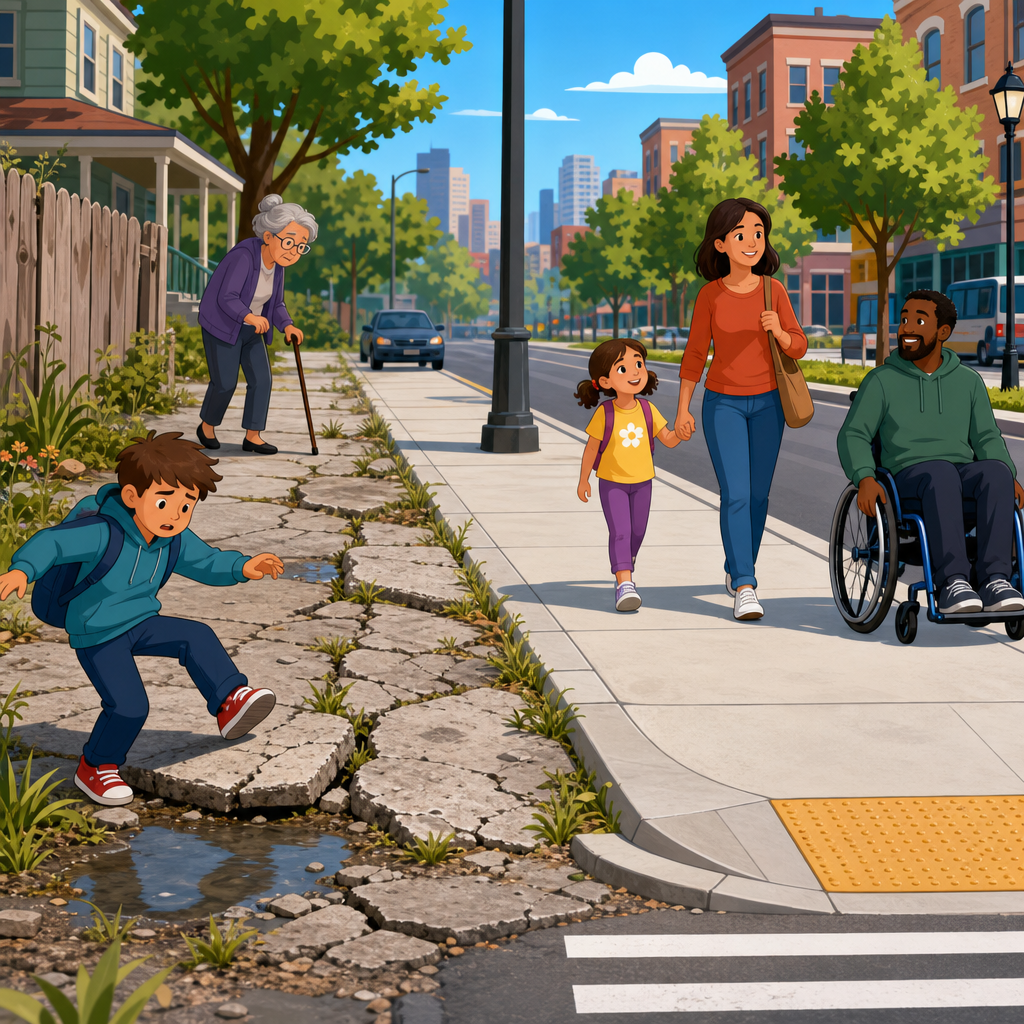
Sidewalks are often treated as background infrastructure, yet they are among the most used public assets in any city. A sidewalk is a paved pedestrian route within the public right-of-way, usually running alongside streets, connecting homes to schools, transit stops, shops, parks, clinics, and workplaces. Maintenance backlog refers to the accumulated repair, replacement, and accessibility work that a city, county, campus, or housing authority has postponed because funding, staffing, or asset management systems have not kept pace with deterioration. When those delays compound, sidewalks stop functioning as reliable infrastructure and begin acting like barriers.
I have worked with municipal asset inventories, capital improvement plans, and pedestrian accessibility reviews, and the pattern is consistent: cracked panels, uplift from tree roots, missing curb ramps, ponding water, narrowed clear zones, and utility patches left uneven for years. These issues are not cosmetic. They affect safety, legal exposure, emergency access, economic activity, and who can realistically move through a neighborhood without a car. A city can resurface arterial roads on schedule and still fail residents if the walking network remains fragmented or hazardous. For children, older adults, wheelchair users, people pushing strollers, and transit riders, sidewalk condition determines whether essential trips are possible.
This matters because sidewalks support policy goals that cities already claim to prioritize: access, public health, climate resilience, transportation choice, and equitable investment. The Americans with Disabilities Act sets clear expectations for accessible routes in the public realm, while the Public Rights-of-Way Accessibility Guidelines provide technical direction on cross slopes, width, curb ramps, detectable warnings, and related features. Local governments also face tort claims when known hazards are not addressed in a reasonable timeframe. Put simply, maintenance backlogs matter because sidewalks are not optional amenities. They are linear civic infrastructure, and when they fail, the consequences spread across transportation, land use, housing, education, and public finance.
Why sidewalks should be managed like core infrastructure
Cities routinely assign pavement condition indexes to roads, inspect bridges on fixed cycles, and map water main age by material and break history. Sidewalks deserve the same discipline. They have service lives, failure modes, user standards, and replacement costs. Concrete panels crack from settlement, freeze-thaw cycles, heavy vehicle overrun, poor subgrade preparation, utility cuts, and root heave. Asphalt paths ravel and deform. Curb ramps become obsolete when detectable warnings are missing or slopes exceed current standards. Drainage failures create icing risks in winter and standing water year-round. These are asset management problems, not isolated complaints.
When a city does not treat sidewalks as a managed network, it falls into reactive maintenance. Crews respond only after 311 reports, injury claims, or political pressure. That approach is expensive and inequitable. Neighborhoods with higher digital access or stronger advocacy get faster repairs, while areas with older residents, renters, or lower household incomes may endure hazards longer despite greater need. A network-based approach starts with inventory, condition scoring, and prioritization. Agencies can then align routine grinding, panel replacement, tree root mitigation, curb ramp upgrades, and corridor reconstruction with risk and demand rather than anecdote.
Good sidewalk management also supports internal coordination. Public works, transportation, parks, water utilities, forestry, and private developers all touch the pedestrian realm. Without a shared asset framework, one department repairs a water service trench while another plans a future streetscape, and the result is wasted money or noncompliant work. In practice, the strongest programs use GIS-based inventories, work order systems such as Cityworks or Cartegraph, and capital planning tied to complete streets policies. The lesson is simple: once sidewalks are recognized as infrastructure, backlog reduction becomes measurable, budgetable, and governable.
What creates a sidewalk maintenance backlog
Backlogs grow from a mix of underfunding, policy ambiguity, and weak information. Many jurisdictions still rely on adjacent property owners to maintain sidewalks, while cities retain responsibility for curb ramps, street trees, and major reconstruction. That split can leave hazards unresolved for years, especially where owners cannot afford repairs or enforcement is inconsistent. In other places, municipalities nominally own the system but do not have a dedicated sidewalk line item in the operating budget, so repairs compete against road resurfacing, fleet replacement, and storm response. Deferred maintenance becomes the default.
Another cause is incomplete inventory. You cannot manage what you have not mapped. Agencies may know lane miles of roadway and number of traffic signals but lack a verified count of sidewalk segments, curb ramps, marked crossings, retaining walls, and pedestrian bridges. When inventories exist, they are often outdated or limited to downtown. Condition data can be equally thin: a city may have a list of complaints but no standardized rating for trip hazards, spalling severity, width deficiencies, or drainage failures. That makes cost forecasting unreliable and allows backlog estimates to swing dramatically between budget cycles.
Regulatory and design transitions also add to the backlog. Older sidewalks were built under past standards or before accessibility requirements were fully incorporated into local practice. Every resurfacing project that alters a street may trigger curb ramp obligations, but agencies often only budget for the pavement work and discover compliance costs late. Street trees create another long-term pressure point. Mature canopies provide shade, heat mitigation, and stormwater benefits, yet poorly selected species or constrained planting conditions can lift panels. When forestry and sidewalk programs are not coordinated, cities face a false choice between accessibility and canopy that better design could avoid.
Why backlog reduction affects safety, access, and local economies
The most immediate impact of a sidewalk backlog is safety. Trip-and-fall hazards increase when vertical displacement exceeds local tolerances, commonly around one-half inch before grinding or replacement is recommended. Broken pavement forces pedestrians into parking lanes or travel lanes, especially where there is no buffer. Missing or steep curb ramps block wheelchair users and create difficulty for anyone using walkers, carts, or strollers. In winter climates, poor drainage and uneven surfaces accelerate ice formation. These conditions do not affect all users equally; they systematically exclude people with the least flexibility in how they travel.
Accessibility is not only about compliance. It is about whether an urban area functions as a connected place. A resident may live a quarter mile from a bus stop, grocery store, or clinic, but if the route includes missing links, narrowed sidewalks blocked by poles, or inaccessible corners, the effective distance becomes much longer. I have seen agencies classify a corridor as transit rich while riders still had to navigate grass shoulders and noncompliant ramps to reach it. That gap between mapped access and lived access is where maintenance backlogs do real harm. It reduces mobility for people who already depend on walking most.
Economic effects follow quickly. Commercial districts with continuous, comfortable sidewalks support foot traffic, storefront visibility, and short local trips that benefit small businesses. Real estate professionals also know that walkable, well-maintained streets contribute to neighborhood desirability and stable property values. By contrast, visibly deteriorated sidewalks signal neglect and can suppress activity after dark or during wet weather. Medical costs, liability settlements, and emergency repairs add direct fiscal pressure. Cities that defer maintenance often pay more later because spot repairs on failed panels and ramps cost more per unit than coordinated corridor rehabilitation scheduled before conditions become severe.
How cities can measure backlog and set priorities
Effective backlog management starts with a complete inventory and a consistent condition assessment method. At minimum, agencies should map sidewalk presence, width, material, curb ramps, crossing types, obstructions, drainage problems, and notable grade constraints. Condition surveys can be performed by trained staff, consultants, or calibrated mobile collection teams using tablets, GPS, and photo logs. The goal is not perfection on day one. It is a defensible baseline that can be updated. Once the network is mapped, each segment can receive a score reflecting hazard severity, accessibility deficiency, user demand, and replacement complexity.
Priority setting should combine risk and equity. High-volume routes near schools, transit stops, senior housing, hospitals, parks, and neighborhood commercial streets usually deserve early attention because they carry many users and support essential trips. Equity screening is equally important. Areas with lower vehicle ownership, higher disability rates, higher rates of older adults, or historical underinvestment often depend more on walking and transit. A backlog program should not simply reward places that generate the most complaints. It should identify where poor conditions have the greatest practical consequence and where public spending can close access gaps that markets will not fix.
| Priority factor | What to measure | Why it matters |
|---|---|---|
| Safety risk | Vertical displacement, missing panels, drainage icing, crash history | Targets locations with the highest injury potential |
| Accessibility need | Missing curb ramps, narrow clear width, excessive cross slope, obstacles | Improves compliance and everyday mobility for disabled users |
| User demand | Proximity to schools, transit, clinics, retail, parks, public housing | Directs funds to routes supporting many daily trips |
| Equity context | Car ownership, age, disability, income, past capital investment | Reduces uneven service across neighborhoods |
| Cost efficiency | Ability to bundle with paving, utility work, or streetscape projects | Lowers unit costs and limits repeat disruption |
Cost estimation should distinguish between routine maintenance, spot replacement, and full reconstruction. Grinding a minor uplift is inexpensive and fast. Replacing a panel and adjusting adjacent grades costs more. Rebuilding an entire corridor with new drainage structures, trees, lighting, and curb ramps is a capital project. Agencies that separate these categories can forecast annual needs more accurately and reserve capital dollars for corridors where patchwork repairs no longer make sense. The best programs also publish dashboards showing miles assessed, hazards corrected, curb ramps upgraded, and estimated unfunded need, which helps elected officials and residents understand the scale of the issue.
Funding, policy tools, and practical strategies that work
Reducing a sidewalk maintenance backlog requires more than one funding source. Local general funds rarely cover systemwide need. Cities typically assemble a package: transportation sales tax revenue, bond proceeds, tax increment financing in redevelopment areas, federal formula funds, Community Development Block Grant dollars for eligible neighborhoods, and state pedestrian safety grants where available. ADA transition plans can help agencies justify and sequence improvements, while development impact fees may support frontage completion in growth areas. The key is to match money type to work type, using stable operating funds for routine fixes and capital funds for corridor reconstruction.
Policy choices matter as much as dollars. Jurisdictions should clarify ownership and maintenance responsibility, standardize temporary patch requirements after utility cuts, and require permit restoration to current pedestrian standards rather than minimum preexisting condition. Tree programs should use species selection, root paths, structural soils, and larger planting zones to reduce future uplift. Design standards should prioritize clear width and accessible curb ramps at every resurfacing trigger. Strong cities also link sidewalk repair to repaving schedules so curb ramps, drainage, crossings, and pavement markings are upgraded together. That bundling approach reduces mobilization costs and avoids rebuilding corners twice.
There are limitations and tradeoffs. Full replacement everywhere is unrealistic in one budget cycle, and historic districts, steep topography, constrained rights-of-way, and utility conflicts can complicate compliance. Some communities prefer cost-sharing with property owners, but that can delay repairs in lower-income areas unless hardship waivers or city-led financing are available. Even so, steady progress is possible when agencies focus on preventive maintenance, transparent prioritization, and network continuity instead of one-off beautification. The most successful backlog programs treat sidewalks as daily mobility infrastructure, publish clear standards, and fix the routes people actually rely on first.
Sidewalk maintenance backlogs matter because they reveal whether a city understands access as a real public service or a slogan. When sidewalks are cracked, missing, flooded, or inaccessible, the cost is paid in falls, missed trips, reduced independence, weaker business districts, and avoidable legal risk. When they are maintained as infrastructure, communities gain safer routes, stronger transit access, better compliance, and more equitable mobility. The practical path forward is clear: inventory the network, score condition consistently, prioritize by risk and need, coordinate departments, and fund repairs as an ongoing obligation rather than an occasional special project.
For planners, public works leaders, elected officials, and community advocates, the main benefit of addressing backlog is not just better concrete. It is a transportation system that works for more people every day. Review your sidewalk inventory, compare it to where residents walk for essential trips, and make backlog reduction a visible part of the capital program. Cities that do this well build trust block by block.
Frequently Asked Questions
What does it mean to think of sidewalks as infrastructure rather than just a streetscape feature?
Thinking of sidewalks as infrastructure means recognizing them as essential public assets that support daily movement, public safety, access to opportunity, and the overall function of a community. Sidewalks are not decorative extras. They are transportation facilities within the public right-of-way, just like streets, signals, drainage systems, and transit stops. People use them to reach schools, jobs, grocery stores, parks, medical offices, libraries, and bus or rail connections. In many places, sidewalks are the first and last link in every trip, including trips that begin by car or public transit.
When cities treat sidewalks as core infrastructure, maintenance is no longer viewed as optional or cosmetic. Cracked pavement, heaving slabs, missing curb ramps, drainage failures, narrow pinch points, and broken crossings become service problems that affect mobility and safety. This perspective also highlights who depends on sidewalks most: children walking to school, older adults, people using wheelchairs or walkers, transit riders, and households without reliable access to a car. A well-maintained sidewalk network improves independence, accessibility, and resilience, while a neglected network creates barriers that can isolate entire groups of residents from basic services and community life.
What is a sidewalk maintenance backlog, and how does it develop over time?
A sidewalk maintenance backlog is the total amount of repair, reconstruction, and accessibility work that has been identified or is reasonably needed but has not yet been completed. It can include damaged pavement, trip hazards, ponding water, vegetation encroachment, failed retaining edges, missing segments, outdated or noncompliant curb ramps, and locations where sidewalks no longer meet current accessibility standards. In practical terms, a backlog is deferred work that continues to grow because the responsible agency does not have enough funding, staffing, contractor capacity, or asset management systems to keep up with deterioration and demand.
Backlogs typically develop gradually. Sidewalks age, tree roots lift panels, freeze-thaw cycles widen cracks, heavy use wears surfaces, and drainage issues weaken the base. At the same time, agencies often prioritize more visible or politically urgent capital needs, leaving pedestrian facilities underfunded for years. In some jurisdictions, responsibility may also be fragmented among cities, counties, transportation departments, campuses, housing authorities, and adjacent property owners, which can slow inspections and repairs. Without regular condition assessments and long-term capital planning, the system shifts from preventive maintenance to crisis response. That is when small defects turn into full panel replacements, corridor rebuilds, and costly accessibility retrofits. The longer the work is postponed, the more expensive and disruptive it usually becomes.
Why do sidewalk maintenance backlogs matter so much for safety, accessibility, and equity?
Maintenance backlogs matter because sidewalk conditions directly affect whether people can move safely and independently through their community. Uneven pavement, broken joints, crumbling edges, blocked routes, and missing curb ramps increase the risk of falls and make routine trips harder or impossible for many users. For a person pushing a stroller, using a wheelchair, managing limited vision, or walking with a cane, even a modest defect can become a serious barrier. In areas with poor lighting, fast traffic, or missing crossings, these problems compound and can push pedestrians into the street, where the risk of injury is much higher.
There is also a strong equity dimension. Sidewalk neglect rarely affects all neighborhoods equally. Lower-income communities, older neighborhoods, transit-dependent areas, and places with a history of underinvestment often carry a disproportionate share of the backlog. That means residents who are most likely to walk for everyday needs may face the worst conditions. When sidewalks are in poor shape, access to school, healthcare, employment, food, and public transportation becomes less reliable. Over time, that limits participation in civic and economic life. Addressing backlogs is therefore not only a maintenance issue but also a public health, civil rights, and access-to-opportunity issue. A functional sidewalk network supports inclusion; a degraded one can quietly reinforce exclusion.
What are the long-term costs of delaying sidewalk repairs and accessibility upgrades?
Delaying repairs almost always increases total cost over the life of the asset. A minor crack seal, grinding treatment, or targeted panel replacement is far less expensive than waiting until a larger section fails and requires full reconstruction. Deferred maintenance also tends to create secondary problems. Poor drainage can undermine adjacent pavement, tree-root conflicts can spread, and repeated patching can leave a route rougher and less accessible than a coordinated rebuild. Agencies that postpone work may eventually face a larger capital burden because the condition of the network declines faster than they can restore it.
There are also legal, operational, and social costs. Hazardous sidewalks can lead to injury claims, complaints, emergency work orders, and reputational damage for the responsible agency. Missed accessibility upgrades may expose public entities to compliance risks and increase pressure for costly accelerated remediation later. Delays can affect transit performance as well, since riders need safe pedestrian access to stops and stations. On a broader level, neglected sidewalks can discourage walking, reduce access to local businesses, and undermine investments in schools, parks, housing, and main streets. In short, backlogs are not just an accounting problem. They represent a compounding liability that grows more expensive in financial, safety, and community terms the longer it is ignored.
How can cities and public agencies reduce sidewalk maintenance backlogs effectively?
Reducing a sidewalk backlog requires more than one-time repair funding. The most effective approach starts with treating sidewalks as managed infrastructure assets. That means creating a complete inventory, assessing condition on a regular cycle, identifying accessibility gaps, and prioritizing work based on risk, usage, and community need. Agencies should know where the highest pedestrian volumes are, where schools and transit stops generate frequent use, where older adults or disabled residents may be disproportionately affected, and which corridors present the greatest safety concerns. Good asset management helps decision-makers shift from reactive repairs to planned maintenance and reconstruction.
Funding strategies matter just as much. Agencies often need a dedicated sidewalk program rather than relying on leftover funds from roadway projects. Some combine local capital budgets with bond programs, transportation grants, ADA transition planning, development requirements, and utility coordination to stretch dollars further. Pairing sidewalk repairs with paving, drainage, tree work, and transit improvements can reduce mobilization costs and minimize disruption. Clear maintenance responsibility is also important, especially where obligations are split between public entities and private property owners. Finally, public communication should be transparent: residents need to understand how issues are reported, how projects are prioritized, and what timelines are realistic. The most successful programs are consistent, data-driven, and equity-focused, with a long-term commitment to preserving the sidewalk network before small defects become major backlogs again.


