
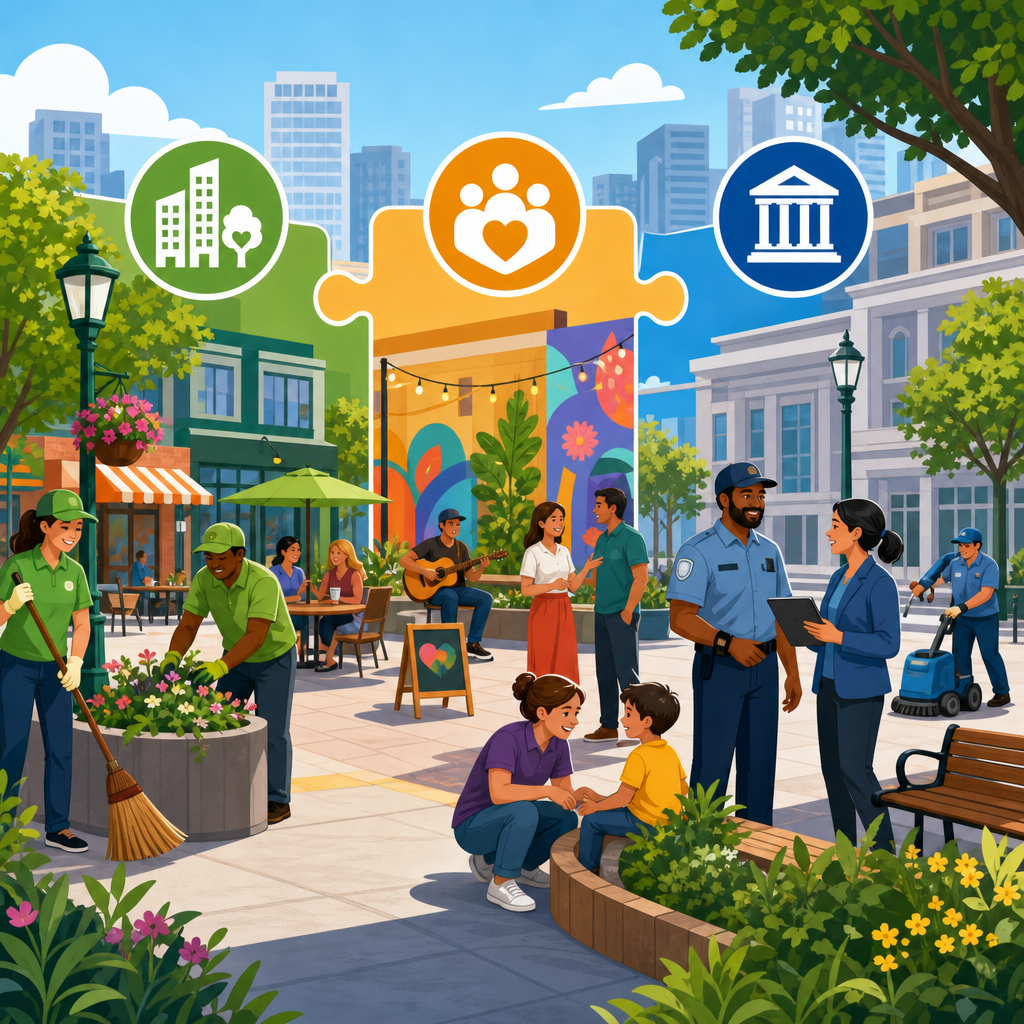
Public realm management models shape whether streets, plazas, parks, and mixed-use districts feel clean, safe, welcoming, and economically productive. In affordable housing contexts, that question is not cosmetic. The public realm is the connective tissue between homes, transit, schools, clinics, shops, and jobs, and the way it is managed affects tenant stability, neighborhood trust, and long-term operating costs. When local leaders ask whether a district should be overseen by a business improvement district, a nonprofit steward, or a city department, they are really asking who sets priorities, who pays, who is accountable, and whose daily experience counts in decision-making.
Public realm management means the ongoing governance, funding, maintenance, programming, safety coordination, vendor management, data collection, and community engagement that keep shared spaces functional. It is different from capital development. Building a plaza, streetscape, or affordable housing campus is a one-time project; managing litter, landscaping, ambassadors, lighting repairs, event permits, wayfinding, sanitation, and conflict mediation is continuous operational work. I have worked with municipalities, housing organizations, and district operators that underestimated this distinction, and the result was predictable: attractive spaces at ribbon cutting, followed by rapid decline when no operator had a durable budget and a clear mandate.
Three models dominate practice. A BID is typically a special assessment district in which property owners pay mandatory fees to fund supplemental services. A nonprofit management organization usually relies on contracts, philanthropy, sponsorships, service agreements, or public grants to manage a district or site. A city department model keeps management directly inside government, often through parks, public works, transportation, or neighborhood services. Each model can work. Each can also fail if its legal authority, revenue design, and community accountability do not match local conditions. For affordable housing districts especially, the best choice depends on parcel ownership, tax-exempt property share, resident representation, service expectations, and political tolerance for dedicated assessments.
This matters because affordable housing rarely exists in isolation. Residents judge a neighborhood not only by rent levels and unit quality but by whether sidewalks are passable, public spaces feel safe without being over-policed, bus stops are maintained, storefronts stay active, and public agencies respond when things break. Strong public realm management can support lease-up, reduce vacancy in nearby retail, improve pedestrian volumes, and help preserve value in mixed-income projects. Weak management can undermine expensive housing investments, increase complaints, and shift burdens back onto housing providers that were never staffed to run district-scale operations.
How business improvement districts work
A BID is usually the most structured and financially predictable model. It is created through state enabling law and local ordinance, with assessed property owners funding a defined service plan. In practice, that means a district map, a formula for assessments, a governing board, and annual reporting. Services often include cleaning, landscaping, hospitality ambassadors, marketing, beautification, small capital improvements, and coordination with police, sanitation, and transportation agencies. The core advantage is stable revenue. Unlike grants, assessments recur, which allows managers to hire staff, procure multi-year contracts, and maintain service levels through political cycles.
For commercial corridors and mixed-use affordable housing districts, that consistency is powerful. A BID can respond quickly to overflowing trash, graffiti, lighting outages, encampment-related sanitation issues, and event logistics without waiting for annual appropriations. Well-known examples in cities such as New York, Philadelphia, and Washington, DC show how district operators use block-by-block service schedules, maintenance standards, customer counts, and merchant outreach to produce visible outcomes. When a neighborhood has many taxable parcels and strong property-owner alignment, a BID can outperform ad hoc municipal management because someone wakes up every day responsible for that geography.
The limitation is structural. BIDs are funded by property assessments, so districts with large amounts of tax-exempt land, nonprofit ownership, public housing, or low assessed values may not raise enough money. Affordable housing areas often have exactly those conditions. Another challenge is governance legitimacy. If the board is dominated by large owners and commercial interests, residents may reasonably feel that public spaces are being programmed for visitors and higher-income consumers rather than existing community needs. I have seen districts where security staffing expanded quickly while seating, youth programming, and restroom access lagged, creating a perception that management was designed to control behavior instead of support daily life.
Successful BIDs address that by hardwiring inclusion into bylaws, committee structures, and service metrics. Resident seats, nonprofit seats, transparent procurement, multilingual outreach, and published performance dashboards matter. So does a careful service plan. A BID should supplement city services, not replace the municipal baseline. If owners believe they are paying twice for sanitation or sidewalk repairs, support erodes. If residents believe the district is privatizing public space, trust erodes. The strongest BID model is disciplined about measurable supplemental services and open about what it can and cannot do.
How nonprofit public realm managers operate
A nonprofit model is often the most adaptable choice for affordable housing districts, redevelopment areas, waterfronts, cultural corridors, and complex campuses with multiple stakeholders. Instead of relying mainly on mandatory assessments, the nonprofit assembles revenue from management contracts, city grants, philanthropy, earned income, sponsorships, concessions, institutional contributions, or developer support. This flexibility makes the model useful where a BID is legally difficult, politically unpopular, or financially weak because of tax-exempt ownership. It also allows a mission-driven organization to align public space operations with housing stability, health access, arts programming, and workforce goals.
In practice, nonprofit operators can act as conveners as much as service providers. They may manage events, coordinate social service outreach, oversee maintenance vendors, run place-based data systems, and advocate for capital improvements while still centering resident voice. This can be effective around affordable housing developments anchored by hospitals, universities, faith institutions, or community development corporations. A nonprofit can negotiate voluntary contributions where formal assessments are impossible and can pilot programs such as community ambassadors, youth employment crews, night markets, or public art stewardship without the procedural rigidity common in city departments.
The weakness is revenue fragility. Grants end, sponsors change priorities, and fundraising does not always cover routine operations well. I have worked with nonprofit districts that produced excellent programming but struggled to fund the unglamorous essentials of sweeping, pressure washing, tree care, and restroom cleaning. Public space users notice those basics first. Nonprofits also risk mission drift if donor interests outweigh district needs. A board enthusiastic about festivals may underinvest in maintenance, while a board driven by institutional funders may give residents too little power. Strong nonprofit management therefore requires multi-year operating commitments, formal service agreements, reserve planning, and governance rules that prevent the organization from becoming a proxy for any single stakeholder.
Where the model excels is in mixed-funding environments. If a neighborhood includes affordable housing, a health clinic, a school, a transit station, and small business frontage, a nonprofit can braid support from each beneficiary. It can also enter into memoranda of understanding with city agencies to clarify service boundaries, which avoids duplication and finger-pointing. The best nonprofit operators use operational plans that look as disciplined as a BID’s, including route maps, response times, asset inventories, and annual impact reports.
What direct city department management does best
City department management is the default public model and remains the right answer in many places. Under this structure, municipal agencies directly deliver maintenance, enforcement, horticulture, programming, and capital repair through public employees or city-managed contracts. The primary advantage is democratic accountability. Budgets are publicly appropriated, labor standards are clear, public records rules apply, and elected officials can be held responsible for service quality. For neighborhoods with limited private market strength, fragmented ownership, or deep concern about privatization, direct city management protects the principle that streets and parks are public goods funded and governed by the public.
This model is especially important in affordable housing areas where equity requires universal baseline service, not just service where assessments or philanthropy can be assembled. A city can coordinate across departments in ways smaller entities often cannot, linking public realm management to housing inspections, homelessness response, traffic engineering, tree maintenance, stormwater systems, and capital planning. It can also spread cost across the tax base rather than concentrating payment on a small number of parcels. For large park systems and citywide street networks, that scale matters.
The challenge is responsiveness. City departments operate within procurement rules, union frameworks, budget cycles, and political oversight that can slow action. Service standards may be citywide rather than tailored to high-intensity districts. In one downtown-adjacent affordable housing corridor I advised on, the city could repave and repair lights, but it could not easily sustain daily presence, merchant support, or rapid removal of recurring litter and graffiti. Those are not signs of bad government; they are signs that municipal systems are built for fairness and compliance first, customization second. If a place needs constant curation, city departments often need a dedicated district team or contracted supplement to meet expectations.
| Model | Main funding source | Best fit | Primary risk |
|---|---|---|---|
| BID | Mandatory property assessments | Taxable, mixed-use districts needing predictable supplemental services | Weak resident representation or insufficient tax base |
| Nonprofit | Contracts, grants, philanthropy, earned income | Mission-driven districts with tax-exempt owners or complex partnerships | Revenue instability and donor-driven priorities |
| City department | Public budget and municipal contracts | Areas requiring universal service and direct public accountability | Slow response and limited place-specific customization |
Choosing the right model for affordable housing districts
The right public realm management model depends less on ideology than on operating conditions. Start with ownership and tax status. If a district is mostly taxable commercial and residential property with owners seeking stronger services, a BID is often feasible. If major landholders are nonprofits, public agencies, or mission-driven housing entities, a nonprofit operator or city-led arrangement is usually more realistic. Next, map the service package. Daily sweeping, horticulture, event programming, social service coordination, and capital repair require different authorities and labor structures. Do not assume one operator can legally or financially handle all of them.
Then test governance. Affordable housing districts need decision-making that includes residents, not just owners and institutions. That means board seats, advisory groups, public reporting, complaint systems, and metrics that reflect lived experience. Measure sidewalk cleanliness, yes, but also shade, seating use, accessibility barriers, restroom availability, and whether programming serves families, seniors, and youth. Finally, stress-test funding over five years. If the model cannot survive a recession, leadership turnover, or a major grant loss, it is not durable enough for a place people rely on every day.
A practical path forward
No single model is universally best. BIDs deliver dependable supplemental services when the assessment base is strong and governance is inclusive. Nonprofits offer flexibility and mission alignment where partnerships, tax-exempt ownership, and community development goals shape the district. City departments provide legitimacy, equity, and baseline service that should never disappear behind special district branding. In many successful neighborhoods, the real answer is hybrid: the city maintains core infrastructure, a nonprofit leads engagement and programming, and a district entity funds enhanced cleaning or hospitality.
For affordable housing leaders, the main benefit of choosing the right management model is simple: better daily conditions for residents and stronger long-term performance for the neighborhood. Clean sidewalks, reliable maintenance, transparent governance, and responsive operations protect both public investment and community trust. Before selecting a structure, audit ownership, define services, model revenue, and require resident representation from day one. If you are planning a corridor, campus, or mixed-income district, build the operating model as carefully as the capital plan, because the public realm succeeds or fails in management, not in renderings.
Frequently Asked Questions
What is the difference between a BID, a nonprofit public realm manager, and a city department?
A Business Improvement District, or BID, is typically a special assessment district in which property owners pay into a defined geography to fund services above the city’s baseline. Those services often include cleaning, landscaping, hospitality, safety ambassadors, events, marketing, public space activation, and small capital improvements. Because a BID has a dedicated funding stream and a clear service area, it can usually deliver consistent operations and measurable performance. That said, its governance and priorities are often shaped by commercial property owners, which can create tension in mixed-income or affordable housing districts if residents, tenants, and community-based institutions do not have a meaningful voice.
A nonprofit management model usually relies on contracts, grants, philanthropy, sponsorships, developer support, earned revenue, or some blend of those sources. Nonprofits can be more flexible than BIDs in mission, programming, and stakeholder engagement. They are often better positioned to center inclusive outcomes, such as resident trust, youth programming, health access, cultural identity, and anti-displacement goals. However, flexibility can come with financial uncertainty. If a nonprofit lacks long-term revenue, strong municipal partnerships, or the staffing needed to manage operations at district scale, service levels can become uneven over time.
A city department model places responsibility for maintenance, safety coordination, programming, and capital stewardship within municipal government. This can support equity, public accountability, and alignment with broader policy goals such as affordable housing, public health, accessibility, and transit integration. City-led management can also ensure that public spaces remain clearly public in both legal and practical terms. The challenge is that city agencies may be constrained by annual budget cycles, procurement rules, union work structures, departmental silos, and changing political priorities. In practice, the choice is less about which model is universally best and more about which structure can provide dependable service, equitable representation, and long-term operational capacity for a specific place.
Which public realm management model works best in affordable housing and mixed-income neighborhoods?
In affordable housing and mixed-income neighborhoods, the strongest model is usually the one that balances reliable service delivery with inclusive governance and anti-displacement safeguards. A district that is home to low-income residents, seniors, families, and local small businesses needs more than beautification. It needs management that supports daily life: safe walking routes, clean sidewalks, well-maintained open spaces, respectful outreach to vulnerable people, coordination with transit, and programming that reflects the actual community rather than just visitors or investors. That means the management model should be judged not only by cleanliness or event attendance, but also by whether residents feel welcome, whether services reduce friction in daily routines, and whether improvements contribute to long-term neighborhood stability.
For some neighborhoods, a BID can work well if it is designed with resident representation, transparent metrics, and protections against a purely commercial agenda. For others, a nonprofit may be better suited because it can anchor a broader social mission and build trust across housing providers, schools, clinics, merchants, and tenant groups. A city department may be the right lead where public accountability and universal service obligations are especially important. In many cases, the most effective approach is hybrid: the city maintains baseline infrastructure and enforcement, while a nonprofit or BID provides enhanced operations, coordination, and programming under clearly defined standards.
The central question is whether the model can sustain quality over time without excluding the people the neighborhood is meant to serve. In affordable housing settings, decision-makers should look closely at who governs the district, how success is measured, how concerns are resolved, how unhoused residents are treated, whether small businesses are supported, and whether public spaces remain accessible and welcoming to a broad range of users. A management model that improves appearance but undermines trust or affordability is not a successful model in the long run.
How should local leaders evaluate funding stability and long-term operating costs when choosing a model?
Funding stability is one of the most important differentiators among public realm management models. A BID often has the advantage of a recurring assessment, which can create predictable annual revenue and support staffing, contracts, and performance management over multiple years. That predictability can be especially valuable in places that need daily maintenance and a visible on-the-ground presence. But leaders should examine how broad the assessment base is, whether major payers are committed to the district, how reassessments are handled, and whether the budget can withstand vacancies, ownership changes, or economic downturns. Predictable revenue is only useful if it is resilient.
Nonprofit models require a more careful review of revenue diversification. If funding depends heavily on grants, developer subsidies, or a small number of donors, the organization may struggle to maintain service levels after leadership changes, market shifts, or the end of initial placemaking enthusiasm. Leaders should ask whether there are multi-year commitments, earned-income opportunities, reserve policies, and clear plans for replacing one-time funding with durable operating support. A nonprofit can be highly effective, but only if its business model matches the operational intensity of the place it is managing.
City department models may appear more stable because they are part of government, but they are not immune to cuts, competing priorities, or deferred maintenance. Municipal funding can be vulnerable to fiscal stress and political turnover, and services may be spread across multiple agencies that do not share a single operational strategy. To compare options fairly, leaders should look beyond the first-year budget and evaluate full life-cycle costs: routine cleaning, landscaping, security coordination, repairs, replacement reserves, insurance, contract management, data reporting, programming, and community engagement. They should also estimate the hidden costs of poor management, including higher turnover in ground-floor retail, greater wear on public assets, resident dissatisfaction, and avoidable strain on affordable housing operations nearby. The best model is the one that can reliably fund not just activation, but stewardship.
What governance structure helps ensure accountability, equity, and community trust?
The most credible governance structure is one that matches operational authority with broad, transparent representation. In practical terms, that means residents, affordable housing stakeholders, small businesses, institutional partners, and property owners should all have a meaningful role in setting priorities and reviewing results. Governance should not be an afterthought or a symbolic advisory panel. It should be built into board composition, committee structures, voting procedures, annual planning, and public reporting. If one constituency controls funding and another experiences the consequences of management decisions, the governance model must intentionally close that gap.
For affordable housing contexts, accountability should include more than financial oversight. It should cover service standards, complaint resolution, procurement practices, treatment of public space users, accessibility, language access, safety protocols, and coordination with social services. A district management entity should publish clear metrics, such as cleaning frequency, maintenance response times, event distribution, tree and landscape care, and community engagement outcomes. It should also explain how it handles difficult issues, including encampments, behavioral health concerns, and conflicts over public space use. Trust grows when people can see both the goals and the rules.
Equity is strengthened when governance is paired with transparency and enforceable agreements. That can include memoranda of understanding with the city, public-facing work plans, regular community meetings, independent audits, sunset or renewal reviews, and clearly defined baseline-versus-enhanced service responsibilities. Leaders should also avoid governance structures that reward only property value growth or visitor activity. In mixed-use districts, success should include resident experience, local business health, cultural relevance, and the usability of public space for everyday life. Strong governance does not slow placemaking down; it makes it more legitimate and more durable.
Can a hybrid model combine the strengths of all three approaches?
Yes, and in many real-world districts, a hybrid model is the most practical answer. Public realm management rarely fits neatly into a single institutional box. A city may be best positioned to own assets, maintain core infrastructure, and enforce public standards. A nonprofit may be best at community engagement, inclusive programming, fundraising, and convening partners across housing, health, education, and local commerce. A BID may bring disciplined operations, supplemental service funding, and strong attention to daily district performance. When these roles are clearly divided and coordinated, a hybrid structure can deliver both reliability and responsiveness.
The key is clarity. Hybrid arrangements fail when responsibilities overlap, baseline city services are quietly replaced instead of enhanced, or no one has final authority over day-to-day outcomes. Successful hybrids define who pays for what, who manages contracts, who reports metrics, who leads outreach, and how decisions are made when priorities conflict. They also create mechanisms for coordination, such as joint operating committees, shared dashboards, cross-agency service plans, and annual reviews tied to measurable outcomes. Without those systems, a hybrid model can become confusing and inefficient.
For affordable housing and mixed-use districts, hybrid models are especially promising because they allow leaders to pair operational excellence with social accountability. For example, the city can protect public access and policy alignment, a nonprofit can safeguard community voice and equitable programming, and a BID-like funding structure can sustain enhanced cleaning, landscaping, and ambassador services. The result can be a public realm that is not only attractive and economically active, but also welcoming, stable, and supportive of residents’ daily lives. The right hybrid model does not simply blend institutions; it aligns them around a shared definition of neighborhood success.


