
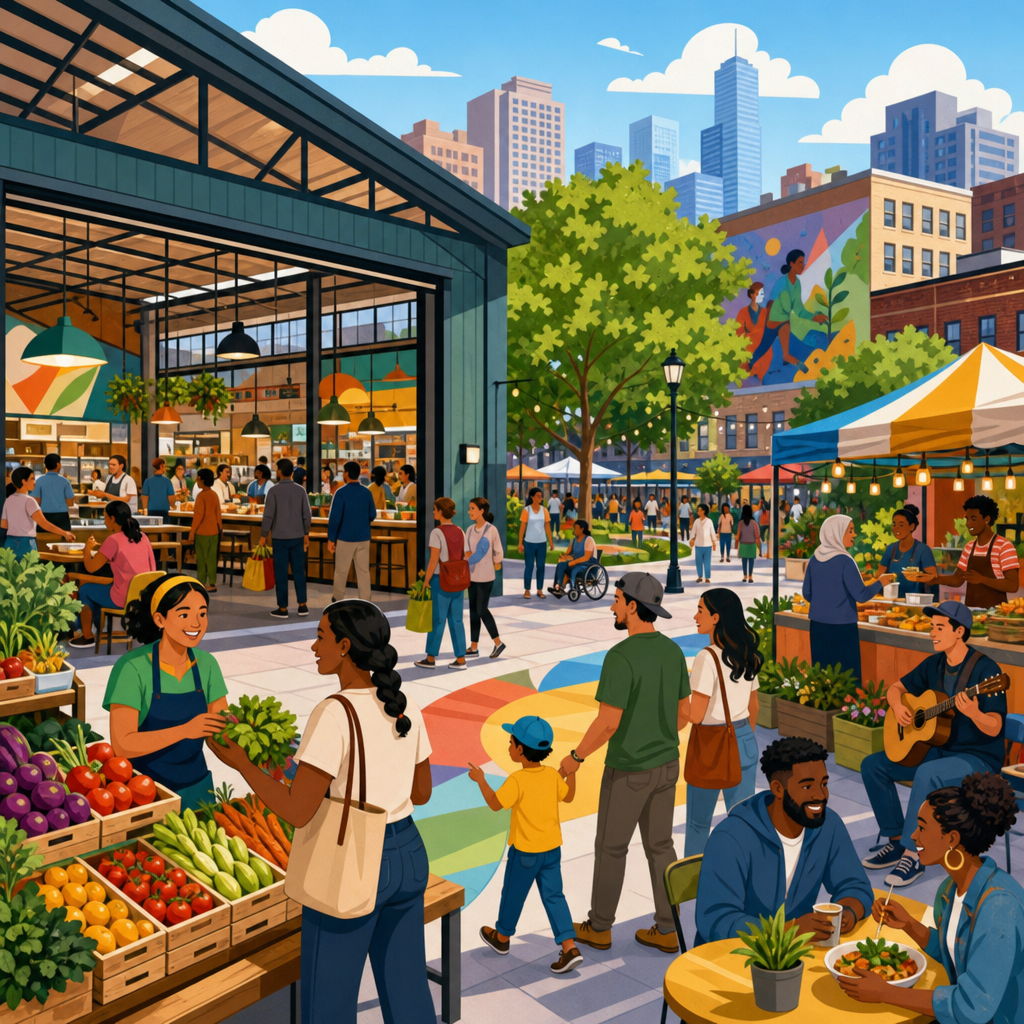
Public markets, food halls, and vendor spaces are often discussed as retail formats, but in practice they are community development tools that can strengthen local economies, support affordable housing goals, and shape neighborhood identity. A public market is a place where multiple independent sellers offer food, goods, or services in a shared setting, usually with a public mission tied to access, entrepreneurship, or civic life. A food hall is a curated indoor market, typically centered on prepared food and small operators, while vendor spaces include kiosks, stalls, carts, incubator storefronts, and flexible retail bays that lower the cost of entry for local businesses. Though the formats differ, the core idea is the same: shared infrastructure reduces barriers for small enterprises and creates a destination that serves residents before tourists.
In affordable housing and equitable development work, these spaces matter because housing alone does not make a complete neighborhood. Residents also need nearby jobs, fresh food, third places, and pathways into ownership. Over the years, I have seen projects struggle when the ground floor was filled with generic retail that never matched local buying power or culture. I have also seen mixed-use developments perform better when market halls or small vendor bays gave neighborhood entrepreneurs a realistic start. When planned well, these spaces help circulate dollars locally, activate underused buildings, reduce commercial vacancy, and create daily foot traffic that supports surrounding businesses. They can also preserve cultural traditions that rising rents often displace.
This hub article explains how public markets, food halls, and vendor spaces function, why they are used in community development, what models are most effective, and where the tradeoffs sit. It also connects the topic directly to affordable housing by examining mixed-use finance, neighborhood stabilization, and resident-serving retail. The key question is not whether every development needs a food hall. It is whether shared commercial space can deliver measurable community benefit more effectively than conventional leasing. In many neighborhoods, the answer is yes, especially when operators align tenant mix, affordability strategy, and public purpose from the start.
Why These Spaces Matter for Affordable Housing and Neighborhood Health
Public markets and vendor spaces support affordable housing objectives because they address economic inclusion at the same time as physical development. A housing project can produce below-market units, but residents still face pressure if everyday needs require long trips or if economic opportunity remains out of reach. Shared markets can bring fresh food, childcare-adjacent services, small business opportunities, and informal social connection into the same district. This is especially important in neighborhoods with weak retail demand, legacy disinvestment, or commercial corridors dominated by absentee ownership. By offering smaller footprints and shared utilities, these formats create lease terms that more local operators can actually sustain.
The community development case is strongest when these spaces are treated as infrastructure rather than lifestyle branding. A well-run market can function like a small business incubator, a food access strategy, a workforce platform, and a civic commons at once. Philadelphia’s Reading Terminal Market is often cited for its regional draw, but the lesson for local practitioners is less about tourism than governance and tenant diversity. Detroit’s Eastern Market shows how market districts can anchor wholesale activity, community events, neighborhood branding, and surrounding reinvestment over decades. Smaller examples matter too: neighborhood mercados in California and Texas have helped immigrant entrepreneurs formalize businesses, test products, and build credit histories that later support expansion into standalone storefronts.
For affordable housing developers, the practical benefit is project resilience. Ground-floor retail frequently underperforms when spaces are too large, rents are underwritten at unrealistic levels, or tenant improvement costs overwhelm local operators. Dividing space into kiosks, micro-stalls, shared kitchens, and short-term vendor bays creates a ladder of entry. Residents may begin with weekend vending, graduate to a stall, then move into a permanent lease. That progression is more aligned with how local businesses actually grow. It also creates more reasons for residents to stay and spend in the neighborhood, which can improve corridor safety perceptions and support nearby transit use.
Core Models: Public Markets, Food Halls, and Flexible Vendor Space
Although these terms are sometimes used interchangeably, the development model changes the outcome. Public markets usually operate with an explicit public-serving mission. They may include fresh produce, meat, staples, household goods, and prepared food, often in a municipally owned or nonprofit-managed setting. Food halls are usually more curated and more heavily weighted toward prepared food, beverage, and social gathering. Vendor spaces are the most flexible category, ranging from indoor kiosks in affordable housing projects to outdoor sheds, shipping-container clusters, and market plazas programmed on certain days of the week. The right model depends on neighborhood demand, operator capacity, and the project’s primary goal.
When the goal is food access and local entrepreneurship, a mission-driven public market is often the strongest fit. When the goal is foot traffic for a mixed-use district, a food hall may work, but only if price points match the trade area. I have seen too many food hall concepts fail because underwriting assumed suburban discretionary spending in a working-class neighborhood. Flexible vendor space tends to be the most durable entry strategy because it can start small, test demand quickly, and adapt seasonally. It also lowers the mismatch risk between rent assumptions and real customer behavior.
| Model | Primary Purpose | Typical Tenant Mix | Best Use Case | Main Risk |
|---|---|---|---|---|
| Public market | Food access, entrepreneurship, civic use | Produce, staples, prepared food, services | Community-serving district anchor | Operational complexity and subsidy need |
| Food hall | Destination dining and placemaking | Prepared food, beverage, specialty retail | High-foot-traffic mixed-use areas | Price mismatch and trend dependence |
| Vendor space | Low-barrier small business entry | Kiosks, carts, micro-retail, market stalls | Affordable housing sites, corridors, events | Limited storage, weather, uneven sales |
Design and operations matter as much as concept. Stall depth, grease capacity, loading, cold storage, waste handling, ADA circulation, and point-of-sale infrastructure all affect who can succeed. So do softer factors such as bilingual signage, simple lease documents, and technical assistance. The strongest projects use common area management and active curation rather than assuming that independent vendors can thrive without support. In community development terms, management is not overhead; it is the mechanism that converts space into outcomes.
Economic Development Benefits and Measurable Community Outcomes
The economic case for public markets is grounded in business formation, job creation, and local spending retention. Small vendors rarely have the capital for a conventional storefront with a long lease, major buildout, and full staffing requirement. Shared markets reduce those fixed costs. Operators can share seating, restrooms, utilities, cleaning, marketing, and security. That lowers break-even sales and lets entrepreneurs test products before taking on greater risk. In neighborhoods with many informal businesses, this can be the bridge to licensing, bookkeeping, and payroll systems. Once vendors establish sales history, they are more bankable and more likely to qualify for microloans or community development financing.
Measured outcomes should go beyond foot traffic. Strong market operators track vendor survival rates, tenant progression into brick-and-mortar space, neighborhood hiring, SNAP or WIC acceptance where applicable, sales per square foot, and the share of tenants from the surrounding ZIP codes. Some projects also track demographic representation among vendors, because inclusion goals are often stated but not measured. If the market sits within or near affordable housing, resident participation should be a core metric: how many residents are employed on site, how many have vending opportunities, and whether price points actually serve household budgets.
Examples from established markets show a range of impacts. Pike Place Market in Seattle demonstrates how a market can combine farm sales, small business tenancy, and social services within a larger district economy. Mercado La Paloma in Los Angeles illustrates how a nonprofit-led model can support immigrant-owned businesses while creating a culturally specific gathering place. In smaller cities, year-round public markets often serve as downtown anchors that pull spending back from auto-oriented retail strips. The lesson across cases is consistent: markets work best when they are embedded in a broader economic strategy, not treated as isolated real estate products.
Planning, Design, and Operations That Make These Projects Work
Successful market projects begin with trade area analysis and neighborhood listening, not branding exercises. Developers need to understand who lives nearby, how residents shop, what price points are realistic, and which product categories are missing. Retail leakage reports can be useful, but they are not enough. A corridor may show unmet demand for groceries while residents still prefer culturally specific formats, smaller basket sizes, or evening shopping hours tied to transit commutes. In practice, vendor recruitment should mirror actual community demand, including prepared food that supports workers, staple food for households, and services that increase repeat visits.
Physical planning should preserve flexibility. Modular stalls, shared prep areas, movable partitions, and utility chases that allow tenant turnover without major demolition reduce long-term risk. Outdoor spillover space can support seasonal vending and lower startup costs further. For affordable housing projects, direct access from the sidewalk matters more than polished interior aesthetics. If residents feel the space belongs to newcomers rather than existing neighbors, the project may generate activity without building trust. Good design signals public welcome through visibility, seating, restrooms, shade, stroller access, and a layout that does not penalize vendors in secondary locations.
Operations determine whether the market remains inclusive after opening day. Lease structures should balance stability with flexibility, using shorter initial terms, percentage-rent options where appropriate, and transparent fees. Technical assistance is usually necessary, especially for first-time tenants navigating health permits, insurance, labor rules, and digital payment systems. Strong operators also program events with purpose. Cooking demonstrations, youth markets, business workshops, and health screenings can increase traffic, but they should reinforce the market’s mission rather than distract from vendor sales. The manager’s role is part landlord, part coach, part curator, and part community liaison.
Financing, Governance, and Common Pitfalls
Most community-serving market projects do not pencil out on rent alone, at least not in the early years. Capital stacks often combine public funds, philanthropy, tax credits, local grants, mission-driven debt, and tenant contributions for equipment. In mixed-use affordable housing developments, the commercial component may require separate underwriting because residential subsidy programs rarely solve retail operating gaps. That is normal. A market with below-market stall rents, community programming, and high-touch management is providing public benefit, so some level of subsidy or cross-support is often justified. The mistake is pretending otherwise in pro formas.
Governance model shapes durability. Municipal ownership can stabilize rents and preserve mission, but public agencies may be slower in leasing and procurement. Nonprofit operators often bring stronger community relationships and fundraising ability. Private operators can move quickly and curate aggressively, yet they may drift toward upscale tenancy if investor pressure dominates. Hybrid models are common, such as public ownership with nonprofit management. Whatever the structure, decision rights should be clear on tenant selection, affordability targets, event programming, and reinvestment of surplus revenue. Ambiguity in governance usually becomes visible when the market gains popularity and competing priorities emerge.
Common pitfalls are predictable. The first is oversizing the project. A smaller market with full stalls and strong turnover is better than a large hall with chronic vacancy. The second is importing a concept that photographs well but does not fit local spending patterns. The third is underbudgeting operations, especially cleaning, staffing, and maintenance. Another frequent issue is failing to support vendors after lease-up. Independent operators need bookkeeping help, marketing support, and realistic renewal terms. Finally, success can create its own pressure. If a market drives corridor appreciation without protections for residents and legacy businesses, it can contribute to the displacement it was supposed to counter.
How This Hub Connects to the Broader Affordable Housing Strategy
As a hub within the affordable housing topic, public markets, food halls, and vendor spaces should be understood as part of a larger neighborhood systems approach. Housing affordability is more durable when households can access jobs, daily necessities, and entrepreneurship close to home. These shared commercial formats can support resident stability by reducing travel costs, creating entry-level business opportunities, and making mixed-use projects more useful to the people who live there. They also give developers and community organizations a practical tool for activating ground floors that might otherwise sit empty or lease only to chains with little local connection.
The strongest takeaway is simple: community-serving markets are not amenities added at the end of a project. They are operating platforms that need intentional design, realistic finance, and accountable management. When those conditions are in place, they can become engines of local wealth building, cultural preservation, and neighborhood vitality. When they are treated as trend pieces, they underperform. If you are evaluating an affordable housing or mixed-use project, start by asking who the space is for, what barriers local vendors face, and how success will be measured over time. Then build the market strategy to answer those questions clearly.
Frequently Asked Questions
1. How do public markets, food halls, and vendor spaces function as community development tools rather than just retail concepts?
Public markets, food halls, and vendor spaces are often described in terms of leasing, merchandising, and foot traffic, but their broader value is social and economic. These spaces create low-barrier opportunities for local entrepreneurs to test concepts, build customer bases, and grow businesses without the full cost and risk of a standalone storefront. That matters in neighborhoods where capital access is limited and where small business ownership can be a pathway to wealth creation, job growth, and local economic resilience.
They also serve as places of connection. Unlike single-tenant retail, these shared environments bring together residents, workers, visitors, and community organizations in one accessible setting. A well-designed market can become a neighborhood gathering place, a venue for civic programming, a showcase for local culture, and a source of fresh food or daily services. In that sense, the market is not just a commercial asset; it is social infrastructure.
From a development perspective, these spaces can support broader goals such as corridor revitalization, adaptive reuse, neighborhood identity building, and inclusive economic development. They can activate underused sites, increase local spending retention, and create visible opportunities for small-scale entrepreneurship. When aligned with public policy and intentional management, they can also help advance equity objectives by reserving space for local vendors, prioritizing minority- and women-owned businesses, accepting nutrition benefits, and offering business support services. The strongest projects are those that see the market not as an amenity alone, but as a platform for community wealth building and long-term neighborhood stabilization.
2. What is the difference between a public market, a food hall, and a vendor space, and why does that distinction matter in planning and development?
A public market is typically defined by mission as much as by format. It usually brings together multiple independent sellers in a shared environment and often has a public-serving purpose tied to food access, small business incubation, cultural representation, entrepreneurship, or civic life. Public markets may be operated by nonprofits, public-private partnerships, or mission-driven entities, and they often emphasize affordability, local ownership, and community participation alongside revenue generation.
A food hall is usually more curated and more focused on prepared food and beverage offerings. Many food halls are privately developed and positioned as destination-oriented experiences that combine dining, design, and programming. That does not make them less valuable, but it often means their priorities are different. Some food halls are highly community-oriented and intentionally support local operators; others are more tourism- or lifestyle-driven and may not include the same affordability or public mission components found in a traditional public market.
Vendor space is the broadest category. It can include market stalls, kiosks, carts, incubator suites, shared retail bays, seasonal booths, and flexible micro-retail formats embedded in larger developments or public spaces. Vendor spaces are important because they create entry points for businesses at different stages of growth. A start-up that cannot yet support a long-term lease might succeed in a stall, kiosk, or pop-up environment first.
The distinction matters because planning, financing, governance, and success metrics should match the model. A mission-driven public market may require public subsidy, nonprofit management, and affordability protections. A food hall may rely more heavily on private capital, destination traffic, and curated leasing. A vendor space strategy may be most effective when paired with business training, flexible lease terms, and infrastructure that supports experimentation. Treating all three formats as interchangeable can lead to unrealistic expectations and weak outcomes. The better approach is to define the purpose first, then select the format, operating structure, and tenant strategy that best advance that purpose.
3. In what ways can these shared market formats support local economies and small business growth?
One of the clearest economic benefits of public markets, food halls, and vendor spaces is that they reduce barriers to entry for independent businesses. Traditional retail space often requires substantial capital for build-out, equipment, staffing, and long lease commitments. Shared market environments can lower those hurdles through smaller footprints, shared utilities, common seating, coordinated marketing, and phased entry points. That makes entrepreneurship more realistic for first-time operators, immigrant-owned businesses, family-run concepts, and businesses that may not qualify easily for conventional financing.
These formats also allow vendors to test demand in real time. Instead of making a large upfront bet on a single location, operators can refine pricing, menus, branding, and customer experience in a smaller setting. Developers and operators benefit as well, because a market can function as a business incubator that helps identify which vendors are ready to scale into permanent retail space elsewhere in the corridor or neighborhood. This creates a local business pipeline rather than relying only on outside tenants.
Beyond individual businesses, the broader local economy can benefit through job creation, supply chain activity, and spending recirculation. Independent vendors are more likely than national chains to purchase from local producers, hire locally, and retain profits within the region. Markets can also draw visitors to commercial districts, increasing exposure for nearby shops and services. When combined with events, arts programming, and community partnerships, they can extend dwell time and strengthen district-level vitality.
The economic impact is strongest when the project includes intentional support systems. These may include affordable lease structures, percentage-rent models, shared commercial kitchens, technical assistance, language access, marketing support, mentorship, and access to capital. Without those supports, shared markets can still generate activity, but they may not deliver the full inclusive development benefits that communities are seeking. The best projects understand that entrepreneurship support is not secondary to the real estate concept; it is central to the value proposition.
4. How can public markets and vendor spaces support affordable housing and broader neighborhood stabilization goals?
At first glance, markets and housing may seem like separate development issues, but in practice they are closely linked. Affordable housing is not only about units; it is also about whether residents can live in neighborhoods that provide services, jobs, food access, and opportunities for economic mobility. Public markets and vendor spaces can contribute to that ecosystem by making neighborhoods more functional and more inclusive without depending exclusively on large-format retail or high-rent commercial tenants.
In mixed-use developments, a market can serve as a neighborhood amenity that supports residents while also creating entrepreneurship pathways for people who live nearby. This is especially relevant in affordable or mixed-income housing projects where the development team wants ground-floor uses that are active, community-serving, and economically accessible. Smaller stalls and flexible vendor space can be more achievable for local businesses than conventional retail bays, which are often too expensive or too rigid for emerging operators.
These spaces can also help stabilize neighborhoods by providing daily-use destinations, increasing pedestrian activity, and strengthening local identity. When residents have access to fresh food, prepared meals, community gathering space, and culturally relevant businesses close to home, the neighborhood becomes more livable and connected. That can support resident retention and improve perceptions of safety and investment.
However, the relationship must be managed carefully. If a market is positioned purely as an upscale amenity without protections for local vendors or existing residents, it can contribute to displacement pressure rather than community benefit. That is why many successful community-oriented projects use tools such as local leasing preferences, below-market rents for small vendors, community advisory structures, anti-displacement strategies, and partnerships with affordable housing providers or community development corporations. When housing, commercial strategy, and public mission are aligned, markets can reinforce neighborhood stability rather than simply raising visibility and rents.
5. What makes a public market or food hall successful from a long-term community development standpoint?
Long-term success depends on more than strong design or an initial burst of visitor interest. A community-serving market needs a clear mission, realistic operating model, and governance structure that can balance financial sustainability with public purpose. That begins with understanding who the market is for. Is the primary goal food access, small business incubation, downtown activation, cultural preservation, tourism, or some combination of these? A project that tries to serve every objective equally without prioritization often struggles operationally.
Tenant mix is another critical factor. Successful markets typically combine anchors and emerging vendors, everyday affordability and destination appeal, and a mix of uses that keep the space active at different times of day. Prepared food may drive traffic, but many community-oriented markets also benefit from staples such as produce, specialty groceries, services, local crafts, and programming partners. The goal is to create both frequency and relevance, not just novelty.
Management matters just as much as concept. Vendors need active support, consistent standards, coordinated promotion, and a landlord or operator who understands that small businesses require more hands-on partnership than conventional retail tenants. Strong operations include maintenance, security, marketing, event programming, data tracking, and ongoing vendor development. Public-facing spaces with weak management can decline quickly even if the original idea was strong.
Finally, the right success measures are essential. For a community development project, performance should not be judged only by sales per square foot. Other indicators may include number of local businesses launched, vendor graduation into permanent space, jobs created, participation by historically underrepresented entrepreneurs, community event attendance, food access outcomes, and the project’s contribution to neighborhood vitality. The most effective markets are not just busy places; they are durable institutions that create economic opportunity, reflect local identity, and continue delivering value long after opening day.


