
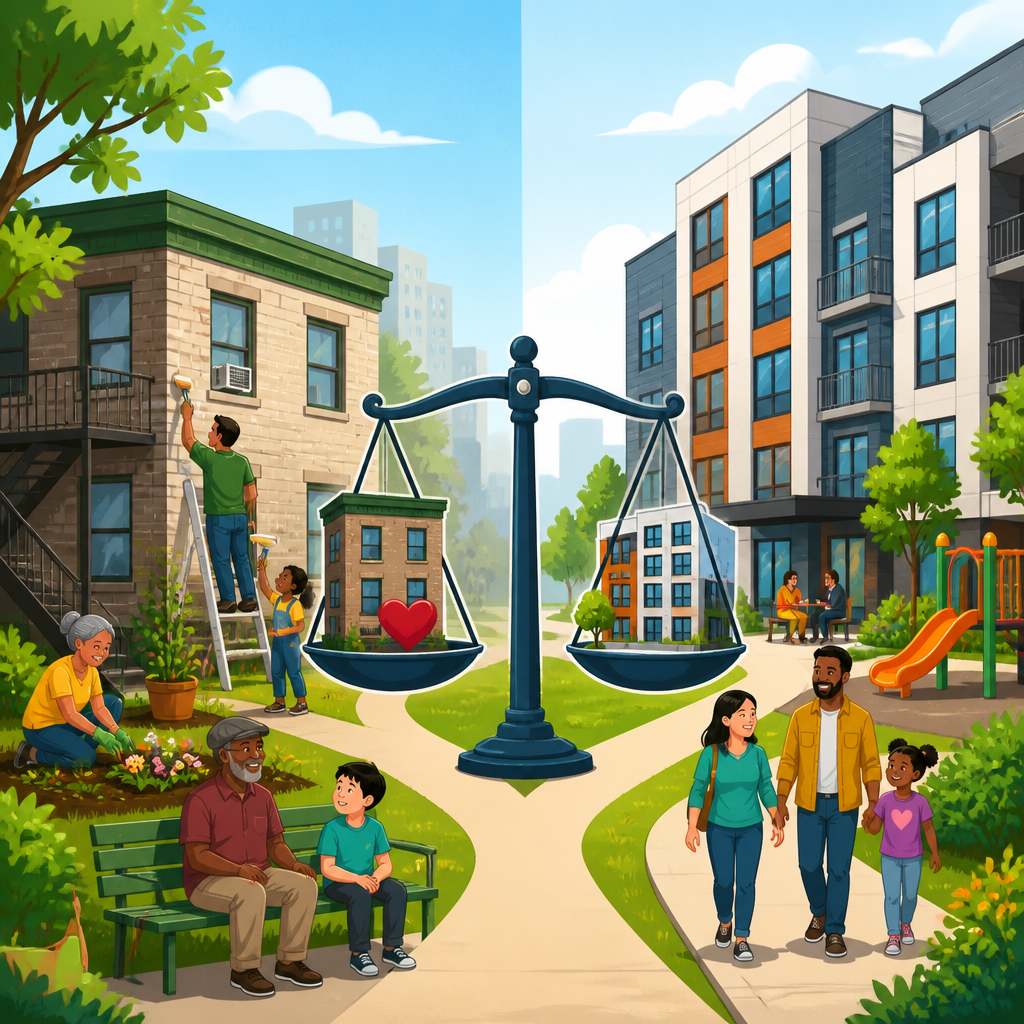
Preservation versus replacement in aging subsidized housing is one of the most consequential decisions in urban planning because it determines whether low-income residents remain rooted in their communities or are displaced by the economics of redevelopment. Subsidized housing includes public housing, project-based Section 8 properties, Low-Income Housing Tax Credit developments, and other rent-restricted homes supported by federal, state, or local programs. Preservation means extending the useful life and affordability of existing buildings through rehabilitation, recapitalization, ownership transfer, or policy protections. Replacement means demolishing obsolete housing and constructing new units, either on the same site or elsewhere, often with a different financing stack, design standard, and timeline. I have worked with housing agencies, owners, and planners evaluating both paths, and the lesson is consistent: the right answer depends on physical condition, cost, resident needs, neighborhood pressures, and long-term affordability controls. This issue matters because the United States already faces a severe shortage of affordable homes, while much of the subsidized stock was built decades ago and now requires major capital investment. Roofs fail, plumbing corrodes, elevators age out, and mechanical systems become inefficient, yet these buildings also anchor school enrollment, transit access, and social networks. Decisions made property by property shape household stability, municipal budgets, carbon emissions, and fair housing outcomes for decades.
What preservation actually means in practice
Preservation is not simply fixing a roof or repainting a hallway. In practice, it is a structured strategy to maintain habitability, extend affordability restrictions, and recapitalize a property so it can operate reliably for another fifteen to forty years. Common preservation tools include Rental Assistance Demonstration conversions for public housing, project-based voucher contracts, tax-exempt bonds, 4 percent and 9 percent housing credits, HOME funds, Community Development Block Grants, historic tax credits when applicable, and local soft loans. A typical preservation transaction starts with a physical needs assessment, a capital needs schedule, environmental review, operating pro forma, relocation plan, and affordability analysis. Teams then determine whether selective rehabilitation, gut renovation, phased construction, or occupied rehab is feasible.
Preservation works best when the building has a sound structural frame, a location that still serves residents well, and a financing path that can close the capital gap without excessive rent pressure. For example, a brick mid-rise with failing boilers, original windows, and outdated kitchens may still be a strong preservation candidate if foundations, floor plates, and unit layouts remain functional. In one portfolio review I supported, replacing central heating, upgrading electrical service, remediating lead hazards, adding insulation, and modernizing elevators cost far less than demolition and new construction once temporary relocation, site work, entitlement risk, and prevailing wage assumptions were fully modeled. Preservation also protects embedded affordability. When a property already serves extremely low-income households, retaining subsidy contracts and regulatory agreements can be more reliable than promising one-for-one replacement later, especially in expensive markets where land costs consume a large share of development budgets.
When replacement becomes the stronger option
Replacement is justified when deterioration is so severe that rehabilitation is technically inefficient, financially irrational, or unsafe for continued occupancy. Red flags include failing foundations, chronic water intrusion causing deep structural damage, obsolete unit configurations that cannot meet accessibility requirements, severe environmental contamination, or superblock site plans that isolate residents from streets and services. Some public housing campuses also suffer from design flaws that preservation alone cannot solve, such as dead-end circulation, blank edges, poor sightlines, or buildings sited within flood zones. In these cases, replacement can produce safer homes, better energy performance, and a more connected urban form.
However, replacement is not automatically modernization. Demolition lengthens delivery timelines, increases resident disruption, and can shrink the number of deeply affordable units if financing is incomplete or land is repurposed for mixed-income redevelopment. A replacement plan should therefore prove several points clearly: the existing asset cannot be reasonably preserved; residents will receive enforceable relocation rights and a genuine right to return; replacement units will match or exceed prior affordability levels; and the phasing plan avoids unnecessary vacancy loss. Strong replacement projects often combine resilient design, universal accessibility, higher density near transit, and improved public realm design. The most defensible cases are evidence based, not image driven. New buildings may photograph better, but housing policy should measure outcomes in affordability term, resident stability, operating sustainability, and neighborhood equity.
How decision makers evaluate preservation versus replacement
The best framework compares options across physical, financial, social, and policy dimensions rather than reducing the choice to upfront construction cost. A capital needs assessment estimates near-term repairs, life-cycle replacements, and systems risk. A redevelopment budget models demolition, abatement, hard costs, soft costs, financing fees, reserves, relocation, and contingency. An operating model tests debt capacity, utility assumptions, subsidy layering, and replacement reserve needs over time. Resident data adds another critical lens: family size, disability status, language access needs, school attendance patterns, and dependence on nearby transit or health providers. Policy context matters too. A city under intense displacement pressure may prioritize preserving every deeply affordable unit in high-opportunity neighborhoods, while a flood-prone site may require strategic retreat and replacement on safer land.
A practical comparison looks like this:
| Decision factor | Preservation usually fits when | Replacement usually fits when |
|---|---|---|
| Building condition | Structure is sound and systems can be renewed | Structural failure or severe contamination makes rehab inefficient |
| Affordability protection | Existing subsidies can be extended with low disruption | New financing can guarantee equal or deeper affordability |
| Resident impact | Occupied or phased rehab limits displacement | Temporary relocation is manageable and right-to-return is enforceable |
| Urban design | Site already connects well to streets, transit, and services | Current layout blocks access, safety, or resilience goals |
| Climate and energy | Envelope and systems upgrades can deliver major savings | Rebuilding is needed to address flood, heat, or code risks |
This kind of matrix clarifies tradeoffs. It also disciplines public debate, which too often swings between nostalgia for old buildings and enthusiasm for new construction without fully accounting for resident outcomes.
Resident impact, relocation, and the right to return
The human stakes are highest during relocation. Even a well-financed redevelopment can destabilize households if communication is inconsistent, temporary moves are too distant, or voucher counseling is weak. In aging subsidized housing, many residents are seniors, people with disabilities, families with children in neighborhood schools, and workers tied to local transit routes. Preservation often reduces disruption because rehabilitation can be phased by building or floor, and some work can occur with residents in place. Yet occupied rehab has limits. Lead hazard control, extensive plumbing replacement, or full electrical rewiring may require temporary moves. The key is planning early, funding relocation fully, and documenting rights in plain language.
Replacement raises these stakes further because demolition usually means every household must move at least once. Best practice includes dedicated relocation staff, language access, moving cost reimbursement, school continuity support, case management for medically vulnerable residents, and legally binding right-to-return provisions without rescreening barriers tied to redevelopment delays. Agencies should track who returns, not merely who was eligible to return. I have seen projects declare success because a right existed on paper while the actual return rate lagged due to communication failures, changing household composition, or prolonged construction timelines. If preservation can keep more residents stably housed through the work, that benefit deserves substantial weight in any policy analysis.
Financing realities and long-term operations
Money often decides the outcome, but simplistic cost per unit comparisons can mislead. Preservation may appear cheaper because it reuses structure and site infrastructure, but hidden conditions inside walls, tenant protection requirements, and patchwork financing can push costs up quickly. Replacement may support better operating efficiency through modern systems, simpler unit layouts, and lower maintenance burden, but it usually faces higher soft costs, longer carrying periods, and more exposure to interest rate shifts. Decision makers should compare total development cost, stabilized operating cost, reserve adequacy, and subsidy durability over the full life cycle of the asset.
Long-term operations matter as much as closing the deal. A preserved property with underfunded reserves will re-enter distress in a decade. A replacement project with ambitious energy systems but weak maintenance capacity can underperform quickly. Strong underwriting uses realistic vacancy assumptions, replacement reserve deposits sized to system life cycles, and clear roles for asset management after conversion. HUD guidance, Uniform Physical Condition Standards inspections, energy benchmarking, and procurement controls all help, but execution determines results. The most resilient deals align capital scope with an owner’s actual ability to manage complex housing over time. Preservation is strongest when recapitalization addresses root causes of deferred maintenance. Replacement is strongest when the new asset is not only attractive at ribbon cutting but financially durable in year twenty.
Climate resilience, health, and neighborhood equity
Aging subsidized housing sits at the intersection of climate risk and public health. Older buildings often leak conditioned air, overheat in summer, and rely on mechanical systems that fail during extreme weather. Preservation can deliver major gains through insulation, air sealing, high-performance windows, heat pumps, balanced ventilation, low-flow fixtures, and backup power for critical loads. These upgrades reduce utility costs and improve indoor air quality, especially when paired with mold remediation and moisture control. For residents with asthma or mobility limitations, such improvements are not cosmetic; they directly affect daily health and safety.
Replacement can go further when a site itself is unsafe. Rebuilding above flood elevations, reconfiguring stormwater systems, using all-electric design, and creating accessible open space may justify a new project in ways preservation cannot. Yet neighborhood equity must remain central. If replacement results in fewer deeply subsidized units in a transit-rich area, a city may worsen segregation even while improving building performance. Conversely, preserving deteriorated housing in a disinvested location without addressing environmental burdens or service gaps can lock residents into inequity. The strongest policy approach joins housing investment with safer streets, tree canopy, transit access, broadband, schools, and health services. The question is not only whether to preserve a building or replace it, but whether the chosen path improves life chances for current and future residents.
Conclusion
Preservation versus replacement in aging subsidized housing is ultimately a decision about lasting affordability, resident stability, and responsible stewardship of scarce public resources. Preservation is often the best path when buildings remain fundamentally sound, existing subsidies can be extended, and rehabilitation can correct deferred maintenance without uprooting households. Replacement is the better choice when structural failure, contamination, unsafe siting, or severe design flaws make rehabilitation a poor use of money and an inadequate response to resident needs. The right analysis is rigorous, transparent, and centered on residents rather than appearances. It compares physical condition, relocation burden, financing durability, climate resilience, and neighborhood equity over the full life of the asset.
For planners, housing authorities, nonprofit owners, and community advocates, the main benefit of getting this choice right is clear: more safe, affordable homes that remain stable for decades instead of repeating cycles of disinvestment and displacement. Use a property-by-property framework, require enforceable resident protections, and test both scenarios with real capital and operating assumptions before committing public funds. If you are building an urban planning and policy strategy, start by reviewing your aging subsidized housing portfolio through this preservation-versus-replacement lens and prioritize the sites where the stakes for residents are highest.
Frequently Asked Questions
What does preservation mean in aging subsidized housing, and how is it different from replacement?
Preservation in aging subsidized housing means keeping existing affordable homes in service by extending affordability restrictions, rehabilitating buildings, modernizing systems, and improving living conditions without eliminating the property’s core role as long-term affordable housing. In practice, that can include renewing project-based rental assistance contracts, recapitalizing properties with Low-Income Housing Tax Credits, using public subsidies for major repairs, addressing deferred maintenance, upgrading accessibility features, and improving energy performance. The central goal is to retain homes that already serve low-income households while minimizing disruption to residents and protecting affordability in neighborhoods where replacement housing may be difficult or expensive to create.
Replacement, by contrast, typically involves demolishing or substantially redeveloping older subsidized housing and building new units in its place, either on the same site or elsewhere. Replacement can deliver brand-new buildings, updated layouts, and higher construction standards, but it often carries major tradeoffs. Redevelopment timelines are longer, financing is more complex, and current residents may face temporary or permanent relocation. In some cases, replacement produces fewer deeply affordable units than existed before, especially when redevelopment includes mixed-income strategies or market-rate components to support financing. That is why the preservation-versus-replacement decision is not simply a question of building age; it is a question of affordability, tenant stability, neighborhood equity, and whether public investment strengthens or weakens the social fabric of a community.
Why is preservation often considered the first choice for aging subsidized housing?
Preservation is often prioritized because it protects one of the hardest resources to recreate in urban housing policy: existing affordable homes in established communities. Many subsidized properties are located near schools, transit, jobs, health care, social networks, and cultural institutions that residents depend on every day. When those homes are preserved, families can remain connected to the places and people that support stability. That matters for older adults, people with disabilities, children in school, and households with limited financial flexibility, all of whom can be disproportionately harmed by relocation, even when relocation is labeled temporary.
There is also a strong economic argument for preservation. In many markets, preserving an existing subsidized property costs less and happens faster than replacing it with new construction, especially when land prices, permitting requirements, infrastructure needs, and construction costs are high. Preservation allows agencies and owners to retain deeply affordable units that may otherwise be impossible to reproduce at the same rent levels. It can also prevent expiring affordability restrictions or physical decline from triggering loss of units to the private market. While preservation is not always the right answer, it is frequently seen as the most practical way to maintain affordability at scale while reducing displacement risk and making more efficient use of limited public funds.
When does replacement make more sense than preservation?
Replacement may make more sense when a property’s physical condition is so compromised that rehabilitation is no longer financially or structurally reasonable. Examples include buildings with severe foundation problems, obsolete layouts that cannot be adapted well, extensive environmental hazards, chronic infrastructure failure, or site conditions that make long-term rehabilitation inefficient and unsafe. In these cases, trying to preserve a building at all costs can divert scarce resources into a property that still may not meet modern standards for health, safety, accessibility, resilience, or quality of life.
Replacement can also be justified when redevelopment creates a clearly better outcome for current and future residents, but that standard should be high. A sound replacement strategy usually includes one-for-one replacement of subsidized units, enforceable long-term affordability, robust resident protections, clear relocation assistance, a realistic right-to-return policy, and transparent community engagement from the earliest planning stages. It may also include larger unit sizes, improved accessibility, modern building systems, climate resilience upgrades, and better site design. In other words, replacement is strongest as a policy choice when it does not merely produce newer buildings, but when it meaningfully improves housing quality without sacrificing affordability or displacing the very households the subsidized housing system was designed to serve.
How does the preservation-versus-replacement decision affect residents and communities?
The effects on residents are profound because housing is not just a physical asset; it is the foundation of everyday life. Preservation generally allows residents to remain in place or experience less disruption, which helps maintain employment, school attendance, caregiving routines, medical access, and neighborhood relationships. Even when preservation requires temporary relocation during construction, the scale and duration of displacement are often less severe than in full redevelopment. Residents may also benefit from upgraded units, healthier indoor environments, improved building security, and lower utility costs when preservation includes modernization and energy-efficiency work.
Replacement can bring major benefits if done well, but it can also destabilize households and reshape neighborhoods in ways that reduce equity. Temporary relocation can become prolonged, and some residents may never return if eligibility rules change, the number of deeply affordable units declines, or redevelopment takes longer than promised. Communities can also lose informal support systems, local spending patterns, and cultural continuity when residents are dispersed. On a broader level, these decisions influence whether cities preserve mixed-income and racially diverse neighborhoods or accelerate patterns of displacement and exclusion. That is why resident engagement, legal protections, relocation planning, and measurable affordability commitments are not side issues; they are central to evaluating whether a preservation or replacement strategy truly serves the public interest.
What should policymakers, housing authorities, and developers evaluate before choosing preservation or replacement?
A credible decision should begin with a rigorous assessment of the property’s physical condition, remaining useful life, capital needs, environmental issues, accessibility gaps, and operating performance. Decision-makers should also evaluate the affordability structure of the property, including subsidy contracts, regulatory agreements, eligibility rules, and the risk of losing units to market conversion. Financial analysis matters as well, but it should not be limited to upfront construction costs. A serious comparison looks at long-term operating costs, financing feasibility, tenant protection costs, timing, public subsidy needs, resilience benefits, and the likelihood that the chosen strategy will actually preserve or expand deeply affordable housing over time.
Just as important, planners should assess resident impact and neighborhood context. That means analyzing displacement risk, school stability, transit access, health outcomes, fair housing implications, and the availability of comparable replacement housing nearby. They should ask whether residents support the plan, whether there is a guaranteed right to return, whether unit counts and bedroom sizes will be maintained, and whether the redevelopment model could unintentionally reduce access for extremely low-income households. The best decisions are transparent, data-driven, and resident-centered. They recognize that subsidized housing is public infrastructure in a social sense as much as a real estate asset, and that the true measure of success is not simply whether a project pencils out, but whether it preserves housing security, dignity, and community continuity for the people who live there.


