
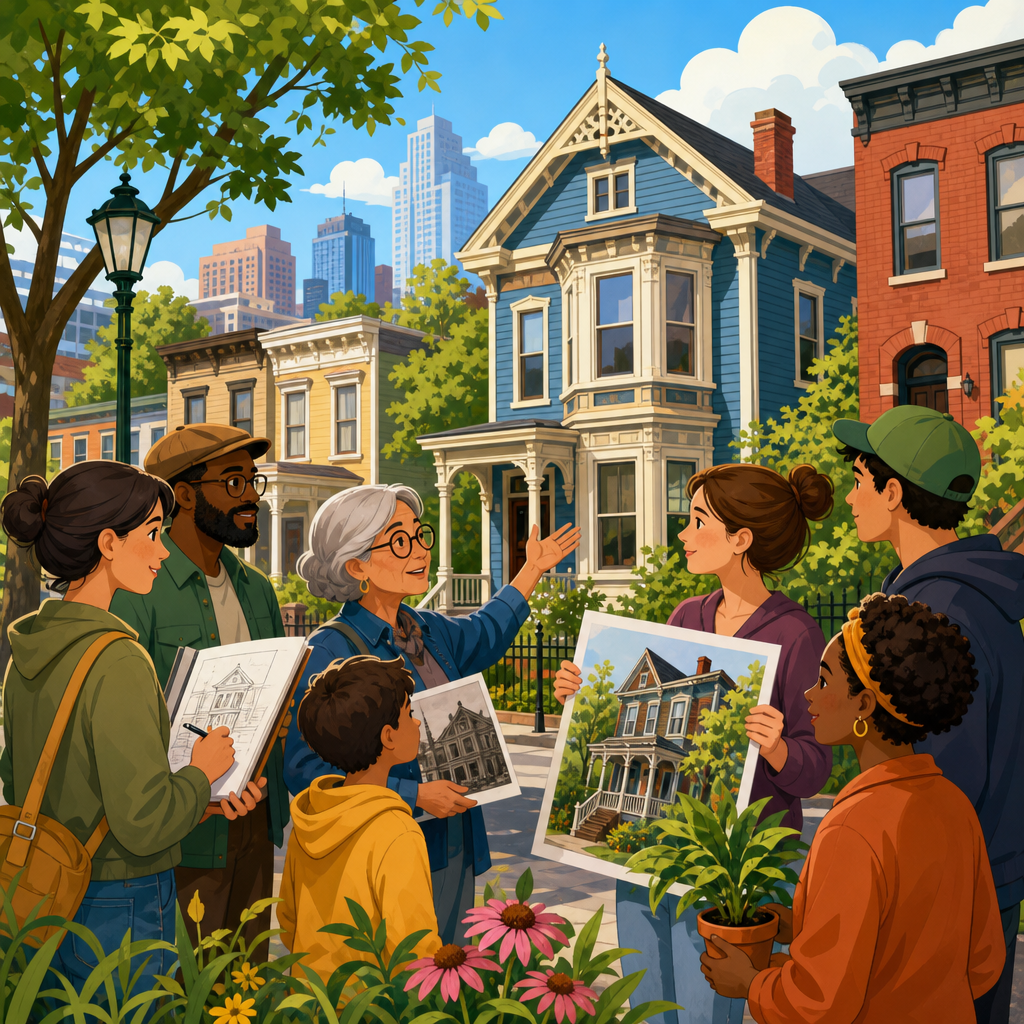
Preservation movements shape how cities remember themselves, how residents defend community identity, and how policymakers balance growth with continuity. In urban planning, historic neighborhood preservation refers to the coordinated effort to protect buildings, streetscapes, public spaces, and cultural patterns that carry architectural, social, and economic significance. A historic neighborhood is not simply old housing. It is a living district where design, land use, migration history, local business patterns, and shared memory combine into a recognizable place. When people ask why preservation matters, the shortest answer is this: once a neighborhood’s fabric is erased, it cannot be authentically rebuilt. New construction can imitate brick facades or row house proportions, but it cannot reproduce the layered history embedded in original materials, street grids, corner stores, religious institutions, and long-standing social networks.
I have worked with preservation plans, zoning text, community surveys, and design review cases, and the same tension appears in almost every city. One side argues that preservation blocks housing, investment, and modernization. The other argues that unchecked redevelopment destroys affordability, displaces residents, and weakens civic identity. Both concerns can be valid. The best preservation movements do not freeze neighborhoods in time. They define what must be protected, where change is appropriate, and how public policy can guide reinvestment without sacrificing character. That is why preservation belongs inside mainstream urban planning and policy, not in a narrow conversation about landmark architecture alone.
Historic neighborhoods matter for practical reasons as well as cultural ones. Older districts often support walkability because they were built before auto-oriented zoning separated homes, shops, schools, and workplaces. Their buildings frequently use durable materials such as stone, old-growth timber, and fired brick. Reusing those structures can reduce demolition waste and preserve the embodied carbon already invested in construction. Preservation can also strengthen local economies. Main streets in historic districts often attract small businesses, heritage tourism, and rehabilitation jobs requiring skilled labor. At the same time, preservation policy needs careful design. Without anti-displacement tools, successful restoration can raise rents and property taxes. The real fight to save historic neighborhoods is therefore about more than facades. It is about governance, equity, memory, environmental responsibility, and the future form of the city.
How preservation movements began and what they are trying to protect
Modern preservation movements grew from repeated losses. In the twentieth century, urban renewal programs, highway construction, speculative demolition, and large-scale redevelopment erased blocks that communities assumed would always exist. In the United States, the demolition of New York’s original Pennsylvania Station in 1963 became a defining turning point because it showed that even monumental architecture was vulnerable. Similar shocks occurred in many cities when working-class districts, Black neighborhoods, immigrant enclaves, and industrial corridors were cleared in the name of progress. Preservation activism emerged as a response not only to aesthetic loss but also to the social damage caused when communities were uprooted and neighborhood institutions disappeared.
What preservation movements try to protect has broadened significantly. Early campaigns often focused on elite landmarks: grand houses, courthouses, train stations, or churches. Today, planners and advocates recognize vernacular buildings, cultural landscapes, social history, and intangible heritage as equally important. A modest row house block can matter because it represents labor history, immigrant settlement, or civil rights organizing. A commercial strip can matter because family-owned businesses have served generations there. A neighborhood can qualify as historic not because every structure is architecturally distinguished, but because the district as a whole tells a coherent story about city building.
That broader understanding changed the tools preservation movements use. Surveys and inventories now document not just style and age, but also association, use, and community meaning. The National Register of Historic Places, local landmark ordinances, conservation districts, historic context statements, and cultural resource surveys all serve different functions. National designation may recognize significance, while local designation usually provides regulatory power over demolition and exterior changes. In practice, strong neighborhood preservation depends on local law, political support, and organized residents. Recognition alone rarely saves a place from redevelopment pressure.
How historic neighborhood preservation works in planning and policy
Preservation becomes effective when it is embedded in the city’s planning system. The central policy question is not whether change will happen. It is how change will be directed. Local governments generally use a combination of zoning, design review, demolition controls, tax incentives, and planning guidance. Historic district overlays can require commissions to review proposed alterations, additions, or teardowns. Demolition delay ordinances create time for negotiation or documentation before a building is lost. Form-based standards can help compatible infill fit existing scale, setbacks, and frontage patterns. Transfer of development rights may shift unused development potential from protected sites to growth areas, allowing cities to preserve valued places while accommodating density elsewhere.
In cities where I have seen preservation succeed, officials start with a historic context study rather than isolated reactions to individual demolition permits. Context studies explain why a neighborhood matters, identify contributing and noncontributing structures, and connect preservation decisions to broader goals such as housing, climate resilience, transportation, and economic development. This is important because preservation policy fails when it is treated as a decorative add-on. It works when it informs comprehensive plans, capital improvement priorities, corridor strategies, and neighborhood reinvestment programs.
Policy design must also distinguish between legitimate rehabilitation and harmful neglect. Building codes, accessibility standards, and energy performance requirements can be met in older buildings, but not always through the same methods used in new construction. The Secretary of the Interior’s Standards for the Treatment of Historic Properties offer widely used guidance for repair, replacement, and adaptive reuse. Tax credits, especially federal historic rehabilitation tax credits in the United States, can make complex projects financially feasible. Yet incentives need administrative clarity. If approvals are unpredictable or review timelines are excessive, property owners may oppose preservation even when they value neighborhood character.
| Policy Tool | What It Does | Main Benefit | Main Limitation |
|---|---|---|---|
| Local historic district | Regulates demolition and exterior changes through design review | Strong protection for neighborhood character | Can be politically contentious and administratively slow |
| Conservation district | Applies lighter design standards to preserve overall form | More flexible than landmark designation | May be too weak to stop teardowns |
| Demolition delay ordinance | Pauses demolition for a set review period | Creates time to find alternatives | Does not guarantee preservation |
| Historic tax credit | Offsets rehabilitation costs for qualifying projects | Encourages reinvestment in older buildings | Complex compliance rules can limit access |
| Adaptive reuse zoning relief | Allows code and use flexibility for existing buildings | Makes preservation financially practical | Needs careful drafting to protect safety and character |
The major threats facing historic neighborhoods today
The threats to historic neighborhoods are more varied now than a simple wrecking ball. Demolition for high-value redevelopment remains a leading risk, especially near downtowns, waterfronts, transit stations, and university districts where land values rise quickly. In hot markets, even structurally sound buildings can be removed because replacement projects yield larger returns. A related problem is incremental erosion. Vinyl windows, incompatible additions, oversized garages, facade stripping, lot consolidation, and signage changes may seem minor individually, yet over time they weaken the district’s integrity and make formal protection harder to justify.
Disinvestment is another serious threat. Some neighborhoods are lost not to prosperity but to abandonment. Deferred maintenance, absentee ownership, predatory speculation, and code enforcement gaps can push older structures into avoidable decline. I have seen owners intentionally neglect buildings, then argue that demolition is the only reasonable option. Preservation advocates call this demolition by neglect, and cities need enforcement tools to stop it. Without minimum maintenance standards, preservation law protects paper designations more than actual buildings.
Climate risk is becoming central to preservation planning. Flooding, wildfire exposure, extreme heat, and stronger storms threaten historic neighborhoods across regions. Coastal districts face repeated inundation and rising insurance costs. Older buildings may also contain hazardous materials such as lead paint or asbestos that complicate rehabilitation. The policy challenge is not whether resilience upgrades should occur, but how to do them without destroying defining features. Elevation, floodproofing, window retrofits, and mechanical system replacement all require technical judgment. Preservation and resilience are not opposing goals, but they do require coordinated standards and realistic funding.
Preservation, housing affordability, and the displacement debate
One of the hardest questions in urban planning is whether historic preservation helps or harms affordability. The honest answer is that it can do either, depending on market conditions and policy design. Critics are correct that strict limits on demolition and redevelopment can constrain supply on valuable land. In high-demand neighborhoods, that may raise prices if preservation is used broadly without parallel housing strategies. Supporters are correct that preservation can also slow speculative teardown cycles, maintain smaller existing units, and protect residents from abrupt neighborhood transformation. Older housing stock is often naturally more affordable than new luxury construction, even when it needs repair.
The key is to separate preservation from exclusion. If a city preserves a historic neighborhood while banning accessory dwelling units, small apartment buildings, missing-middle infill, and adaptive reuse nearby, pressure intensifies and costs rise. If that same city directs more housing to transit corridors, commercial nodes, vacant parcels, and underused sites, preservation can coexist with growth. Good policy also includes property tax relief for long-time owners, low-interest rehabilitation loans, rental stabilization tools where legal, and targeted support for legacy businesses. Preservation that saves buildings but loses residents has only partially succeeded.
There is also a justice dimension. Many historically significant neighborhoods associated with Black, Latino, Asian, Indigenous, and immigrant communities were overlooked for decades because preservation systems favored architecturally grand or politically connected places. Correcting that bias requires better surveys, inclusive criteria, oral history, and community-led designation. It also requires acknowledging that recognition can increase visibility and investment, which may invite displacement unless affordability protections are in place from the start. Saving a neighborhood means protecting both its physical fabric and the people whose lives gave it meaning.
What effective community-led preservation looks like
The strongest preservation movements are local, organized, and specific. They gather evidence early, before demolition permits are filed and before rumors become irreversible deals. Effective groups document building conditions, ownership patterns, vacancy rates, cultural landmarks, and redevelopment pressure. They map churches, schools, social halls, murals, corner stores, and housing types. They interview elders, collect photographs, and establish a clear historic context that planners and elected officials can use. This work matters because public hearings are often won by the side with the most credible record, not the loudest message.
Community-led preservation also works best when it offers solutions rather than only objections. In practice, that can mean proposing design guidelines for compatible infill, identifying buildings suitable for adaptive reuse, supporting small developer rehabilitation, or advocating phased code compliance instead of full demolition. I have seen neighborhood coalitions gain credibility when they paired preservation demands with workable housing and economic development proposals. Cities respond more constructively when advocates show how a district can absorb change while keeping its defining features intact.
Partnerships are essential. Preservation organizations, tenant groups, business associations, planning staff, housing nonprofits, and local historians often approach the same place from different priorities. When they collaborate, they can build stronger cases for grants, tax credit deals, facade improvement programs, and anti-displacement measures. Digital tools have improved this work. Geographic information systems help map significance and risk. Story maps translate technical surveys into public narratives. Drone imagery, parcel databases, and assessor records reveal trends that residents can use in testimony. The neighborhoods most likely to be saved are usually the ones where memory, data, law, and politics are brought together in a disciplined campaign.
The future of historic neighborhoods in growing cities
The future of preservation movements depends on moving beyond a false choice between stasis and redevelopment. Historic neighborhoods can remain living places if cities adopt a layered strategy: protect the most significant fabric, allow context-sensitive infill, invest in infrastructure, and keep existing residents in place. That approach is more demanding than either blanket opposition or unrestricted growth, but it produces better urban outcomes. It respects historic character while recognizing that cities change, households evolve, and climate adaptation is unavoidable. Preservation should not be a museum policy. It should be a city-building policy.
Several principles stand out. First, survey early and update often; neighborhoods cannot be protected if their significance is undocumented. Second, align preservation with housing policy so growth goes to appropriate locations rather than being forced into a fight with every older block. Third, fund rehabilitation, because regulation without financial support favors only well-capitalized owners. Fourth, treat cultural history with the same seriousness as architectural style. Finally, measure success by continuity of place and community, not by the survival of isolated facades. A saved neighborhood still needs residents, businesses, schools, public space, and everyday use.
Preservation movements endure because people understand that historic neighborhoods carry value markets do not fully price. They hold memory, craftsmanship, social ties, and urban form that newer development often tries to replicate after it has been destroyed. The fight to save historic neighborhoods is therefore not anti-growth. It is a demand for smarter growth, fairer policy, and deeper respect for the places that make cities distinct. If you work in planning, development, or community advocacy, start with your own blocks: identify what matters, document what is at risk, and push for policies that preserve both buildings and belonging.
Frequently Asked Questions
What is a historic neighborhood, and why does preserving one matter?
A historic neighborhood is more than a collection of old buildings. It is a living place where architecture, street patterns, public spaces, local businesses, migration history, and long-standing social relationships come together to tell the story of a community. These districts often reflect how a city developed over time, including the people who built it, the industries that sustained it, and the cultural traditions that gave it identity. In that sense, preservation is not only about saving attractive facades or famous landmarks. It is about protecting the broader physical and cultural environment that helps residents recognize where they are and how their neighborhood fits into the larger history of the city.
Preserving historic neighborhoods matters because cities are shaped by memory as much as by new construction. When historic districts are protected, communities retain tangible evidence of their past, from vernacular housing styles and corner stores to churches, schools, parks, and streetscapes that have served generations of residents. These places support continuity and belonging, especially in neighborhoods where cultural identity has been built over decades through shared routines, family networks, and local institutions. Preservation can also provide educational, economic, and civic value by encouraging heritage tourism, stabilizing property investment, and reinforcing neighborhood pride. At its best, historic preservation helps cities grow without erasing the places and stories that define them.
How do preservation movements help protect community identity?
Preservation movements help protect community identity by organizing residents, historians, planners, and advocates around the idea that neighborhoods carry meaning beyond their market value. In many cases, these movements begin when people notice threats such as demolition, incompatible redevelopment, infrastructure expansion, or rising speculative pressure. Preservation campaigns give communities a framework for documenting what makes a neighborhood significant, including its architectural character, cultural traditions, local institutions, and patterns of daily life. That documentation can then support historic designation, zoning changes, conservation policies, or public awareness efforts that make it harder for important places to disappear without scrutiny.
Just as important, preservation movements often broaden the public understanding of what deserves to be saved. Earlier preservation efforts sometimes focused narrowly on elite buildings or monumental architecture, but contemporary movements increasingly emphasize working-class neighborhoods, immigrant districts, Black heritage landscapes, industrial areas, and places associated with social movements. This shift recognizes that community identity lives in ordinary blocks and shared spaces as much as in grand structures. By elevating stories that might otherwise be overlooked, preservation movements help residents defend not only buildings but also memory, belonging, and representation. They can create a stronger civic voice for communities that have historically had little power in land-use decisions.
What are the biggest challenges in saving historic neighborhoods?
One of the biggest challenges is balancing preservation with development pressure. In growing cities, land in older neighborhoods can become extremely valuable, making demolition and large-scale redevelopment financially attractive. Developers may argue that new construction is necessary to increase housing supply, improve infrastructure, or boost tax revenue. At the same time, preservation advocates may be concerned that rapid change will destroy the district’s architectural fabric and displace long-term residents. This tension can become especially sharp when planning decisions are framed as a choice between growth and history, even though many successful preservation strategies aim to accommodate both through adaptive reuse, context-sensitive infill, and targeted design controls.
Another major challenge is the uneven distribution of political and financial resources. Not every community has the same access to legal expertise, historical research, grant funding, or city-level influence. Some neighborhoods may struggle to prove their significance because their history has not been formally documented, even though it is deeply important to residents. In addition, preservation itself can be complicated by maintenance costs, code compliance, and disagreements over what changes are appropriate. There is also the risk of preservation becoming disconnected from social equity if rising attention and investment lead to higher property values and displacement. For that reason, saving historic neighborhoods requires more than landmark rules alone; it often depends on coordinated policies that address housing affordability, community participation, and long-term stewardship.
How do cities balance historic preservation with urban growth and modernization?
Cities balance preservation and growth by treating historic neighborhoods as active parts of the urban future rather than frozen relics. A strong planning approach usually begins by identifying which elements of a neighborhood are most significant, such as building scale, street layout, materials, public spaces, cultural landmarks, or patterns of mixed-use activity. Once those features are clearly defined, local governments can guide change through tools like historic district designation, design review, conservation overlays, form-based codes, demolition delay ordinances, and incentives for rehabilitation. These tools allow neighborhoods to evolve while still maintaining the qualities that give them character and meaning.
Modernization does not have to conflict with preservation when it is handled thoughtfully. Older buildings can often be upgraded for safety, accessibility, and energy performance without losing their historic integrity. Adaptive reuse is a key strategy because it allows schools, warehouses, houses, and commercial buildings to serve new purposes while keeping the physical fabric that anchors neighborhood identity. Cities can also direct higher-density growth toward appropriate corridors, vacant parcels, or underused sites, reducing pressure on the most sensitive historic blocks. The most effective balance comes from comprehensive planning that includes preservation professionals, residents, developers, and public officials in the same conversation. When done well, preservation supports a form of growth that is more distinctive, more sustainable, and more connected to local history.
What can residents do if they want to help save a historic neighborhood?
Residents play a central role in preservation because they are often the first to recognize what is at risk and the best sources of local knowledge. A practical first step is to document the neighborhood’s significance by gathering photographs, oral histories, property records, maps, and information about architecture, businesses, community institutions, and notable events. This material can support historic designation efforts and strengthen public arguments against demolition or inappropriate redevelopment. Residents can also attend planning meetings, monitor zoning proposals, speak at hearings, and work with local preservation organizations or neighborhood associations to build a coordinated advocacy strategy. The more clearly a community can articulate why a place matters, the more influence it tends to have in public decision-making.
It is also important for residents to connect preservation with broader community goals. Successful campaigns often pair historic protection with concerns about affordable housing, anti-displacement measures, small business continuity, environmental sustainability, and equitable reinvestment. That approach makes preservation more relevant and more resilient because it shows that saving a neighborhood is not just about aesthetics; it is about protecting social fabric and long-term community stability. Residents can support rehabilitation projects, encourage sensitive reuse of older buildings, and push policymakers to adopt incentives that make preservation financially feasible. In many cities, the strongest preservation movements are those that combine historical knowledge with civic organizing, making the case that neighborhoods deserve to survive not only because they are old, but because they still matter to the people who live there now.


