
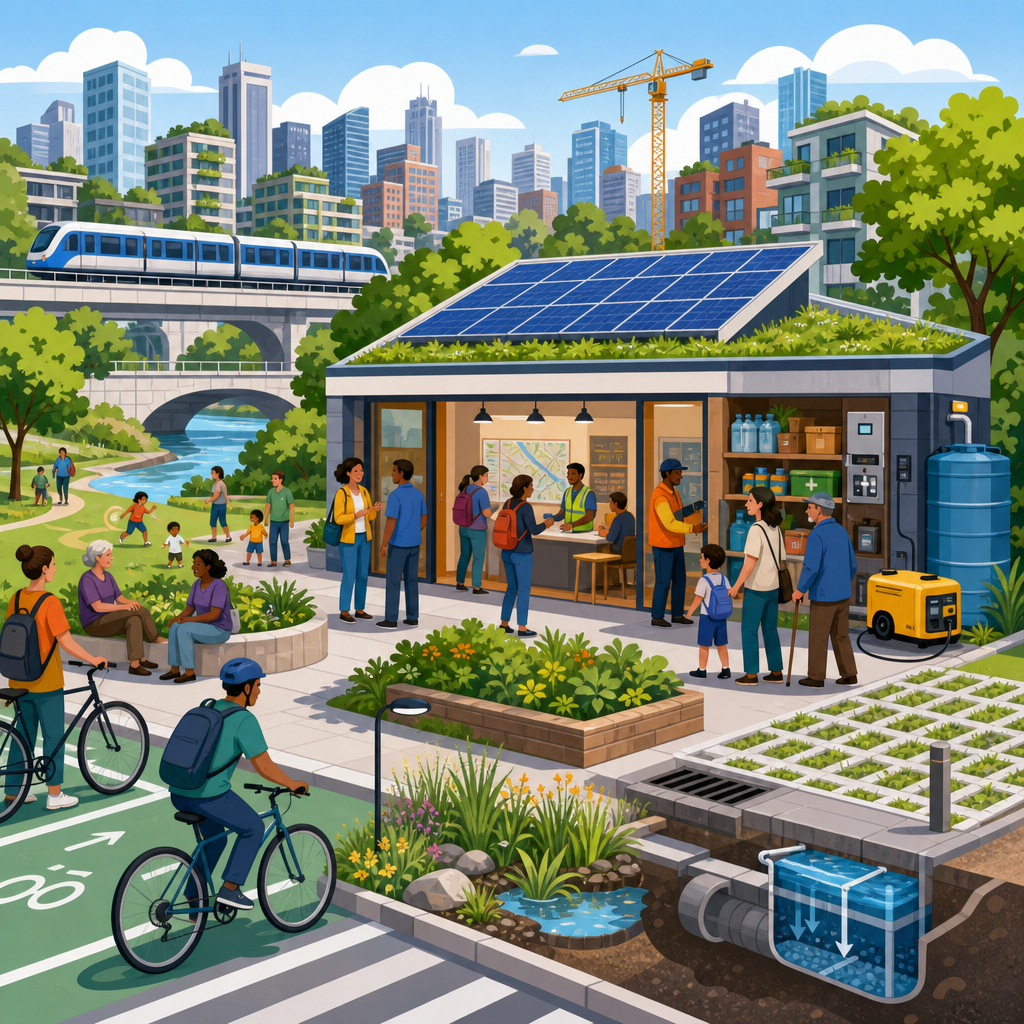
Resilience hubs are becoming a practical cornerstone of urban infrastructure planning because cities now face overlapping shocks that traditional systems were not designed to absorb. In planning terms, a resilience hub is a trusted, physically accessible community facility that supports residents in everyday life and then shifts into emergency service during disasters, outages, heat waves, floods, smoke events, or public health disruptions. The concept matters because infrastructure is no longer judged only by efficiency, capacity, and cost. It is judged by whether it keeps people safe when power fails, roads flood, digital networks go down, and vulnerable households need local help quickly.
In my work with municipal planning teams and community-serving institutions, I have seen the same pattern repeatedly: cities invest heavily in pipes, pavement, substations, and buildings, yet the missing link is often a neighborhood-scale place that connects those assets to people. A resilience hub fills that gap. It can be a library, recreation center, school, public housing community room, or nonprofit campus upgraded with backup power, communications, cooling, storage, and trained staff. When planners integrate these facilities into capital programs, hazard mitigation, and land use policy, they turn static buildings into operational infrastructure.
That shift is important because climate risk is local and unequal. Extreme heat now kills more Americans in many years than hurricanes, tornadoes, or floods. FEMA hazard mitigation guidance, CDC social vulnerability indicators, and local climate risk maps all show that low-income neighborhoods, older adults, disabled residents, renters, and linguistically isolated households often face the highest exposure and the fewest resources for recovery. A resilience hub responds directly to that reality by placing preparedness, response, and recovery functions where people already gather and where trust already exists. Good urban planning increasingly treats those social connections as infrastructure, not as an optional add-on.
Understanding how resilience hubs fit into urban infrastructure planning requires a broad view of infrastructure itself. The term includes gray infrastructure such as roads, water systems, and electric grids; green infrastructure such as trees, bioswales, and wetlands; and social infrastructure such as schools, clinics, libraries, and community organizations. Resilience hubs sit at the intersection of all three. They rely on buildings and energy systems, benefit from cooling landscapes and stormwater design, and operate through local institutions that residents know. That intersection makes them uniquely valuable in both daily service delivery and emergency management.
What a resilience hub does in practice
A resilience hub is not just a shelter and not just a community center. The most effective hubs provide routine services before a disaster, scale up during an event, and support recovery afterward. In normal operations, a hub may host workforce training, food distribution, digital access, health outreach, tenant meetings, and climate education. During an extreme heat event, the same site may become a cooling center with backup electricity, potable water, charging stations, air filtration, medical device support, and multilingual information. After a storm, it may serve as a place for insurance navigation, debris information, mutual aid coordination, and benefit enrollment.
This layered function is why planners value the model. A facility that is busy and trusted year-round is more likely to be used in a crisis than a site that opens only after an emergency declaration. I have seen libraries outperform standalone emergency sites for exactly that reason. Residents know the location, know the staff, and know how to reach it on foot or by transit. That familiarity shortens response time and reduces confusion. It also improves operational realism: if a building cannot serve daily needs well, it is unlikely to perform under stress.
Core capabilities usually include backup power through solar photovoltaic systems paired with battery storage or generators, accessible restrooms, refrigeration for medicines, resilient communications, flexible interior space, and supplies storage. Many hubs also need high-efficiency HVAC with filtration rated for smoke, floodproofing where appropriate, ADA-compliant design, and an operations plan that defines triggers, staffing, security, and partnerships. The exact package depends on local hazards. In wildfire-prone areas, clean air space is critical. In flood-prone districts, first-floor protection, elevated equipment, and dry egress routes matter more.
Why resilience hubs belong inside infrastructure planning
Urban infrastructure planning decides where capital flows, which standards govern design, how agencies coordinate, and which neighborhoods receive priority. If resilience hubs are treated as stand-alone community projects, they remain vulnerable to short-term grants and fragmented management. When cities place them inside infrastructure planning, they gain access to capital improvement plans, hazard mitigation funding, utility partnerships, transportation coordination, and performance metrics. That is the difference between a pilot project and a durable public system.
Resilience hubs also solve a common planning problem: large infrastructure assets often operate at city scale, while emergencies are experienced at neighborhood scale. A substation can restore a wide service territory, but residents still need a nearby place to cool down, charge devices, receive information, and access supplies. A stormwater tunnel can reduce flooding citywide, but a flooded block may still need a local staging site. Hubs translate metropolitan investments into block-level support. They become the neighborhood front door for complex systems that otherwise feel distant.
From a policy perspective, hubs fit naturally into comprehensive plans, climate action plans, capital budgets, public facilities plans, hazard mitigation plans, and zoning updates. They can be mapped against transit access, tree canopy, energy burden, flood exposure, and social vulnerability to identify priority service gaps. In several cities, planners use GIS overlays to select candidate sites by combining FEMA flood data, heat island mapping, outage history, and community asset inventories. That method is more defensible than choosing facilities based on convenience or politics alone.
There is also a strong financial argument. Upgrading an existing public facility into a resilience hub often costs less and delivers more near-term benefit than building a new standalone emergency structure. A library retrofit that adds rooftop solar, battery storage, envelope improvements, and backup communications can reduce energy bills in normal years while creating emergency capacity for bad days. Those co-benefits matter to budget officers and utility partners because they improve the business case beyond disaster response alone.
How planners choose locations and capabilities
Site selection should begin with risk, access, and trust. Risk means understanding local hazards through climate projections, historical incidents, and infrastructure failure patterns. Access means residents can reach the site by walking, wheelchair, bicycle, transit, or short vehicle trip, even when conditions deteriorate. Trust means the operator is known locally and has relationships with populations most likely to need help. A well-equipped building in the wrong place will underperform. A modest building in a trusted location can be highly effective if planners upgrade it thoughtfully.
The best selection process combines technical screening with community input. Start by identifying candidate facilities such as libraries, schools, parks buildings, public housing sites, faith-based campuses, and neighborhood health centers. Then assess structural condition, roof capacity for solar, electrical room location, flood exposure, indoor air quality, occupancy limits, and ADA access. After that, validate the list with residents and frontline organizations. Community engagement should answer practical questions: Who already uses this site? Which languages are spoken? Is there safe nighttime access? Can medically vulnerable residents get there during outages?
| Planning factor | What to assess | Why it matters |
|---|---|---|
| Hazard exposure | Heat, flood, smoke, wind, outage history, seismic risk | Determines protective upgrades and activation scenarios |
| Accessibility | ADA compliance, sidewalks, transit stops, bike access, parking | Ensures residents can reach the site during disruptions |
| Building readiness | Structural condition, HVAC, roof space, electrical capacity, storage | Shows whether retrofit is feasible and cost-effective |
| Operator capacity | Staffing, partner network, volunteer management, training | Strong operations are as important as physical upgrades |
| Community trust | Existing programs, cultural competence, language access | Drives real usage before, during, and after emergencies |
Capabilities should match the hazard profile and service population. In a dense urban neighborhood with frequent outages and dangerous summer heat, the first investment may be batteries, cooling, refrigeration, and charging. In a coastal district, flood barriers, raised equipment, and emergency communications may come first. In public housing, elevator backup and medical device support can be mission critical. The key principle is fit for purpose. Resilience hubs are strongest when they are not generic.
Design, operations, and partnerships that make hubs work
Physical design is only half the job. Operations determine whether a resilience hub can move from daily service to incident response without confusion. Every hub needs a written concept of operations that defines who activates the site, under what conditions, for how long, with which supplies, and under whose authority. Cities often align this with the Incident Command System so responsibilities are clear across emergency management, public health, parks, libraries, school districts, and community partners. Without that structure, even well-funded facilities can stall during a real event.
Energy design deserves special attention because backup power is one of the most visible and valuable hub features. Solar plus battery storage is increasingly preferred for urban resilience hubs because it lowers operating costs, avoids fuel delivery problems that affect generators, and can support quiet indoor operations for longer durations if loads are managed well. Still, batteries are not a universal solution. Critical loads analysis, islanding capability, fire code compliance, and maintenance planning all matter. Some sites still need generators for extended runtime or large HVAC loads. The right answer depends on building demand and local code requirements.
Partnerships are what turn a site into a service network. Utilities can support microgrid planning, demand management, and outage coordination. Health systems can advise on medical refrigeration and respiratory support needs. Food banks and mutual aid groups can help with storage and distribution protocols. Transit agencies can coordinate access during emergencies. School districts, housing authorities, and library systems often provide the best physical footprint because they already operate neighborhood facilities. In successful programs, the city does not act alone; it convenes and standardizes a network of operators.
Training and exercises are equally important. Staff should know how to open the site safely, manage lines, document supplies, communicate with emergency managers, and serve residents with disabilities or limited English proficiency. Tabletop exercises reveal small failures before a crisis exposes them publicly. In one planning process I supported, a simple exercise showed that a proposed hub had backup power but no secure after-hours access to the battery room, no translation protocol, and no plan for pet accommodation. Those are fixable issues, but only if they are discovered before activation.
Funding, policy alignment, and common implementation mistakes
Funding for resilience hubs usually comes from blended sources rather than one grant. Local capital budgets, federal hazard mitigation programs, Community Development Block Grant funds, Inflation Reduction Act and energy incentives where eligible, state climate resilience programs, utility partnerships, philanthropic support, and institutional capital plans can all contribute. The strongest funding strategy links resilience upgrades to routine facility renewal. When a city already plans to replace a roof, improve HVAC, or renovate a branch library, adding resilience specifications is cheaper than retrofitting later as a separate project.
Policy alignment matters because the hub model crosses departmental boundaries. Comprehensive planning can identify priority neighborhoods. Zoning can support accessory energy systems, flexible community facility use, and reduced barriers to retrofits. Building codes and procurement rules can affect battery installation, floodproofing, and equipment lead times. Public health policy can shape air quality and cooling center standards. Emergency management plans can define activation protocols. If these pieces are not aligned, implementation slows down. I have seen cities approve the concept enthusiastically, then lose a year to interdepartmental ambiguity over ownership and operating authority.
Several mistakes appear repeatedly. First, cities overemphasize equipment and underinvest in staffing and governance. A battery system does not create a resilience hub by itself. Second, they choose sites based on available buildings rather than community need. Third, they fail to budget for maintenance, software updates, replacement cycles, and training. Fourth, they overlook accessibility, language access, and cultural competence, which are essential for actual use. Finally, some programs define success too narrowly around emergency sheltering, when the real value comes from year-round service that builds trust before disaster strikes.
The most credible urban infrastructure planning approach treats resilience hubs as an integrated network of neighborhood assets, not isolated projects. Done well, hubs improve everyday public service, strengthen disaster readiness, and target investment where climate risk and social vulnerability overlap most sharply. For cities updating infrastructure strategies, the next step is straightforward: map trusted facilities, analyze hazards and access, identify retrofit candidates, and create a cross-agency implementation plan with funding and operating responsibilities. That work turns resilience from a slogan into a durable part of urban planning, where it belongs.
Frequently Asked Questions
What is a resilience hub, and why is it important in urban infrastructure planning?
A resilience hub is a community-serving facility that supports residents during normal conditions and then transitions into a critical support center during emergencies. In everyday use, it may function as a library, recreation center, school, community health site, cultural center, or nonprofit facility. During a crisis, the same location can provide cooling or clean air shelter, backup power, communications, basic medical support, food and water distribution, charging stations, information updates, and coordination for neighborhood response. That dual-purpose role is what makes resilience hubs so valuable in modern urban infrastructure planning.
The importance of resilience hubs comes from a major shift in how cities think about infrastructure. Traditional infrastructure systems were often designed around efficiency and single-purpose service delivery, not around absorbing repeated disruptions. Today, cities face overlapping risks such as extreme heat, flooding, wildfire smoke, prolonged power outages, supply chain disruptions, and public health emergencies. Resilience hubs help fill the gap between large-scale city systems and the immediate needs of residents at the neighborhood level. They create a practical, local layer of support that can reduce harm, speed recovery, and improve trust between communities and public institutions.
From a planning perspective, resilience hubs matter because they connect physical infrastructure, social infrastructure, and emergency management. They are not just buildings with generators. When properly designed, they are embedded in transportation access, energy systems, communications planning, public health strategy, and community engagement. In other words, resilience hubs fit into urban infrastructure planning because they make cities more adaptable, more equitable, and better prepared to function when centralized systems are under stress.
How do resilience hubs differ from traditional emergency shelters or disaster response centers?
The biggest difference is that resilience hubs are meant to be useful before, during, and after a disruption, not just activated after disaster strikes. Traditional emergency shelters often open in response to a specific event and are primarily designed for short-term refuge. Disaster response centers may focus on relief coordination, supplies, or recovery services once damage has already occurred. Resilience hubs, by contrast, are integrated into community life year-round. They build relationships, provide ongoing services, and establish neighborhood familiarity long before an emergency begins.
That year-round presence is significant. Residents are more likely to trust and use a place they already know, can reach easily, and associate with reliable support. A hub that hosts workforce programs, public health outreach, food access, digital access, or community meetings during normal times is far more effective in a crisis than a temporary site that people have never visited. This continuity improves communication, reduces confusion, and strengthens participation during stressful events.
Operationally, resilience hubs are also broader in scope. They may include distributed energy resources such as solar power and battery storage, indoor air quality improvements, cooling and heating capabilities, accessible design, multilingual communications, and trained local staff or volunteers. Their purpose is not simply to shelter people, but to help neighborhoods maintain critical functions and recover faster. In that sense, resilience hubs are a planning tool for continuity and adaptation, while traditional shelters are often a narrower emergency response measure.
What features and infrastructure systems are typically included in a well-designed resilience hub?
A well-designed resilience hub usually combines building upgrades, emergency capabilities, and community-focused amenities. On the physical side, common features include backup power, solar panels, battery storage, energy-efficient systems, cooling and heating capacity, potable water access, refrigeration for medicines or food, resilient communications equipment, and indoor spaces that can safely accommodate residents during extreme conditions. Air filtration is especially important in cities dealing with wildfire smoke or poor air quality, while flood protection measures may be essential in low-lying or storm-prone areas.
Accessibility is another foundational feature. A resilience hub should be physically accessible to people with disabilities, easy to reach by walking, transit, bike, or car, and designed with clear signage and inclusive wayfinding. Planners also look for facilities with restrooms, flexible gathering rooms, charging access, secure storage, and adaptable spaces that can shift quickly from daily programming to emergency operations. The ability to support vulnerable populations, including older adults, children, people with chronic health conditions, and residents with limited mobility or limited English proficiency, is central to good hub design.
Just as important are the operational systems behind the building. A resilience hub needs staffing plans, emergency protocols, supply partnerships, communication channels, and coordination with agencies such as public health departments, utilities, emergency management offices, and community-based organizations. Many successful hubs also include training, mutual aid networks, and neighborhood outreach so residents understand what the hub offers and when to use it. In practice, the strongest resilience hubs are not defined by any single technology. They succeed because physical systems, human systems, and governance systems are designed to work together.
How do resilience hubs support equity and community resilience in cities?
Resilience hubs are especially valuable because they can direct infrastructure investment toward communities that face the greatest risks and the fewest resources. In many cities, the impacts of heat, flooding, power outages, pollution, and public health disruption are not distributed evenly. Low-income neighborhoods, communities of color, older housing areas, and places with weaker public services often experience more severe consequences during emergencies. A resilience hub can help correct that imbalance by placing protective infrastructure and trusted support directly where it is most needed.
Equity is not just about site selection, though that is important. It also depends on how hubs are planned, operated, and governed. Community involvement should shape decisions about location, services, hours, language access, partnerships, and cultural relevance. Residents often know best which local institutions are trusted, what barriers people face in reaching services, and what capabilities would make the greatest difference during a crisis. When planners involve local organizations, neighborhood leaders, and frontline residents early in the process, the resulting hub is more likely to be used, supported, and sustained over time.
Resilience hubs also build community resilience by strengthening social connections. During emergencies, information, trust, and local coordination can matter as much as physical assets. A hub can become a place where neighbors know where to go, how to help one another, and how to access reliable updates. That social cohesion improves response capacity and often speeds recovery. In urban infrastructure planning, this is a crucial insight: resilience is not only about hardening systems against failure, but also about enabling communities to stay connected, informed, and capable under stress.
How can cities integrate resilience hubs into long-term urban infrastructure planning?
Cities can integrate resilience hubs most effectively by treating them as part of core infrastructure strategy rather than as stand-alone pilot projects. That means aligning hub planning with capital improvement programs, climate adaptation plans, hazard mitigation strategies, public health goals, facility modernization efforts, and neighborhood investment priorities. In many cases, the best approach is to identify existing public or nonprofit facilities that already serve residents, then upgrade those sites with the systems and operational capacity needed to function during emergencies.
Site selection is a major planning step. Cities typically assess where climate and infrastructure risks are highest, where vulnerable populations are concentrated, what facilities are already trusted by the community, and how accessible those locations are by multiple transportation modes. They also evaluate building condition, energy opportunities, space availability, and the feasibility of integrating backup systems. A hub should fit into the broader urban network, meaning it should connect logically with transit routes, healthcare resources, emergency response operations, and utility planning.
Long-term integration also depends on funding and governance. Cities may combine local capital budgets, federal resilience grants, utility partnerships, philanthropic support, and community development resources to finance upgrades. But physical investment alone is not enough. Clear ownership, staffing responsibilities, maintenance plans, and activation protocols are essential if the hub is going to work when it is truly needed. The most successful cities build resilience hubs into standard planning and budgeting processes so they become a durable part of the urban infrastructure system, not a temporary initiative. When done well, resilience hubs help cities move from reactive disaster response toward a more proactive, neighborhood-centered model of resilience.


