
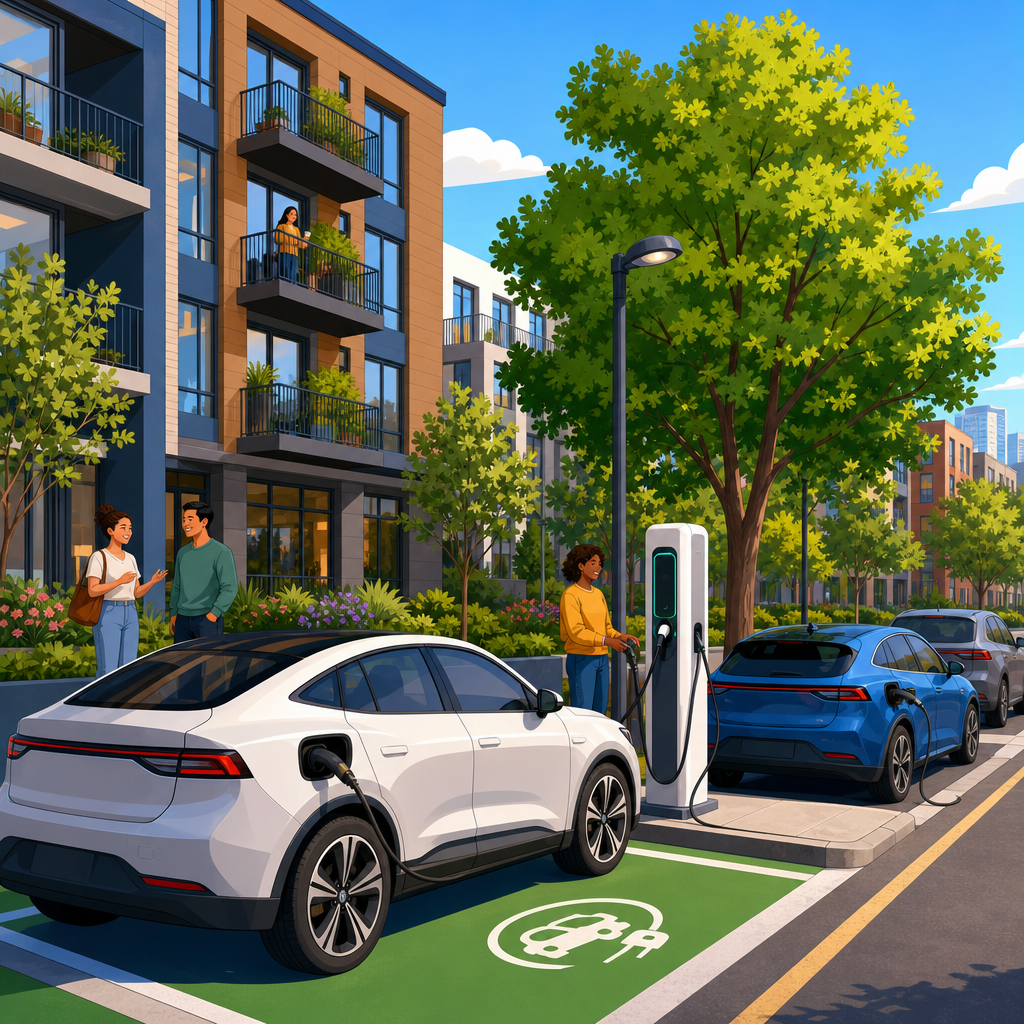
EV charging infrastructure for multifamily buildings and curbside parking has moved from a niche amenity to a core urban planning and policy issue. In dense cities, many residents do not have private garages or dedicated driveways, which makes home charging far less straightforward than it is in suburban single-family neighborhoods. Multifamily buildings include apartments, condominiums, mixed-use developments, student housing, and affordable housing complexes where parking may be shared, deeded, leased, or entirely absent. Curbside charging refers to public or semi-public chargers installed along streets, in parking lanes, or near sidewalks to serve drivers who park on the street. Together, these two settings determine whether electric vehicle adoption is practical for millions of urban households.
The stakes are high because charging access shapes who can participate in transportation electrification. When I have worked with property owners and municipal teams on charging plans, the same questions always surface first: who pays, who controls access, how much electrical capacity is available, and how do you avoid conflicts over parking spaces? Those questions are not minor operational details; they are the difference between a program that sits idle and one that consistently serves residents. Good policy recognizes that convenience, reliability, electrical readiness, and equitable distribution matter as much as the charger itself.
Urban leaders also need to distinguish among charging levels and use cases. Level 1 charging uses a standard 120-volt outlet and is inexpensive but slow, usually adding only a few miles of range per hour. Level 2 charging typically uses 208- or 240-volt service and is the workhorse for homes, apartments, and public destination charging, often adding roughly 15 to 35 miles of range per hour depending on vehicle and power output. DC fast charging delivers much higher power and can rapidly add range, but it is expensive, utility-intensive, and usually unsuitable for most residential parking contexts. In multifamily and curbside settings, the planning challenge is not simply installing chargers. It is matching charging speed, parking duration, grid capacity, and user behavior to the physical reality of cities.
That is why a strong hub article on EV charging infrastructure for multifamily buildings and curbside parking must connect technology, policy, finance, operations, and design. The best outcomes come from treating charging as a building system and a public service at the same time. Residents want dependable overnight access. Property managers want manageable billing and maintenance. Cities want reduced emissions without sidewalk clutter or inequitable deployment. Utilities want controlled load growth and safe interconnection. When these interests are aligned early, charging can be deployed at scale without creating avoidable friction.
Why multifamily charging is different from single-family home charging
Multifamily charging is fundamentally a shared-infrastructure problem. In a detached house, one household usually controls the parking space, the electrical panel, and the utility account. In an apartment or condominium, those controls are often split among tenants, homeowners associations, landlords, parking operators, and common-area electrical systems. A resident may have a reserved parking space but no authority to alter it. A building owner may support charging but lack spare panel capacity. A condominium board may approve installation only after resolving insurance, metering, and cost allocation rules. These governance layers slow projects unless responsibilities are clearly assigned.
Load management is another major differentiator. A 200-unit building does not need 200 fully powered chargers operating at maximum output simultaneously, but it does need a system that can serve many vehicles over time. Smart charging software can balance available capacity across ports, reduce peak demand, and prioritize overnight charging windows when cars are parked for long periods. In practice, this often allows far more ports to be installed than a simple nameplate calculation would suggest. Engineers typically assess spare capacity at the service entrance, distribution panels, and parking area, then evaluate whether managed charging, panel upgrades, or a new service is the most cost-effective path.
Parking design also matters. Surface lots are easier and cheaper to retrofit than structured parking, while older underground garages can present long conduit runs, firestopping requirements, and ventilation or clearance constraints. Americans with Disabilities Act access routes, bollard protection, cable management, and lighting must be integrated from the start. Buildings that prewire during renovation or new construction avoid much higher retrofit costs later. That is why many cities and states now require EV-capable or EV-ready parking spaces in building codes, even where full charger installation is not yet mandatory.
Curbside charging as essential public infrastructure
Curbside charging fills the gap for residents who rely on street parking. In neighborhoods with low off-street parking availability, it may be the only realistic form of overnight or near-home charging. The policy rationale is straightforward: if cities want broad electric vehicle adoption, they cannot limit charging access to people with private parking. Curbside charging can be deployed through pedestal chargers at the curb, chargers integrated into streetlights, or chargers in nearby municipal lots that function as neighborhood charging hubs. Each model has tradeoffs related to capital cost, accessibility, maintenance, and utilization.
Streetlight-based charging is attractive because it can reduce trenching and visual clutter, but existing lighting circuits are not always adequate for vehicle charging loads. Dedicated service upgrades are often still required. Pedestal chargers may support higher power and better cable ergonomics, yet they can obstruct narrow sidewalks if not carefully sited. Some cities solve this by placing equipment in furnishing zones, using rear-access maintenance designs, and selecting retractable or overhead cable systems. Time limits and pricing are also critical. If drivers occupy curbside chargers all day after reaching full charge, turnover falls and availability collapses.
Curb management rules therefore matter as much as hardware. Cities commonly designate charging-only parking windows, idle fees after charging is complete, and enforcement protocols tied to parking officers rather than relying solely on charger operators. Real-world deployment also requires coordination with utilities, public works departments, accessibility offices, and neighbors. Residents often support neighborhood charging in principle but object to the loss of parking flexibility or sidewalk space. Early engagement works best when planners can show expected utilization, equity criteria, and a clear maintenance plan rather than vague promises.
Technology choices, electrical design, and operating models
For most multifamily buildings and curbside applications, Level 2 charging is the right baseline because dwell times are long enough to recover daily driving needs. A resident driving 30 miles per day generally does not require rapid charging overnight. The design objective is dependable energy delivery, not maximum instantaneous power. In projects I have seen perform well over time, the winning formula is usually more ports at moderate power with dynamic load balancing, not a small number of high-powered chargers that create contention. Open Charge Point Protocol support is important because it reduces vendor lock-in and gives owners flexibility in selecting network providers.
Metering and payment architecture must be resolved early. Some properties place charging on the house meter and bill users through network software. Others install dedicated submeters or utility meters for charging circuits. Condominium settings may require especially careful allocation rules where common-area electricity is funded through association fees. Reliability depends on more than hardware quality. Network connectivity, remote diagnostics, spare parts availability, preventive maintenance, and clear user support channels all influence uptime. The industry increasingly recognizes uptime as a core performance metric, especially for publicly accessible chargers.
| Setting | Typical charger type | Best use case | Main constraint |
|---|---|---|---|
| Apartment surface lot | Level 2 shared chargers | Overnight resident charging | Panel capacity and space assignment |
| Condominium garage | Level 2 networked ports | Reserved-space charging | Governance and cost allocation |
| Curbside parking lane | Level 2 curbside charger | Near-home charging for street parkers | Turnover, enforcement, sidewalk clearance |
| Neighborhood mobility hub | Level 2 plus some DC fast charging | Mixed resident and fleet demand | High capital cost and utility upgrades |
Another key decision is whether chargers are assigned or shared. Assigned chargers are easier for users to understand and can support premium parking fees, but they may leave infrastructure underutilized if some residents charge infrequently. Shared chargers typically improve utilization and lower upfront cost per resident served, though they require reservation systems, parking rules, and user education. In affordable housing, shared charging paired with transparent pricing can expand access without forcing all residents to subsidize infrastructure equally. In market-rate properties, managed shared charging can still outperform one-to-one installations because vehicle adoption rates rise gradually rather than all at once.
Policy, permitting, and funding strategies that unlock deployment
Policy determines speed and scale. Building codes that require EV-capable conduit, panel space, or EV-ready circuits in new multifamily construction dramatically reduce future retrofit costs. Right-to-charge laws can help tenants or condominium owners seek charger installation, though these laws vary widely in scope and conditions. Permitting reform matters too. Standardized plan sets, over-the-counter permits for common designs, and preapproved equipment lists reduce delay and soft costs. For curbside projects, cities often need formal siting criteria covering utility distance, sidewalk width, parking demand, ADA compliance, flood risk, and proximity to multifamily residences with limited off-street parking.
Funding typically combines local capital budgets, utility make-ready programs, state energy office grants, air quality funds, tax incentives, and private operator investment. Utility make-ready programs are especially influential because trenching, conduit, transformers, and service upgrades can cost more than the chargers themselves. Some utilities pay for infrastructure up to the charger stub, while site hosts or charging companies fund the charging equipment and networking. This split often improves project economics. The federal National Electric Vehicle Infrastructure program focuses on highway corridors, but many states and municipalities have separate programs tailored to urban residential access and disadvantaged communities.
Pricing policy should reflect public goals. If curbside charging is priced too low, drivers may use it as cheap parking and block access. If it is priced too high, residents without driveways effectively pay a penalty for living in dense neighborhoods. A balanced model usually includes an energy fee, time-based components to encourage turnover, and idle fees once charging is complete. For multifamily properties, subscription models can work when usage is predictable, but pay-as-you-go billing is often fairer during early adoption. Transparency is essential: residents should understand what they are paying for, whether electricity, equipment recovery, parking privileges, or software service.
Equity, accessibility, and long-term planning for urban neighborhoods
Equity is not a side issue in EV charging infrastructure for multifamily buildings and curbside parking; it is the central planning test. Residents of lower-income urban neighborhoods are more likely to rent, more likely to park on the street, and less likely to control building improvements. If charging deployment follows only near-term private return, these areas are underserved even when transportation burdens are already high. Effective programs use explicit equity criteria, such as prioritizing affordable housing, environmental justice communities, older apartment stock with limited parking retrofits, and neighborhoods with low private charger access. This is not just socially preferable. It is practical market development.
Accessibility must be designed, not assumed. A charger that blocks a pedestrian path, has a screen too high to reach, or requires awkward cable handling fails many users. The U.S. Access Board has proposed guidance for electric vehicle charging stations that cities and property owners should treat as the baseline for inclusive design. That means clear floor space, accessible routes, operable parts within reach ranges, and thoughtful placement that does not force wheelchair users into traffic. Curbside sites require particular care because streets were not originally designed around charging equipment.
Long-term planning should also anticipate fleet and modal change. Multifamily residents may own fewer cars per household, but delivery fleets, ride-hail vehicles, car-share operators, and accessible transport providers all add demand near residential areas. A neighborhood charging strategy should therefore map likely users, average dwell times, feeder capacity, and future building electrification loads such as heat pumps. The strongest plans are phased: prewire broadly, install chargers where demand is immediate, monitor utilization, and expand using real operating data. Cities and property owners that start with this systems view avoid stranded assets and create charging networks that residents can actually rely on.
The core lesson is simple: successful EV charging in multifamily buildings and at the curb is less about finding a perfect charger and more about building a durable operating system. The right mix of policy, electrical design, pricing, curb management, and user experience can turn constrained urban parking into practical charging access. For planners, property owners, and public agencies, the main benefit is scale with fairness: more residents can adopt electric vehicles without needing a private garage. Audit your buildings, map your curbside opportunities, and create a phased deployment plan that matches real neighborhood demand.
Frequently Asked Questions
Why is EV charging in multifamily buildings and curbside parking more complicated than in single-family homes?
EV charging is typically easiest in single-family settings because the resident usually controls both the parking space and the electrical service. In multifamily buildings and curbside environments, those conditions rarely exist. Parking may be shared, assigned, deeded, leased separately, or located in a common garage that serves many households. Residents may also rotate spaces, park off-site, or rely on street parking with no guaranteed access to the same location each day. That makes charger placement, billing, access control, and maintenance much more complex than simply installing a charger in a private garage.
Electrical capacity is another major factor. Older apartment buildings, condominiums, mixed-use properties, student housing communities, and affordable housing developments were often not designed with significant vehicle charging loads in mind. Property owners and associations may need to evaluate panel capacity, transformer limits, load management options, conduit routing, and utility coordination before they can support meaningful charging access. In dense urban settings, installation can also involve trenching, fire and life-safety reviews, accessibility compliance, metering decisions, and coordination with local permitting authorities.
Curbside charging adds a public-right-of-way dimension. Once charging equipment moves into sidewalks, curbs, or street-adjacent spaces, cities must weigh pedestrian access, ADA considerations, traffic operations, utility interconnection, parking enforcement, vandalism risks, and equity impacts. Policymakers also have to decide who can use the chargers, how long vehicles may remain connected, whether spaces are EV-only, and how pricing should be structured. In short, the challenge is not only technical. It is operational, legal, financial, and policy-driven, which is why EV charging for multifamily and curbside use has become a central urban planning issue rather than just a building amenity.
What are the best charging options for apartment buildings, condominiums, and other multifamily properties?
The best solution depends on the building type, parking arrangement, resident turnover, and available electrical capacity. In many multifamily properties, Level 2 charging is the most practical long-term option because it provides a meaningful overnight charge and supports routine residential use. A resident parked for several hours or overnight can typically recover enough range for daily driving without needing the higher costs associated with DC fast charging. For assigned spaces, dedicated Level 2 chargers tied to a specific resident can work well. For shared garages or surface lots, common-use chargers with access controls and user billing software are often more effective.
Load management is especially important in multifamily settings. Rather than upgrading the electrical service immediately to support every charger at full output simultaneously, many properties use networked charging systems that balance power across multiple ports. This approach can significantly reduce upfront infrastructure costs while still serving resident demand. A property may also install “EV-ready” infrastructure first, such as conduit, panel space, and capacity planning, then add active chargers over time as adoption grows. This phased strategy is often financially smarter than waiting until demand becomes urgent.
There is no single model that fits every property. Condominium associations may prefer chargers that allow individual cost allocation to unit owners. Rental communities may treat charging as a premium amenity, utility passthrough, or separately billed service. Affordable housing providers may prioritize equitable access, grant eligibility, and low operating costs. Mixed-use buildings may need to serve residents, retail customers, employees, and visitors under different rules. The most successful multifamily charging plans usually begin with a site assessment, resident demand analysis, electrical review, and policy framework that addresses who can charge, where they can charge, how usage is billed, and how future expansion will be handled.
How can building owners, HOAs, and property managers pay for EV charging infrastructure?
Funding usually comes from a combination of private investment, utility incentives, government programs, and phased capital planning. Many utilities offer rebates for chargers, make-ready infrastructure, panel upgrades, or load management systems, especially when projects support managed charging goals or broader transportation electrification targets. State and local governments may also provide grants, tax incentives, low-interest financing, or special programs for multifamily housing, disadvantaged communities, and publicly accessible charging. Because incentive rules vary widely by jurisdiction, owners and managers should review local utility and agency programs early, before design and procurement are finalized.
Cost recovery models also matter. In some buildings, residents pay directly for electricity through a networked charging platform that tracks usage by user, session, or parking space. In others, the owner recovers costs through monthly fees, amenity pricing, parking surcharges, or rent structures. Condominium and homeowners associations may allocate infrastructure costs as common expenses while allowing individual users to pay charging-session costs separately. Public-private partnership models are also increasingly common, where a charging provider installs and operates equipment in exchange for a revenue share, service agreement, or host-site arrangement. This can reduce upfront costs for the property but may require long-term contractual commitments.
The most resilient financial strategy usually balances immediate demand with future readiness. Instead of installing a charger in every space at once, a property can invest in backbone infrastructure such as conduit pathways, electrical capacity planning, and panel upgrades, then deploy chargers in phases. That limits stranded capital while preserving expansion flexibility. For curbside charging, cities may rely on municipal budgets, franchise agreements, utility partnerships, or concession models with private operators. Whether the project is private or public, the key is to evaluate not just installation cost, but also software fees, maintenance, network subscriptions, insurance, enforcement, repairs, and equipment replacement over the full life of the system.
What should cities consider when planning curbside EV charging for residents without private parking?
Curbside charging should be treated as a transportation access strategy, not just a hardware deployment exercise. In neighborhoods where residents depend on on-street parking, curbside charging can help close a major adoption gap for drivers who do not have garages or dedicated off-street spaces. However, cities need to plan carefully to avoid creating inequities or operational conflicts. Key considerations include neighborhood demand, existing parking pressure, sidewalk width, accessibility requirements, utility proximity, traffic safety, streetscape impacts, and whether charging equipment will interfere with pedestrians, cyclists, transit stops, or loading zones.
Site selection is especially important. A charger placed in the wrong location can create safety issues or go underused, while a charger placed strategically near multifamily housing can unlock meaningful access for residents. Cities often need to determine whether curbside chargers should be concentrated in high-demand districts, distributed equitably across neighborhoods, or prioritized near apartment clusters and older housing stock. They must also decide how spaces will be regulated. Common policy questions include whether charging stalls are reserved only while actively charging, how overstays are handled, what signage is required, whether time-of-day rules apply, and how enforcement will be managed.
Pricing and public access are also central policy issues. If curbside charging is too expensive, it may exclude the residents who need it most. If it is underpriced, it may be congested and difficult to access. Cities may choose to structure pricing to encourage turnover, support off-peak charging, or align with broader climate and equity goals. Reliability is equally critical. Public charging that is frequently blocked, broken, or difficult to use undermines public trust. For that reason, successful curbside programs usually include strong maintenance standards, clear user information, data collection requirements, and a long-term deployment strategy that integrates utilities, transportation departments, public works, accessibility staff, and community input.
How can multifamily and curbside charging be implemented in a way that is fair, scalable, and future-ready?
Fair and scalable implementation starts with the recognition that EV charging access is increasingly tied to housing access, transportation affordability, and climate policy. In dense cities, residents who live in apartments or rely on street parking should not be left behind simply because they do not own a single-family home with a garage. That means building owners and public agencies need to think beyond one-off installations and develop systems that expand access over time. In multifamily buildings, this often involves designing for future demand through EV-capable or EV-ready parking, adopting transparent rules for charger requests, and ensuring that both current and future residents can reasonably access charging without excessive cost or administrative barriers.
Equity should be built into program design from the beginning. For multifamily properties, that may mean avoiding models where only a small number of premium tenants benefit while the broader resident base has no viable pathway to charging. In affordable housing and workforce housing, it may involve targeted subsidies, lower-cost charging rates, or public support for make-ready infrastructure. For curbside charging, equity means more than just geographic distribution. It also includes affordability, language access, user-friendly payment systems, dependable uptime, and attention to neighborhoods that have historically received less infrastructure investment.
Future readiness depends on flexibility. Technology, vehicle adoption rates, utility tariffs, and building codes are all changing quickly. The best projects account for that by using scalable electrical designs, interoperable charging systems, data-driven utilization tracking, and policies that can be updated as demand grows. Load management, phased deployment, and open standards can help owners and cities avoid expensive rework later. Ultimately, successful implementation is about matching infrastructure to real-world urban living patterns: shared parking, limited space, multiple stakeholders, and growing demand for practical, reliable charging access where people actually live and park.


