
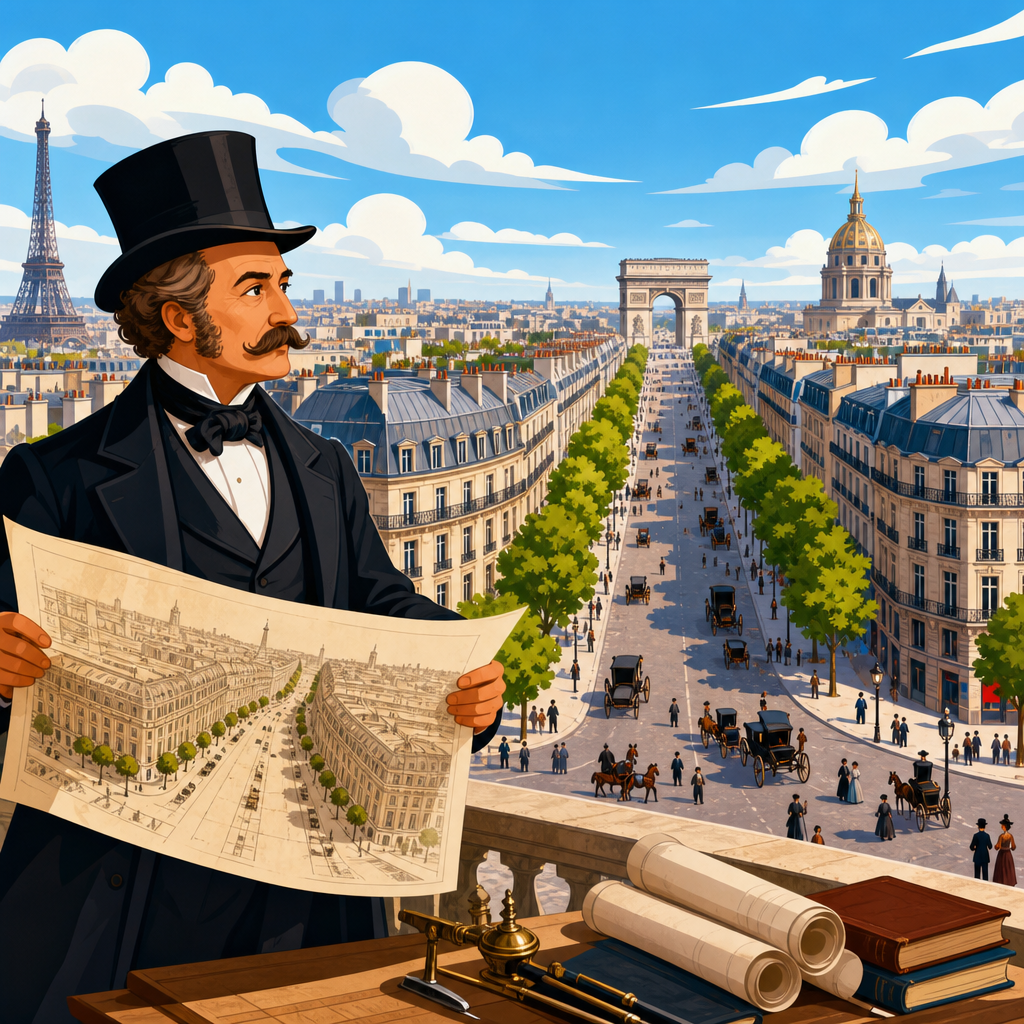
Haussmann’s Paris and the politics of urban transformation remain central to any serious discussion of urban planning because the remaking of nineteenth-century Paris established a template for how states use streets, infrastructure, housing, and public space to govern city life. “Haussmannization” refers to the sweeping reconstruction program directed by Georges-Eugène Haussmann under Napoleon III from 1853 to 1870, when medieval street patterns, overcrowded districts, and weak sanitation networks were replaced by broad boulevards, parks, sewers, rail connections, and monumental vistas. Urban transformation, in this context, means far more than physical redevelopment. It is the deliberate reorganization of land, movement, property, administration, and everyday behavior through planning decisions backed by political power, law, and capital. I have found that readers often know the boulevards but not the governing logic behind them: Paris was redesigned not only to look modern, but to function as an imperial capital, a healthier city, a more efficient market, and a more controllable social space.
That distinction matters because Haussmann’s Paris was neither a purely benevolent public works campaign nor a simple story of authoritarian destruction. It combined genuine improvements in water supply, sewage disposal, circulation, and public amenities with aggressive expropriation, displacement, debt financing, and social sorting. The project linked urban form to political stability. Wide avenues reduced the tactical advantage of barricades that had defined revolutionary Paris in 1830 and 1848. New infrastructures lowered disease risks in districts long associated with crowding and filth. Redevelopment raised land values, attracted investment, and reinforced state prestige through architecture and ceremony. At the same time, costs were unevenly distributed. Working-class residents were pushed toward peripheral neighborhoods, older communities were broken apart, and public authority became more centralized. For planners, policymakers, historians, and citizens today, Haussmann’s Paris offers a clear lesson: every major urban transformation embeds choices about who benefits, who pays, who moves, and who gains control over the city’s future.
The Political Context Behind Haussmann’s Paris
Haussmann’s program cannot be understood without the Second Empire. After the 1848 Revolution and the rise of Louis-Napoléon Bonaparte, later Napoleon III, the French state pursued legitimacy through order, growth, and spectacle. Paris was both symbolic and strategic. It was the seat of government, the stage for insurrection, and a city whose infrastructure lagged behind its political importance. When Haussmann became prefect of the Seine in 1853, he was given unusual authority to align urban design with imperial governance. This was not planning by municipal consensus in the modern sense. It was a top-down administrative project enabled by centralized institutions, legal expropriation powers, and close coordination between engineers, financiers, and ministries.
The politics were explicit. Narrow medieval streets had repeatedly allowed insurgents to erect barricades and resist troops. Broad, straight boulevards improved circulation, but they also made surveillance and military movement easier. In my own work reviewing nineteenth-century planning records, this dual purpose appears constantly: infrastructure and security were intertwined, not separate goals later imposed by critics. Napoleon III also wanted Paris to rival London as a modern capital. That meant rail terminals connected to major arteries, coherent public spaces, upgraded sanitation, and an urban image that projected competence. Haussmann delivered this through administrative speed, but speed required concentrating decision-making power and limiting local opposition. The remade city therefore embodied a political principle still familiar today: when governments frame urban intervention as urgent modernization, they often expand executive power and compress democratic debate.
How the Reconstruction Program Actually Worked
Haussmann’s transformation was not a single project but an integrated system of street building, utility expansion, landscape design, and redevelopment regulation. Major arteries such as Boulevard de Sébastopol and Avenue de l’Opéra cut through older fabric to connect stations, markets, administrative sites, and monuments. Engineers under Eugène Belgrand expanded aqueducts, reservoirs, and sewers, creating one of the era’s most advanced urban water systems. Jean-Charles Alphand led the development of parks and promenades, including the Bois de Boulogne, Bois de Vincennes, Parc Monceau, Buttes-Chaumont, and Montsouris. Building facades along new streets were shaped by alignment rules and height conventions, producing the visual coherence now associated with Parisian urbanism.
Financing relied on a mix of public borrowing, state-backed mechanisms, and property-value capture through redevelopment. Expropriation allowed the state to acquire land for public works, while adjoining parcels often appreciated sharply after improvements. This model made large-scale intervention possible, but it also generated controversy over debt, speculation, and opaque accounting. Critics in the 1860s argued that Haussmann’s methods overstretched public finances and privileged developers. They were not entirely wrong. Yet the physical results were substantial, and many persisted because the program addressed networked urban systems rather than isolated beautification. Streets were coordinated with sewers; parks with circulation; housing blocks with frontage rules; administrative reforms with engineering works. That integration is one reason Haussmann’s Paris became so influential. It demonstrated that urban transformation becomes durable when transport, health, land, and governance are planned together rather than in separate bureaucratic silos.
Public Health, Circulation, and the Modern Infrastructure City
One reason Haussmann’s legacy endures is that many interventions solved real urban problems. Mid-nineteenth-century Paris faced overcrowding, inadequate drainage, contaminated water, and poor accessibility. Cholera outbreaks, especially the devastating epidemic of 1832, exposed how dangerous weak sanitation could be in dense neighborhoods. Belgrand’s water and sewer works did not eliminate disease by themselves, but they materially improved urban health conditions by expanding clean water distribution and waste removal. Wider streets also increased light and air, which nineteenth-century reformers considered essential to healthier urban life. Their medical theories were incomplete by modern standards, yet the practical gains from better infrastructure were significant.
Circulation mattered just as much. Before reconstruction, movement across Paris was slow and fragmented. New boulevards linked key destinations and reduced travel times for goods, workers, officials, and visitors. Markets became more accessible, railway stations were better integrated, and commercial life benefited from predictable flows. The city was reorganized as a machine for movement. Modern planners would recognize this as network logic: value rises when connections are legible, continuous, and scaled to demand. The lesson is not that wider streets are always better. In fact, many twentieth-century highway projects misread Haussmann by prioritizing vehicle throughput over urban life. The deeper lesson is that infrastructure politics shape who can access opportunity, how risks are distributed, and what kinds of daily life a city makes easy or difficult. Haussmann’s Paris improved public health and mobility, but it did so through state power strong enough to redraw the social geography of the capital.
Displacement, Class, and the Social Cost of Renewal
The most persistent criticism of Haussmann’s Paris is displacement, and it is justified. Demolitions in central districts removed large numbers of lower-income residents, many of whom relocated to cheaper peripheral areas beyond the newly valorized core. Precise totals vary by source because nineteenth-century demographic records are uneven, but the pattern is clear: reconstruction redistributed populations by class. The polished boulevards and regulated facades that signaled modernity were paired with rising rents and intensified land speculation. Haussmannization therefore changed not only streets but also the social map of Paris.
This process resembles what later scholars would call state-led gentrification, though the nineteenth-century legal and economic context was different. The state created value through infrastructure and urban form, then that value was captured unevenly through property markets. Small workshops, informal housing arrangements, and neighborhood networks were disrupted. Residents lost proximity to jobs, kin, and mutual support systems. I think this is where simplified narratives fail most badly. It is not enough to say Haussmann beautified Paris, nor enough to say he merely expelled the poor. He did both improvement and exclusion at once, which is exactly why the case remains so important in planning debates today.
| Dimension | Main Objective | Primary Benefit | Primary Cost |
|---|---|---|---|
| Boulevards | Circulation and control | Faster movement, clearer connections | Demolition of older districts |
| Sanitation | Health and utility modernization | Cleaner water and sewer capacity | High public expenditure |
| Parks | Public amenity and prestige | Recreation, environmental relief | Uneven access across classes |
| Redevelopment | Economic growth and order | Higher land values, new investment | Displacement and rent pressure |
Urban Design as Governance and Symbolic Power
Haussmann’s Paris shows that urban design communicates authority as much as it organizes space. Long sight lines, monumental intersections, and aligned facades created a readable capital in which the state was visually present. Buildings framed boulevards with remarkable consistency because regulations shaped cornice lines, materials, and frontage relationships. This was not uniformity for its own sake. It produced legibility, prestige, and a sense of order that supported the political image of the regime. Public space became a theater of governance.
At street level, design altered behavior. Broad sidewalks encouraged promenading and consumption. Arcades, shops, and cafés benefited from increased flows. Parks offered controlled leisure environments that folded recreation into public order. Even the famous Parisian vista had administrative intent: when avenues connect monuments, institutions, and transport nodes, they create a city that can be navigated, displayed, and policed. I have seen similar ambitions in later capital-city plans from Washington to New Delhi, where ceremonial form and governing logic are tightly linked.
This symbolic dimension helps explain why Haussmann’s work traveled globally. Cities in Europe, Latin America, North Africa, and beyond borrowed boulevard planning, facade regulation, and infrastructural modernization as signs of entry into modern statehood. Yet imitation often copied the image without the integrated systems underneath. A boulevard without sewer investment, transit coordination, housing policy, or fiscal discipline is just a costly avenue. Haussmann’s real contribution was not a style alone. It was the demonstration that urban form can consolidate political authority when law, engineering, finance, and representation operate together.
What Haussmann’s Paris Teaches Urban Planning and Policy Today
For contemporary urban planning and policy, Haussmann’s Paris is best treated as a foundational case in the tradeoffs of transformative public action. First, comprehensive planning works better than fragmented intervention when a city faces interconnected problems. Streets, drainage, water, housing, green space, and regional access affect each other, and policy failures usually occur when governments address them separately. Second, infrastructure is never neutral. Decisions presented as technical almost always carry distributional consequences. If a new corridor improves access for some neighborhoods while pricing out others, that is a political outcome, not an accidental side effect.
Third, speed and scale can deliver results, but they also heighten the risk of democratic exclusion. Haussmann succeeded partly because opposition had limited power to stop him. Modern governments operating under stronger rights protections and public participation rules cannot, and should not, replicate that model. The challenge is to preserve strategic capacity without sacrificing transparency, compensation, and accountability. Tools such as environmental review, inclusionary zoning, tenant protections, land readjustment, and participatory budgeting exist precisely because past transformations often imposed benefits and burdens unevenly.
Finally, cities should resist the temptation to separate beauty from justice. Paris demonstrates that urban design quality matters. Attractive streets, coherent blocks, public parks, and durable infrastructure improve civic life. But design excellence cannot excuse displacement. The strongest planning practice combines high standards for form with measurable safeguards for affordability, access, and social continuity. If you are studying urban planning and policy, use Haussmann’s Paris as a hub case: it connects transportation planning, public health, housing, governance, finance, landscape architecture, and urban politics in one powerful example. Revisit it whenever a city proposes large-scale renewal. Ask the basic questions clearly: what problem is being solved, what systems are being integrated, who is likely to gain, who may be pushed out, and what protections are in place. Those questions made sense in nineteenth-century Paris, and they remain the right starting point for judging urban transformation now.
Frequently Asked Questions
What does “Haussmannization” mean, and why is it so important in urban history?
“Haussmannization” refers to the large-scale reconstruction of Paris carried out under Baron Georges-Eugène Haussmann during the reign of Napoleon III, especially between 1853 and 1870. The term has come to mean more than a local building campaign. It describes a model of state-directed urban transformation in which streets, sewers, parks, housing, transportation, and administrative power were reorganized together as part of a single political project. In Paris, this meant replacing many narrow medieval streets and overcrowded neighborhoods with broad boulevards, new public squares, upgraded sanitation systems, railway connections, uniform building facades, and monumental vistas that projected order and modernity.
Its importance lies in the fact that Haussmann’s work helped define the modern city as something that could be consciously designed and governed from above. Paris became a laboratory for urban planning, showing how physical space could be used to improve circulation, reduce disease, stimulate commerce, enhance property values, and symbolize national power. At the same time, Haussmannization exposed the social and political costs of modernization, including demolition, displacement, class segregation, and the strengthening of centralized state control. For that reason, the remaking of Paris remains a foundational case for historians, planners, and political theorists who want to understand how urban development can simultaneously promise public improvement and deepen inequality.
Why did Napoleon III and Haussmann decide to rebuild Paris on such a massive scale?
The rebuilding of Paris was driven by a combination of public health concerns, political calculation, economic ambition, and imperial image-making. By the mid-nineteenth century, much of central Paris still had extremely dense and aging urban fabric, with cramped streets, poor drainage, inadequate water supply, and unsanitary housing conditions. These conditions contributed to disease outbreaks and made the city increasingly difficult to manage as its population grew. Modernization, in practical terms, meant creating better sewers, cleaner water systems, wider streets, and improved circulation of goods and people.
But the project was never purely technical. Napoleon III wanted Paris to embody the prestige of the Second Empire and to compete with other great capitals as a center of commerce, culture, and state authority. Broad boulevards, monuments, train stations, and landscaped parks were meant to signal a new era of progress and imperial confidence. There was also an unmistakable political dimension. Paris had a long history of insurrection, and its older street patterns had made it easier for rebels to build barricades and resist troops. Wider avenues improved movement for commerce, but they also made surveillance and military intervention easier. In that sense, the reconstruction of Paris was a strategy of governance: redesigning urban space to shape behavior, stabilize authority, and reduce the city’s capacity for collective uprising.
How did Haussmann’s redesign change everyday life in Paris?
Haussmann’s redesign transformed daily life at multiple levels, from basic sanitation to patterns of work, leisure, and mobility. One of the most consequential changes was infrastructural. Expanded sewer systems, improved water supply, and street widening helped address long-standing health and circulation problems. Residents moved through the city differently as new boulevards connected districts that had once been more isolated. Markets, railway terminals, administrative buildings, and commercial zones became more integrated into a city increasingly organized around speed, visibility, and movement.
The redesign also reshaped the social experience of urban life. New parks, promenades, and boulevards created public spaces for strolling, shopping, display, and social observation. The boulevard became an emblem of modern urban culture, associated with cafés, department stores, theaters, and a more regularized street life. Standardized building facades and uniform streetscapes altered how Parisians perceived the city, replacing much of the irregularity of the old fabric with a more legible and controlled environment.
At the same time, these improvements were not experienced equally. Working-class communities often bore the burden of demolition and rising rents. Many residents were pushed away from central areas into peripheral neighborhoods, changing the social geography of Paris. So while some people experienced the new city as cleaner, safer, and more elegant, others experienced it as exclusionary and disruptive. Everyday life became more modern in an infrastructural sense, but also more shaped by class divisions and state planning.
Was Haussmann’s Paris really about modernization, or was it mainly a tool of political control?
The most accurate answer is that it was both, and that is precisely why Haussmann’s Paris remains so politically significant. The reconstruction program undeniably modernized the city. It improved sanitation, circulation, water access, traffic flow, and public amenities on a scale that earlier administrations had not achieved. It also created urban forms that supported commerce, tourism, administration, and metropolitan expansion. From this perspective, Haussmann’s work was a major infrastructural achievement that addressed real urban problems.
Yet modernization and political control were not separate agendas. They reinforced one another. The new boulevards made transportation and trade more efficient, but they also enabled easier troop movement and reduced the defensive value of older neighborhoods. Open vistas improved light and air, but they also enhanced visibility and surveillance. Administrative centralization allowed coordinated planning, but it concentrated power in the hands of the state and limited local resistance. Even aesthetic order carried political meaning, presenting the regime as rational, progressive, and authoritative.
This is why scholars often treat Haussmann’s Paris as a classic example of the politics of urban form. Built space was used not just to solve technical problems, but to organize society. The reconstruction showed that streets and infrastructure are never neutral. They can promote health and mobility while also managing populations, displacing communities, and embedding state priorities into the physical landscape. In modern urban studies, that dual character is exactly what makes Haussmannization so influential.
What is Haussmann’s legacy for modern cities and contemporary urban planning?
Haussmann’s legacy is enormous and still visible in how cities are planned, governed, and debated today. His reconstruction of Paris established a powerful precedent for comprehensive urban intervention: the idea that cities can be remade through coordinated action on transportation, sanitation, housing, public space, and visual design. Planners around the world drew lessons from Paris when designing boulevards, zoning strategies, infrastructure systems, monumental centers, and large-scale renewal programs. In that sense, Haussmann helped shape the very notion of urban planning as a modern state practice.
At the same time, his legacy is deeply contested. Twentieth- and twenty-first-century critics have repeatedly pointed to the social violence that can accompany grand plans imposed from above. Urban renewal projects in many cities have echoed Haussmann’s methods by clearing neighborhoods, displacing poorer residents, and justifying intervention through the language of improvement and efficiency. As a result, Haussmann’s Paris functions both as a model of ambitious modernization and as a warning about the human costs of redevelopment without democratic accountability.
For contemporary readers, the lasting lesson is that urban transformation is always political. Decisions about streets, transit, housing, parks, and public space determine who belongs where, who benefits from investment, and whose lives are disrupted in the name of progress. Haussmann’s Paris remains central because it revealed, with unusual clarity, that the design of the city is also the design of social order. Any serious conversation about urban planning, gentrification, infrastructure, or state power still returns to that nineteenth-century remaking of Paris.


