
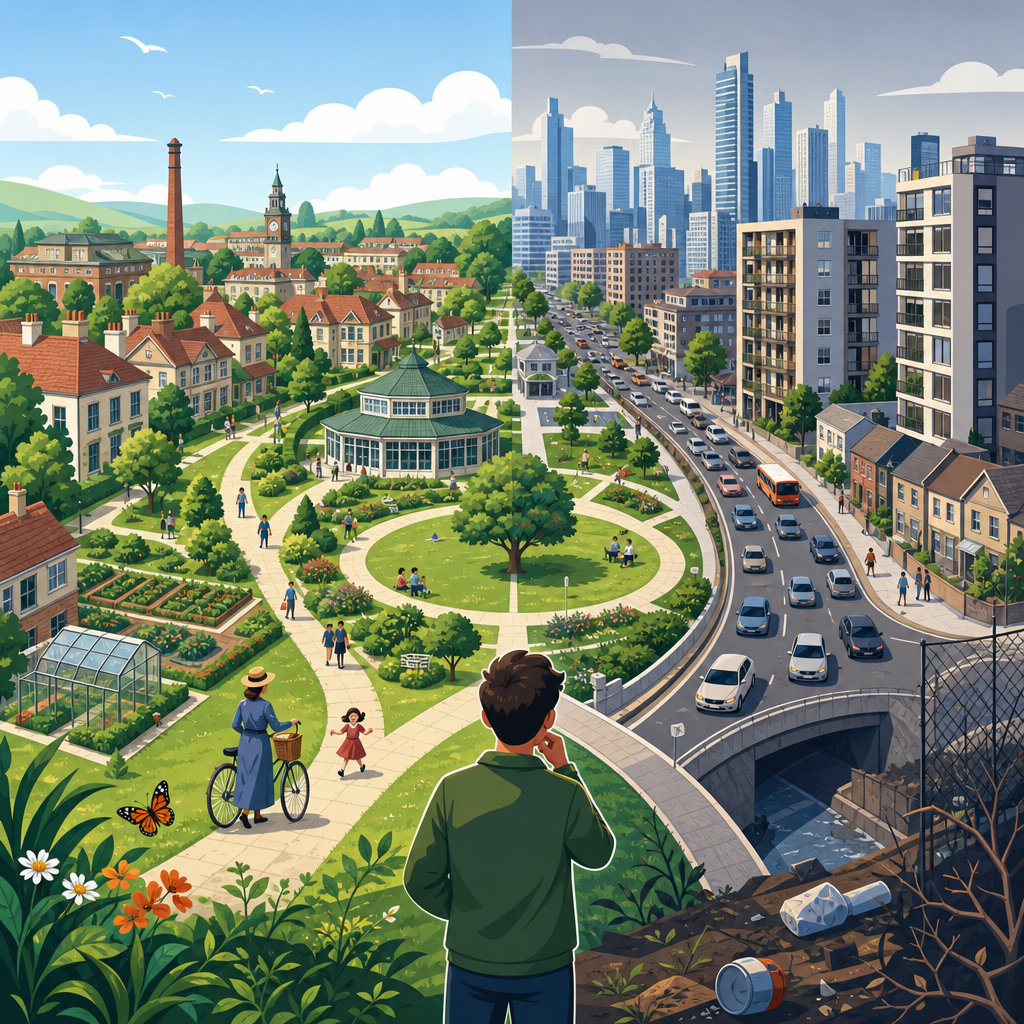
The Garden City Movement still shapes how planners talk about healthy urban growth, even though many of its original promises proved difficult to deliver. Coined by Ebenezer Howard in 1898, the term “garden city” described a new kind of settlement that would combine the social opportunity of the city with the fresh air, green space, and civic balance of the countryside. Howard’s model proposed self-contained communities, limited in size, ringed by protected agricultural land, and connected to each other by rail. More than a design style, it was a social and economic program meant to address overcrowding, speculation, public health failures, and class division produced by industrial urbanization.
The movement matters because it sits at the root of many planning ideas that now feel mainstream: greenbelts, neighborhood units, planned new towns, mixed housing, separated industry, public parks, and the belief that land policy shapes social outcomes. I have worked with planning documents and new-town case studies that still cite Howard directly or indirectly, and the pattern is consistent. When modern officials discuss growth boundaries, walkable districts, housing near jobs, or the value of urban green networks, they are often revisiting questions first organized clearly by the Garden City Movement. At the same time, when critics point to exclusionary suburbs, long commutes, or idealistic plans detached from market realities, they are also reacting to the movement’s legacy.
To revisit the Garden City Movement is to ask two practical questions. What endured because it solved real urban problems, and what failed because the model underestimated politics, finance, infrastructure, and human behavior? The answer is not simple praise or dismissal. The movement succeeded as a planning vocabulary and as a source of enduring tools. It failed whenever its social reform ambitions depended on perfect governance, disciplined land ownership, or a level of economic self-containment that most places could not sustain. Understanding both sides is essential for anyone studying urban planning and policy, because the movement’s strengths and weaknesses still appear in debates over housing affordability, climate resilience, regional growth, and the public purpose of land development.
What the Garden City Movement Actually Proposed
Howard’s framework was often reduced to leafy neighborhoods, but his proposal was far more structured. In To-Morrow: A Peaceful Path to Real Reform, later reissued as Garden Cities of To-Morrow, he outlined towns of roughly 32,000 people on about 6,000 acres, with a built-up core, radial boulevards, public institutions, workplaces, and a permanent agricultural belt. The key mechanism was collective control of land value. Instead of allowing private speculation to capture all gains from urban growth, the community would retain land ownership or land-rent revenues and reinvest them in services, infrastructure, and social welfare. That financing principle was as important as the physical plan.
This is where many modern summaries become misleading. The movement was not simply about putting more trees near housing. It aimed to unite urban employment, rural access, and municipal stewardship in one repeatable model. The famous “Three Magnets” diagram asked people to choose between Town, Country, and Town-Country, arguing that a better settlement could combine wages, culture, and social life with beauty, lower congestion, and cleaner air. In policy terms, Howard was trying to solve a systems problem. Industrial cities suffered from overcrowding, disease, smoke, inflated land prices, and social inequality, while rural areas lacked opportunity. The garden city was meant to relieve both pressures at once.
The first built examples, Letchworth Garden City and Welwyn Garden City in England, translated theory into practice with mixed results. They demonstrated that planned communities could coordinate streets, utilities, green space, and industry more coherently than piecemeal urban expansion. Yet even these flagship projects struggled to fully realize Howard’s communal land model and employment balance. That tension between inspiring form and incomplete reform runs through the movement’s history.
What Endured in Planning Practice
The strongest legacy of the Garden City Movement is not the exact blueprint but the set of planning principles it normalized. Greenbelts are one clear example. The idea that urban growth should have a defined edge, beyond which agricultural land or open space remains protected, became influential in Britain and beyond. While greenbelts remain controversial when housing supply is tight, they established the principle that unlimited outward expansion carries public costs. That concept still informs metropolitan growth boundaries in places such as Portland, Oregon, and regional open-space strategies across Europe.
Another enduring contribution is the integration of parks and civic open space into the basic structure of neighborhoods. Before these ideas matured, many industrial districts treated green space as an afterthought. Garden city thinking made it normal to plan for public landscapes, tree-lined streets, recreation grounds, and access to daylight and air. Contemporary public-health planning, climate adaptation, and stormwater design all benefit from that shift. In current practice, when planners argue for green infrastructure, urban cooling corridors, or distributed recreational space, they are extending a logic the movement helped establish.
The movement also advanced the case for coordinated land-use planning. Rather than allowing housing, factories, institutions, and roads to emerge without overall structure, garden city practice treated urban development as something that could be organized around function, health, and long-term public interest. This principle shaped twentieth-century planning statutes, zoning systems, and comprehensive plans, even in places that never built formal garden cities. It also influenced the postwar New Towns program in the United Kingdom, where places such as Milton Keynes and Harlow reflected the belief that planned settlements could absorb growth more effectively than overcrowded cores.
| Enduring Idea | How It Worked in the Movement | Where It Appears Today |
|---|---|---|
| Greenbelts | Protected rural land around settlements to limit sprawl | Growth boundaries, regional open-space policy, farmland preservation |
| Planned open space | Parks and landscaped streets embedded in community layout | Green infrastructure, urban heat mitigation, recreation planning |
| Balanced land use | Housing, work, civic uses, and services arranged intentionally | Comprehensive plans, master-planned districts, new towns |
| Transit connection | Rail links between settlements and larger urban regions | Transit-oriented development, regional rail planning |
| Land value capture | Community benefit from rising land values | Development charges, public land leasing, tax increment tools |
Perhaps the most underestimated legacy is land value capture. Howard understood that infrastructure and collective growth raise land prices, and he argued that the public should retain part of that increase. Today, planners and policy makers use different instruments, including betterment levies, development impact fees, public land leasing, and tax increment financing. The mechanisms vary, but the underlying logic is recognizably Howardian: when society creates value, society should share in the return.
Where the Movement Fell Short
The movement failed wherever its physical planning ambitions outran its economic and political foundations. The central weakness was self-containment. Howard imagined towns with enough jobs, housing, services, and agriculture to function as relatively balanced communities. In reality, most settlements became dependent on larger regional economies. Residents commuted, industries relocated, retail patterns changed, and agricultural belts did not guarantee local food systems or economic independence. Once widespread car ownership arrived, the self-contained town became even harder to preserve.
Finance posed another major problem. Acquiring large sites, assembling infrastructure, and holding land in ways that serve long-term public benefit require institutions with patience, capital, and legal authority. In my experience reviewing planned-community models, this is where idealism most often collides with implementation. Private developers usually need shorter return cycles. Public agencies face election cycles, budget constraints, and legal limits. Cooperative or quasi-public ownership structures can work, but they demand strong governance and administrative discipline. Without those conditions, the social reform element weakens, and only the attractive physical form survives.
The movement also struggled with social inclusivity. Although Howard’s ideas were reformist, many later adaptations drifted toward low-density, middle-class environments rather than truly mixed communities. This happened partly because well-designed green settlements became desirable and therefore expensive. In some cases, what began as an alternative to unhealthy industrial urbanism became a precursor to exclusionary suburban development. The presence of greenery and planned streets did not automatically produce social equity, and the movement never fully solved that contradiction.
There was also a design tradeoff. Separating uses could reduce nuisances from heavy industry, but too much separation reduced vitality and increased travel demand. Twentieth-century planning often exaggerated this tendency, creating dormitory suburbs and office districts that lacked the daily mix of uses now associated with walkability. Garden city principles were not solely responsible for modern sprawl, but selective borrowing from the movement contributed to it when planners copied the open space and low-rise form without maintaining job access, transit quality, or compactness.
How the Garden City Idea Spread and Changed
The movement’s global influence came through adaptation rather than direct replication. In Britain, it informed suburban extensions, satellite towns, and the New Towns Act of 1946. In the United States, designers such as Clarence Stein and Henry Wright drew from garden city principles in projects like Radburn, New Jersey, especially its superblock layout, internal green space, and pedestrian separation. These ideas later influenced neighborhood planning standards, though often in diluted forms.
Across Europe, the movement blended with local housing reform, cooperative development, and social-democratic planning traditions. In Germany, the settlement reform movement and later modernist estates shared concerns with light, air, greenery, and healthier living conditions. In Scandinavia, postwar suburbs often combined transit, landscape planning, and neighborhood services in ways that echoed Howard, even when the architecture looked entirely different. In Asia, planned capitals and new towns borrowed selective elements, especially green buffers and ordered districting, but usually abandoned the original communal land vision.
This spread matters because it shows the movement was less a single template than a transferable planning grammar. Its concepts could support humane reform, but they could also be repurposed for bureaucratic order or suburban dispersion. That flexibility explains both its endurance and its distortion. Once the language of planned greenery, limited growth, and separated functions entered mainstream planning, it could be used for many agendas, not all of them aligned with Howard’s social aims.
Lessons for Today’s Urban Planning and Policy
The most useful lesson is that physical design cannot substitute for governance. A beautifully planned settlement will not stay affordable, inclusive, or environmentally balanced unless institutions manage land, transport, housing supply, and public services over time. Current debates about transit-oriented development make this clear. Building near stations is not enough if zoning restricts housing choice, land prices rise unchecked, or jobs remain too far away. Howard’s partial failure on this point is instructive because he correctly identified land economics as fundamental, even though implementation proved difficult.
A second lesson is that green space works best as infrastructure, not decoration. Parks, trees, waterways, and agricultural edges deliver measurable benefits when they are connected to mobility, drainage, biodiversity, and public health systems. Cities now confronting heat waves and flooding have rediscovered this principle. Green corridors can lower surface temperatures, improve stormwater absorption, and provide active transport routes. The movement’s instinct was right: nature should be built into urban form from the start. The modern upgrade is to pair that instinct with environmental science and metropolitan-scale coordination.
Third, balanced communities require regional thinking. No district is fully self-sufficient, but places can still reduce harmful imbalances between jobs and housing, center and edge, growth and conservation. Successful contemporary planning uses tools Howard did not have, including metropolitan transport modeling, inclusionary zoning, GIS-based land analysis, and climate risk mapping. Yet the strategic question is familiar: how can growth be directed so that settlements remain livable, connected, and socially useful rather than fragmented and speculative?
For policy makers, the answer is rarely to recreate a classic garden city from scratch. It is to apply the durable insights selectively: capture some land value for public purposes, protect meaningful open space, plan complete neighborhoods, link them with strong transit, and maintain institutional capacity after construction ends. Those steps are less utopian than Howard’s original vision, but they are more realistic and more relevant to twenty-first-century urban conditions.
The Garden City Movement endures because it named a permanent urban challenge: how to combine density, opportunity, health, and access to nature without letting growth become chaotic or unjust. Its lasting achievements are visible in greenbelts, parks systems, planned new towns, and the broader expectation that urban form should serve public well-being. Its failures are equally important. Self-contained settlements rarely remained self-contained, communal land models were hard to sustain, and pleasant environments did not guarantee affordability or social inclusion.
For anyone exploring urban planning and policy, this movement is a crucial hub because it connects land economics, transport, housing, public health, environmental design, and governance in one historical framework. It teaches that planning ideas survive when they can adapt, and fail when their institutions are too fragile to carry them. The best way to revisit the Garden City Movement is neither to romanticize it nor to dismiss it as a quaint precursor to suburbia. Read it as a serious attempt to align urban growth with social purpose, then test its tools against today’s housing shortages, climate pressures, and regional inequalities.
If you are mapping this subtopic further, start with the movement’s core components: land ownership, greenbelts, new towns, neighborhood design, and transit connection. From there, compare what was promised with what was built. That exercise reveals why the Garden City Movement still matters and which of its ideas deserve renewal now.
Frequently Asked Questions
What was the original goal of the Garden City Movement?
The original goal of the Garden City Movement was to solve some of the most damaging problems created by rapid industrial urbanization in the late 19th century. Ebenezer Howard proposed a new kind of settlement that would offer the best qualities of both city and country while avoiding the worst features of each. In his vision, people would enjoy access to jobs, culture, and civic life without being trapped in overcrowded, polluted, unhealthy cities. At the same time, they would benefit from fresh air, parks, gardens, and a closer relationship to nature without suffering the isolation or economic limitations often associated with rural life.
Howard’s model was not just about attractive neighborhoods or more trees along streets. It was a full social and economic framework. The ideal garden city would be planned in advance, limited in size, surrounded by a permanent agricultural greenbelt, and designed to be self-contained. Housing, industry, public institutions, and open space would be arranged in a balanced way so that growth did not become chaotic. He also believed that land should be managed in a way that benefited the whole community rather than simply enriching private landowners through speculation.
In that sense, the movement was both a planning idea and a reform project. It responded to concerns about public health, class inequality, urban congestion, and land use. The broader ambition was to create healthier, more stable communities through careful design, shared civic purpose, and a built environment that supported everyday life rather than undermined it.
Which parts of the Garden City idea actually endured in modern planning?
Several core ideas from the Garden City Movement proved remarkably durable, even when the complete original model was rarely achieved. One of the clearest legacies is the continued importance of green space in urban planning. Parks, tree-lined streets, neighborhood gardens, and access to open land are now widely seen as essential features of healthy communities rather than optional luxuries. The modern emphasis on livability, walkability, and mental and physical well-being owes a great deal to this earlier belief that the environment shapes social life.
Another enduring contribution is the principle of planned growth. Howard argued that cities should not simply spread without limits or structure. Today, planners still work with related ideas when they create master plans, regulate urban expansion, establish growth boundaries, or reserve land for public use. The concept of the greenbelt in particular has had a long afterlife, influencing policies intended to prevent unchecked sprawl and to preserve farmland or natural landscapes at the edge of metropolitan regions.
The movement also helped normalize the idea that housing, jobs, transportation, recreation, and civic institutions should be considered together rather than separately. This integrated approach remains central to urban design and regional planning. Even if modern cities are far more complex than Howard imagined, the underlying logic of balanced land use still matters. Many contemporary planning conversations around mixed-use neighborhoods, transit-oriented development, and community-centered design reflect this inheritance, even when they no longer use the language of the Garden City Movement directly.
What parts of the Garden City Movement failed or proved unrealistic?
The most significant failure was the difficulty of fully delivering Howard’s ideal of self-contained communities. In theory, garden cities would provide enough housing, jobs, services, and social infrastructure to function independently while remaining connected to a larger regional network. In practice, many settlements inspired by the model became tied economically and socially to nearby major cities. Instead of operating as truly autonomous places, they often evolved into commuter suburbs or partial satellites, dependent on external employment and investment.
Another major challenge was land ownership and financing. Howard’s vision depended on coordinated land control and a system in which rising land values would support the community as a whole. That was far easier to imagine than to implement. Private real estate markets, political resistance, and the pressures of development made it difficult to preserve the social and economic foundations of the original concept. As a result, many projects adopted the physical appearance of the garden city—low-rise housing, greenery, and orderly layouts—without reproducing its deeper institutional model.
The movement also underestimated how powerful population growth, industrial change, and regional mobility would become. Limiting the size of settlements sounded sensible, but it was hard to maintain once demand increased. Protected greenbelts could come under pressure, and carefully balanced plans could be disrupted by market forces. In some cases, the low-density interpretation of the garden city ideal unintentionally contributed to sprawl rather than containing it. This is one of the central historical ironies: a movement intended to manage urban growth sometimes helped inspire forms of development that dispersed people and resources over larger areas.
How did the Garden City Movement influence suburbs and new towns?
The Garden City Movement had a profound influence on both suburban development and the later new towns tradition, though the results were mixed. In the suburban context, its visual and spatial ideas were especially influential. Curving streets, generous setbacks, neighborhood greens, tree planting, and a quieter residential atmosphere all became associated with a more humane alternative to dense industrial districts. Developers and planners borrowed these elements enthusiastically, and many 20th-century suburbs were shaped by the garden city vocabulary of openness, greenery, and ordered domestic life.
However, suburban adaptation often simplified the original idea. Howard had envisioned communities with social diversity, economic purpose, public institutions, and a balance between homes and employment. Many suburbs kept the pleasant landscape but dropped the self-contained civic and economic structure. That shift matters because it transformed a reformist planning model into a residential pattern that could depend heavily on commuting and separate zoning. In other words, the aesthetic legacy was often stronger than the social one.
The movement’s influence on new towns was in some ways closer to Howard’s intentions. In Britain and elsewhere, 20th-century new town programs drew on the idea that entire communities could be planned to absorb growth in a more orderly and healthy way. These projects frequently emphasized neighborhood units, open space, separation of incompatible land uses, and regional strategy. Even when they departed from Howard’s exact blueprint, they shared his belief that urban expansion should be shaped deliberately rather than left to chance. That legacy remains significant in the history of planned communities and state-led urban development.
Why does the Garden City Movement still matter today?
The Garden City Movement still matters because it raises questions that remain central to urban life: how cities grow, who benefits from development, how much green space people need, and whether planning can create healthier and more equitable communities. Even if the original model now appears idealistic in important respects, it established a durable framework for thinking about the relationship between settlement patterns, social outcomes, and environmental quality. That framework still informs debates about sustainable development, climate resilience, housing design, and regional planning.
It also matters because it serves as both inspiration and caution. On the inspiring side, the movement reminds planners and policymakers that urban form is not inevitable. Communities can be designed intentionally, and public goals such as health, beauty, access to nature, and civic coherence can be built into growth strategies. On the cautionary side, the history of the movement shows how easily ambitious planning ideals can be diluted by market pressures, political compromise, and uneven implementation. A place can look like a garden city without fulfilling the deeper promises of inclusion, affordability, and economic balance.
For contemporary readers, the lasting value of revisiting the Garden City Movement lies in that tension between enduring insight and practical failure. It helps explain why green urbanism remains so appealing, why the suburb became such a dominant form, and why planners continue searching for models that combine density, livability, and environmental stewardship. The movement did not solve the urban question once and for all, but it permanently changed the terms of the conversation.


