
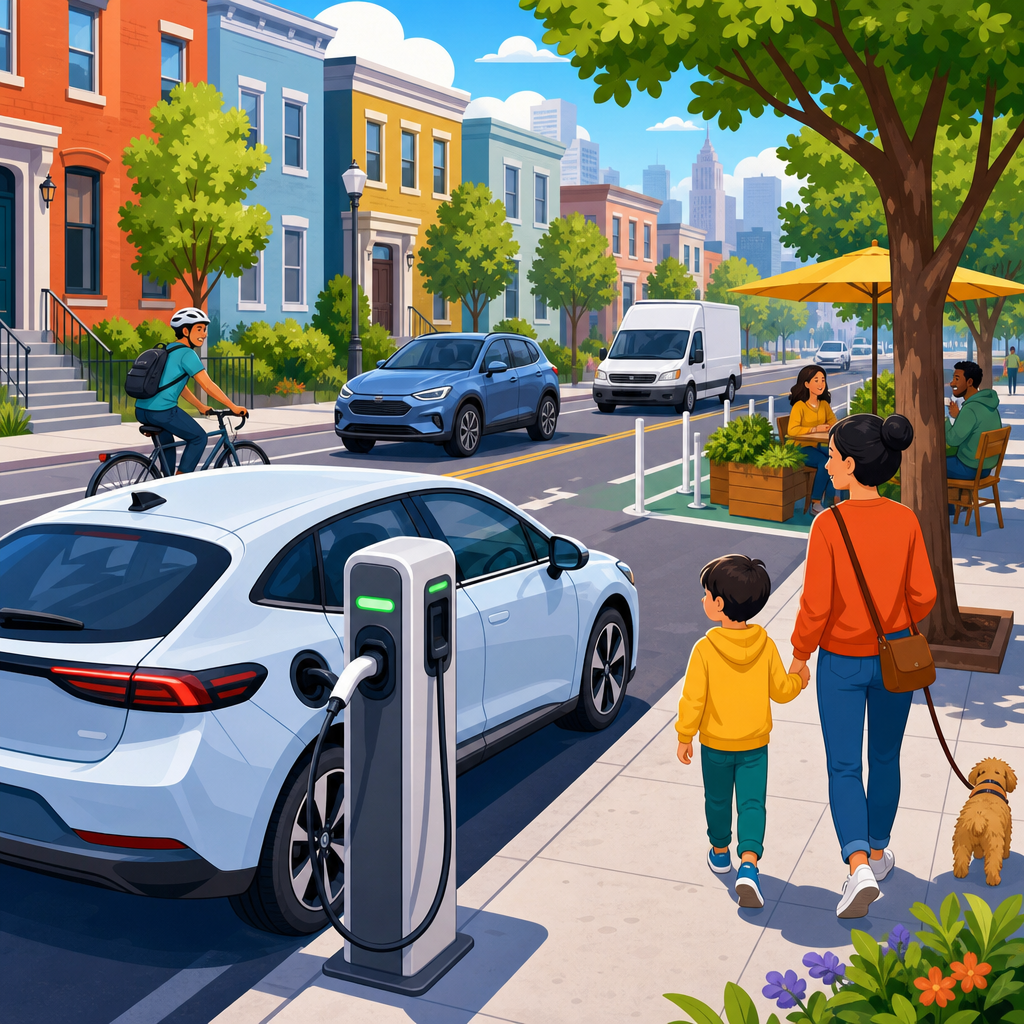
Curbside EV charging is rapidly becoming one of the defining urban planning questions of the decade because it forces cities to decide how limited public street space should serve drivers, transit riders, cyclists, delivery vehicles, pedestrians, and climate goals at the same time. The term refers to electric vehicle charging infrastructure installed along public streets, usually at the curb, where residents or visitors can plug in without access to private garages or driveways. In practice, curbside charging includes pole-mounted chargers, pedestal units embedded in the furnishing zone, chargers integrated into streetlights, and dedicated charging bays managed through parking rules. I have worked on transportation and streetscape projects where a single parking lane had to absorb requests for bike corrals, bus boarding islands, parklets, loading zones, trees, and now charging access, and the lesson is always the same: the charging debate is not mainly about hardware. It is about governance, equity, pricing, design standards, and who gets to use public right-of-way.
This matters because many urban residents cannot charge at home. In dense neighborhoods, especially in older apartment districts, off-street parking is scarce and electrical capacity inside buildings may be limited or expensive to upgrade. If those households are excluded from practical charging, electric vehicle adoption will tilt toward people with private driveways, worsening existing inequities. At the same time, curb space is already one of the most contested assets a city manages. One block face may need room for ADA access, bus stops, hydrants, daylighting at intersections, freight loading, ride-hail pick-up, and protected bike lanes before anyone even discusses charging. A curbside EV charging strategy therefore sits at the intersection of transportation planning, utility coordination, parking management, land use, and public finance. Getting it right means understanding not only how chargers work, but how street space works under real urban conditions.
Why curbside charging is fundamentally a street allocation problem
The core question is simple: should a public parking space become a mobility utility, and if so, for whom? Traditional fuel distribution never required reserving a neighborhood curb stall for several hours while one vehicle replenished energy. EV charging often does. Even with Level 2 equipment in the 7 to 19 kilowatt range, a vehicle may occupy a curbside charger for two to eight hours depending on battery size, state of charge, and power sharing. That duration creates an opportunity cost. A space assigned to charging cannot simultaneously function as a short-term loading zone, bike parking area, transit bulb, taxi stand, or general parking stall. Cities therefore need to treat curbside charging as a use-class decision, not merely as an amenity layered onto existing parking.
Street allocation becomes even more complicated when charging demand is geographically uneven. Affluent neighborhoods may show higher early EV adoption, but lower-income districts are often where off-street parking is least available and public charging has the greatest long-term necessity. If cities simply place chargers where current EV registrations are highest, they reinforce present inequities. If they place chargers solely where need is greatest, utilization may initially lag and invite political criticism. The strongest programs balance both by combining registration data, housing type, utility capacity, and walkability metrics. London boroughs, for example, have expanded lamp-column charging in residential areas partly because curb access is essential for households without driveways. In U.S. cities, pilots increasingly use equity screens to identify multifamily neighborhoods with limited private parking access before selecting sites.
Another street allocation issue is turnover. A charger installed at the curb is valuable only if drivers can predict access. Without active management, drivers may “ICE” a space by parking non-electric vehicles there, or EV drivers may remain long after charging is complete. That is why charging policy cannot be separated from parking enforcement, time limits, and payment systems. The battle for street space is won or lost in these operating details.
Design choices that shape whether curbside EV charging works
Not all curbside charging designs create the same impacts. Pole-mounted and streetlight-integrated chargers often minimize sidewalk obstruction and reduce installation costs by using existing infrastructure. They can work well on narrow sidewalks if cable management is carefully handled and ADA clearances are preserved. Pedestal chargers may offer more visible branding and easier maintenance access, but poorly placed units can block pedestrian paths, conflict with tree roots, or complicate snow clearance. In my experience reviewing streetscape plans, the most overlooked design issue is not the charger itself but the charging cable path. A technically successful installation can still fail from a public realm standpoint if cords cross the sidewalk or require awkward reach from vehicle to pedestal.
Power level also affects curb use. Level 2 charging is usually the most practical curbside option for residential overnight or multi-hour dwell parking because it balances grid demand, equipment cost, and dwell time. DC fast charging can reduce occupancy time dramatically, but it introduces heavier utility upgrades, larger cabinets, ventilation and noise concerns, and greater pressure for vehicle turnover in dense areas. Fast charging is generally better near commercial corridors, fleet depots, or mobility hubs than on purely residential block faces. The best siting decisions align charging speed with the expected parking behavior of the location rather than chasing maximum power everywhere.
| Approach | Best use case | Primary advantage | Main tradeoff |
|---|---|---|---|
| Streetlight-integrated Level 2 | Residential neighborhoods with narrow sidewalks | Lower visual clutter and potentially lower installation cost | Limited power availability at some poles |
| Pedestal Level 2 at dedicated bays | Mixed-use streets with predictable overnight demand | Clear user visibility and scalable hardware options | Can obstruct sidewalks and requires careful enforcement |
| DC fast charging at the curb | Commercial corridors, taxis, ride-hail, light fleets | Shorter charging sessions and higher throughput | Higher grid upgrade cost and stronger curb competition |
| Charging hubs off the main curb lane | Municipal lots, garages, edge-of-neighborhood sites | Reduces pressure on premium street frontage | Less convenient than true curb access for some residents |
Accessibility standards must guide every choice. Sidewalks need clear through-zones, reachable controls, understandable payment interfaces, and parking geometry that allows disabled drivers to use equipment safely. National guidance such as the Public Right-of-Way Accessibility Guidelines and local complete streets standards provide a starting point, but cities still need project-level design review. A curbside charger that narrows the pedestrian realm or creates a tripping hazard is not a sustainable mobility solution, even if it increases charging counts on paper.
Policy, pricing, and enforcement determine real performance
Curbside EV charging succeeds when regulations are as carefully designed as the hardware. The first policy decision is whether charging spaces are exclusive to EVs at all times, exclusive only while actively charging, or open to general parking during certain hours. Each approach has tradeoffs. Full-time exclusivity improves charger reliability but may reduce utilization in low-demand periods. Shared-time rules support broader curb efficiency but can frustrate drivers who arrive expecting to charge. Cities need demand-responsive policies based on neighborhood context, not one-size-fits-all rules.
Pricing is equally important. If electricity is underpriced relative to parking, a curbside charger becomes de facto cheap vehicle storage. If priced too high, drivers avoid it and infrastructure sits idle. Effective tariffs usually bundle energy fees with parking logic: connection fees, time-based fees after charging completion, and idle penalties to encourage turnover. Operators such as ChargePoint, FLO, and Ubitricity have shown that software-based pricing can shape behavior as much as physical capacity does. The point is not revenue maximization alone. It is matching scarce public space with efficient public use.
Enforcement often determines whether a curbside charging program earns public trust. Clear pavement markings, regulatory signage, license plate integration, and active parking control are essential. Some jurisdictions permit towing or ticketing for non-charging vehicles occupying EV-only stalls, but enforcement must be frequent enough to matter. Data integration can help. When a charger can indicate whether a vehicle is connected and charging, enforcement officers can target violations more precisely. In several pilots, weak enforcement led to low charger reliability, which then depressed demand and created the false impression that curbside charging was unnecessary. The lesson is straightforward: poor operations can make good infrastructure look ineffective.
Equity, utilities, and the economics behind deployment
The economics of curbside EV charging are rarely simple. Installation costs vary widely depending on trenching, utility service upgrades, panel capacity, permitting complexity, and streetscape restoration. A charger attached to an existing streetlight may cost far less than a new installation requiring transformer upgrades and cabinet placement. Ongoing costs include network fees, maintenance, payment processing, electricity demand charges in some cases, and enforcement administration. Because utilization may be modest in the early years, many programs require public subsidy, utility partnership, or cross-subsidization from other charging assets.
Utilities play a decisive role because the curb is only the visible front end of a larger power system. Distribution capacity, transformer loading, interconnection timelines, and managed charging capabilities all shape what cities can deploy. Smart charging can stagger load, reduce peak demand, and delay expensive upgrades, especially on residential feeders. Time-of-use pricing can encourage overnight charging when grid conditions are favorable. Some utilities also support make-ready programs, covering parts of the electrical infrastructure while site hosts or operators fund the chargers themselves. From a planning perspective, early utility coordination saves months of redesign and prevents political promises that the grid cannot deliver on schedule.
Equity requires more than geographic distribution. It also involves payment access, language accessibility, reliability, and vehicle diversity. Many public chargers still assume users have smartphones, bank cards, and comfort with app-based onboarding. That excludes some residents. Inclusive programs provide multiple payment methods, transparent pricing, multilingual instructions, and customer support that does not depend on downloading another app on the sidewalk at night. Cities should also remember that not every resident will own an EV soon, and some may never choose private car ownership. Public investment in curbside charging must therefore be weighed against transit, walking, cycling, and safety needs. The right answer in some locations is fewer curb chargers and more shared fast-charging hubs near apartment clusters or municipal lots.
What cities are learning and how to build a durable curbside strategy
Leading cities are converging on a few practical lessons. First, start with a curb management plan, not a charger procurement plan. Inventory every block face for competing uses, then identify where charging supports wider transportation and climate objectives without undermining transit priority or pedestrian safety. Second, pilot multiple formats. A residential district may need lamp-post charging, while a commercial street may perform better with short-dwell fast charging near retail and loading management. Third, publish siting criteria. Transparent rules reduce accusations that charging deployment is arbitrary or politically captured.
Data should guide iteration. Useful metrics include utilization by hour, average dwell time, energy dispensed per session, ICEing and overstay rates, sidewalk conflict reports, maintenance downtime, and equity distribution by neighborhood and housing type. Cities that monitor only charger count miss the actual question, which is whether the curb is being used productively. I have seen installations celebrated at ribbon cuttings yet underperform because signage, pricing, and turnover rules were never refined after launch. Conversely, modest pilots have scaled successfully when managers adjusted tariffs, repainted curb markings, and relocated underused units based on observed behavior.
For a durable strategy, cities should think in layers. Some residents need slow, nearby overnight charging. Fleets and ride-hail drivers need faster charging with predictable access. Visitors need interoperable payment and visible wayfinding. Freight electrification will add another layer, especially for delivery vans competing for the same curb lanes. No single charger type solves all of these needs. A citywide network should combine curbside charging with off-street hubs, workplace charging, fleet infrastructure, and building code reforms that make future installations easier. The curb is important, but it should not carry the entire transition.
Curbside EV charging and the battle for street space will define whether urban electrification is convenient, fair, and compatible with better streets. The central lesson is that chargers are not simply pieces of equipment; they are long-term claims on public right-of-way. Cities that treat them as a narrow parking amenity will struggle with conflict, low utilization, and public backlash. Cities that treat them as part of integrated curb management can balance access, equity, and efficiency. That means matching charger type to land use, aligning prices with turnover goals, coordinating early with utilities, enforcing rules consistently, and protecting the pedestrian realm at every step.
The biggest benefit of a well-designed curbside charging program is not just more plugs. It is broader access to electrification for residents who lack private parking, without sacrificing the many other functions streets must serve. Public street space is too valuable for improvisation. If your city is revising parking policy, climate plans, or street design standards, make curbside charging part of a complete curb strategy now. The sooner those decisions are made deliberately, the better the street will work for everyone.
Frequently Asked Questions
What is curbside EV charging, and why has it become such a major urban planning issue?
Curbside EV charging refers to electric vehicle charging equipment placed along public streets, usually at or near the curb, so drivers can recharge without relying on a private driveway or garage. This matters most in dense cities, where many residents park on the street and do not have access to home charging. As electric vehicle adoption grows, cities are under increasing pressure to provide charging options that work for apartment dwellers, renters, and visitors, not just homeowners with off-street parking.
What makes curbside charging a major planning issue is that curb space is already one of the most contested pieces of public real estate in any city. The same stretch of street may be needed for bus lanes, bike lanes, ride-hailing pickups, freight loading, accessible parking, tree planting, stormwater management, wider sidewalks, outdoor dining, and safer pedestrian crossings. Installing EV chargers is therefore not just a technical decision about power supply. It is a public policy choice about who gets priority in a limited and highly valuable space.
That is why curbside EV charging sits at the intersection of transportation equity, climate strategy, land use, utility planning, and street design. Cities must decide whether chargers should primarily serve local residents, support commercial fleets, encourage cleaner air, or help accelerate broader EV adoption. In many cases, the debate is less about whether EV charging is necessary and more about how to provide it without undermining other goals such as transit reliability, walkability, and traffic safety.
Why is street space such a battleground when cities try to add curbside EV chargers?
Street space is limited, and every new use usually displaces another. A curb lane that could host EV charging might otherwise be used for metered parking, bus stops, delivery access, taxi stands, car-share parking, ADA-accessible spaces, bike corrals, or loading zones for local businesses. Because the curb is one of the few parts of the transportation network that can flex between many functions, any attempt to dedicate it to charging can trigger conflict among residents, merchants, drivers, transit agencies, and advocates for safer streets.
The conflict becomes even sharper because curbside EV charging often requires more than just a parking space. It may involve utility connections, protective bollards, signage, pavement markings, charging cabinets, and rules about time limits or vehicle eligibility. In some designs, the space may effectively become reserved for EVs while charging, which raises questions about fairness if demand for parking is already high. In other designs, chargers are shared among multiple spaces, which can improve utilization but also create confusion and enforcement challenges.
From a planning perspective, the battle over street space is really a battle over city priorities. Should public curb lanes continue to function mainly as long-term car storage, or should they be redesigned to move more people and goods efficiently? Should cities use curbside charging to support private EV ownership, or should they focus on electrifying buses, delivery vans, taxis, and shared mobility fleets first? These are not simple tradeoffs, and they explain why curbside EV charging debates often become proxies for larger disagreements about the future of urban transportation.
Who benefits most from curbside EV charging, and how does it affect equity?
Curbside EV charging can provide significant benefits for people who want or need an electric vehicle but lack off-street parking. That includes renters, apartment residents, lower-car-ownership households in mixed-use neighborhoods, and workers who park near their jobs for long periods. Without publicly accessible charging, EV ownership tends to be easier for higher-income households with garages and home chargers, which can reinforce existing inequalities in access to cleaner transportation.
Equity, however, is more complex than simply installing chargers in dense neighborhoods. If curbside charging mainly subsidizes parking for private vehicles in areas with strong transit access, some critics argue that it may favor a relatively narrow segment of residents while consuming public land that could serve broader community needs. There are also affordability questions: if electricity prices, parking fees, or charging memberships are too high, the infrastructure may exist physically but remain inaccessible in practice. Reliable access, simple payment systems, multilingual instructions, and thoughtful placement all matter if cities want curbside charging to be genuinely inclusive.
Equitable planning usually means targeting investment where charging gaps are largest, especially in neighborhoods with many multifamily buildings and limited private parking. It can also mean pairing curbside chargers with policies that support accessibility, transparent pricing, and universal design. Some cities are exploring ways to prioritize shared charging hubs, community charging depots, or fleet charging for services that benefit many people, such as paratransit, car-share, and urban deliveries. In that sense, the most equitable curbside charging strategy is often one that treats charging as part of a broader public mobility system rather than as a stand-alone amenity for individual drivers.
What are the biggest practical challenges cities face when installing and managing curbside EV charging?
The practical challenges start with basic infrastructure. Cities need available electrical capacity, utility coordination, permitting pathways, equipment standards, and installation methods that fit existing sidewalks and curb layouts. In older neighborhoods, underground utility conflicts, constrained sidewalks, or aging electrical systems can make deployment slower and more expensive than expected. Even after installation, chargers must be maintained, repaired quickly when out of service, and designed to withstand weather, vandalism, and heavy public use.
Operations and enforcement are just as important as hardware. Cities need clear rules about who can use a charger, how long they can stay, whether a vehicle must be actively charging, and how to prevent “charger blocking” by gasoline vehicles or fully charged EVs that remain parked. Poorly designed rules can reduce turnover and create frustration, while inconsistent enforcement can undermine public trust. Payment systems also need to be intuitive and interoperable so users are not forced to download multiple apps or navigate confusing pricing structures for every different charger network.
Another major challenge is utilization. If a charger is placed where demand is weak, it may sit underused. If it is placed in a high-demand corridor without enough turnover, it may be constantly occupied and fail to serve enough users. Cities must therefore balance convenience, visibility, electrical feasibility, and neighborhood needs. The most successful programs usually rely on data-driven siting, phased pilots, community input, and regular adjustment over time rather than assuming one curbside charging model will work everywhere.
How can cities balance curbside EV charging with transit, cycling, walking, deliveries, and other street priorities?
The most effective approach is to treat curbside EV charging as one tool within a complete curb management strategy, not as an isolated infrastructure project. That means cities should first identify which street functions are essential on each corridor: transit movement, bike safety, loading access, pedestrian space, accessible access, short-term parking, and vehicle charging. Once those priorities are clear, chargers can be placed where they support electrification goals without undermining the highest-value uses of the street.
In practice, this often means avoiding charger placement in locations where it would interfere with bus lanes, protected bike lanes, daylighting at intersections, or heavily used loading zones. It may also mean favoring side streets, dedicated charging hubs, municipal lots, or shared neighborhood charging clusters instead of assigning every charger to the most visible curb on the main commercial corridor. Some cities are also exploring time-based curb management, where a space can serve deliveries at certain hours and charging or short-term parking at others, depending on local demand patterns.
Long term, the best balance comes from recognizing that not every EV needs to charge directly at the curb in front of a destination. A resilient urban charging system is usually a mix of solutions: home charging where possible, workplace charging, public fast-charging hubs, fleet depots, and targeted curbside chargers for neighborhoods that truly need them. When cities think in systems rather than single spaces, they are better able to support EV adoption while still protecting transit performance, safer cycling networks, active streets, and the everyday functioning of the public realm.


