
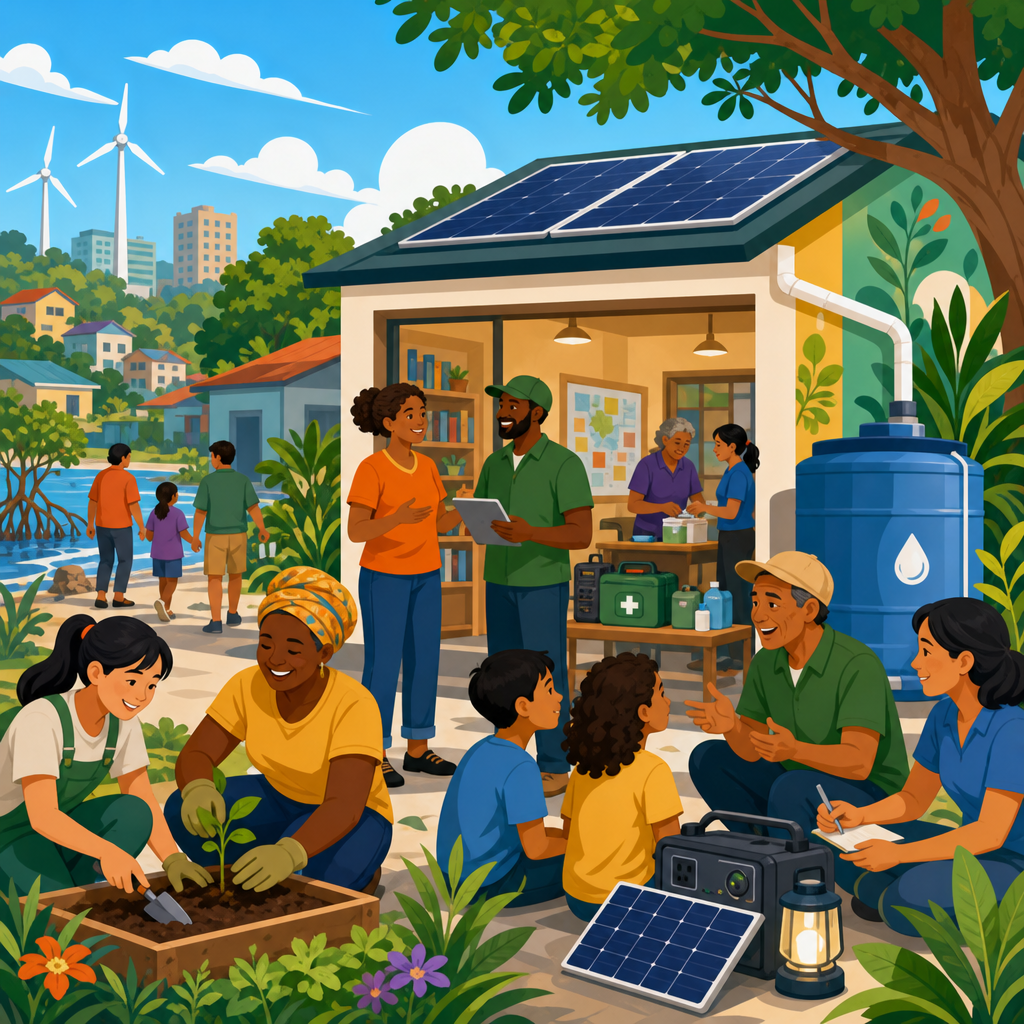
Community-led climate resilience hubs are neighborhood-based spaces that help residents prepare for, withstand, and recover from climate shocks while strengthening daily community life. In practice, they can be libraries, schools, housing authority offices, faith buildings, community centers, or purpose-built sites that provide trusted information, cooling and clean air, backup power, food access, internet, case management, and local coordination before, during, and after emergencies. The key terms matter. “Community-led” means residents shape priorities, operations, and governance rather than being treated only as service recipients. “Climate resilience” means reducing harm from heat, wildfire smoke, flooding, storms, power outages, and chronic stressors such as energy burden or poor indoor air quality. “Hub” means a multipurpose anchor, not a single program.
These hubs matter especially within affordable housing because lower-income households often face the highest climate risk and the fewest recovery resources. I have worked with housing providers and municipal resilience teams that learned this the hard way during heat waves and smoke events: a building can remain technically habitable while residents still lack safe indoor temperatures, medication refrigeration, device charging, transportation, or reliable updates in their language. A resilience hub closes that gap by connecting physical infrastructure with social infrastructure. The physical side includes solar-plus-storage, efficient cooling, filtration, and water access. The social side includes trusted messengers, mutual aid networks, tenant leaders, and clear activation plans.
Well-designed hubs also solve a planning problem. Traditional emergency management often concentrates resources downtown or activates too late for medically vulnerable residents. Community-led hubs localize response and make resilience visible year-round. They host tenant meetings, legal clinics, digital access, preparedness training, youth programming, and health outreach on normal days, then shift into emergency functions when hazards escalate. This dual-use model is why they are increasingly referenced in city climate action plans, public health strategies, and housing preservation initiatives. For affordable housing owners, resident associations, and local governments, resilience hubs are not a nice extra. They are a practical operating model for reducing harm, preserving housing stability, and building neighborhood trust.
What a community-led climate resilience hub includes
A community-led climate resilience hub combines place, services, and governance. The place must be physically accessible, familiar, and close enough that residents can reach it during a disruption. In affordable housing contexts, the most effective sites are often on or near existing properties because walking distance matters when transit fails or heat makes travel dangerous. The services should address both acute hazards and everyday needs. At minimum, strong hubs plan for thermal comfort, clean air, power, communications, water, food coordination, health support, and referral pathways. Governance is the distinguishing feature. Resident councils, tenant leaders, community-based organizations, and frontline service providers should share decision-making on programming, activation triggers, staffing, and accountability.
In real projects, the hub usually starts with a risk and asset assessment. Teams map hazard exposure such as extreme heat days, floodplain overlap, outage history, and smoke vulnerability. They then inventory neighborhood assets: trusted organizations, multilingual outreach capacity, healthcare partners, volunteer networks, and buildings with resilient features. A hub may not need to provide every service directly. It should, however, operate as the coordination point where residents know they can get accurate information and immediate support. During one summer planning process I supported, residents ranked air filtration, charging stations, and evening cooling hours above nearly every other proposed feature because those were the most immediate barriers they faced during outages and smoke alerts.
The operational design should specify normal operations, partial activation, and full activation. Normal operations can include preparedness workshops, benefit enrollment, food distribution, and digital literacy. Partial activation might begin when a heat advisory or air quality alert is issued, extending hours and opening cooling or clean-air rooms. Full activation may occur during prolonged outages, severe storms, or evacuation support, when the hub coordinates transport, wellness checks, refrigeration for medicine, and communication with emergency management. This structure prevents confusion and makes the hub useful every month, not just during declared disasters.
Why resilience hubs matter for affordable housing communities
Affordable housing residents are disproportionately exposed to climate hazards because housing quality, neighborhood conditions, and financial constraints intersect. Older buildings may overheat due to poor insulation, dark roofs, limited shading, or aging electrical systems that cannot support efficient cooling upgrades. Ground-floor units can flood first. Residents working hourly jobs may be unable to leave early for emergencies or absorb the cost of hotel stays, spoiled food, or missed wages. Households managing disability, chronic illness, caregiving, or language barriers face additional friction when official guidance is inconsistent or difficult to access.
Community-led resilience hubs reduce these risks through proximity and trust. Proximity matters because a cooling center three miles away is not functionally accessible to a resident with mobility limitations, young children, or no car during a blackout. Trust matters because people act on guidance from organizations and neighbors they already know. In affordable housing, the most effective messengers are often resident leaders, property staff, promotoras, building service coordinators, and faith or cultural groups with established credibility. A hub formalizes those relationships so information moves quickly and support is coordinated rather than fragmented.
There is also a direct housing stability benefit. Climate events frequently trigger rent delinquency, health complications, insurance disputes, temporary displacement, and property damage that can cascade into eviction risk. A hub can intervene early by connecting residents to utility assistance, disaster case management, legal aid, replacement food benefits, transportation, and healthcare follow-up. For owners and operators, hubs help protect building operations and resident well-being simultaneously. They improve communication during emergencies, provide a location for distributing supplies, and support continuity planning when management offices or common systems fail.
Core functions and design features
The strongest hubs are designed around specific functions rather than broad aspiration. First, they provide safe indoor conditions. That usually means high-efficiency cooling or heating, robust ventilation, and filtration rated appropriately for smoke and particulates, often using MERV-13 or better where the HVAC system can support it. Second, they provide reliable power for critical loads such as refrigeration, charging, lights, communications equipment, and medical devices. Solar paired with battery storage is increasingly favored because it can island during outages and reduce operating costs, though diesel backup may still be used where budgets or site constraints limit alternatives. Third, they support communications with multilingual alerts, posted protocols, radio backup, and staff trained to relay verified information.
Accessibility is nonnegotiable. Hubs should comply with ADA requirements, include accessible restrooms, seating, and clear wayfinding, and plan for sensory and cognitive needs. Public health design matters too. Clean-air rooms need doors and windows managed to maintain indoor air quality, and occupancy should be matched to ventilation rates. Water, sanitation, and infection control cannot be afterthoughts. In mixed-use or multifamily settings, security planning should separate public access from resident privacy without creating an intimidating atmosphere. Good design supports dignity as much as safety.
| Feature | Why it matters | Affordable housing example |
|---|---|---|
| Cooling and clean-air room | Protects residents during heat waves and smoke events | Retrofit a community room with heat-pump cooling and upgraded filtration |
| Solar plus battery storage | Keeps critical services running during outages | Power lights, phone charging, Wi-Fi, and medicine refrigeration for one property cluster |
| Multilingual communications plan | Reduces confusion and delayed action | Text alerts, printed notices, and resident captains covering top neighborhood languages |
| Resident governance structure | Aligns services with actual local needs | Tenant council co-approves activation triggers and monthly programming |
| Resource referral network | Links emergency support to long-term stability | Onsite enrollment help for utility aid, food benefits, and legal services |
Site selection should weigh hazard exposure, walkability, transit access, utility resilience, and ownership control. A ground-floor room in a flood-prone building may be the wrong location even if it is centrally located. Conversely, a school gym with resilient power may work well if community access agreements are secured in advance. The design principle is simple: choose spaces residents can reach, trust, and use under stress, then invest in the minimum infrastructure needed to keep essential functions operating.
How governance, partnerships, and funding work
Community-led governance is what separates a resilience hub from a standard emergency shelter or service center. Residents should help set priorities, define activation protocols, select communication methods, and evaluate performance. That can be done through a tenant association, resident advisory board, cooperative structure, or formal shared-governance agreement with a nonprofit or housing provider. Compensation matters. Asking low-income residents to provide unpaid planning labor weakens participation and skews decisions toward those with spare time. Stipends, childcare, food, and translation are not extras; they are basic conditions for equitable governance.
Partnerships should be practical and role-based. Housing owners may contribute space, building data, and capital upgrades. Community-based organizations may lead outreach, case management, or food logistics. Public health agencies can advise on cooling, smoke, and medically vulnerable populations. Emergency management can align alert thresholds, resource requests, and incident command protocols. Utilities can support outage coordination and resilience incentives. Philanthropy may fund planning or pilot phases, but durable hubs need braided funding that includes capital, operations, staffing, and maintenance. In my experience, underfunded operations are the most common failure point. A beautiful retrofit means little if no one is paid to run the hub, maintain equipment, or update contact lists.
Funding often comes from multiple streams. Capital improvements may draw on federal resilience grants, hazard mitigation programs, weatherization funds, green bank financing, utility incentives, local bond measures, or housing rehabilitation dollars. Operations may rely on city contracts, healthcare partnerships, community benefit funding, or property operating budgets. Some hubs align with resilience and decarbonization goals at once by pairing efficiency upgrades with emergency capability. That creates a stronger financial case because lower energy bills, avoided outage losses, and better health outcomes can support long-term investment.
Common challenges and how successful hubs address them
The first challenge is defining scope. Many communities want a hub to solve every social need immediately, but overexpansion can stall implementation. Successful teams start with the highest-risk hazards and the most feasible services, then phase in additional functions over time. The second challenge is trust. If residents were not involved early, a new hub may be seen as another top-down project. Transparent decision-making, paid resident leadership, and visible quick wins such as air purifiers, multilingual outreach, or backup charging stations build credibility.
Another challenge is sustaining operations between disasters. Hubs that sit idle lose relevance. The answer is regular programming tied to resident priorities: after-school activities, tenant meetings, job access, food distribution, health screenings, or benefits navigation. Maintenance is equally important. Batteries need monitoring, filters need replacement, generators need testing, and staff turnover requires retraining. Written standard operating procedures should cover activation thresholds, partner roles, data privacy, procurement, and after-action review. This is routine operational discipline, not bureaucracy.
There are also real tradeoffs. Not every neighborhood can afford solar-plus-storage immediately, and not every building can host a public-facing site. In some cases, a networked model works better: one primary hub with several smaller partner sites for outreach and distribution. Extreme events can exceed local capacity, so hubs should complement, not replace, formal emergency management. The best resilience hub plans are honest about limits while making the strongest possible use of local assets. That honesty is part of what makes them dependable.
What success looks like and why this model is growing
A successful community-led climate resilience hub is measured by outcomes residents can feel. During a heat wave, fewer people suffer dangerous indoor temperatures because they have nearby access to cooling, water, and trusted guidance. During smoke events, families know where to find clean air and filter supplies. During outages, residents can charge devices, refrigerate medicine, receive updates, and check on neighbors. Over time, the same hub helps households reduce utility burden, improve preparedness, and stay connected to services that stabilize housing. Those are concrete results, not abstract resilience language.
The model is growing because it addresses several policy goals at once. Cities need neighborhood-scale climate adaptation. Affordable housing providers need practical ways to protect residents and properties. Public health systems need trusted channels into vulnerable communities. Residents need places that serve them before, during, and after emergencies. A community-led hub meets all four needs when it is governed locally, funded realistically, and designed around actual hazard conditions. For anyone working in affordable housing, this is the central takeaway: resilience is strongest when it is embedded where people already live, organize, and seek help. Build the relationships, map the risks, invest in the site, and give residents real authority. That is how a resilience hub becomes essential neighborhood infrastructure.
Frequently Asked Questions
What is a community-led climate resilience hub?
A community-led climate resilience hub is a trusted neighborhood space that helps residents prepare for, respond to, and recover from climate-related disruptions such as extreme heat, wildfire smoke, storms, flooding, and power outages. What makes it “community-led” is not just the building itself, but who shapes it and how it operates. These hubs are typically designed with local residents, grassroots groups, and neighborhood partners so that services reflect real community needs rather than a one-size-fits-all emergency model.
In practice, a resilience hub can take many forms. It might be a library, school, community center, faith building, housing authority office, or a purpose-built site. The physical location matters less than its function as a dependable, accessible place where people can get support before, during, and after climate emergencies. On an everyday basis, a hub may offer information, internet access, food distribution, benefits enrollment, health referrals, workforce support, or community programming. During crises, it may provide cooling, clean indoor air, charging stations, backup power, emergency communications, supplies, and coordination assistance.
The most effective hubs do more than respond to disasters. They strengthen social ties, improve access to resources, and build local leadership year-round. That ongoing role is important because resilience is not created in a single emergency. It grows from trusted relationships, practical support, and local capacity that already exist before a shock occurs. A community-led climate resilience hub is, at its core, a neighborhood anchor that makes climate readiness more practical, equitable, and rooted in everyday community life.
Why do community-led climate resilience hubs matter so much for climate preparedness and recovery?
Community-led climate resilience hubs matter because climate impacts are experienced locally, unevenly, and often through existing social and economic vulnerabilities. When extreme weather or infrastructure failures happen, not everyone has the same ability to stay safe, leave quickly, absorb costs, or recover afterward. Older adults, renters, people with disabilities, immigrants, low-income households, and residents with limited transportation or internet access often face the greatest barriers. Resilience hubs help close those gaps by putting practical support and trusted information close to where people live.
They also matter because formal emergency systems can be stretched thin, especially during prolonged or overlapping events. A neighborhood-based hub can complement city and county response by acting as a local coordination point. Instead of residents trying to navigate multiple agencies during a stressful moment, they can turn to a familiar place that already knows the community, speaks local languages, understands neighborhood risks, and can connect people to the right resources quickly.
Another reason these hubs are so valuable is that they strengthen resilience every day, not just during declared emergencies. A neighborhood with stronger social connections, better access to health and social services, and clearer communication channels is generally better able to withstand shocks. Hubs can host preparedness trainings, mutual aid networks, public health outreach, tenant education, energy assistance signups, and youth or elder programming that all contribute to long-term community stability. In that sense, resilience hubs matter because they bridge emergency management, public health, social infrastructure, and community development in one place.
Perhaps most importantly, community-led hubs can build trust where trust is often missing. In many neighborhoods, residents are more likely to rely on familiar local organizations than on distant institutions. That trust can make the difference between people ignoring a warning and taking action, or between struggling alone and seeking help early. By centering local leadership and relationships, resilience hubs make climate preparedness and recovery more credible, more inclusive, and more effective.
What services do climate resilience hubs typically provide before, during, and after emergencies?
Before emergencies, climate resilience hubs often focus on preparedness, education, and relationship-building. That can include distributing trusted information about heat safety, evacuation routes, flood risks, smoke protection, and utility shutoffs. Many hubs host workshops on emergency planning, first aid, tenant rights, energy savings, and household readiness. They may help residents sign up for alerts, identify transportation needs, assemble emergency kits, or connect to benefits and case management that improve stability before a crisis hits.
During emergencies, hubs can serve as highly practical support centers. Depending on their design and resources, they may offer cooling during heat waves, cleaner indoor air during wildfire smoke events, refrigeration for medications, backup power for charging phones and medical devices, internet access, food and water, and real-time information updates. Some hubs help coordinate wellness checks, volunteer mobilization, language access, supply distribution, and referrals to shelters, clinics, or disaster assistance programs. Their role is often especially important for residents who cannot easily relocate or who need support navigating rapidly changing conditions.
After emergencies, resilience hubs often shift toward recovery and stabilization. That might include insurance and FEMA application support, housing navigation, debris cleanup coordination, replacement of essential supplies, mental health referrals, legal assistance, and ongoing case management. Recovery can be long and uneven, so hubs may continue helping residents access food, financial assistance, school and childcare support, and rebuilding resources weeks or months after the immediate event has passed.
What distinguishes a resilience hub from a standard emergency site is this continuity across all phases. It is not only a place to go in a crisis; it is a standing neighborhood asset that supports everyday well-being and becomes more intensive when hazards escalate. That ongoing presence helps ensure that emergency services are not detached from community reality, but built into the rhythms and needs of local life.
How is a community-led resilience hub different from a traditional emergency shelter or disaster response center?
A community-led resilience hub differs from a traditional emergency shelter or disaster response center in both purpose and design. Traditional shelters are often activated when a crisis is already underway and are primarily focused on immediate safety, temporary refuge, and short-term emergency operations. They are essential, but they are usually not designed to function as year-round neighborhood institutions. Resilience hubs, by contrast, are intended to serve communities continuously, building preparedness and social support long before a disaster and remaining active through recovery.
Another major difference is governance. A community-led hub is shaped by residents and local organizations that understand neighborhood priorities, barriers, and assets. This local leadership affects everything from operating hours and language access to the kinds of services offered and the way information is communicated. Rather than expecting communities to adapt to a rigid emergency model, the hub adapts to the community. That makes it more responsive, more trusted, and more likely to reach people who are often left out of conventional systems.
Resilience hubs also tend to take a broader view of what safety means. A shelter may provide a place to stay, but a resilience hub may combine physical safety with public health support, social services, digital access, food systems, energy resilience, and local organizing capacity. For example, a hub might have solar-plus-storage for backup power, HVAC upgrades for cooling and clean air, staff trained in case management, and partnerships with food providers, health agencies, schools, and tenant groups. These features make the hub useful during emergencies, but also deeply relevant in everyday life.
In short, an emergency shelter is usually a temporary response asset, while a community-led resilience hub is an ongoing neighborhood resilience strategy. Both are important, but the hub model addresses the bigger picture: how communities reduce risk, strengthen trust, and recover more effectively over time.
What makes a climate resilience hub effective, equitable, and worth investing in?
An effective climate resilience hub is rooted in community trust, practical function, and long-term sustainability. First, it must be locally credible. Residents need to know the site, feel welcome there, and believe the people running it understand their needs. That trust is built through consistent year-round programming, visible partnerships, cultural competence, multilingual communication, and genuine resident involvement in decision-making. Without trust, even a well-equipped facility may be underused when it matters most.
Second, an effective hub must match neighborhood risks with real operational capacity. In a heat-vulnerable area, that may mean reliable cooling, extended hours, backup power, hydration supplies, and transportation planning. In areas affected by wildfire smoke, indoor air filtration and air quality communication may be more important. In flood-prone communities, the hub may need strong communication systems, emergency supply storage, and partnerships for evacuation and recovery support. The strongest hubs are not generic; they are tailored to local hazard profiles and community conditions.
Equity is also central. A hub is worth investing in when it intentionally serves the people most affected by climate and infrastructure disruptions. That means considering accessibility for people with disabilities, language justice, affordability, transit access, hours that work for families and workers, and services that reflect the needs of renters, elders, youth, undocumented residents, and others who may face structural barriers. Equity also means sharing power, not just services. Residents should help define priorities, shape programming, and guide evaluation.
Finally, resilience hubs are worth investing in because they deliver value beyond emergencies. They can support public health, reduce isolation, improve service access, strengthen local networks, and create a foundation for coordinated neighborhood action. Investments in resilient buildings, backup energy, air quality improvements, food systems, and community staffing can pay off repeatedly across multiple kinds of disruptions. When done well, a resilience hub is not simply a disaster expense. It is a smart, place-based investment in healthier communities, stronger local institutions, and more durable climate resilience.


