
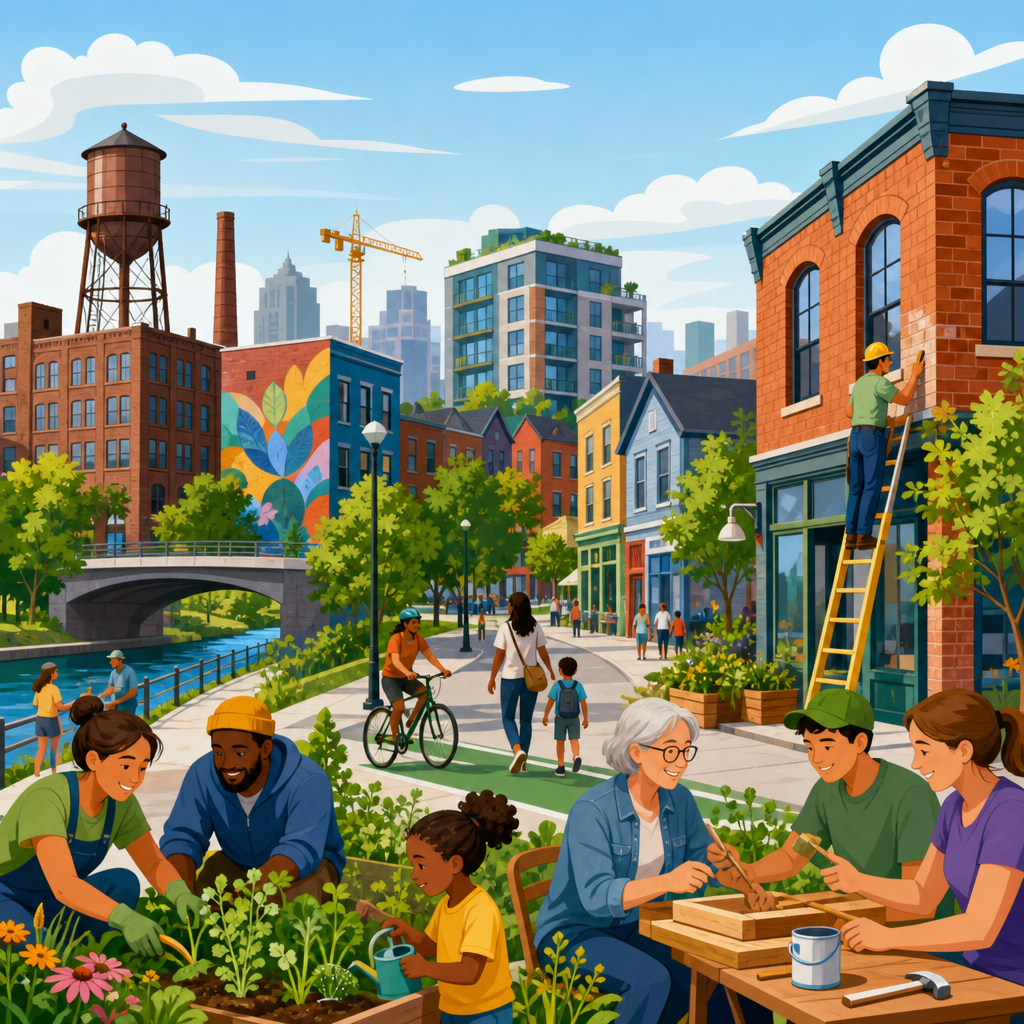
Community development in legacy cities depends on a clear-eyed response to population loss, aging infrastructure, and distressed housing markets. Legacy cities are older industrial communities that once held larger populations, stronger tax bases, and more concentrated job centers than they do today. Reuse means adapting vacant land, buildings, and infrastructure for productive new purposes. Repair means stabilizing homes, public systems, and neighborhood institutions before decline accelerates. Right-sizing means aligning public services, land use, and housing strategy with current population and market conditions rather than with a past peak that is unlikely to return.
I have worked on housing and neighborhood plans in cities where entire blocks had more vacant parcels than occupied homes, and the lesson is consistent: communities do not recover through demolition alone or through preservation alone. They recover when public agencies, residents, nonprofits, and lenders make practical choices about what to save, what to repurpose, and where to invest first. That matters because affordable housing in legacy cities is not only about producing new units. It is about reducing displacement risk, preserving naturally occurring affordable housing, lowering operating costs for older homes, and rebuilding confidence in places that have endured decades of disinvestment.
This hub article explains how reuse, repair, and right-sizing work together in community development practice. It also frames the core questions readers usually ask: How should cities prioritize vacant properties? What repairs deliver the greatest neighborhood impact? When is right-sizing responsible rather than retreat? Which policies improve affordability without trapping residents in unsafe or isolated conditions? The answers require more than theory. They depend on parcel conditions, ownership patterns, code enforcement capacity, infrastructure liabilities, transit access, school quality, and the strength of local organizations. In legacy cities, the most effective affordable housing strategies are targeted, data-driven, and neighborhood-specific.
Why legacy cities need a different affordable housing playbook
Legacy cities face a housing paradox. Prices may be low compared with fast-growing metros, yet affordability problems remain severe because many homes are physically obsolete, utility costs are high, credit access is weak, and incomes are constrained. A house purchased for a modest price can still be unaffordable once roof replacement, lead hazard control, plumbing repairs, insurance, taxes, and heating bills are included. In markets with widespread vacancy, appraised values often lag behind rehabilitation costs, creating the classic appraisal gap that discourages conventional lending. That is why community development in legacy cities cannot rely on a single production model.
Older housing stock can be a major advantage when it is repaired. Many legacy city neighborhoods contain durable brick homes, walkable street grids, and commercial buildings suitable for mixed-use redevelopment. These assets support incremental revitalization and affordable housing preservation. But the same neighborhoods may also have fragmented ownership, tax delinquency, obsolete lot configurations, and combined sewer or water system burdens that drain municipal budgets. Planners therefore use market typologies, parcel surveys, code data, and infrastructure analyses to distinguish between strong, transitional, and severely distressed areas. A citywide strategy without neighborhood triage usually spreads resources too thinly to change outcomes.
In practical terms, a different playbook means linking housing decisions to land banking, public works, health outcomes, and economic development. It means treating vacant property not simply as blight, but as inventory that can be assembled, rehabilitated, sold, side-lotted, greened, or held for future use. It means understanding that affordability includes habitability, transportation access, and resilience to flooding or extreme heat. It also means acknowledging tradeoffs. Some blocks can support infill and rehabilitation right away. Others need nuisance abatement, infrastructure downsizing, or ecological reuse before private investment becomes realistic. Honest diagnosis is the foundation of fair policy.
Reuse: turning vacancy into neighborhood assets
Reuse is the disciplined process of matching abandoned or underused assets with the most realistic next use. In legacy cities, that often begins with a property inventory: occupied structures, vacant structures, vacant lots, tax-foreclosed parcels, environmental constraints, and ownership status. Land banks are central tools because they can clear title, bundle parcels, extinguish delinquent taxes in some circumstances, and transfer property according to public goals instead of speculative timing. The Genesee County Land Bank in Flint demonstrated how strategic acquisition, maintenance, and disposition can reduce blight while preparing sites for rehab, side lots, urban agriculture, and redevelopment.
Adaptive reuse of buildings is especially valuable in older downtowns and neighborhood corridors. Former schools can become senior housing. Warehouses can become loft apartments or light industrial space. Vacant upper floors above storefronts can become small rental units that support main street activity. These projects are often financing puzzles. Federal Historic Tax Credits, Low-Income Housing Tax Credits, New Markets Tax Credits, state brownfield tools, and local gap subsidies may all be needed. The reason reuse matters for affordable housing is straightforward: it preserves embodied carbon, leverages existing infrastructure, and often creates units in walkable locations where residents can reduce transportation costs.
Reuse also includes small-scale interventions that rarely make headlines but change block conditions quickly. Side-lot programs let adjacent homeowners acquire vacant parcels for gardens, play areas, or stormwater management. Community gardens and pocket parks can stabilize blocks with sparse housing demand, especially when maintenance responsibility is clearly assigned. Interim uses are useful when long-term redevelopment is uncertain. I have seen cities overpromise transformational projects on weak-market land and lose credibility. A better approach is to permit temporary greening, manage expectations, and keep future options open until market conditions or public investment justify more permanent development.
Repair: preserving homes, safety, and neighborhood confidence
Repair is the most underappreciated affordable housing strategy in legacy cities. Basic home repair, code compliance, weatherization, lead abatement, accessibility modifications, and emergency system replacement preserve far more affordable units than new construction alone can produce. The best repair programs target homeowners and small landlords who own aging properties but lack savings or access to low-cost credit. Deferred maintenance does not stay small. A roof leak becomes mold. Faulty wiring becomes a fire risk. Broken porches and stairs increase injury. Water infiltration accelerates structural damage and pushes occupants toward displacement.
Strong repair systems combine several tools. Housing inspection identifies hazards early. Rehab financing closes the gap between needed work and what owners can pay. Weatherization assistance lowers utility burdens for low-income households, especially in drafty prewar homes. Lead-safe renovation standards and asbestos controls protect residents during upgrades. In many jurisdictions, Community Development Block Grant funds, HOME funds, utility efficiency programs, state housing trust funds, and philanthropic repair grants can be braided. The key is administrative simplicity. If owners face five applications, duplicative inspections, and long reimbursement delays, the homes most in danger will not get fixed in time.
Repair has a neighborhood effect beyond the individual property. One stabilized house improves comparable values, reduces visible distress, and reassures nearby owners that continued upkeep is rational. Repair is also critical for aging in place. In cities with older populations, grab bars, ramp access, first-floor bathrooms, and heating system replacement can prevent costly institutionalization. Public health evidence supports this approach. Lead exposure, asthma triggers, and fall hazards are all linked to poor housing conditions. When community development corporations pair repair with resident outreach, contractor oversight, and anti-scam protections, they create trust that larger redevelopment programs often lack.
| Strategy | Primary goal | Best use case | Main limitation |
|---|---|---|---|
| Home repair grants or low-interest loans | Preserve occupied affordable housing | Older owner-occupied homes with deferred maintenance | Demand often exceeds available subsidy |
| Targeted rehabilitation of vacant houses | Return structures to productive use | Blocks with solid occupancy and market traction | Appraisal gaps can block financing |
| Adaptive reuse of obsolete buildings | Create housing from underused assets | Downtowns, corridors, historic structures | Complex capital stacks and code upgrades |
| Selective demolition with reuse planning | Remove dangerous blight and prepare land | Severely distressed structures beyond feasible repair | Can hollow out blocks if not tied to long-term land strategy |
| Right-sizing infrastructure and services | Match public systems to current conditions | Areas with persistent vacancy and fiscal stress | Politically sensitive and easy to mischaracterize |
Right-sizing: aligning land use, services, and population reality
Right-sizing is often misunderstood as abandonment. In professional practice, it means aligning service levels, capital spending, and land use expectations with actual settlement patterns and municipal capacity. When a city built for 300,000 residents now serves 120,000, every mile of road, water line, sewer pipe, and streetlight carries a higher per-capita maintenance burden. Continuing to plan as if widespread reinvestment will reach every block equally is fiscally unsound. Right-sizing accepts that some areas can support renewed residential density, while others need lower-intensity uses, ecological functions, or long-term holding strategies.
The most responsible right-sizing plans start with data and resident engagement. They map occupancy, building condition, tax delinquency, utility age, flood risk, transit access, and public facility costs. Then they identify where public reinvestment will reinforce existing strengths: near jobs, schools, commercial nodes, and stable housing clusters. In stronger areas, the city may prioritize infill housing, rehab incentives, streetscape improvements, and code enforcement. In weaker areas with persistent abandonment, it may consolidate public maintenance, acquire vacant parcels, remove dangerous structures, and convert land to stormwater detention, tree canopy, recreation, or urban agriculture.
Detroit, Youngstown, and Buffalo each offer lessons. Youngstown’s long-range planning made population decline explicit rather than pretending growth was imminent. Detroit’s varied neighborhood strategies showed that a single citywide prescription fails in highly uneven markets. Buffalo demonstrated how anchor institutions, historic fabric, and strategic corridor investment can support targeted revival. The common thread is not copying one city’s plan. It is building a transparent framework for hard choices. Right-sizing succeeds when residents understand why some investments are concentrated, what protections exist for occupied homes, and how land reuse will improve safety, environmental performance, and fiscal stability.
Implementation: governance, financing, and resident trust
Execution determines whether reuse, repair, and right-sizing improve affordability or become disconnected initiatives. Effective implementation starts with a shared parcel database that joins assessor records, code violations, utility shutoffs, tax delinquency, demolition status, and ownership history. Without this backbone, cities duplicate work and miss opportunities for clustering investment. Cross-agency coordination matters just as much. Planning, housing, public works, legal departments, land banks, and school districts often hold pieces of the same neighborhood puzzle. A mayoral delivery unit or interdepartmental housing cabinet can accelerate decision-making and clarify accountability.
Financing must match neighborhood conditions. Stronger-market areas can use acquisition loans, rehab lending, tax credits, and employer-assisted housing. Transitional areas usually need soft subsidies, appraisal gap financing, and small developer support. Distressed areas require more public control, including nuisance abatement, demolition funds, green reuse budgets, and long holding periods. The Inflation Reduction Act, weatherization resources, state housing finance agencies, and EPA brownfield programs can all contribute depending on project type. Local partners matter too. Community development financial institutions, hospitals, universities, and faith-based groups often supply flexible capital and on-the-ground legitimacy that city hall alone cannot provide.
Resident trust is the final requirement. Legacy city neighborhoods have often experienced broken promises, speculative absentee ownership, and sporadic enforcement. People know the difference between a plan and a commitment. That is why visible early wins matter: repaired porches, cleared titles, boarded and secured houses, functioning streetlights, and transparent property disposition rules. Anti-displacement protections should be built into reinvestment areas through tax relief for long-term homeowners, tenant protections during rehab, and pathways for local contractors and small developers to participate. If existing residents do not benefit first, community development will be seen as extraction rather than recovery.
Conclusion: building durable affordability in legacy cities
Community development in legacy cities works when reuse, repair, and right-sizing are treated as complementary tools rather than competing ideologies. Reuse turns vacancy into assets. Repair preserves the homes and buildings people already depend on. Right-sizing aligns public obligations with present-day realities so limited resources can produce visible, lasting gains. Together, these strategies address the real affordability challenge in older weak-market cities: not just rent levels or sale prices, but the condition, safety, location, and long-term viability of housing and neighborhood infrastructure.
The central lesson is practical. Start with parcel-level facts, not nostalgia or slogans. Protect occupied homes before decline spreads. Reinvest where public spending can reinforce stable clusters. Repurpose land where conventional redevelopment is unlikely in the near term. Use established tools such as land banks, code enforcement, rehab finance, weatherization, tax credits, and targeted capital planning. Most important, make decisions transparently and with residents, because trust is infrastructure too. Affordable housing strategies fail when they ignore local context, and they succeed when they recognize that every block has a different combination of assets, liabilities, and possibilities.
Use this hub as your starting point for deeper work on affordable housing in legacy cities. Review your local property data, map repair needs, identify reuse candidates, and test whether current service patterns match actual population and market conditions. Then build a neighborhood strategy that is specific enough to act on. Durable community development is not about chasing a return to the past. It is about creating safer homes, stronger blocks, and a city form that residents can sustain.
Frequently Asked Questions
What does community development mean in legacy cities, and why does it require a different approach?
Community development in legacy cities is the work of strengthening neighborhoods, public systems, and local economies in places that were built for far more people and industry than they serve today. These cities often have durable housing stock, historic commercial corridors, rail and utility infrastructure, and civic institutions that reflect a much larger tax base and population. As population declined and jobs decentralized or disappeared, many blocks were left with vacant homes, underused land, aging water and sewer systems, and public assets that became harder to maintain. That means community development cannot rely on a simple growth-first playbook. It has to deal honestly with weak markets, disinvestment, and uneven demand across neighborhoods.
In practice, this different approach means matching public investment to real conditions on the ground. Some areas may be ready for housing rehabilitation, small business support, and transit-oriented redevelopment. Others may need vacancy management, environmental cleanup, property assembly, and strategic land reuse before private investment can return. Successful legacy-city strategies focus on stabilizing occupied blocks, preventing avoidable abandonment, preserving functioning neighborhood institutions, and creating realistic long-term land-use patterns. The goal is not to recreate past population peaks, but to build healthier, safer, and more financially sustainable communities around present-day realities and future opportunity.
What does “reuse” mean in the context of legacy cities?
Reuse refers to adapting vacant or underused land, buildings, and infrastructure so they contribute again to neighborhood life and local economic value. In legacy cities, reuse is especially important because many communities inherited more industrial land, housing, commercial space, streets, and utility capacity than current demand can support. Leaving those assets idle often accelerates decline by inviting dumping, vandalism, fire risk, and lower nearby property values. Reuse is a way to turn liabilities into productive assets, whether through housing rehabilitation, adaptive reuse of factories and schools, side-lot programs, urban agriculture, green stormwater infrastructure, community facilities, renewable energy projects, or new light-industrial and commercial uses.
The strongest reuse strategies are highly place-specific. A former warehouse near a downtown job center may be suitable for mixed-use redevelopment or maker space. A cluster of tax-foreclosed lots in a low-demand neighborhood may be better suited for stormwater detention, tree planting, recreation, or land banking for future assembly. A vacant school might become a health center, senior services hub, or small business incubator if there is a viable operator and community need. Reuse works best when cities align zoning, code enforcement, land disposition, environmental review, and infrastructure planning so that vacant property can move into realistic new uses rather than remaining stuck in limbo.
Why is “repair” just as important as redevelopment in distressed housing markets?
Repair matters because in many legacy-city neighborhoods, the most cost-effective community development strategy is not large-scale new construction but preserving what still works. Aging homes, sidewalks, water lines, schools, libraries, parks, and neighborhood institutions often deteriorate gradually until a crisis makes intervention far more expensive. In distressed housing markets, where sales prices may not cover full rehabilitation costs, property owners frequently defer maintenance, investors may strip value instead of adding it, and small physical problems can quickly lead to vacancy. Repair interrupts that cycle. It keeps occupied homes habitable, protects residents from health and safety risks, and prevents the loss of structures that are still valuable to the block and the city.
Repair is also a practical equity strategy. Longtime residents in legacy cities are often living in older homes that need roof work, plumbing upgrades, lead hazard control, energy retrofits, porch stabilization, or accessibility improvements. Without help, those households may face displacement through condemnation, utility failures, or rising maintenance burdens rather than through rent spikes alone. Publicly supported repair programs, emergency home remediation, landlord accountability systems, and infrastructure maintenance plans help residents remain safely housed while preserving neighborhood fabric. When paired with targeted code enforcement and support for responsible ownership, repair can stabilize blocks faster and at lower cost than waiting for wholesale redevelopment that may never arrive.
What does “right-sizing” mean, and is it the same as managed decline?
Right-sizing is the process of aligning land use, public services, infrastructure systems, and investment priorities with a city’s current population, fiscal capacity, and market conditions. It recognizes that a place built for 300,000 residents cannot sustainably maintain the same service footprint if it now has 120,000 residents spread across the same geography. Right-sizing can involve rethinking where roads, water lines, parks, transit service, housing incentives, and redevelopment efforts should be concentrated. It often includes stronger vacancy strategies, selective demolition, green reuse of excess land, and reinvestment in stable or recoverable neighborhoods. The purpose is to reduce waste, improve service quality, and support healthier long-term urban form.
It is not simply another term for abandonment or “managed decline,” though that concern is understandable and historically rooted. Poorly executed right-sizing can become a justification for disinvestment if decisions are imposed without transparency, resident input, or fair treatment. Done well, however, right-sizing is about making systems more reliable and neighborhoods more livable. It can help cities focus scarce resources where they will preserve occupied housing, protect public health, and create visible improvement. The key is that right-sizing should be guided by clear data, community priorities, anti-displacement safeguards where markets are strengthening, and a commitment to maintaining dignity and basic services in every neighborhood, even when investment strategies differ by place.
How can local leaders and residents make reuse, repair, and right-sizing work together?
These three strategies are most effective when they are coordinated rather than treated as separate policy silos. Local leaders should begin with a block-by-block understanding of occupancy, property condition, market strength, infrastructure burden, environmental risks, and community assets. That allows them to identify where repair can stabilize existing residents quickly, where reuse can reactivate vacant land and buildings, and where right-sizing can reduce the mismatch between public obligations and actual demand. For example, a city might pair home repair grants and small landlord rehabilitation financing on an occupied corridor, while using a land bank to assemble nearby vacant parcels for side yards, green infrastructure, and future development sites. At the same time, infrastructure capital planning can prioritize the areas where residents are most concentrated and buildings are most salvageable.
Residents play a critical role because the best plans depend on local knowledge about which institutions are trusted, which properties are chronic problems, which vacant spaces could serve the neighborhood, and what improvements would make people stay. Effective implementation usually requires cross-sector collaboration among city departments, community development corporations, utilities, land banks, anchor institutions, philanthropy, and private lenders. It also requires steady execution: code enforcement that is fair and consistent, property data that is current, funding that supports both small repairs and larger redevelopment, and public engagement that influences real decisions. When reuse, repair, and right-sizing are linked in this way, legacy cities are better positioned to convert vacancy into opportunity, preserve the neighborhoods that remain, and build a more resilient future on a realistic foundation.


