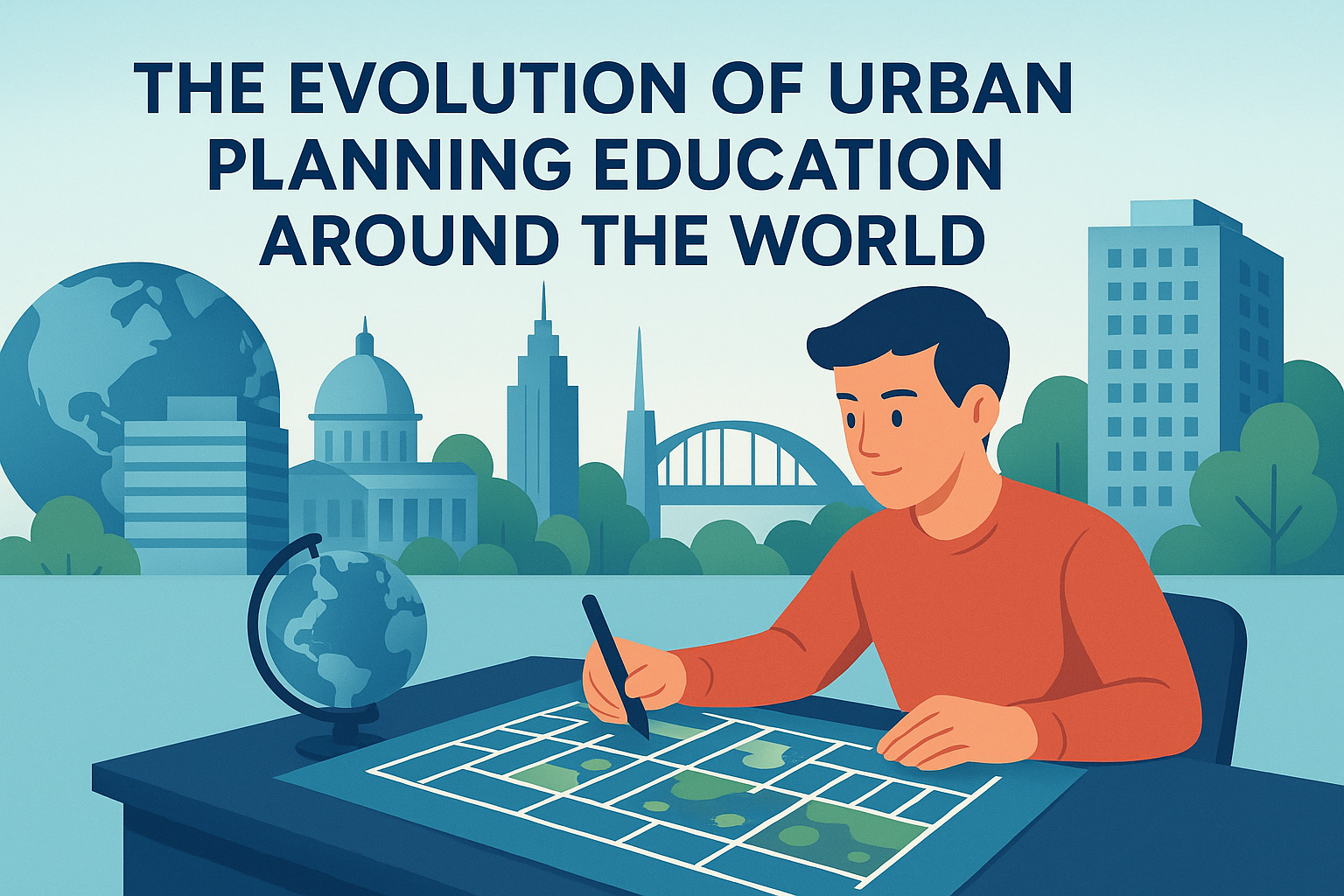
Urban planning education has seen a remarkable transformation over the decades, adapting to changing societal needs and environmental concerns. Urban planning, by definition, involves designing and regulating the use of space within cities, considering infrastructural, economic, social, and environmental factors to improve the quality of life and ensure sustainable development. As the world continues to urbanize rapidly, urban planning has become crucial in managing urban growth, enhancing infrastructure resilience, and ensuring equitable access to resources and opportunities.
This topic is crucial because urban planners play a significant role in shaping the environments where people live, work, and play. Quality urban planning underpins the success of urban development by promoting sustainability, reducing environmental impact, and enhancing the quality of life for city dwellers. Understanding the evolution of urban planning education is key for future urban planners, academics, and policymakers to address contemporary challenges effectively and innovate future urban developments.
The Genesis of Urban Planning Education
Urban planning education began in the late 19th and early 20th centuries as industrialization spurred the need for organized development in rapidly growing cities. Europe, particularly Germany and Britain, was at the forefront of urban planning education. The first formal courses in town planning were offered as part of architecture programs, influenced by city design movements like the Garden City Movement and the Chicago School of Sociology’s urban ecology theories.
A classic example of early urban planning education is the establishment of the Town Planning Institute in 1914 in London, which formalized the profession and education practices. These foundational programs focused heavily on design, architecture, and public health, reflecting the era’s specific economic and social drivers.
Global Spread and Diversification
As the 20th century progressed, urban planning education expanded beyond Europe to North America, Asia, and other parts of the world, adapting to regional specificities. In the United States, the urban planning program at the Massachusetts Institute of Technology (MIT), established in the 1930s, became a model for American universities. These educational institutions integrated new disciplines like sociology, economics, and environmental sciences, reflecting a broadened approach to urban issues.
The globalization of urban planning education became evident as the International Federation for Housing and Planning (IFHP) and later the United Nations began promoting international standards and practices. This led to the establishment of urban planning faculties in a diverse range of global contexts. For instance, the University of São Paulo in Brazil emerged as a leader in urban planning education in Latin America, addressing unique challenges like informal settlements through an interdisciplinary approach.
The Impact of Technological Advancements
The rapid technological advancements of the late 20th and early 21st centuries have significantly reshaped urban planning education. Geographic Information Systems (GIS), remote sensing, and computer-aided design (CAD) tools revolutionized how planning data is collected, analyzed, and visualized. Educational programs integrated these technologies, training students to use sophisticated tools to make informed planning decisions.
A prominent example is the incorporation of GIS and simulation modeling in the curriculum of the University of Melbourne’s urban planning program. By leveraging such technologies, students can now simulate urban growth patterns and assess environmental impacts, leading to more data-driven planning outcomes. This technological integration has not only enhanced the ability of urban planners to address complex urban phenomena but also expanded the skills required in the field.
The Role of Sustainable Development Goals
The introduction of the United Nations Sustainable Development Goals (SDGs) in 2015 provided a framework for urban planning education to align with global sustainability goals. Programs around the world have adapted curricula to emphasize sustainable development principles, with a strong focus on climate change mitigation, resource efficiency, and inclusive urban growth.
Educational institutions such as the University of Cape Town have been at the forefront of integrating SDGs into urban planning education. Their curriculum emphasizes addressing socio-economic inequalities and fostering sustainable urban environments, equipping students with the necessary skills to contribute to global sustainability targets.
| Region | Key Focus in Education | Example Institution |
|---|---|---|
| Europe | Design and public health | University College London (UCL) |
| North America | Interdisciplinary approach | Massachusetts Institute of Technology (MIT) |
| Asia | Infrastructure and technological integration | National University of Singapore (NUS) |
| Africa | Sustainable growth and inequality | University of Cape Town |
Challenges and Future Directions
While urban planning education has made great strides, it faces challenges such as tight budgets, the need for updated curricula, and bridging the gap between theoretical knowledge and practical application. Additionally, there is a growing recognition of the need to decolonize urban planning education, ensuring inclusivity and representing diverse perspectives and histories.
A future focus area might be the increased importance of urban resilience and adaptability in the face of global challenges like climate change, pandemics, and migration. Institutions might create education programs emphasizing adaptive urban planning and involving smart city technologies, collaboration with local communities, and cross-disciplinary innovations.
Conclusion: Facing Forward
The evolution of urban planning education reflects the dynamic nature of urban development and the critical role planners play in shaping sustainable and equitable cities. Throughout the world, urban planning programs continue to evolve, incorporating new technologies, methodologies, and ethical considerations to address contemporary urban challenges. As a result, urban planning education remains vital for training competent professionals who can make informed decisions and drive positive change in urban environments.
The key takeaway is that urban planners are integral to creating resilient and sustainable urban spaces. The reader is encouraged to explore current urban planning programs and support initiatives that aim to innovate and improve urban environments globally. Through education and collaboration, we can collectively address pressing urban challenges and contribute to sustainable development in our rapidly changing world.
Join the global conversation on urban planning, engage with educational programs, and be part of the movement to build better, more sustainable cities for future generations.
Frequently Asked Questions
1. What is the significance of urban planning education in today’s world?
Urban planning education is incredibly significant in today’s world due to the rapid pace of urbanization globally. As more people move to cities, the demand for well-planned urban spaces is increasing. Proper urban planning ensures that cities are not only livable but also sustainable and equitable. Urban planners are tasked with integrating considerations such as infrastructure, transportation, housing, social equity, and environmental sustainability into the fabric of urban development. Education in this field helps to equip future planners with the necessary skills and knowledge to address complex challenges, adapt to new technologies, and create robust, resilient urban environments. Moreover, urban planning education fosters a multidisciplinary approach, drawing from fields such as architecture, geography, sociology, and economics, which is crucial for addressing the multifaceted nature of modern urban challenges.
2. How has urban planning education evolved over time?
The evolution of urban planning education has been driven by both the changing landscape of cities and the advancing body of knowledge in the field. Initially, urban planning focused primarily on physical design and zoning. In the early to mid-20th century, many planning programs emphasized land use and transportation planning primarily from an engineering and architectural perspective. However, as cities evolved, faced with issues like environmental degradation, social inequality, and economic shifts, so did the curriculum of urban planning. Today, urban planning education is much broader and includes a focus on sustainability, public participation, climate change adaptation, technology integration, and global urbanization trends. Furthermore, with the rise of digital tools and geographic information systems (GIS), the scope of urban planning has expanded to include data-driven decision-making, allowing planners to better predict and manage urban growth effectively.
3. What are some common challenges faced by urban planning educators worldwide?
Urban planning educators face several challenges across the globe, largely shaped by differing regional contexts and the constant evolution of urban issues. One significant challenge is ensuring that curriculum is relevant and adaptive to the fast-changing urban dynamics and the emerging needs for planners to deal with climate change, technological advancements, and socio-economic inequities. Another challenge is integrating interdisciplinary approaches within the curriculum to prepare students to tackle complex, multifaceted urban problems. Ensuring the availability and inclusion of updated technological tools such as GIS and remote sensing for planning use is also a major hurdle in less resource-endowed regions. Additionally, there is a growing need to include public engagement and participatory planning methods into educational programs, teaching students how to effectively incorporate community voices into planning processes. Lastly, securing adequate funding for programs and facilitating international academic collaborations are continual pressures in the education ecosystem.
4. How does urban planning education vary globally?
Urban planning education varies significantly around the world, influenced by local cultures, economic capacities, governance structures, and urban challenges specific to each region. For instance, in developed countries, urban planning curricula might have a more significant emphasis on technological innovation, smart city planning, and climate adaptation strategies given their advanced technological infrastructures and resources. In contrast, curricula in developing countries may focus more on basic infrastructure planning, affordable housing, and addressing rapid urbanization effects such as informal settlements and urban poverty. Some countries emphasize highly on environmental sustainability in their programs, while others might integrate extensive public policy and governance elements, depending on local legal and administrative frameworks. Moreover, cultural values play a crucial role in shaping the educational approach, with some regions prioritizing community-centric planning practices and others focusing more on economic efficiency and growth-driven models. Consequently, the differences in educational emphasis reflect the unique urban realities and future aspirations of nations globally.
5. What future directions are anticipated for urban planning education?
Looking ahead, urban planning education is anticipated to further embrace technology, interdisciplinary approaches, and global perspectives. As smart city concepts and technology-driven public spaces gain traction, there will likely be increased integration of digital tools, such as virtual reality and artificial intelligence, into urban planning curricula. Education will further emphasize sustainability, focusing on teaching future planners how to create resilient urban environments that can adapt to climate change impacts, such as rising sea levels and extreme weather conditions. Additionally, the increasing significance of data science means that future urban planners will need robust training in data analytics to inform effective decision-making processes. Another anticipated direction is the global exchange of knowledge and best practices, with education programs incorporating case studies and urban experiences from diverse parts of the world to broaden students’ understanding. Importantly, as social equity continues to be a pivotal discussion, urban planning education will likely focus more on participatory planning methods, teaching planners how to engage communities effectively and inclusively in planning processes.