
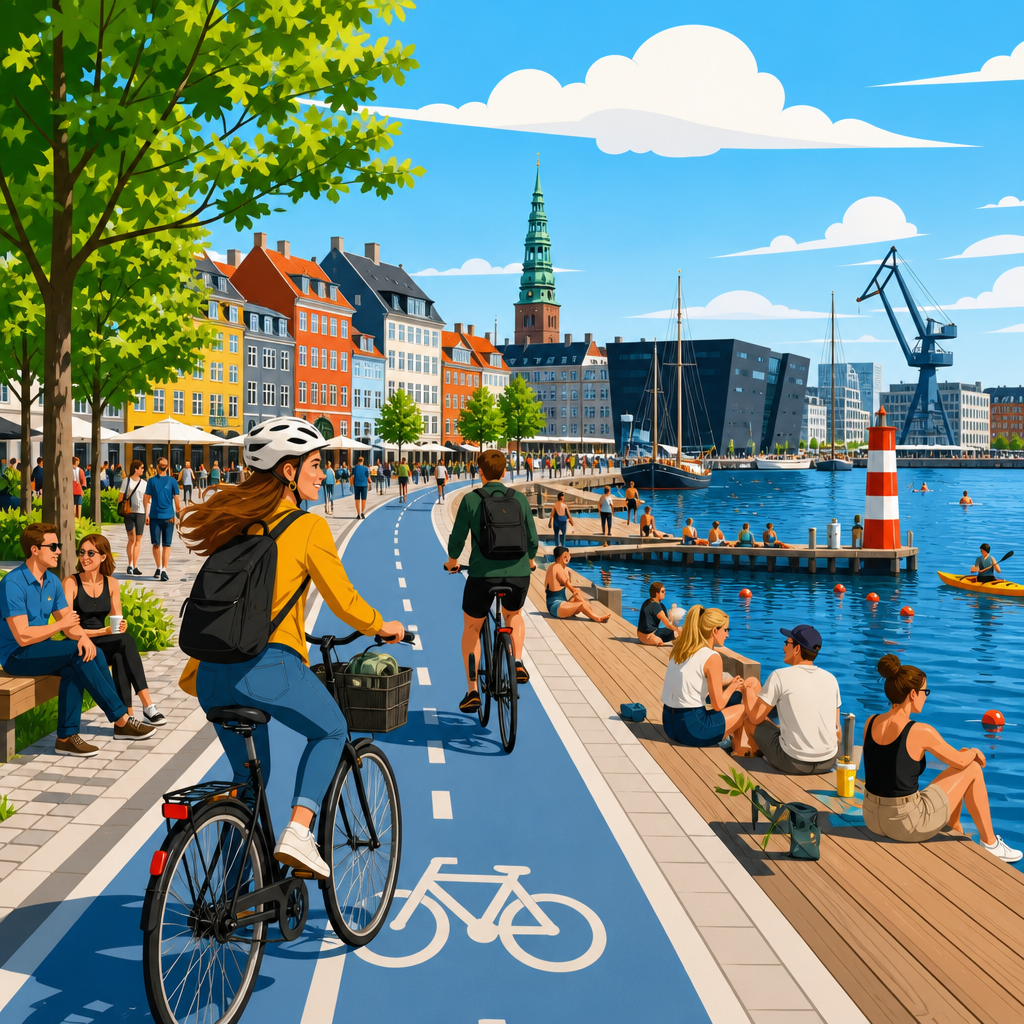
Copenhagen offers one of the clearest modern examples of how a city can reshape daily life through public space, cycling infrastructure, and waterfront regeneration. Over years of studying European planning practice and walking, biking, and observing projects on the ground, I have found that Copenhagen’s success is not the result of a single flagship project. It comes from consistent policy, careful street design, strong municipal governance, and an unusually disciplined commitment to human-scale urbanism. For planners, elected officials, developers, and residents, the city provides practical lessons rather than utopian theory.
Public space, in this context, means the streets, squares, parks, promenades, and waterfront areas that are open and usable by everyone. Cycling policy refers not only to bike lanes, but to the full system that makes bicycle travel safe, convenient, and normal across age groups. Harbor reuse means converting a working or polluted industrial waterfront into mixed public, recreational, residential, and economic space without losing urban function. These three areas are deeply connected. A harbor promenade succeeds when people can reach it easily on foot or by bike. A bike network succeeds when streets feel safe and inviting. Public space succeeds when land use, mobility, and environmental cleanup are planned together.
Why does this matter beyond Denmark? Because many cities face the same pressures: congestion, climate risk, rising housing demand, aging infrastructure, and public skepticism about change. Copenhagen shows that improvements can be cumulative and measurable. The city has spent decades reducing barriers between neighborhoods, reclaiming former industrial land, protecting access to the water, and designing streets around predictable human behavior. It demonstrates that quality of life can be treated as infrastructure, not as an afterthought. That is a powerful lesson for any urban planning and policy agenda.
The most important takeaway is that Copenhagen did not begin with perfection. In the mid-twentieth century, like many cities, it faced traffic growth, waterfront decline, and environmental degradation. The harbor was heavily polluted, several streets prioritized vehicle throughput, and postwar development pressures could easily have produced fragmented urban form. Instead, planners and political leaders steadily changed direction. They invested in sewage treatment and stormwater management so the harbor could become swimmable again. They built physically separated cycle tracks, improved intersections, and connected routes into a coherent network. They expanded pedestrian areas and programmed public spaces so they remained active across seasons. The result is a city where infrastructure, health, environmental performance, and civic life reinforce one another.
Public space as essential urban infrastructure
One of Copenhagen’s central lessons is that public space should be planned as core infrastructure, with clear performance goals, maintenance standards, and social purpose. In practice, this means squares and streets are not residual spaces left over after traffic engineering. They are designed first around how people move, gather, wait, play, and spend time. The famous pedestrian corridor centered on Strøget helped prove that removing car dominance from key retail streets could increase foot traffic and urban vitality rather than weaken commerce. Since then, the city has expanded this logic into neighborhood streets, waterfront edges, and small local plazas.
I have seen the difference this makes in ordinary settings, not just in postcard locations. Seating is placed where sun, shelter, and views matter. Corners are opened visually to improve safety. Ground floors face streets with active uses. Materials are durable but not hostile. Public spaces are programmed for both routine and special events, which matters because successful places depend on repeat daily use more than occasional festivals. Jan Gehl’s people-centered methodology, developed in Copenhagen and later applied internationally, gave city staff a practical way to count behavior, map dwell time, and evaluate whether design actually supports public life. That measurement culture is a major reason the city’s public realm policy has endured.
Another lesson is that access matters as much as aesthetics. A beautiful waterfront is less valuable if it is isolated by high-speed roads or surrounded by private enclaves. Copenhagen repeatedly protects permeability: multiple entry points, legible routes, short blocks, and transitions between transit, walking, and cycling. This approach increases both equity and use. Parents with strollers, older adults, commuters, tourists, and schoolchildren can all navigate the same public system without needing a car. The policy implication is straightforward: when evaluating redevelopment, planners should ask not only what a place looks like, but who can realistically reach it, comfortably stay there, and return frequently.
Cycling works when the network feels complete
Copenhagen is often described as a cycling city, but the real lesson is not cultural exceptionalism. People cycle because the network is reliable, intuitive, and safe enough to use every day. The city’s cycle tracks are typically separated from moving traffic, intersections are designed to reduce conflict, and routes connect residential districts to schools, shops, workplaces, rail stations, and recreational areas. This level of continuity matters more than isolated demonstration corridors. In city after city, I have watched single bike lanes fail because they begin confidently, then disappear at complex junctions or narrow bridges. Copenhagen avoided that trap by treating cycling as a transport system rather than a recreational amenity.
Safety is built through design details. Protected intersections, advance stop lines, bicycle signals, curb separation, and predictable crossing geometry reduce uncertainty. Maintenance also matters. Snow clearance, pavement quality, lighting, and wayfinding shape whether people trust the network in winter and at night. The city has also invested in bicycle bridges, such as the Cykelslangen, to remove bottlenecks and create direct routes where older industrial barriers once interrupted movement. These interventions are not decorative. They lower friction, save time, and make cycling competitive with driving on urban trips.
The data supports the design approach. Copenhagen has long reported high bicycle mode share for work and education trips within the city, often around or above 40 percent depending on the measure and year. That level is not achieved through messaging alone. It reflects street standards, intersection management, parking policy, and integration with regional rail. Importantly, the bicycle is normalized across demographics. Business professionals, parents carrying children in cargo bikes, students, and older riders all use the same basic network. When a city reaches that level of everyday ridership, cycling stops being a niche identity and becomes ordinary transport.
| Planning lesson | Copenhagen practice | Why it works |
|---|---|---|
| Build complete routes | Connected cycle tracks across districts and bridges | Prevents gaps that discourage less confident riders |
| Design intersections carefully | Bicycle signals, set-back crossings, clear turning geometry | Reduces conflict with cars and improves predictability |
| Link mobility to daily destinations | Routes connect homes, schools, stations, shops, and parks | Makes cycling useful for routine trips, not just leisure |
| Maintain infrastructure year-round | Snow removal, lighting, smooth surfaces, secure parking | Supports reliability in all seasons and at all ages |
There are also policy tradeoffs worth noting. Copenhagen’s cycling success does not mean every street can simply remove vehicle access without consequence. Freight, emergency access, transit operations, and disability access still require careful accommodation. The city’s better projects solve these tensions through street hierarchy and design clarity, not slogans. For other cities, the lesson is to identify which corridors should prioritize through traffic, which should prioritize local access, and which should prioritize active travel. Trying to make every street serve every mode equally often produces weak results for all users.
Harbor reuse depends on cleanup, access, and mixed function
The Copenhagen harbor demonstrates that waterfront redevelopment works best when environmental repair, public access, and economic reuse happen together. For decades, many industrial harbors in Europe and North America were treated as back-of-house spaces for shipping, storage, and heavy industry. As those functions changed, cities often redeveloped waterfronts with housing or offices but failed to restore public access or ecological performance. Copenhagen took a broader path. Massive investment in wastewater treatment, sewer upgrades, and pollution control gradually improved water quality enough to support harbor bathing. The harbor baths at Islands Brygge and later facilities made water contact a visible proof of environmental recovery.
That symbolism matters, but the planning mechanics matter more. Harbor reuse in Copenhagen did not rely on one land use. Former docklands such as Nordhavn have been planned as mixed districts with housing, jobs, transit, public spaces, and climate adaptation features. Quays and promenades are treated as civic infrastructure, not merely front yards for private development. New districts retain industrial traces where useful, but they are reconnected to the wider city through metro extensions, bike links, pedestrian routes, and public amenities. This mixed-function model spreads activity across the day and strengthens long-term value.
Another lesson is that waterfronts must remain porous. Too many redeveloped harbors become visually attractive but socially thin, lined with expensive buildings and minimal public life. Copenhagen generally avoids this by giving the edge itself a public role. Steps, decks, bathing areas, kayak launches, benches, and broad promenades pull people to the water even if they are not customers of adjacent businesses. The city also benefits from temperate seasonal variation that encourages diverse uses: sunbathing in summer, commuting and walking in shoulder seasons, and scenic recreation year-round. Good edge design makes the harbor useful beyond tourism.
Climate adaptation is now inseparable from harbor planning. Copenhagen’s Cloudburst Management Plan, developed after severe rain events including the 2011 cloudburst, uses streets, parks, and blue-green corridors to store and direct stormwater. In harbor districts, this means public space often serves dual functions: recreation during normal weather and water management during extreme events. That is an important policy model. Cities facing sea-level rise and heavier rainfall should not treat waterfront design, drainage engineering, and public realm planning as separate silos. Copenhagen shows that resilience is stronger when infrastructure is visible, legible, and integrated into everyday urban experience.
Governance, measurement, and long-term policy consistency
Copenhagen’s achievements are often discussed as design triumphs, but they rest on governance discipline. Long-term progress required municipal agencies that could coordinate land use, transport, utilities, housing, and environmental investment over decades. It also required political stability around broad goals even when individual projects were debated. This is one of the hardest lessons for other cities because it is less visible than a bike bridge or harbor bath. Without stable institutions, clear standards, and capital planning, physical improvements remain isolated.
Measurement has been critical. Copenhagen has consistently tracked bicycle volumes, public space use, environmental indicators, and mobility patterns. That evidence base helps justify investment and refine policy. If a corridor underperforms, officials can adjust design rather than abandon the strategy. If a public square attracts one group but excludes another, programming and furniture can change. In my experience, cities that count only traffic delay miss the broader value of urban investments. Copenhagen counts people, time spent, mode share, and access, which better reflects actual urban life.
The city also benefits from strong planning culture and public expectation. Residents are used to the idea that streets can change and that infrastructure should serve social and environmental goals. That culture was built gradually through visible success. Each pedestrian improvement, safer route, cleaner waterfront, and well-used square reinforced confidence in the next project. This cumulative legitimacy is important for policy transfer. Other cities should not copy forms blindly; they should build local trust through pilots, transparent metrics, and early wins that people can feel in daily life.
For urban planning and policy professionals, the broader hub lesson is integration. Public space policy cannot be separated from transport policy. Cycling investment cannot be separated from land use and maintenance budgets. Harbor redevelopment cannot be separated from utility upgrades and climate planning. Copenhagen stands out because it links these systems. That integrated approach produces better public health outcomes, lower transport emissions, stronger placemaking, and higher everyday convenience. The model is demanding, but it is not mysterious. It starts with clear priorities, measurable design, and patient implementation.
Copenhagen’s biggest lesson is that cities become more livable through accumulation, not miracle projects. Public space improves when it is treated as essential infrastructure with clear access, durable design, and active management. Cycling becomes mainstream when routes are complete, intersections are safe, and daily destinations are connected. Harbor reuse succeeds when environmental cleanup, public access, mixed-use redevelopment, and climate resilience advance together. These are practical principles that any city can adapt, even if budgets, density, and politics differ.
The city also proves that urban quality is measurable. Cleaner water, higher bicycle mode share, stronger public life, and better neighborhood connectivity are not abstract aspirations. They are outcomes shaped by standards, investment, and governance. Just as important, Copenhagen shows that tradeoffs can be managed honestly. Streets still need servicing, redevelopment still needs financing, and climate infrastructure still requires major capital. The difference is that the city works through those constraints without losing its human-scale focus.
For anyone shaping urban planning and policy, the value of studying Copenhagen is not imitation for its own sake. It is learning how consistent choices create civic trust and better daily experience. Start by auditing your own streets, waterfronts, and public spaces through the eyes of people walking, cycling, waiting, and gathering. Then align design, maintenance, and land use around those observations. That is how durable urban transformation begins.
Frequently Asked Questions
What is the main lesson other cities can learn from Copenhagen’s approach to public space?
The biggest lesson is that Copenhagen did not become a global reference point through one iconic project or a single burst of investment. Its success comes from a long-term civic strategy that consistently prioritizes people over vehicle throughput in the design of streets, squares, parks, and waterfronts. Public space in Copenhagen works well because it is treated as essential urban infrastructure, not leftover land between buildings or traffic lanes. That means city leaders pay close attention to comfort, accessibility, safety, edges, seating, walking routes, bike movement, lighting, and the everyday experience of being outdoors in all seasons.
Another important takeaway is that human-scale design is not vague or sentimental. In Copenhagen, it is operational. Street widths, crossing distances, curb details, bike lane alignments, and the placement of trees or benches all influence whether people actually use public space. The city’s planners and designers understand that small physical decisions shape social life. If a place is easy to reach, pleasant to linger in, and safe for children, older adults, and everyday riders, it becomes part of daily routines rather than a special destination.
For other cities, the real lesson is discipline. Copenhagen shows that public life improves when municipal policy, transportation planning, and urban design all point in the same direction over many years. This kind of consistency often matters more than visionary renderings. Cities that want similar results need to think less about copying a Scandinavian aesthetic and more about building a governance culture that repeatedly asks a simple question: does this decision make everyday urban life better for ordinary people?
Why is Copenhagen’s cycling culture so difficult to replicate by simply adding bike lanes?
Copenhagen’s cycling success is often misunderstood as a story about enthusiasm or identity, when it is really a story about infrastructure quality, network continuity, and policy consistency. People cycle in large numbers because the system feels normal, safe, direct, and reliable. The city has spent years building routes that connect neighborhoods to jobs, schools, shops, transit, and public spaces without forcing riders into stressful or fragmented conditions. That is very different from cities that install short stretches of bicycle infrastructure but leave dangerous intersections, missing links, and high-speed traffic untouched.
Just as important, cycling in Copenhagen is integrated into the broader street hierarchy. It is not treated as an afterthought or a recreational add-on. Streets are designed to accommodate predictable movement by bike, often with protected facilities, clear signals, and logical transitions at intersections. The result is a system that works for ordinary people in everyday clothes, including parents, seniors, students, and commuters carrying bags or groceries. That broad usability is a sign of successful planning. A truly mature bike network should not require confidence, special gear, or athletic ability to use comfortably.
Replication is also difficult because cycling levels depend on institutional choices beyond engineering. Speed management, parking policy, transit coordination, land use patterns, and maintenance all matter. If a city continues to subsidize fast driving, tolerates unsafe road behavior, and spreads destinations too far apart, bike lanes alone will not produce Copenhagen-like outcomes. The deeper lesson is that cycling thrives when it is supported by a complete urban system: compact development, safe intersections, connected routes, clear priorities, and a political willingness to allocate street space differently.
How did Copenhagen reuse its harbor in a way that supports both environmental recovery and public life?
Copenhagen’s harbor transformation is significant because it did not stop at beautification or real estate branding. The waterfront changed because environmental cleanup, infrastructure investment, and public access were pursued together. Historically industrial harbors in many cities become either fenced-off utility zones or privatized luxury districts with limited civic value. Copenhagen offers another path, where water quality improvements, urban redevelopment, and public recreation reinforce one another.
One of the clearest achievements is that the harbor has become swimmable and socially active. That outcome required more than attractive promenades. It depended on serious work in wastewater management, stormwater control, and environmental regulation so the water itself could become an asset rather than a liability. Once the harbor was clean enough for bathing and recreation, the city could create public destinations that felt authentic and widely accessible. Harbor baths, walking routes, cycling connections, seating areas, and open edges turned the waterfront into part of everyday urban life rather than an isolated spectacle.
The broader planning lesson is that successful harbor reuse depends on treating the waterfront as civic territory. Copenhagen demonstrates the value of maintaining public access, mixing uses, and connecting redevelopment areas back into the existing city. A harbor should not function as a disconnected enclave. It should serve residents across income levels and age groups, while also accommodating climate resilience, ecological performance, and economic redevelopment. In that sense, the harbor’s reuse is not just a design success. It is a governance success that aligns environmental repair with social use and long-term urban value.
What role does municipal governance play in Copenhagen’s public space and transportation success?
Municipal governance is central to the story. Copenhagen’s achievements are often described in visual terms, but the underlying force is administrative continuity. The city has benefited from public institutions capable of setting long-term goals, measuring outcomes, coordinating across departments, and sticking with a human-centered agenda over time. That matters because streets, waterfronts, and mobility systems are shaped through countless incremental decisions, not just major plans. Without strong governance, even good design ideas tend to become inconsistent, diluted, or politically reversible.
A well-functioning municipal structure allows the city to align transportation planning, public works, environmental management, and urban design. In practice, that means cycling infrastructure connects logically to public spaces, waterfront investment supports broader city goals, and improvements are maintained rather than abandoned after a ribbon-cutting. Copenhagen also benefits from a planning culture that values evidence. Data on travel behavior, public life, and street performance help justify changes and refine them over time. This reduces the tendency to treat urban design as purely symbolic or ideological.
For other cities, this is one of the most important and least glamorous lessons. Strong governance does not generate headlines the way a dramatic building or bridge does, but it is what makes high-quality urbanism possible at scale. Cities that want to improve public space and everyday mobility need institutions that can coordinate across silos, maintain standards, and make durable decisions in the public interest. Copenhagen suggests that the real foundation of successful city-making is not just design talent. It is the capacity to govern with patience, competence, and a clear civic purpose.
Can the lessons from Copenhagen apply to cities with different climates, densities, or political cultures?
Yes, but not through direct imitation. Copenhagen’s lessons are most useful when understood as principles rather than templates. Every city has its own geography, climate, development pattern, fiscal capacity, and political constraints. What transfers well is the logic behind Copenhagen’s choices: design for everyday use, prioritize safety and comfort, connect infrastructure into coherent networks, protect public access to valuable spaces, and align policy with long-term urban goals. Those principles can be adapted in many contexts, whether a city is large or small, cold or warm, dense or relatively dispersed.
Climate is often used as an excuse, but Copenhagen itself shows that weather alone does not determine public life or cycling levels. People use outdoor spaces and active transportation when the system is convenient, safe, and socially normalized. Likewise, density matters, but what matters even more is whether destinations are connected well and whether street design supports short trips without requiring a car for every daily task. Political culture also varies, yet many improvements can begin with targeted pilots, corridor redesigns, intersection upgrades, and waterfront access projects that demonstrate visible benefits.
The key is to avoid superficial copying. Installing a stylish bike lane, a harbor promenade, or Scandinavian street furniture will not recreate Copenhagen’s results if the larger urban system still rewards speed, fragmentation, and privatization. The more useful approach is to ask how Copenhagen built cumulative success over time. It did so through consistency, measurement, public investment, and a persistent commitment to human-scale urbanism. Any city can learn from that process, even if the physical outcome looks different. The goal is not to become Copenhagen. The goal is to become a better version of one’s own city by applying the same seriousness to public life, mobility, and shared space.


